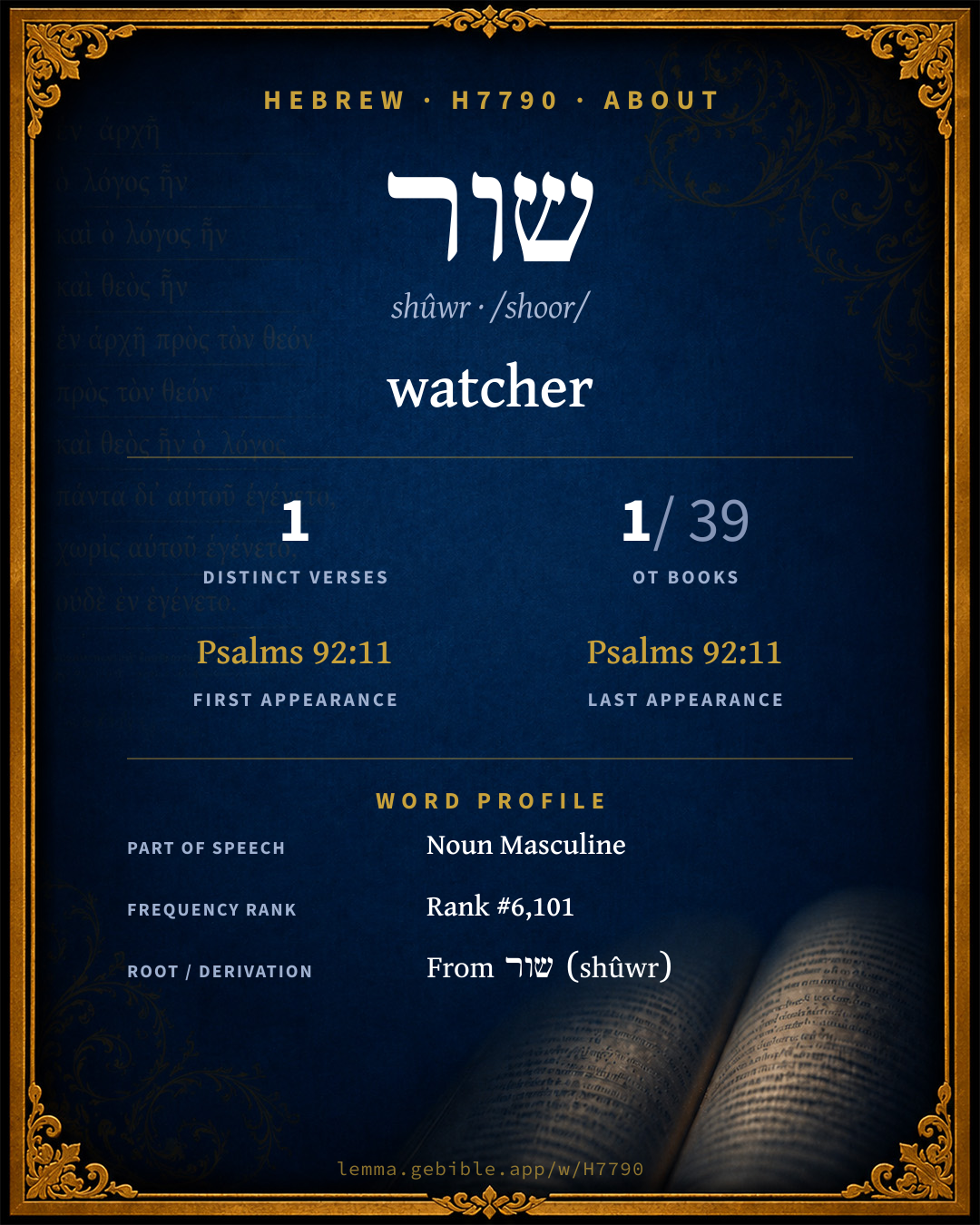
שׁוּר
watcher
‘watcher’ is one of 2 main senses fuller range ↓
Full lexicon entry — Brown-Driver-Briggs (BDB)
From Brown-Driver-Briggs (BDB)
Where this word appears
Grammar key — what these labels mean
Noun type
- Common
- A common noun — a general class of person, place, or thing (“king,” “city,” “water”), not a specific name.
State
- Construct
- A noun bound to a following noun in a possessive / “of” relationship (the construct chain).
Gender
- Masculine
- Grammatically masculine.
Number
- Plural
- More than one (in Hebrew, generally three or more).
Every verse where H7790 appears — 1 distinct verse across 1 book. Click any verse to open its interlinear word-by-word view. Verse text shown in the World English Bible for context — . Each verse’s Hebrew form is shown with its reference; the English is not keyword-highlighted, since the data carries no word-level English alignment. Use “Compare translations” on any verse to read it across multiple English versions. This concordance covers the Hebrew Bible; Septuagint (Greek Old Testament) occurrences are not indexed here.
Psalms 1 verse
About this entry
At a glance — auto-summarized from this page’s data, not written by a person. Every figure links to its source below. This summary describes the numbers; it doesn’t interpret them.
שור (shûwr) is a Hebrew noun most often rendered “watcher.” It occurs a mere 1 verse across Scripture. It clusters heavily in Psalms, which alone accounts for 100% of its uses. It occurs only once, in Psalms 92:11. Not a single-sense word: explore its full sense range. The sections below give every sense, occurrence, and version rendering.
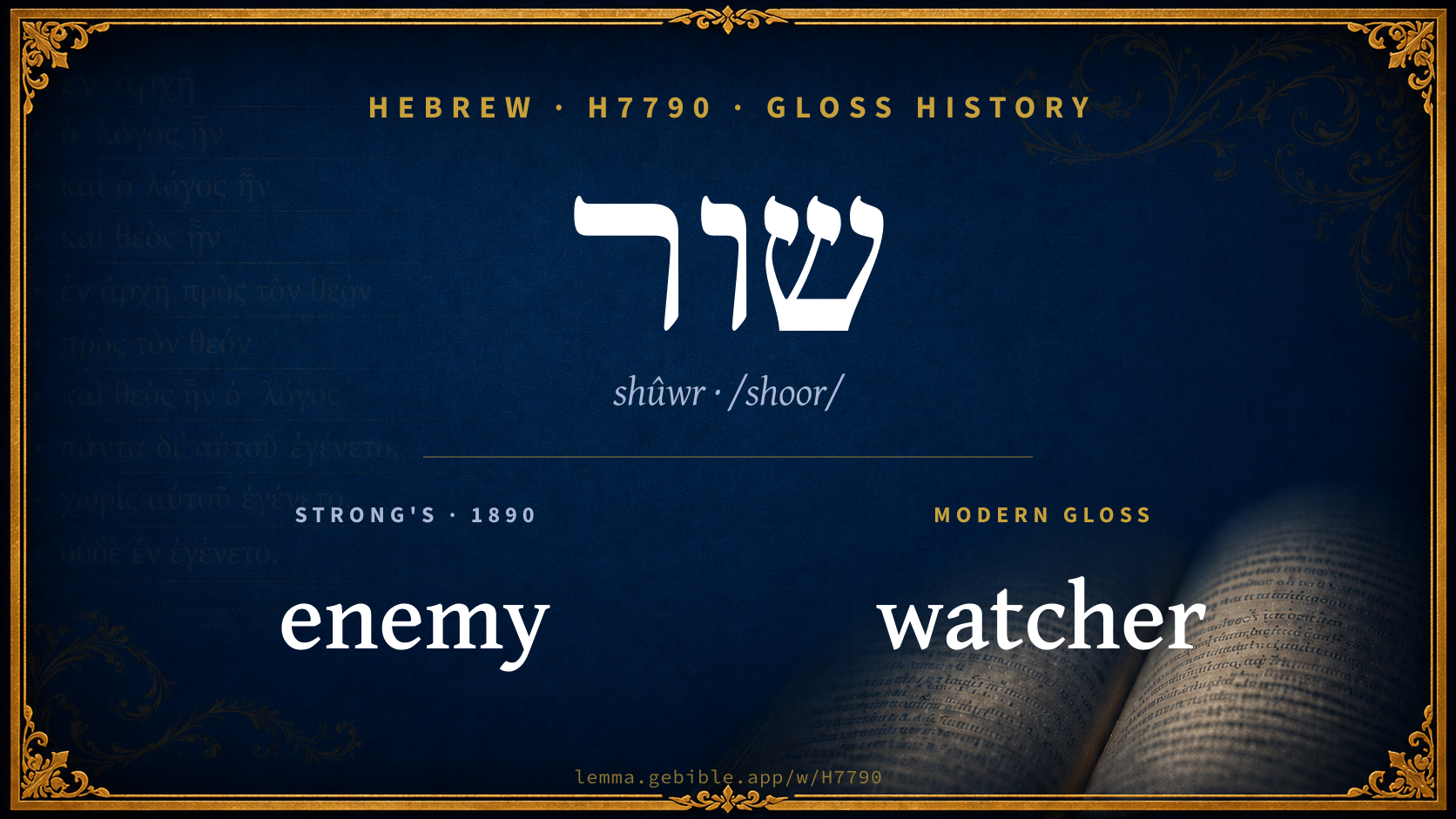
Gloss history
Strong's 1890 vs modern scholarship
About this word
Strong's H7790 catalogs a Hebrew word from the Hebrew Old Testament.
These counts are not copied from any lexicon or concordance. They are computed here, from the morphology-tagged Hebrew Old Testament. What Lemma adds →
- 1
- distinct verses
- The word appears in 1 distinct verse.
- 1 / 39
- OT books
- The word appears in 1 of 39 Old Testament books.
- #6,101
- by frequency
- Rank #6,101 (rank 6,101 of 8,640 Hebrew words by occurrence).
View all 1 occurrence in the concordance →
Most concentrated in
- Psalms 1 verse 100%
By section of the Old Testament
By traditional corpus
Conventional, traditional groupings — biblical authorship is debated, so this is a traditional corpus grouping, not an authorship claim. Each share is this word’s portion of its verses in that division of the Hebrew canon. Each figure is a share of the word’s 1 distinct verse.
- Writings (Ketuvim) 1 verse · 100%
How translations render this word
Counts come from each version’s own published word-to-Strong’s tagging or interlinear alignment — an approximate guide to how each version renders this word, not a word-level alignment the data otherwise carries. Because each total is that version’s own tagged count, the per-version totals vary from one another and need not match the appearance or distinct-verse counts above. These counts may also differ from a printed concordance because Lemma counts each distinctly tagged rendering and does not collapse phrase taggings into a single head-word total. This is a fixed set of word-tagged versions (KJV, ASV, BSB, ULT) and does not change with the reading translation you choose elsewhere. Each version’s license is shown beside its name below (and on Sources).
BDB lists this Strong’s number as 6 distinct words (homographs). Each count above pools all of them and is not split by sense — see the Senses section below. A low-frequency rendering may belong to a different one of those words, not the primary meaning.
- King James Version†: Desire on mine enemies 1×
- American Standard Version†: Desire on mine enemies 1×
- Berean Standard Bible†: Enemies 1×
- unfoldingWord Literal Text†: Foes 1×
King James Version Public Domain
Renders H7790 across 1† tagged occurrence — most commonly:
American Standard Version Public Domain
Renders H7790 across 1† tagged occurrence — most commonly:
Berean Standard Bible Public Domain
Renders H7790 across 1† tagged occurrence — most commonly:
unfoldingWord Literal Text CC BY-SA 4.0
Renders H7790 across 1† tagged occurrence — most commonly:
Senses in the full BDB
What do BDB’s symbols mean?
BDB uses these scholarly abbreviations:
| Symbol | Meaning |
|---|---|
| 𝔊 | the Septuagint (the ancient Greek translation, LXX) |
| 𝔙 | the Vulgate (the Latin translation) |
| 𝔖 | the Syriac version (the Peshitta) |
| 𝔗 | the Targum (the Aramaic translation) |
| ψ | the Psalms |
| √ | root (the underlying root or stem) |
| ‖ | parallel passage (a synonymous or contrasted parallel) |
| † | the dagger: every passage where the word occurs is cited |
The 5 senses and sub-senses the full Brown-Driver-Briggs lexicon distinguishes for this word, in lexicon order (not ranked by frequency), with BDB’s own verbatim wording and sub-sense lettering. Shown in Hebrew script with BDB’s own scholarly abbreviations. The condensed entry is in the Lexicon Entry tab.
שור I
Qal
- Impf. 2 fs. וַתָּשֻׁרִי לַמֶּלֶךְ בַּשֶּׁמֶן Is 57:9 and thou (the apostate faction) didst journey to (the god) Melek with (thine) oil, i.e. bring, offer it (Che Marti read וַתָּסֻכִי). Pt. fpl. שָׁרוֹתַיִךְ Ez 27:25 ships of Tarshish were thy travellers (i.e. traders), but improbable; Krae שָׁרוֹת לָךְ בְּ journey for thee with thy wares; Toy רֹכְלַיִךְ בְּ; Co שֵֽׁרְתוּךְ served thee. e.g. Isaiah 57:9
שור II behold, regard (especially Jb)
Qal
- Impf. 3 ms. יָשׁוּר Je 5:26, sf. יְשׁוּרֶנּוּ Jb 34:29, etc.; Imv. ms. שׁוּר Jb 35:5;— e.g. Jeremiah 5:26
- 1. behold, c. acc. pers. Nu 23:9; 24:17 (poems in JE, ‖ רָאָה), לֹא תְּשׁוּרֵנִי, subj. eye, Jb 24:15, and (= I shall not exist) 7:8, cf. 20:9 (subj. מְקוֹמוֹ), 17:15; God object 34:29; 35:14; look, gaze, abs., מִן loc. Ct 4:8. e.g. Numbers 23:9
- 2. regard with watchful care (subj. י׳) Ho 14:9; so, = notice, Jb 35:13; regard, observe, acc. rei, God’s word Jb 33:14 (Hi De Da al.), so, (reading 2 ms.), Siegf Bu; Du יְשִׁיבֶנָּה he (God) retracts it not. e.g. Hosea 14:9
- 3. watch stealthily, lie in wait, כְּנָמֵר עַל־דֶּרֶךְ אָשׁוּר Ho 13:7 (subj. י׳; Meinh Marti אֶשְׁקֹד; 𝔊 𝔖 𝔙 We Now al. אַשּׁוּר), Je 5:26 (subj. wicked).—Jb 33:27 v. שׁיר. e.g. Hosea 13:7
שור III dub. word, only pl. sf. וַתַּבֵּט עֵינִי בְּשׁוּרָ֑י ψ 92
שור IV (insidious) watcher, (proposes Pōʿl. Pt., מְ׳ om., Ges§ 52 s)
שור V [m.] wall (Aramaic שׁוּרָא, ܫܽܘܪܳܐ )
שור VI loc. SW. of Palestine, on E. border of Egypt
Senses from the full Brown-Driver-Briggs lexicon (Brown, Driver, Briggs; Oxford 1906 — public domain), digitized via Sefaria, supplemented by the OpenScriptures HebrewLexicon (CC BY 4.0). Full attribution on Sources.
Word origin
I. vb. perhaps travel, journey (Assyrian šâru, pass along, take one’s way, Arabic سَارَ (ى) go, pass along, journey, سَيَّارَةٌ caravan, Palm. שירתא Lzb 375 SAC113 Cooke271, Syriac ܫܝܳܪܬܳܐ (? Arabic loan-wd., Frä 180));—
II. vb. behold, regard (especially Jb);—
III. dub. word, only pl. sf. וַתַּבֵּט עֵינִי בְּשׁוּרָ֑י ψ 92:12, read בְּשׁוֹרְרָ֑י (Bae al.) v. foll.
I. n.m. (insidious) watcher, (proposes Pōʿl. Pt., מְ׳ om., Ges§ 52 s);—pl. sf. שׁוֹרְרַי ψ 56:3, שׁוֹרְרָ֑י 5:9; 27:11, שֹׁרְרָ֑י 54:7; 59:11; 92:12 v. foregoing.
IV. n.[m.] wall (Aramaic שׁוּרָא, ܫܽܘܪܳܐ );—Gn 49:22 (poem in J), 2 S 22:30 = ψ 18:30; pl. sf. שׁוּרֹתָם Jb 24:11 their walls De Di De, cf. Bu; but v. שׁוּרָה infra; שָׁרוֹתֶיהָ Je 5:10 = its walls, according to Vrss AV RV Gf Gie, read then שֻׁ׳, but v. id.
V. n.pr.loc. SW. of Palestine, on E. border of Egypt;—Gn 16:7 (J; דֶּרֶךְ שׁ׳), 20:1 (E), towards Egypt 25:18 (J), 1 S 15:7, שׁ֫וּרָה 27:8; מִדְבַּר־שׁ׳ Ex 15:22 (J).—Often supposed to denote properly the ‘wall’ or line of fortresses, built by Egyptian Kings across isthmus of Suez; but dub.: cf. Dr Hast.DB Shur.
— Brown-Driver-Briggs (Oxford 1906, public domain), digitized via Sefaria, supplemented by the OpenScriptures HebrewLexicon (CC BY 4.0). See Sources.
Derived from שור (shûwr) (H7789) — to see.
Jastrow Dictionary
A second Hebrew/Aramaic lexicon for comparison, covering Aramaic and post-biblical (Talmudic, Targumic, Midrashic) usage that the biblical-Hebrew BDB does not. Matched by lemma rather than by Strong’s number, so a lemma may carry more than one Jastrow headword (shown separately below), and the entries cover usage well beyond the Bible.
שְׁוָורִים
- , pl. of שׁוֹר.
שְׁוַר
- , v. שְׁוַור, שַׁוָּור.
שׁוּר I
- to sing; Polel שׁוֹרֵר, v. שִׁיר I.
שׁוּר II
- מִדְבַּר ש׳ desert of Shur (caravan road), v. כּוּב, a. next. w.
שׁוּר III
- 1. wall, fortification, stronghold. Gen. R. s. 98 (ref. to שׁוֹר, Gen. XLIX, 6; v. Targ. O. a. Y. 1) עקרתון שׁוּרָן של גרים you have uprooted the stronghold (reliance) of proselytes (by dealing faithlessly with the Shechemites); בשביל … עקרתם שורן וכ׳ in order to gratify your passion, you have uprooted &c. e.g. Genesis 49:6
- 2. protected habitation, civilized condition (cmp. יִשּׁוּב), opp. מדבר. Ex. R. s. 24 (play on מדבר שור, Ex. XV, 22) עד שלא יצאו … נעשה העולם ש׳ before Israel went out of Egypt, the world was a desert (lawless); when they went forth, the world became civilized; עד שלא קיבלו … ש׳ before Israel received the Law, the world was a desert; when they received it, the world became &c. e.g. Exodus 15:22
שׁוּר
- 1. wall, fortification. Targ. O. Gen. XLIX, 6 (Y. I שׁוֹר; v. preced.). Targ. Lam. II, 8. Targ. Prov. XXV, 28; a. fr.—Lam. R. to II, 8 (expl. חל וחומה, ib.) ש׳ ובר ש׳ the large circumvallation and the smaller wall; Pes. 86ᵃ; Y. ib. VII, 35ᵇ bot. Y. B. Bath. II, 13ᵇ bot. ש׳ דחמץ the wall of Emesa; M.M. Kat. 26ᵃ ש׳ דלודקיא the wall of Laodicea; a. fr.—Pl. שׁוּרִין, שׁוּרַיָּא. Targ. Ex. XIV, 22. Targ. II Kings XXV, 4. Targ. O. Deut. XXVIII, 52; a. fr.
- 2. (v. שׁוּרָה) line, road. Y. Keth. VII, 31ᶜ, v. פּוּתְיָא.—V. שׁוּרְתָא.
שׁוֹר I
- , Fl. to Levy Talm. Dict. IV, p. 680) ox. B. Kam. 65ᵇ ש׳ בן יומו קרוי ש׳ an ox on the day of his birth is called shor (by ref. to Lev. XXII, 27). Ib. I, 1 הש׳ damage done by an ox (Ex. XXI, 28; XXII, 4). Ib. IV, 7 ש׳ המדבר the ox of the desert (aurochs, being ownerless). Kil. VIII, 6; Ḥull. 80ᵃ בר(ה) ש׳ wild ox, aurochs; a. fr.—Erub. 53ᵇ (in enigmatic speech) ש׳ משפט (not במשפט) = תור דין = תְּרָדִין, v. תְּרָדָא I.—Pl. שְׁוָורִים, שְׁוָורִין, שְׁוָר׳. Gen. R. s. 75 (ref. to Gen. XXXII, 6) משור אחד יצאו ש׳ הרבה from the one ox (which I originally possessed) many oxen went forth. B. Kam. III, 8. Y. Gitt. IX, 46ᵈ bot.; a. fr. e.g. Leviticus 22:27
שׁוֹר II
- chain, cord, esp. umbilical cord. Lev. R. s. 5 ואני חותכת את שׁוֹרְךָ and I shall cut thy umbilical cord (with which thou art attached to me); Yalk. Job 908 טבורך).
שִׁיר I
- denom. of next w.) to sing. Ber. 14ᵇ ושַׁרְנוּ לך and we sang (praises) unto thee. Snh. 91ᵇ (ref. to Ex. XV, 1) שָׁר לא נאמר אלא יָשִׁיר it does not read, ‘he sang’; but, ‘he shall sing’; Mekh. B’shall., Shir., s. 1; a. e. e.g. Exodus 15:1
- ) שׁוֹרֵר same. Num. R. s. 3 (play on ב̇כ̇וש̇ר̇ות, Ps. LXVIII, 7) אותן שהיו ב̇וכ̇ין … מְ֗ש̇ו̇רְ֗רִין עכשיו those who formerly wept …, were now singing. Ib. ועבד מְשׁוֹרֵר וכ׳ and the slave sings, because he is relieved &c. B. Bath. 120ᵃ מְשׁוֹרְרִים לפניה went singing (bridal songs) before her; a. fr.—[Midr. Till. to Ps. CXVI באין ושוררין, read: ושׁוֹרִין, v. שָׁרָה II.]—מְשׁוֹרֵר singer, esp. Temple singer (Levite). Arakh. 11ᵇ מ׳ ששיער ומשוער ששורר if one designated as a singer acts as gate-guard, or a gate-guard acts as singer; a. fr.—Pl. מְשׁוֹרְרִים, מְשׁוֹרְרִין. Ib. שאתה מן המ׳ וכ׳ for thou belongest to the singers, and not to the gate-guards; a. fr. e.g. Psalms 68:7
A Dictionary of the Targumim, the Talmud Babli and Yerushalmi, and the Midrashic Literature (Marcus Jastrow; London, Luzac, 1903) — Public Domain. Digitized via Sefaria. Digitized via Sefaria. Full attribution on Sources.