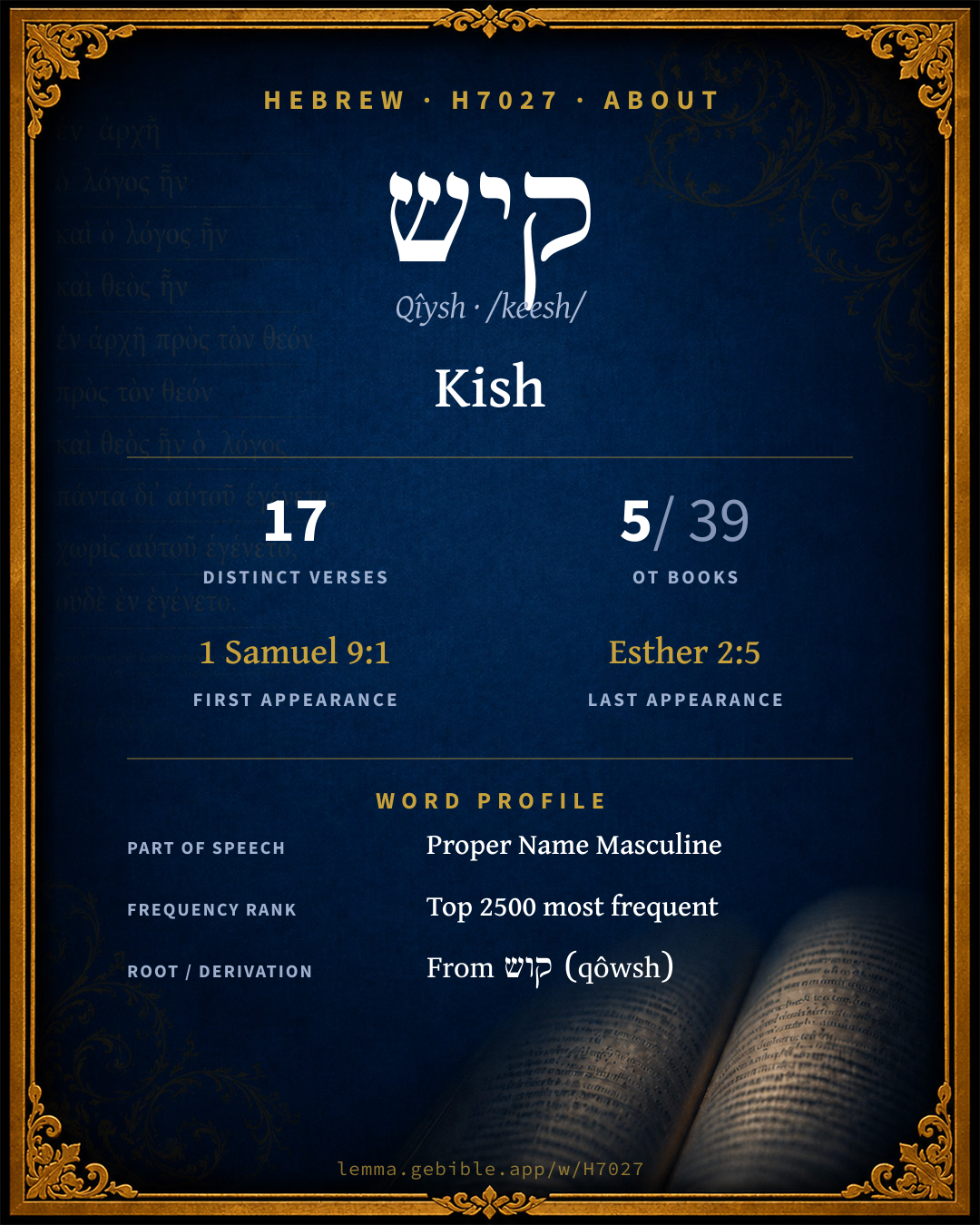
קִישׁ
Kish
BDB lists 6 entries for ‘Kish’ fuller range ↓
Full lexicon entry — Brown-Driver-Briggs (BDB)
From Brown-Driver-Briggs (BDB)
Where this word appears
Grammar key — what these labels mean
Part of speech
- Noun
- A naming word — a person, place, thing, or idea.
Noun type
- Proper
- A name of a specific person, place, or people (e.g. Abraham, Zion, Israel).
Every verse where H7027 appears in the Book of 1 Chronicles — 9 distinct verses. Click any verse to open its interlinear word-by-word view. Verse text shown in the World English Bible for context — . Each verse’s Hebrew form is shown with its reference; the English is not keyword-highlighted, since the data carries no word-level English alignment. Use “Compare translations” on any verse to read it across multiple English versions. This concordance covers the Hebrew Bible; Septuagint (Greek Old Testament) occurrences are not indexed here.
1 Chronicles
- 1 Chronicles 8:30 וְ/קִ֖ישׁ conj + n Proper and his firstborn son Abdon, and Zur, and Kish, and Baal, and Nadab,
- 1 Chronicles 8:33 קִ֔ישׁ וְ/קִ֖ישׁ n Proper conj + n Proper Ner became the father of Kish; and Kish became the father of Saul; and Saul became the father of Jonathan, and Malchishua, and Abinadab, and Eshbaal.
- 1 Chronicles 9:36 וְ/קִ֔ישׁ conj + n Proper and his firstborn son Abdon, and Zur, and Kish, and Baal, and Ner, and Nadab,
- 1 Chronicles 9:39 קִ֔ישׁ וְ/קִ֖ישׁ n Proper conj + n Proper Ner became the father of Kish; and Kish became the father of Saul; and Saul became the father of Jonathan, and Malchishua, and Abinadab, and Eshbaal.
- 1 Chronicles 12:1 קִ֑ישׁ n Proper Now these are those who came to David to Ziklag, while he yet kept himself close because of Saul the son of Kish; and they were among the mighty men, his helpers in war.
- 1 Chronicles 23:21 וְ/קִֽישׁ conj + n Proper The sons of Merari: Mahli and Mushi. The sons of Mahli: Eleazar and Kish.
- 1 Chronicles 23:22 קִ֖ישׁ n Proper Eleazar died, and had no sons, but daughters only: and their brothers the sons of Kish took them [to wife].
- 1 Chronicles 24:29 לְ/קִ֖ישׁ קִ֥ישׁ prep + n Proper n Proper Of Kish; the sons of Kish: Jerahmeel.
- 1 Chronicles 26:28 קִ֔ישׁ n Proper All that Samuel the seer, and Saul the son of Kish, and Abner the son of Ner, and Joab the son of Zeruiah, had dedicated, whoever had dedicated anything, it was under the hand of Shelomoth, and of his brothers.
About this entry
At a glance — auto-summarized from this page’s data, not written by a person. Every figure links to its source below. This summary describes the numbers; it doesn’t interpret them.
“Kish” is the headline sense of the Hebrew name קיש (Qîysh). More than half of its appearances fall in 1 Chronicles. It appears 17 verses across 5 books of the Hebrew Bible, among its uncommon vocabulary. First canonically at 1 Samuel 9:1, it enters the text early. The sections below give every occurrence and version rendering.
Gloss history
Strong's 1890 vs modern scholarship
About this word
Strong's H7027 catalogs a Hebrew word from the Hebrew Old Testament.
These counts are not copied from any lexicon or concordance. They are computed here, from the morphology-tagged Hebrew Old Testament. What Lemma adds →
- 17
- distinct verses
- The word appears in 17 distinct verses.
- 5 / 39
- OT books
- The word appears in 5 of 39 Old Testament books.
- #1,462
- by frequency
- Top 2500 most frequent Hebrew words (rank 1,462 of 8,640 Hebrew words by occurrence).
View all 17 occurrences in the concordance →
Most concentrated in
- 1 Chronicles 9 verses 53%
- 1 Samuel 5 verses 29%
- 2 Samuel 1 verse 6%
By section of the Old Testament
By traditional corpus
Conventional, traditional groupings — biblical authorship is debated, so this is a traditional corpus grouping, not an authorship claim. Each share is this word’s portion of its verses in that division of the Hebrew canon. Each figure is a share of the word’s 17 distinct verses.
- Writings (Ketuvim) 11 verses · 65%
- Prophets (Nevi'im) 6 verses · 35%
How translations render this word
Counts come from each version’s own published word-to-Strong’s tagging or interlinear alignment — an approximate guide to how each version renders this word, not a word-level alignment the data otherwise carries. Because each total is that version’s own tagged count, the per-version totals vary from one another and need not match the appearance or distinct-verse counts above. These counts may also differ from a printed concordance because Lemma counts each distinctly tagged rendering and does not collapse phrase taggings into a single head-word total. This is a fixed set of word-tagged versions (KJV, ASV, BSB, ULT) and does not change with the reading translation you choose elsewhere. Each version’s license is shown beside its name below (and on Sources).
- King James Version: Kish 19×
- American Standard Version: Kish 20×
- Berean Standard Bible: Kish 20×
- unfoldingWord Literal Text: Kish 19×
King James Version Public Domain
Renders H7027 across 21 tagged occurrences — most commonly:
Plus 2 renderings that appear only once — usually multi-word phrases or single function words the recovered tagging swept in, not distinct renderings.
American Standard Version Public Domain
Renders H7027 across 21 tagged occurrences — most commonly:
Plus 1 rendering that appears only once — usually multi-word phrases or single function words the recovered tagging swept in, not distinct renderings.
Berean Standard Bible Public Domain
Renders H7027 across 21 tagged occurrences — most commonly:
Plus 1 rendering that appears only once — usually multi-word phrases or single function words the recovered tagging swept in, not distinct renderings.
unfoldingWord Literal Text CC BY-SA 4.0
Renders H7027 across 22 tagged occurrences — most commonly:
Plus 3 renderings that appear only once — usually multi-word phrases or single function words the recovered tagging swept in, not distinct renderings.
Senses in the full BDB
What do BDB’s symbols mean?
BDB uses these scholarly abbreviations:
| Symbol | Meaning |
|---|---|
| 𝔊 | the Septuagint (the ancient Greek translation, LXX) |
| 𝔙 | the Vulgate (the Latin translation) |
| 𝔖 | the Syriac version (the Peshitta) |
| 𝔗 | the Targum (the Aramaic translation) |
| ψ | the Psalms |
| √ | root (the underlying root or stem) |
| ‖ | parallel passage (a synonymous or contrasted parallel) |
| † | the dagger: every passage where the word occurs is cited |
The 5 senses and sub-senses the full Brown-Driver-Briggs lexicon distinguishes for this word, in lexicon order (not ranked by frequency), with BDB’s own verbatim wording and sub-sense lettering. Shown in Hebrew script with BDB’s own scholarly abbreviations. The condensed entry is in the Lexicon Entry tab. See also the Forms in the corpus table below.
- 1. father of Saul 1 S 9:1, 3(×2): 10:11, 21; 14:51; 2 S 21:14; 1 Ch 8:30, 33 (where read אַבְנֵר, Be Kau Kit), v 33 = 9:36, 39 (read as above), v 39; 12:1; 26:28. e.g. 1 Samuel 9:1
- 2. Levites;
- a. 1 Ch 23:21, 22; 24:29(×2). e.g. 1 Chronicles 23:21
- b. 2 Ch 29:12. e.g. 2 Chronicles 29:12
- 3. ancestor of Mordecai Est 2:5 (Κεισαίου). e.g. Esther 2:5
Senses from the full Brown-Driver-Briggs lexicon (Brown, Driver, Briggs; Oxford 1906 — public domain), digitized via Sefaria, supplemented by the OpenScriptures HebrewLexicon (CC BY 4.0). Full attribution on Sources.
Word origin
n.pr.m. (prob. *קַיְשְׁ, Arabic قَيْس, Aramaic קישׁא, NöZMG xi (1886), 167; orig. n.pr.dei as Arabic قيس, wh. now only in n.pr. pers. WeHeid. 2, 67);—Κ(ε)ις:
— Brown-Driver-Briggs (Oxford 1906, public domain), digitized via Sefaria, supplemented by the OpenScriptures HebrewLexicon (CC BY 4.0). See Sources.
Derived from קוש (qôwsh) (H6983) — to lure.
Jastrow Dictionary
A second Hebrew/Aramaic lexicon for comparison, covering Aramaic and post-biblical (Talmudic, Targumic, Midrashic) usage that the biblical-Hebrew BDB does not. Matched by lemma rather than by Strong’s number, so a lemma may carry more than one Jastrow headword (shown separately below), and the entries cover usage well beyond the Bible.
קִישׁ I
- (b. h.) Kish, the father of king Saul. Meg. 12ᵇ בן ק̇יש̇ הק̇יש̇ וכ׳, v. נָקַשׁ; a. e.
קִישׁ II
- (נָקַשׁ) clapping, the sound ḳish-ḳish. B. Mets. 85ᵇ, v. כִּישׁ.
קִישׁ III
- , part. of קְשַׁשׁ II.
A Dictionary of the Targumim, the Talmud Babli and Yerushalmi, and the Midrashic Literature (Marcus Jastrow; London, Luzac, 1903) — Public Domain. Digitized via Sefaria. Digitized via Sefaria. Full attribution on Sources.
Forms in the corpus
The 12 distinct written forms H7027 takes in the Hebrew Bible, most frequent first — each parse links to that state’s occurrences in the concordance. Hebrew forms include their vowel points and cantillation, so a single lemma takes many written forms.
| Form | Parsing | Example | Uses |
|---|---|---|---|
| קִ֔ישׁ | Noun, Proper | 1 Chronicles 8:33 | 5 |
| וְ/קִ֖ישׁ | Noun, Proper | 1 Chronicles 8:30 | 3 |
| לְ/קִ֖ישׁ | Noun, Proper | 1 Chronicles 24:29 | 2 |
| קִ֖ישׁ | Noun, Proper | Esther 2:5 | 2 |
| קִ֣ישׁ | Noun, Proper | 1 Samuel 9:1 | 2 |
| וְ/קִ֔ישׁ | Noun, Proper | 1 Chronicles 9:36 | 1 |
| וְ/קִ֧ישׁ | Noun, Proper | 1 Samuel 14:51 | 1 |
| וְ/קִֽישׁ | Noun, Proper | 1 Chronicles 23:21 | 1 |
| קִ֑ישׁ | Noun, Proper | 1 Chronicles 12:1 | 1 |
| קִ֚ישׁ | Noun, Proper | 2 Chronicles 29:12 | 1 |
| קִ֜ישׁ | Noun, Proper | 1 Samuel 9:3 | 1 |
| קִ֥ישׁ | Noun, Proper | 1 Chronicles 24:29 | 1 |
Same root — word family
Other BDB entries built from the same root as H7027, grouped by Strong’s listed origin. These share a root / origin per the lexicon — not necessarily a shared meaning. Each links to that word’s own entry.
Derives from
Proper names from this root
People and places named from this root — a name, not an additional meaning of the word.
- קושיהו qûwshâyâhûw H6984 Kushaiah
- קישון Qîyshôwn H7028 Kishon
- קישי Qîyshîy H7029 Kishi
- Κις Kís G2797 Kish
Compare all same-root words → Showing 4 of 6 — not the complete family. 4 of the same-root words are proper names (people or places). They share a root, not necessarily a meaning.
Bible dictionary
Public-domain dictionary articles matched to this entry by name (Kish). A biblical name can be shared by more than one person or place, so an article may treat several.
Easton's Bible Dictionary · M. G. Easton, 1897
A bow. (1.) A Levite of the family of Merari (1 Chr. 23:21; 24:29).
(2.) A Benjamite of Jerusalem (1 Chr. 8:30; 9:36).
(3.) A Levite in the time of Hezekiah (2 Chr. 29:12).
(4.) The great-grandfather of Mordecai (Esther 2:5).
(5.) A Benjamite, the son of Abiel, and father of king Saul (1 Sam. 9:1, 3; 10:11, 21; 14:51; 2 Sam. 21:14). All that is recorded of him is that he sent his son Saul in search of his asses that had strayed, and that he was buried in Zelah. Called Cis, Acts 13:21 (R.V., Kish).
Smith's Bible Dictionary · William Smith, 1863
(a bow).
+ The father of Saul; a Benjamite of the family of Matri. (B.C. 1095.) + Son of Jehiel and uncle to the preceding. (1 Chronicles 9:36) + A Benjamite, great-grandfather of Mordecai. (Esther 2:5) + A Merarite of the house of Mahli, of the tribe of Levi. (1 Chronicles 23:21,22; 24:28,29)
Hitchcock's Bible Names Dictionary · Roswell D. Hitchcock, 1869
hard; difficult; straw; for age
Classic public-domain reference works; full attribution on Sources.
Septuagint verse parallels
This word appears in 17 verses that also exist in the Greek Old Testament (Septuagint), out of the 17 Hebrew verses it occurs in. You can read those verses in Greek by switching the Old Testament edition to the Septuagint.
Read these verses in the Septuagint
This is a verse-level parallel only — the same verses exist in both the Hebrew and Greek Old Testaments. No word-level Hebrew↔Greek correspondence is claimed: the data carries no such alignment, so no Greek word is shown as this Hebrew word’s translation. Coverage is not total — the Septuagint omits the deuterocanon and renumbers the Psalms, so some Hebrew verses have no direct Greek parallel.