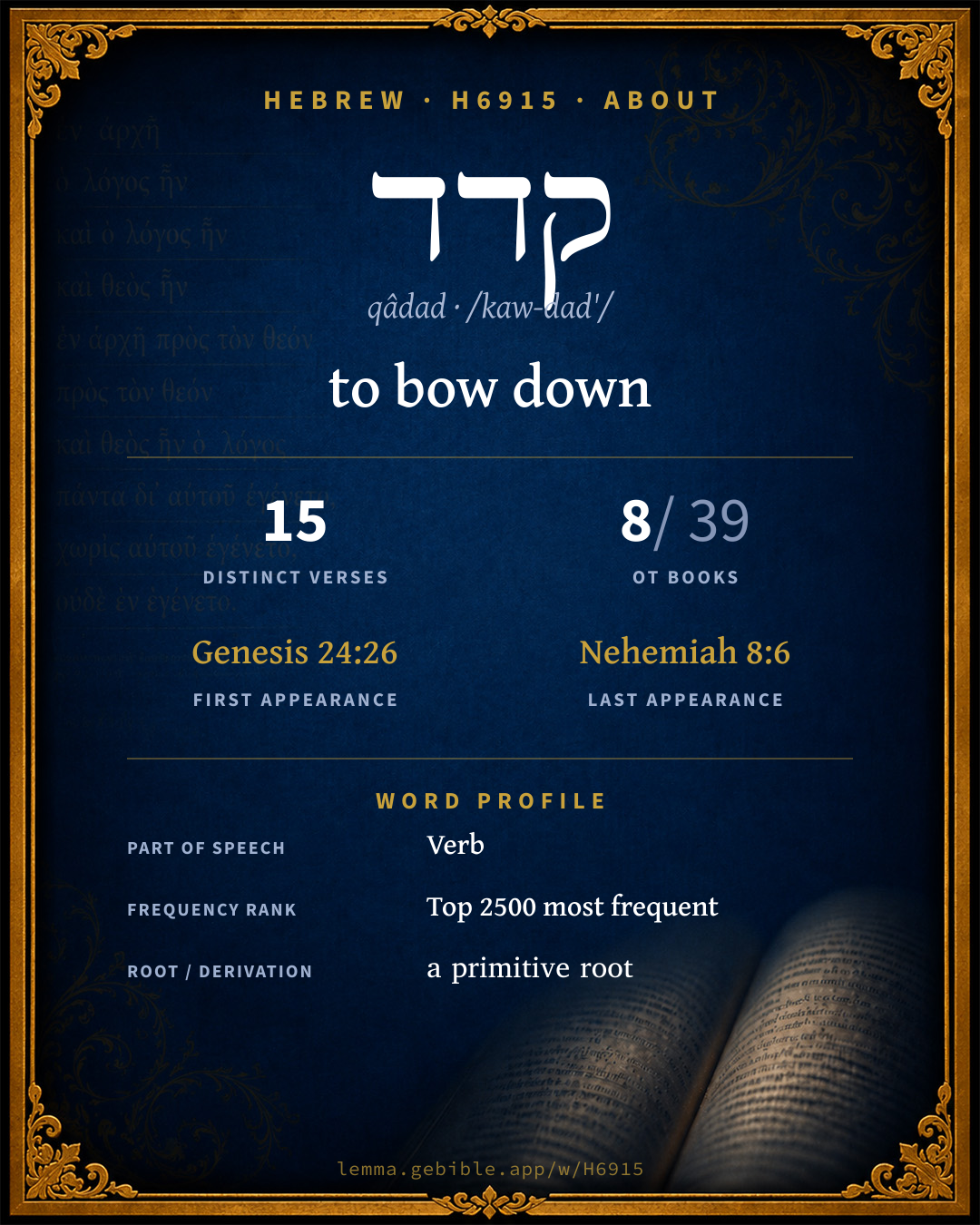
קָדַד
to bow down
Full lexicon entry — Brown-Driver-Briggs (BDB)
From Brown-Driver-Briggs (BDB)
Where this word appears
Grammar key — what these labels mean
Stem
- Qal
- The basic, simple active stem — the plain form of the verb (“he wrote”).
Form
- Sequential Imperfect
- An imperfect with prefixed waw — the standard past-narrative form (waw-consecutive imperfect).
Person
- 3rd Person
- The one spoken about (“he / she / it / they”).
- 1st Person
- The speaker (“I / we”).
Gender
- Masculine
- Grammatically masculine.
- Feminine
- Grammatically feminine.
- Common
- Either gender — not distinguished for this form.
Number
- Singular
- One.
- Plural
- More than one (in Hebrew, generally three or more).
Every verse where H6915 appears in the Book of 1 Chronicles — 1 distinct verse. Click any verse to open its interlinear word-by-word view. Verse text shown in the World English Bible for context — . Each verse’s Hebrew form is shown with its reference; the English is not keyword-highlighted, since the data carries no word-level English alignment. Use “Compare translations” on any verse to read it across multiple English versions. This concordance covers the Hebrew Bible; Septuagint (Greek Old Testament) occurrences are not indexed here.
1 Chronicles
About this entry
At a glance — auto-summarized from this page’s data, not written by a person. Every figure links to its source below. This summary describes the numbers; it doesn’t interpret them.
At its core, קדד (qâdad) means “to bow down.” Scripture first uses it in Genesis 24:26. It appears 15 verses across 8 books of the Hebrew Bible, among its uncommon vocabulary. It clusters with קדה and קדקד under a shared root. For the data behind this summary, explore the sense tree and the renderings breakdown below.
Gloss history
Strong's 1890 vs modern scholarship
About this word
Strong's H6915 catalogs a Hebrew word from the Hebrew Old Testament.
These counts are not copied from any lexicon or concordance. They are computed here, from the morphology-tagged Hebrew Old Testament. What Lemma adds →
- 15
- distinct verses
- The word appears in 15 distinct verses.
- 8 / 39
- OT books
- The word appears in 8 of 39 Old Testament books.
- #1,836
- by frequency
- Top 2500 most frequent Hebrew words (rank 1,836 of 8,640 Hebrew words by occurrence).
View all 15 occurrences in the concordance →
By section of the Old Testament
By traditional corpus
Conventional, traditional groupings — biblical authorship is debated, so this is a traditional corpus grouping, not an authorship claim. Each share is this word’s portion of its verses in that division of the Hebrew canon. Each figure is a share of the word’s 15 distinct verses.
- Torah (Pentateuch) 7 verses · 47%
- Prophets (Nevi'im) 4 verses · 27%
- Writings (Ketuvim) 4 verses · 27%
How translations render this word
Counts come from each version’s own published word-to-Strong’s tagging or interlinear alignment — an approximate guide to how each version renders this word, not a word-level alignment the data otherwise carries. Because each total is that version’s own tagged count, the per-version totals vary from one another and need not match the appearance or distinct-verse counts above. These counts may also differ from a printed concordance because Lemma counts each distinctly tagged rendering and does not collapse phrase taggings into a single head-word total. This is a fixed set of word-tagged versions (KJV, ASV, BSB, ULT) and does not change with the reading translation you choose elsewhere. Each version’s license is shown beside its name below (and on Sources).
- King James Version: Bowed 3×, They bowed their heads 2×
- American Standard Version: Bowed 3×, Bowed his head 2×, He bowed 2×
- Berean Standard Bible: Bowed down 5×, They bowed down 4×, Bowed 3×
- unfoldingWord Literal Text: And 5×, Bowed 4×, Bowed down 2×
King James Version Public Domain
Renders H6915 across 15 tagged occurrences — most commonly:
Plus 10 renderings that appear only once — usually multi-word phrases or single function words the recovered tagging swept in, not distinct renderings.
American Standard Version Public Domain
Renders H6915 across 15 tagged occurrences — most commonly:
Plus 6 renderings that appear only once — usually multi-word phrases or single function words the recovered tagging swept in, not distinct renderings.
Berean Standard Bible Public Domain
Renders H6915 across 14 tagged occurrences — most commonly:
Plus 2 renderings that appear only once — usually multi-word phrases or single function words the recovered tagging swept in, not distinct renderings. Not rendered by a distinct English word in 1 further occurrence.
unfoldingWord Literal Text CC BY-SA 4.0
Renders H6915 across 21 tagged occurrences — most commonly:
Plus 4 renderings that appear only once — usually multi-word phrases or single function words the recovered tagging swept in, not distinct renderings.
Senses in BDB
The 1 sense BDB distinguishes for this word, in lexicon order (not ranked by frequency or importance). The full entry — with sub-senses — is in the Lexicon Entry tab.
- (Qal) to bow down
Word origin
[ קָדַד ] vb. bow down
— Brown-Driver-Briggs (Oxford 1906, public domain), digitized via Sefaria, supplemented by the OpenScriptures HebrewLexicon (CC BY 4.0). See Sources.
Origin: a primitive root
Jastrow Dictionary
A second Hebrew/Aramaic lexicon for comparison, covering Aramaic and post-biblical (Talmudic, Targumic, Midrashic) usage that the biblical-Hebrew BDB does not. Matched by lemma rather than by Strong’s number, so a lemma may carry more than one Jastrow headword (shown separately below), and the entries cover usage well beyond the Bible.
קָדַד
- 1. b. h.)to bow. Ex. R. s. 5 (ref. to Ex. IV, 31) וַיּקְּדוּ על הפקידה, v. פְּקִידָה.—V. קָדָה. e.g. Exodus 4:31
- 2. (cmp. כַּד a. כָּדַר) to cave, cut out, v. קָדַר.
קְדַד
- ch. as preced. 2, v. קְדַר
קָדַר I
- (cmp. כָּדַר, גָּדַר, גָּדַד) to cut around, perforate, cut out. Sabb. 116ᵃ; Y. ib. XVI, 15ᶜ bot. קוֹדֵר (Ar. קוֹדֵד), v. אַזְכָּרָה. Snh. 103ᵇ מנשה ק׳ וכ׳ (Ar. קדר) Manasseh cut the divine names out (of the Scriptures). Kidd. 22ᵇ קוֹדֵד ויורד וכ׳ Ar. (ed. דוקד והולך) one must bore (through the slave’s ear) until the door is reached. Ḥull. 77ᵃ כל שהרופא קוֹדְרוֹ (Ar. a. Ms. M. correct. קוֹדְדוֹ, v. Rabb. D. S. a. l. note) such flesh as the physician cuts out; a. e.—Part. pass. (קָדוּד) קָדוּר. Ab. Zar. 32ᵃ (expl. עור לבוב) כל שקרוע … וק׳ וכ׳ a hide which is slit open opposite the heart and cut out like an air-hole; Tosef. ib. IV (V), 7 כל שק׳ כנגד לבו Var. ed. Zuck. (text שנקוב, oth. ed. שקרוע). Ukts. II, 4 קְדוּרָה (ed. Dehr. קְדוּדָה) cut into, opp. שלמה.
- 1. to cut through; (in measuring distances) to estimate the level distance between two places separated by mountains. Erub. V, 4 (58ᵃ) שמעתי שמְקַדְּרִין בהרים (Y. ed. Ven. שמְקַדְּדִין; v. Rabb. D. S. a. l. note 90) I have heard a tradition that in measuring Sabbath distances elevations are considered as cut through. Ib. 58ᵇ כיצד מְקַדְּרִין וכ׳ how is the measuring done to obtain the tunnel distance? He who stands below holds the rope against his heart, while he who stands above holds the other end of the rope against his feet. Ib. אין מקדרין אלא בחבל וכ׳ only a rope of four cubits can be used for measuring &c. Ib. אין מקדרין לא בעגלה וכ׳ this method of measuring distances is not applied in the case of a slain body found in the field (v. עֶגְלָה), or for cities of refuge. Tosef. ib. VI (V), 11 מְקַדֵּר ועולה מק׳ ויורד וכ׳ we go up measuring the air-line and down again (on the other side), and consider the elevation as if it were cut through before us. Erub. 58ᵃ מַקְדִּיר ועולה וכ׳; Tosef. l. c. 12 מקדר. Y. ib. V, 22ᵈ (repeatedly מְקַדְּדִין). Ib. מקדימין (corr. acc.). Y. Sot. V, 20ᵇ bot. מקדדין; Y. Macc. II, end, 32ᵃ מקדרין; a. fr.—Y. Keth. XIII, 36ᵇ top מקדר ויוצא וכ׳ he may cut his way through the vines and get out (v. פָּסַג).—[Pes. 11ᵇ מקדרין, read: מקרדין, v. קָרַד.]
- 2. (denom. of קָדֵר or קַדָּר) to make pots, pretend to be a potter. Ruth R. to I, 1 (s. 2), v. קַדָּרוּת.
- to cut through; to penetrate. Erub. 58ᵃ, v. supra. Nidd. 56ᵇ; Tosef. ib. VI, 13 מַקְדִּיר, v. גָּלַד; [perh. fr. קָדַר II, becomes dull].
- to be cut out. Ḥull. 77ᵃ נ׳ כמין טבעת (Ar. נִקְדַּד) if the flesh over a fracture is cut out like a ring. Ib. 57ᵇ רחל … שנ׳ קנה שלה וכ׳ a lamb … whose windpipe was perforated, and they inserted a tube of reed, and it recovered.
קְדַר
- , to penetrate. Men. 83ᵃ בשר אגב דשמין קָדֵיר (Ms. M. קריר, v. Rabb. D. S. a. l. note) meat being fat penetrates (the fat is communicated to an object with which it comes in contact); Zeb. 98ᵃ משום דקריר (Ms. K. דקדיר; Ms. R. 1 דקריד; v. Rabb. D. S. a. l. note 6). Ib. 79ᵇ שאני רוק דקדיר Ms. M. (ed. דקריר; Ms. R. 2 a. Ms. K. דקריד; Ms. R. 1 דקרור) it is different with saliva, because it penetrates.
- to measure level distances. Y. Bicc. I, end, 64ᵇ מאן דמְקַדֵּר וכ׳, v. שִׁגְרוֹנַיָּיה.
- to be caved or arched. Targ. Esth. VIII, 10 אִתְקַדְּרוּ פיסת וכ׳ (ed. Lag. אתקדדו) the soles of their feet were arched (so that they, in running, touched the ground only with their toes).
A Dictionary of the Targumim, the Talmud Babli and Yerushalmi, and the Midrashic Literature (Marcus Jastrow; London, Luzac, 1903) — Public Domain. Digitized via Sefaria. Digitized via Sefaria. Full attribution on Sources.
Forms in the corpus
The 9 distinct written forms H6915 takes in the Hebrew Bible, most frequent first — each parse links to that stem’s occurrences in the concordance. Hebrew forms include their vowel points and cantillation, so a single lemma takes many written forms.
| Form | Parsing | Example | Uses |
|---|---|---|---|
| וַ/יִּקֹּ֥ד | Verb, Qal, Sequential Imperfect, 3rd Person, Masculine, Singular | Exodus 12:27 | 4 |
| וַֽ/יִּקְּד֖וּ | Verb, Qal, Sequential Imperfect, 3rd Person, Masculine, Plural | Exodus 4:31 | 3 |
| וַ/יִּקְּד֧וּ | Verb, Qal, Sequential Imperfect, 3rd Person, Masculine, Plural | 1 Chronicles 29:20 | 2 |
| וַ/יִּקֹּ֣ד | Verb, Qal, Sequential Imperfect, 3rd Person, Masculine, Singular | Genesis 24:26 | 1 |
| וַ/יִּקֹּ֧ד | Verb, Qal, Sequential Imperfect, 3rd Person, Masculine, Singular | 2 Chronicles 20:18 | 1 |
| וַ/יִּקֹּ֨ד | Verb, Qal, Sequential Imperfect, 3rd Person, Masculine, Singular | 1 Samuel 24:8 | 1 |
| וַ/תִּקֹּ֣ד | Verb, Qal, Sequential Imperfect, 3rd Person, Feminine, Singular | 1 Kings 1:16 | 1 |
| וַ/תִּקֹּ֨ד | Verb, Qal, Sequential Imperfect, 3rd Person, Feminine, Singular | 1 Kings 1:31 | 1 |
| וָ/אֶקֹּ֥ד | Verb, Qal, Sequential Imperfect, 1st Person, Common, Singular | Genesis 24:48 | 1 |
Same root — word family
Other BDB entries built from the same root as H6915, grouped by Strong’s listed origin. These share a root / origin per the lexicon — not necessarily a shared meaning. Each links to that word’s own entry.
Derived from this word
Compare all same-root words → They share a root, not necessarily a meaning.
Septuagint verse parallels
This word appears in 14 verses that also exist in the Greek Old Testament (Septuagint), out of the 15 Hebrew verses it occurs in. You can read those verses in Greek by switching the Old Testament edition to the Septuagint.
Read these verses in the Septuagint
- Genesis 24:26
- Exodus 4:31
- Numbers 22:31
- 1 Samuel 24:8
- 1 Kings 1:16
- 1 Chronicles 29:20
- 2 Chronicles 20:18
This is a verse-level parallel only — the same verses exist in both the Hebrew and Greek Old Testaments. No word-level Hebrew↔Greek correspondence is claimed: the data carries no such alignment, so no Greek word is shown as this Hebrew word’s translation. Coverage is not total — the Septuagint omits the deuterocanon and renumbers the Psalms, so some Hebrew verses have no direct Greek parallel.