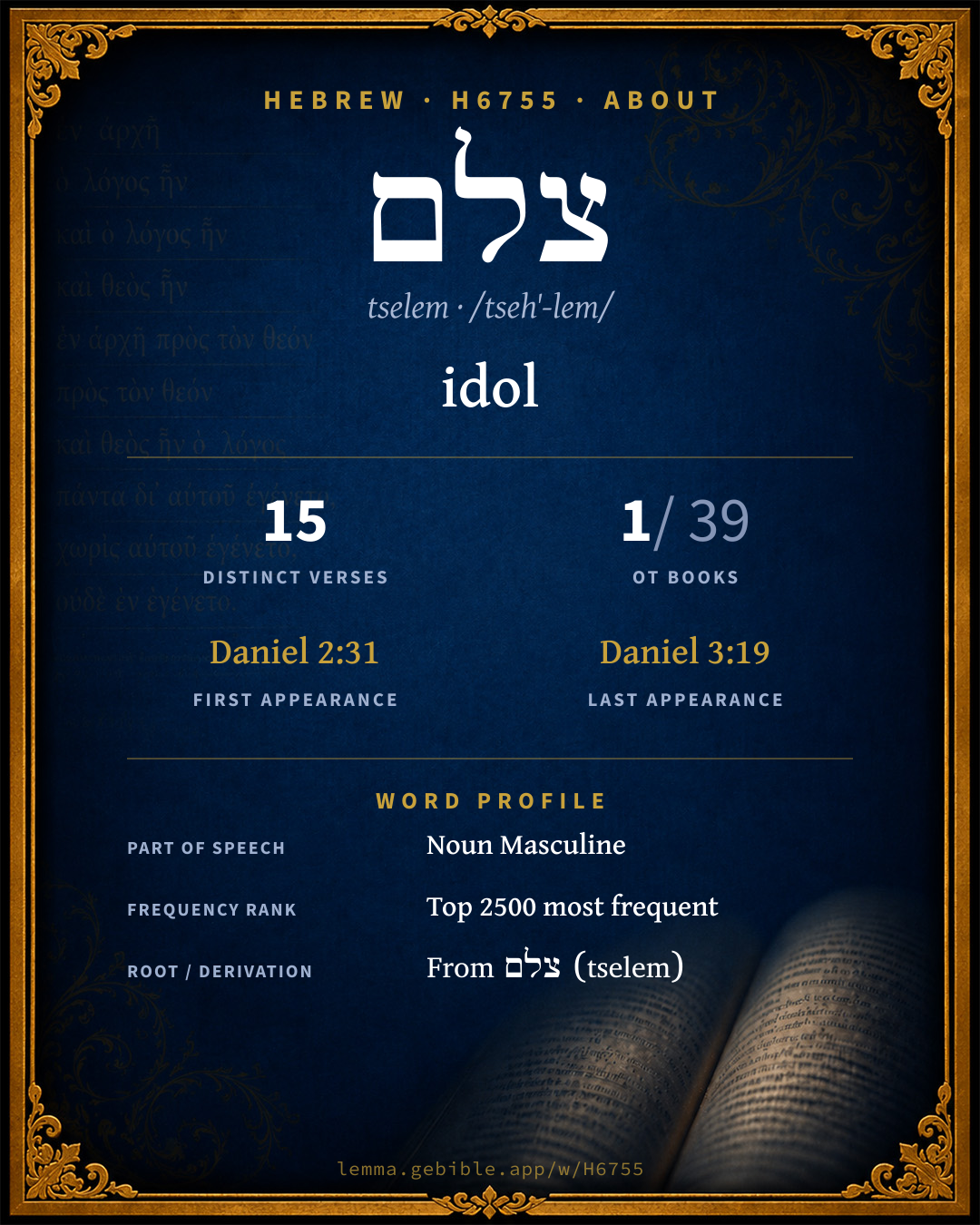
צְלֵם
idol
Full lexicon entry — Brown-Driver-Briggs (BDB)
From Brown-Driver-Briggs (BDB)
Where this word appears
See every Construct-state word in the Hebrew Bible →
Grammar key — what these labels mean
Part of speech
- Noun
- A naming word — a person, place, thing, or idea.
Noun type
- Common
- A common noun — a general class of person, place, or thing (“king,” “city,” “water”), not a specific name.
State
- Construct
- A noun bound to a following noun in a possessive / “of” relationship (the construct chain).
- Absolute
- The independent form of a noun, not bound to a following word.
Gender
- Masculine
- Grammatically masculine.
Number
- Singular
- One.
7 distinct verses where H6755 appears in the Construct state, across 1 book. Filtered view — show all forms. Click any verse to open its interlinear word-by-word view. Verse text shown in the World English Bible for context — . Each verse’s Hebrew form is shown with its reference; the English is not keyword-highlighted, since the data carries no word-level English alignment. Use “Compare translations” on any verse to read it across multiple English versions. This concordance covers the Hebrew Bible; Septuagint (Greek Old Testament) occurrences are not indexed here.
Daniel 7 verses
- Daniel 3:5 לְ/צֶ֣לֶם prep + n c ms cs that whenever you hear the sound of the horn, flute, zither, lyre, harp, pipe, and all kinds of music, you fall down and worship the golden image that Nebuchadnezzar the king has set up;
- Daniel 3:7 לְ/צֶ֣לֶם prep + n c ms cs Therefore at that time, when all the peoples heard the sound of the horn, flute, zither, lyre, harp, pipe, and all kinds of music, all the peoples, the nations, and the languages, fell down and worshiped the golden image that Nebuchadnezzar the king had set up.
- Daniel 3:10 לְ/צֶ֥לֶם prep + n c ms cs You, O king, have made a decree, that every man that shall hear the sound of the horn, flute, zither, lyre, harp, pipe, and all kinds of music, shall fall down and worship the golden image;
- Daniel 3:12 וּ/לְ/צֶ֧לֶם conj + prep + n c ms cs There are certain Jews whom you have appointed over the affairs of the province of Babylon: Shadrach, Meshach, and Abednego; these men, O king, have not regarded you: they don't serve your gods, nor worship the golden image which you have set up.
- Daniel 3:14 וּ/לְ/צֶ֧לֶם conj + prep + n c ms cs Nebuchadnezzar answered them, Is it on purpose, Shadrach, Meshach, and Abednego, that you don't serve my god, nor worship the golden image which I have set up?
- Daniel 3:18 וּ/לְ/צֶ֧לֶם conj + prep + n c ms cs But if not, be it known to you, O king, that we will not serve your gods, nor worship the golden image which you have set up.
- Daniel 3:19 וּ/צְלֵ֤ם conj + n c ms cs Then was Nebuchadnezzar full of fury, and the form of his visage was changed against Shadrach, Meshach, and Abednego: [therefore] he spoke, and commanded that they should heat the furnace seven times more than it was wont to be heated.
About this entry
At a glance — auto-summarized from this page’s data, not written by a person. Every figure links to its source below. This summary describes the numbers; it doesn’t interpret them.
“idol” is the headline sense of the Hebrew noun צלם (tselem). It clusters heavily in Daniel, which alone accounts for 100% of its uses. It turns up in 15 verses across 1 book, an uncommon footprint. Its earliest occurrence is Daniel 2:31. Older and newer Bibles part ways — “image” in the King James Version, “statue” (Berean Standard Bible) in modern versions. See the renderings breakdown. See the sense tree, 15-verse concordance, and the renderings breakdown below.
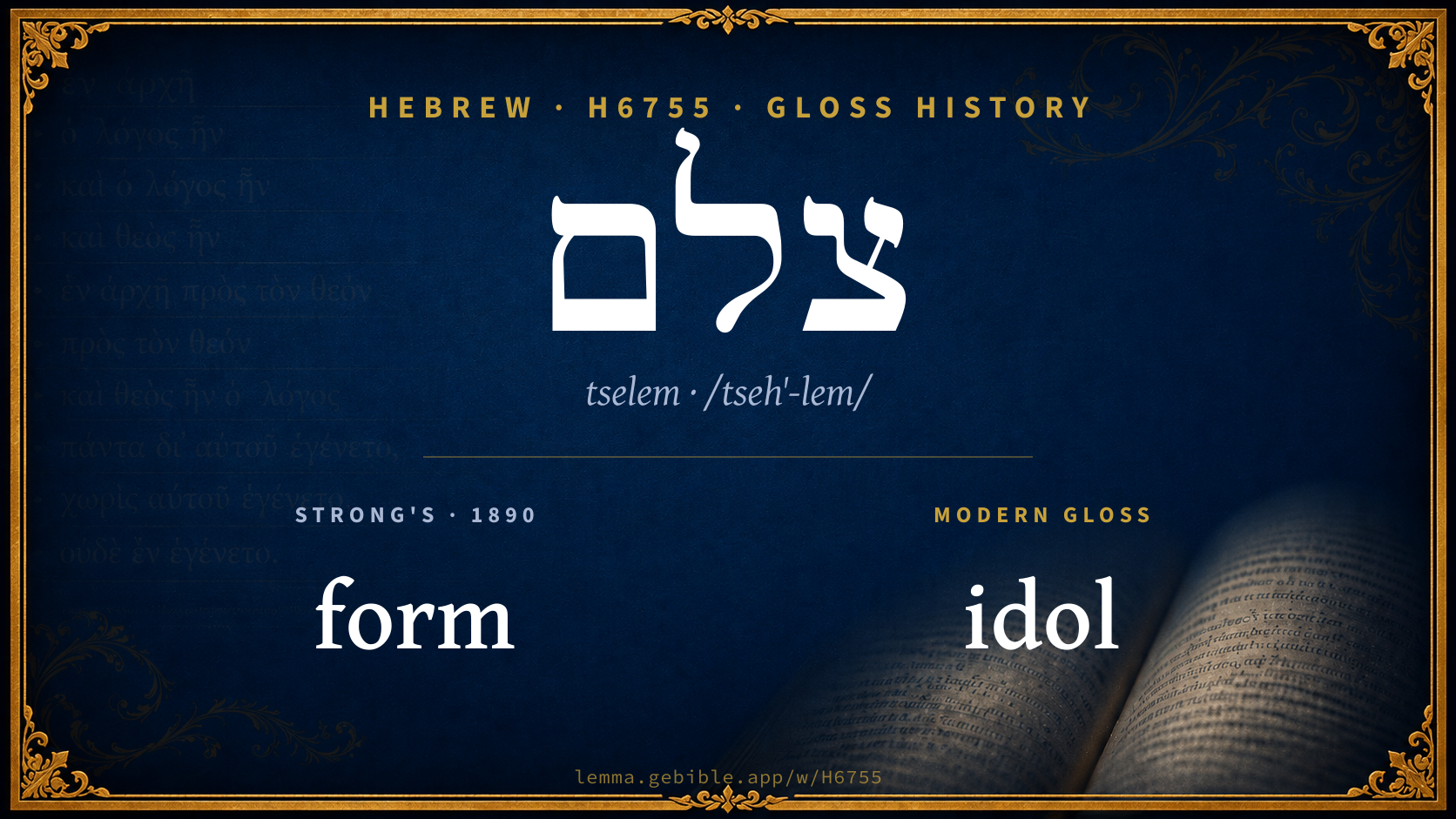
Gloss history
Strong's 1890 vs modern scholarship
About this word
Strong's H6755 catalogs a Hebrew word from the Hebrew Old Testament.
These counts are not copied from any lexicon or concordance. They are computed here, from the morphology-tagged Hebrew Old Testament. What Lemma adds →
- 15
- distinct verses
- The word appears in 15 distinct verses.
- 1 / 39
- OT books
- The word appears in 1 of 39 Old Testament books.
- #1,671
- by frequency
- Top 2500 most frequent Hebrew words (rank 1,671 of 8,640 Hebrew words by occurrence).
View all 15 occurrences in the concordance →
Most concentrated in
- Daniel 15 verses 100%
By section of the Old Testament
By traditional corpus
Conventional, traditional groupings — biblical authorship is debated, so this is a traditional corpus grouping, not an authorship claim. Each share is this word’s portion of its verses in that division of the Hebrew canon. Each figure is a share of the word’s 15 distinct verses.
- Writings (Ketuvim) 15 verses · 100%
How translations render this word
Counts come from each version’s own published word-to-Strong’s tagging or interlinear alignment — an approximate guide to how each version renders this word, not a word-level alignment the data otherwise carries. Because each total is that version’s own tagged count, the per-version totals vary from one another and need not match the appearance or distinct-verse counts above. These counts may also differ from a printed concordance because Lemma counts each distinctly tagged rendering and does not collapse phrase taggings into a single head-word total. This is a fixed set of word-tagged versions (KJV, ASV, BSB, ULT) and does not change with the reading translation you choose elsewhere. Each version’s license is shown beside its name below (and on Sources).
- King James Version: Image 15×
- American Standard Version: Image 16×
- Berean Standard Bible: Statue 14×
- unfoldingWord Literal Text: Image 10×, Statue 5×, The 5×
King James Version Public Domain
Renders H6755 across 17 tagged occurrences — most commonly:
Plus 2 renderings that appear only once — usually multi-word phrases or single function words the recovered tagging swept in, not distinct renderings.
American Standard Version Public Domain
Renders H6755 across 17 tagged occurrences — most commonly:
Plus 1 rendering that appears only once — usually multi-word phrases or single function words the recovered tagging swept in, not distinct renderings.
Berean Standard Bible Public Domain
Renders H6755 across 16 tagged occurrences — most commonly:
Plus 2 renderings that appear only once — usually multi-word phrases or single function words the recovered tagging swept in, not distinct renderings. Not rendered by a distinct English word in 1 further occurrence.
unfoldingWord Literal Text CC BY-SA 4.0
Renders H6755 across 25 tagged occurrences — most commonly:
Plus 2 renderings that appear only once — usually multi-word phrases or single function words the recovered tagging swept in, not distinct renderings.
Senses in BDB
The 1 sense BDB distinguishes for this word, in lexicon order (not ranked by frequency or importance). The full entry — with sub-senses — is in the Lexicon Entry tab.
- image, idol
Word origin
Derived from צלם (tselem) (H6754) — image.
Jastrow Dictionary
A second Hebrew/Aramaic lexicon for comparison, covering Aramaic and post-biblical (Talmudic, Targumic, Midrashic) usage that the biblical-Hebrew BDB does not. Matched by lemma rather than by Strong’s number, so a lemma may carry more than one Jastrow headword (shown separately below), and the entries cover usage well beyond the Bible.
צְלַם
- , Pa. צַלֵּם (denom. of צַלְמָא) to paint (dark). B. Mets. 60ᵇ שרא לצַלּוּמֵי גירי allowed to paint arrows; לצ׳ דיקולי to paint baskets (in order to improve their appearance).
צֶלֶם
- , p. 141 note) shadow, picture, image. Gen. R. s. 8 העליונים נבראו בצ׳ ובדמות וכ׳ the celestials are created in the (divine) image and likeness &c.; הריני בורא אותו בצ׳ ובדמות וכ׳ I will create him (man) in an image and likeness that he may partake of the nature of the celestials &c. Ib. (ref. to Gen. I, 26; 28) את שהוא בצַלְמֵינוּ כדמותינו ורדו וכ׳ of him who is in our image and likeness (who imitates the Creator) it is said, ur’du (rule); of him who is not &c., it is said yerʾdu (they shall go down); Yalk. ib. 14. Ab. III, 14 שנברא בצ׳ that he was created in the image (of God). Tanḥ. Mishp. 19 תנו כבוד לצַלְמוֹ וכ׳ pay honor to the image of the Lord! Gen. R. s. 89 (Daniel divined) חלמא … חלום הצ׳ וחלום האילן the dream and its interpretation, the dream of the shadow (imagination) and the dream of the tree (reality). Midr. Till, to Ps. XXV, 8 על כל … צ׳ והיתה וכ׳ every mile was a station, and at every station was a figure with a curved hand which pointed towards the places of refuge &c.; a. fr.—Esp. idol. Ex. R. s. 24 צלמו של מיכה; Esth. R. to III, 7, v. מִיכָה I. Taan. IV, 6 (26ᵇ) והועמד צ׳ בהיכל Ms. M. (ed. והעמיד) and an idol was placed in the temple. Ruth R. to II, 14 אדם שהעמיד צ׳ וכ׳ wilt thou receive in repentance the man (Manasseh) that put an idol in the Temple? Lam. R. to I, 9 צ׳ חלול a hollow idol. Ib. introd. (R. Josh. 1), v. לוֹכְסָן; a. fr.—Pl. צְלָמִים, צְלָמִין. Meg. 15ᵇ כיון שהגיעה לבית הצ׳ וכ׳ when she (Esther) reached the room of the idols (in the palace), the Divine Presence left her; a. e.—[Kil. IV, 9, v. צַלְמוֹן.] e.g. Genesis 1:26
צֶלֶם ²
- Targ. Gen. I, 26. Targ. Ex. XX, 4. Targ. Jud. XVII, 3; a. fr.—Lam. R. to I, 9 בגין דאמר לי צ׳ פלן וכ׳ since that certain idol told me &c. Ruth R. to II, 14 והוה צווח צ׳ פלן צ׳ פלן וכ׳ and he (Manasseh) cried, O, idol—, O, idol—, save me. Y. Shek. II, end, 47ᵃ, a. e., v. אֲדוּרֵי; a. fr.—B. Kam. 98ᵇ לצ׳ (Ms. H. לצִלְמַיָּיה), v. כָּשׁוֹרָא.—[Y. Kil. VII, beg. 30ᵈ בהדין צ׳, read: צוֹנָמָא.]—Pl. צְלָמַיָּא, צִלְמַ׳, צִלְמִין, צִלְמֵי, צִי׳. Targ. Y. Lev. XXVI, 1. Targ. Is. XLIV, 9; a. fr.—Y. Ab. Zar. IV, 43ᵈ bot. תבר כל אילין צ׳ וכ׳ break all those idols in the bath-house. Y. Ber. II, 4ᵇ, v. אֲדוּרֵי.—B. Kam. 23ᵇ דשף צלמי when the animal rubbed paintings off the wall. Ib. 86ᵇ, v. כָּשׁוֹרָא; a. fr.
A Dictionary of the Targumim, the Talmud Babli and Yerushalmi, and the Midrashic Literature (Marcus Jastrow; London, Luzac, 1903) — Public Domain. Digitized via Sefaria. Digitized via Sefaria. Full attribution on Sources.
Forms in the corpus
The 12 distinct written forms H6755 takes in the Hebrew Bible, most frequent first — each parse links to that state’s occurrences in the concordance. Hebrew forms include their vowel points and cantillation, so a single lemma takes many written forms.
| Form | Parsing | Example | Uses |
|---|---|---|---|
| וּ/לְ/צֶ֧לֶם | Noun, Common, Masculine, Singular, Construct | Daniel 3:12 | 3 |
| צַלְמָ֔/א | Particle, Definite Article | Daniel 3:2 | 3 |
| לְ/צֶ֣לֶם | Noun, Common, Masculine, Singular, Construct | Daniel 3:5 | 2 |
| וּ/צְלֵ֤ם | Noun, Common, Masculine, Singular, Construct | Daniel 3:19 | 1 |
| לְ/צֶ֥לֶם | Noun, Common, Masculine, Singular, Construct | Daniel 3:10 | 1 |
| לְ/צַלְמָ/א֙ | Particle, Definite Article | Daniel 2:34 | 1 |
| לְ/צַלְמָ֗/א | Particle, Definite Article | Daniel 2:35 | 1 |
| לְ/צַלְמָ֣/א | Particle, Definite Article | Daniel 3:15 | 1 |
| צְלֵ֣ם | Noun, Common, Masculine, Singular, Absolute | Daniel 3:1 | 1 |
| צְלֵ֥ם | Noun, Common, Masculine, Singular, Absolute | Daniel 2:31 | 1 |
| צַלְמָ֗/א | Particle, Definite Article | Daniel 2:32 | 1 |
| צַלְמָ֨/א | Particle, Definite Article | Daniel 2:31 | 1 |
Same root — word family
Other BDB entries built from the same root as H6755, grouped by Strong’s listed origin. These share a root / origin per the lexicon — not necessarily a shared meaning. Each links to that word’s own entry.
Derives from
Proper names from this root
People and places named from this root — a name, not an additional meaning of the word.
Compare all same-root words → 1 of the same-root words is a proper name (a person or place). They share a root, not necessarily a meaning.
Septuagint verse parallels
This word appears in 15 verses that also exist in the Greek Old Testament (Septuagint), out of the 15 Hebrew verses it occurs in. You can read those verses in Greek by switching the Old Testament edition to the Septuagint.
Read these verses in the Septuagint
This is a verse-level parallel only — the same verses exist in both the Hebrew and Greek Old Testaments. No word-level Hebrew↔Greek correspondence is claimed: the data carries no such alignment, so no Greek word is shown as this Hebrew word’s translation. Coverage is not total — the Septuagint omits the deuterocanon and renumbers the Psalms, so some Hebrew verses have no direct Greek parallel.