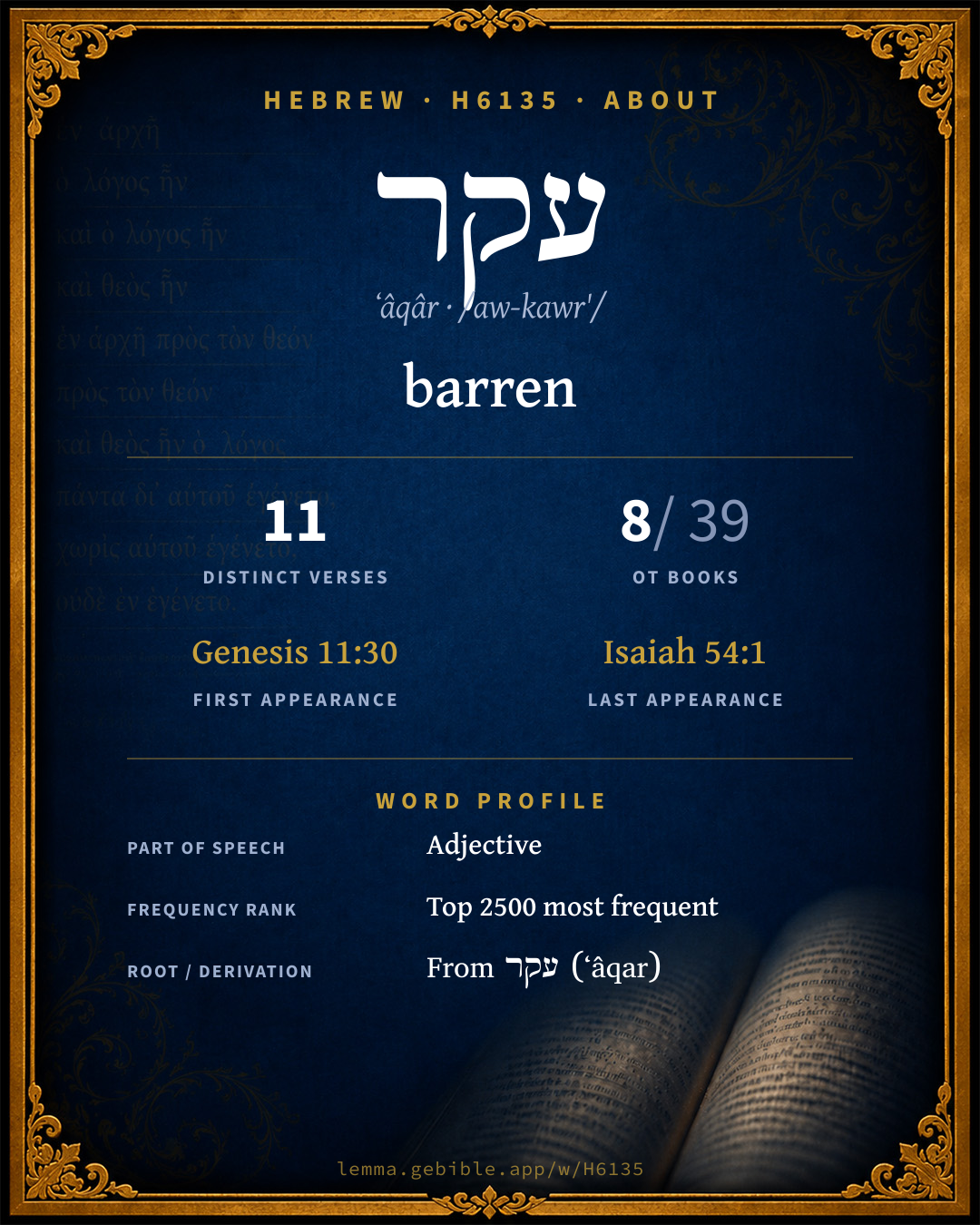
עָקָר
barren
Full lexicon entry — Brown-Driver-Briggs (BDB)
From Brown-Driver-Briggs (BDB)
Where this word appears
Grammar key — what these labels mean
Part of speech
- Adjective
- A word that describes or qualifies a noun.
State
- Absolute
- The independent form of a noun, not bound to a following word.
- Construct
- A noun bound to a following noun in a possessive / “of” relationship (the construct chain).
Gender
- Feminine
- Grammatically feminine.
- Masculine
- Grammatically masculine.
Number
- Singular
- One.
Every verse where H6135 appears in the Book of 1 Samuel — 1 distinct verse. Click any verse to open its interlinear word-by-word view. Verse text shown in the World English Bible for context — . Each verse’s Hebrew form is shown with its reference; the English is not keyword-highlighted, since the data carries no word-level English alignment. Use “Compare translations” on any verse to read it across multiple English versions. This concordance covers the Hebrew Bible; Septuagint (Greek Old Testament) occurrences are not indexed here.
1 Samuel
About this entry
At a glance — auto-summarized from this page’s data, not written by a person. Every figure links to its source below. This summary describes the numbers; it doesn’t interpret them.
עקר — transliterated ʻâqâr — is a Hebrew adjective carrying the sense “barren.” Debuting at Genesis 11:30, it then recurs through the corpus. The Hebrew Bible uses it across 11 verses — uncommon. More than a quarter of its appearances fall in Genesis. It shares a root with עקר, עקר and עקר. See the sense tree, 11-verse concordance, and the renderings breakdown below.
Gloss history
Strong's 1890 vs modern scholarship
About this word
Strong's H6135 catalogs a Hebrew word from the Hebrew Old Testament.
These counts are not copied from any lexicon or concordance. They are computed here, from the morphology-tagged Hebrew Old Testament. What Lemma adds →
- 11
- distinct verses
- The word appears in 11 distinct verses.
- 8 / 39
- OT books
- The word appears in 8 of 39 Old Testament books.
- #2,101
- by frequency
- Top 2500 most frequent Hebrew words (rank 2,101 of 8,640 Hebrew words by occurrence).
View all 11 occurrences in the concordance →
By section of the Old Testament
By traditional corpus
Conventional, traditional groupings — biblical authorship is debated, so this is a traditional corpus grouping, not an authorship claim. Each share is this word’s portion of its verses in that division of the Hebrew canon. Each figure is a share of the word’s 11 distinct verses.
- Torah (Pentateuch) 5 verses · 45%
- Prophets (Nevi'im) 4 verses · 36%
- Writings (Ketuvim) 2 verses · 18%
How translations render this word
Counts come from each version’s own published word-to-Strong’s tagging or interlinear alignment — an approximate guide to how each version renders this word, not a word-level alignment the data otherwise carries. Because each total is that version’s own tagged count, the per-version totals vary from one another and need not match the appearance or distinct-verse counts above. These counts may also differ from a printed concordance because Lemma counts each distinctly tagged rendering and does not collapse phrase taggings into a single head-word total. This is a fixed set of word-tagged versions (KJV, ASV, BSB, ULT) and does not change with the reading translation you choose elsewhere. Each version’s license is shown beside its name below (and on Sources).
- King James Version: Barren 3×, Was barren 3×
- American Standard Version: Was barren 3×, Barren 2×
- Berean Standard Bible: Barren 5×, Barren woman 3×
- unfoldingWord Literal Text: Barren 4×, Was barren 3×
King James Version Public Domain
Renders H6135 across 12 tagged occurrences — most commonly:
Plus 6 renderings that appear only once — usually multi-word phrases or single function words the recovered tagging swept in, not distinct renderings.
American Standard Version Public Domain
Renders H6135 across 12 tagged occurrences — most commonly:
Plus 7 renderings that appear only once — usually multi-word phrases or single function words the recovered tagging swept in, not distinct renderings.
Berean Standard Bible Public Domain
Renders H6135 across 12 tagged occurrences — most commonly:
Plus 4 renderings that appear only once — usually multi-word phrases or single function words the recovered tagging swept in, not distinct renderings.
unfoldingWord Literal Text CC BY-SA 4.0
Renders H6135 across 13 tagged occurrences — most commonly:
Plus 6 renderings that appear only once — usually multi-word phrases or single function words the recovered tagging swept in, not distinct renderings.
Senses in BDB
The 1 sense BDB distinguishes for this word, in lexicon order (not ranked by frequency or importance). The full entry — with sub-senses — is in the Lexicon Entry tab.
- barren, sterile
Word origin
adj. barren;—ע׳ of male Dt 7:14, עֲקָרָה of female v 14 (mankind and beasts), Ex 23:26 (E; female); elsewhere of women Gn 11:30; 25:21; 29:31 (all J), Ju 13:2, 3; 1 S 2:5; Jb 24:21 ψ 113:9 (עֲקֶרֶת cstr.); of personif. Zion Is 54:1.
— Brown-Driver-Briggs (Oxford 1906, public domain), digitized via Sefaria, supplemented by the OpenScriptures HebrewLexicon (CC BY 4.0). See Sources.
Derived from עקר (ʻâqar) (H6131) — to pluck up.
Jastrow Dictionary
A second Hebrew/Aramaic lexicon for comparison, covering Aramaic and post-biblical (Talmudic, Targumic, Midrashic) usage that the biblical-Hebrew BDB does not. Matched by lemma rather than by Strong’s number, so a lemma may carry more than one Jastrow headword (shown separately below), and the entries cover usage well beyond the Bible.
עָקַר
- [to be curved, bent; denom. עִיקָּר root,]
- 1. to uproot, tear loose, detach, remove; to eradicate, undo, abolish, abrogate. Hor. 14ᵃ עוֹקֵר הרים; Snh. 24ᵃ עוקר הרי הרים, v. הַר. Ab. III, 17 הרוח באה ועוֹקַרְתּוֹ וכ׳ a wind comes and uproots it and turns it &c. Pesik. Ekha, p. 123ᵃ כל מקום שנאמר ארון עוקר דיורין ומכניס וכ׳ wherever Adon (Master) is mentioned in the Bible, it means (the landlord) that displaces tenants and imports tenants; ib. עוקר כנענים וכ׳ who drives out the Canaanites and brings in the Israelites. Y. Yeb. I, 2ᵈ; ib. XIII, beg. 13ᵇ ממאנת … לַעֲקוֹר זיקת המת she may (on arriving at majority) refuse the Yabam, which has the effect of annulling her relation to her deceased husband. Ib. כל עמה מודיי שהיא עוֹקֶרֶת all agree that by doing so she annuls her marriage to her deceased husband. Pes. 101ᵇ עָקְרוּ רגליהן לצאת when they detached their feet, in order to go. Sabb. 5ᵃ ע׳ ממקומו וכ׳ (sub. רגליו) he moved from his place and received it. Y. Bets. V, 63ᵃ bot., v. קִיפּוּץ. Meg. 5ᵇ בקש לעקור תשעה וכ׳ wanted to abolish the fast of the Ninth of Ab. Pes. 115ᵇ אין עוֹקְרִין את השלחן we do not remove the table (v. comment.); a. v. fr.—Part. pass. עָקוּר; f. עֲקוּרָה; pl. עֲקוּרִים, עְקוּרִין; עֲקוּרוֹת a) uprooted, torn out. Peah VI, 9 תבואה ע׳ loose (cut) grain, שאינה ע׳ still in the ground.—b) = עָקָר [rootless,] barren, impotent. Yeb. 64ᵃ יצחק אבינו ע׳ היה Isaac was impotent; שניהם ע׳ היו both of them (Isaac and Rebecca) were impotent. Ib. מפני מה היו אבותינו ע׳ wherefore were our ancestors childless (until they prayed)?; a. fr.—Bekh. 44ᵇ (ref. to Deut. VII, 14 ועקרה) שלא תהא תפלתך ע׳ וכ׳ that thy prayer shall not be fruitless before the Lord; Yalk. Deut. 884 שלא … ע׳ מלפני המקום that thy prayer shall not be removed from before the Lord; שלא יהא ביתך עקור מן התלמידים (not עקורה) that thy house shall not be deprived of scholars. e.g. Deuteronomy 7:14
- 2. to mutilate, hamstring; to make barren, v. infra.
- to be uprooted; to be removed, eradicated, destroyed. Y. Kil. III, 28ᶜ bot. נֶעֶקְרוּ הראשונים if the first seeds have been taken out. Ber. IX, 1 הרואה … מקום שנֶעֶקְרָה וכ׳ he who sees … a place from which an idol has been removed (by destruction). Ib. 12ᵇ לא שתֵּעָקֵר … ממקומה וכ׳ not that the memory of the going out from Egypt will be removed from its place (entirely extinct) &c., v. עִיקָּר. Ib.ᵇ לא שיֵעָקֵר יעקב וכ׳ not that the name of Jacob will entirely fall into disuse; a. fr.
- to make barren (עָקָר). Cant. R. to II, 14 מפני מה הֶעֱקַרְתִּי אתכן why did I decree that you be childless? Because I desired to hear your prayer; Gen. R. s. 45 עִקּרְתִּי Pi. (or עָקַרְתִּי Kal).
- 1. to uproot; to tear loose &c. Gen. R. s. 42 מְעַקַּר בגפנים tried to uproot the vines (destroy the entire nation); Lev. R. s. 11. Ib. המן … לעַקֵּר וכ׳ Haman … undertook to destroy the vines; Gen. R. l. c. ביקש לַעֲקוֹר הגפן כלה. Ḥull. V, 3 המעקר he who tears loose the organs to be cut at slaughtering (v. סִימָן); a. fr.
- 2. to unfit, mutilate, hamstring; to make barren. Treat. S’maḥ. ch. VIII שורפין ומְעַקְּרִין לפני מלכים you may burn (clothes &c.) and hamstring horses at a king’s death; Ab. Zar. 11ᵃ עוֹקְרִין; Tosef. Sabb. VII (VIII), 19 עוקרין; v. עִיקּוּר. Gen. R. s. 45, v. supra; a. e.
- to be made barren. Ib. למה נִתְעַקְּרוּ האמהות וכ׳ why were the Mothers allowed to be childless? Because the Lord desired to hear their prayers; Cant. R. l. c.; a. e.
עֲקַר I
- , to uproot &c. Targ. II Kings III, 25. Targ. Jer. I, 10. Targ. Lam. III, 5; a. fr.
- to uproot, destroy; to mutilate, hamstring. Targ. II Sam. XVII, 13; a. e.—Ib. VIII, 4 (ed. Wil. עֲקַר Pe.). Targ. Josh. XI, 6; a. e.—Pes. 115ᵇ קא מְעַקְּרֵי תכא וכ׳ they want to remove the tray before us. Ib. 113ᵃ לא תְעַקֵּר ככא, v. כַּכָּא; a. e.
- 1. to be uprooted, detached, removed. Targ. Prov. II, 22. Ib. XXIV, 31. Targ. Ps. LXXVI, 7; a. fr.—Sabb. 63ᵇ, v. וְלַד. Pes. 101ᵃ ואִיתְעַקְּרָא ליה שרגא his lamp was upset. Y. Ab. Zar. II, 40ᶜ bot. ואִיתְעַקְּרוּן and they were ruined (their trade became extinct), opp. קמון they remained in the trade. Sabb. 147ᵇ איע׳ תלמודיה his learning was uprooted; i.e. he forgot what he had learned; a. e.
- 2. to become impotent. Yeb. 64ᵇ איע׳ מפרקיה דרב וכ׳ became impotent through sitting at the lectures of R. H. (by suppressing his needs). Keth. 62ᵇ אִיעַקְּרָא דביתהו his wife had lost the faculty of conceiving; a. e.
עִקָּר
- , v. עִיקָּר
עָקָר
- preced. wds.) [rootless,] sterile, impotent, barren. Bekh. 44ᵇ נמצא ע׳ he becomes impotent. Ib. (ref. to Deut. VII, 14) [read:] לא יהיה בך ע׳ שלא יהיה ביתך ע׳ מן התלמידים ‘there shall be no barren one among thee’, means that thy house shall never be barren of scholars (v. Yalk. Deut. 848); Deut. R. s. 3 עקר ועקרה מן התשובה impotent to give a proper answer (to heretics). Ib. לא תהא תפלתך ע׳, v. עָקַר. Gen. R. s. 53 לא היית אומר אברם פרדה ע׳ וכ׳ didst thou not say, Abram is a barren mule &c.?; B. Bath. 91ᵃ (in Chald. dict.) כודנא עקרה, v. כּוּדְנָא; a. fr.—Num. R. s. 14 (play on עקרת, Num. VII, 55) א"ת קערת אלא עֲקֶרֶת כנגד יעקב וכ׳ read not ḳaʿãrath (dish), but ʿãḳereth (uprooted), corresponding to Jacob who wrested the birthright from Reuben and gave it to Joseph.—Pl. עֲקָרִים; f. עֲקָרוֹת. Gen. R. s. 39 אברהם … על הע׳ וכ׳ Abraham prayed for the childless women, and they were visited. Gen. R. s. 53 הרבה ע׳ נפקדו עמה many childless ones were visited at the same time with her (Sarah); a. fr. e.g. Deuteronomy 7:14
עֲקַר II
- same. Targ. O. Deut. VII, 14. Targ. Ps. CXIII, 9; a. fr.—Sabb. 152ᵃ עקר Ag. Hatt. (ed. עיקרא), v. אִיקָא. Gen. R. s. 47, beg. וצווחין דא ע׳; ib. s. 53, v. יְנֵי I. Yeb. 65ᵇ סמא דע׳ a drug which causes barrenness; a. fr.—Pl. עַקְרִין; f. עַקְרָן. Targ. Y. Deut. l. c. (ed. Vien. נשין עקרין, corr. acc.).
A Dictionary of the Targumim, the Talmud Babli and Yerushalmi, and the Midrashic Literature (Marcus Jastrow; London, Luzac, 1903) — Public Domain. Digitized via Sefaria. Digitized via Sefaria. Full attribution on Sources.
Forms in the corpus
The 9 distinct written forms H6135 takes in the Hebrew Bible, most frequent first — each parse links to that state’s occurrences in the concordance. Hebrew forms include their vowel points and cantillation, so a single lemma takes many written forms.
| Form | Parsing | Example | Uses |
|---|---|---|---|
| עֲקָרָ֖ה | Adjective, Adjective, Feminine, Singular, Absolute | Genesis 25:21 | 3 |
| עֲקָרָה֙ | Adjective, Adjective, Feminine, Singular, Absolute | 1 Samuel 2:5 | 2 |
| וַ/עֲקָרָ֖ה | Adjective, Adjective, Feminine, Singular, Absolute | Exodus 23:26 | 1 |
| וַֽ/עֲקָרָ֖ה | Adjective, Adjective, Feminine, Singular, Absolute | Deuteronomy 7:14 | 1 |
| עֲ֭קָרָה | Adjective, Adjective, Feminine, Singular, Absolute | Job 24:21 | 1 |
| עֲקֶ֬רֶת | Adjective, Adjective, Feminine, Singular, Construct | Psalms 113:9 | 1 |
| עֲקָרָ֑ה | Adjective, Adjective, Feminine, Singular, Absolute | Genesis 11:30 | 1 |
| עֲקָרָֽה | Adjective, Adjective, Feminine, Singular, Absolute | Genesis 29:31 | 1 |
| עָקָ֥ר | Adjective, Adjective, Masculine, Singular, Absolute | Deuteronomy 7:14 | 1 |
Same root — word family
Other BDB entries built from the same root as H6135, grouped by Strong’s listed origin. These share a root / origin per the lexicon — not necessarily a shared meaning. Each links to that word’s own entry.
Derives from
Shares the same root
Proper names from this root
People and places named from this root — a name, not an additional meaning of the word.
Compare all same-root words → Showing 4 of 5 — not the complete family. 1 of the same-root words is a proper name (a person or place). They share a root, not necessarily a meaning.
Septuagint verse parallels
This word appears in 11 verses that also exist in the Greek Old Testament (Septuagint), out of the 11 Hebrew verses it occurs in. You can read those verses in Greek by switching the Old Testament edition to the Septuagint.
Read these verses in the Septuagint
- Genesis 11:30
- Exodus 23:26
- Deuteronomy 7:14
- Judges 13:2
- 1 Samuel 2:5
- Job 24:21
- Psalms 113:9
- Isaiah 54:1
This is a verse-level parallel only — the same verses exist in both the Hebrew and Greek Old Testaments. No word-level Hebrew↔Greek correspondence is claimed: the data carries no such alignment, so no Greek word is shown as this Hebrew word’s translation. Coverage is not total — the Septuagint omits the deuterocanon and renumbers the Psalms, so some Hebrew verses have no direct Greek parallel.