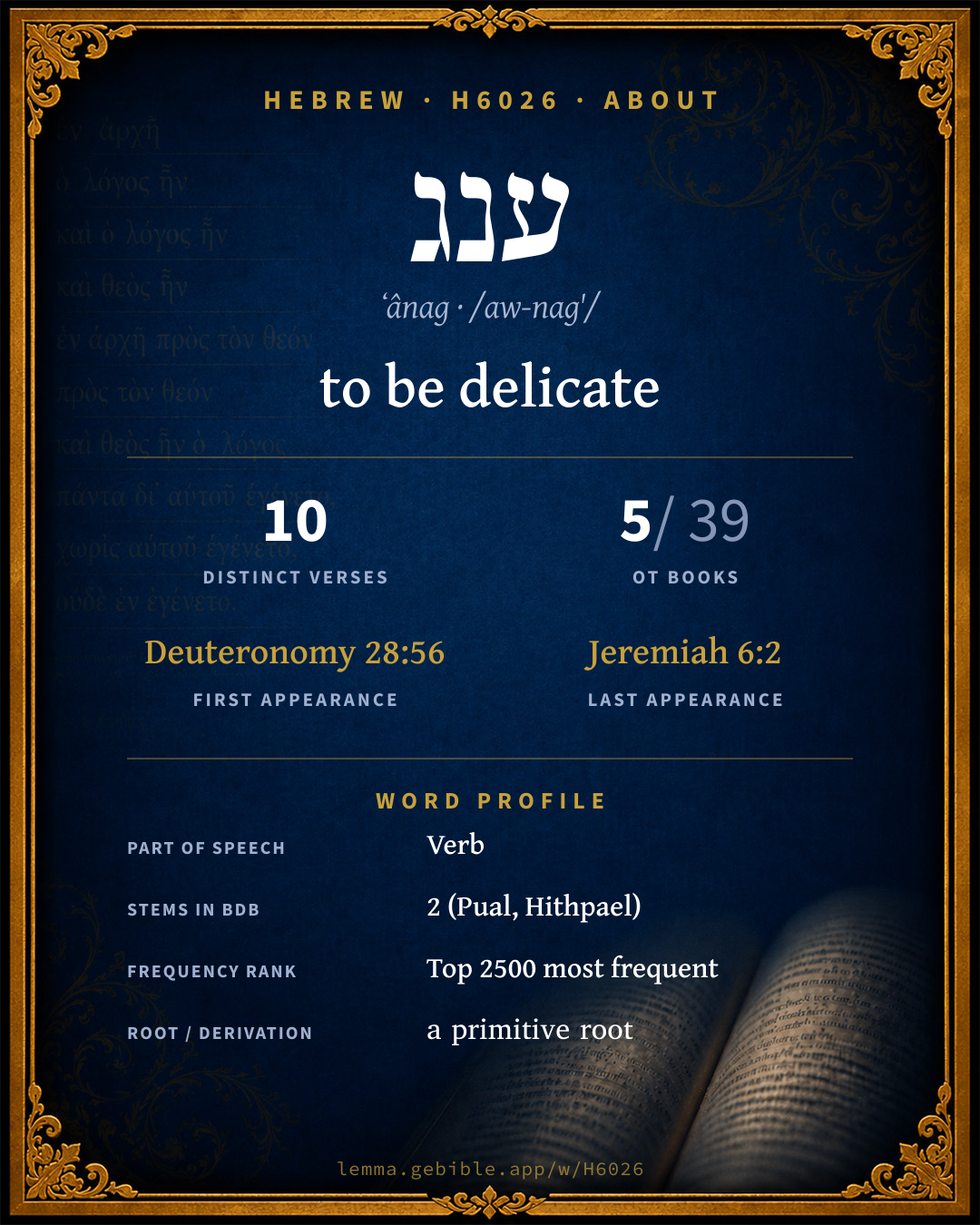
עָנֹג
to be delicate
‘to be delicate’ is one of 2 main senses fuller range ↓
Full lexicon entry — Brown-Driver-Briggs (BDB)
From Brown-Driver-Briggs (BDB)
Where this word appears
Grammar key — what these labels mean
Part of speech
- Verb
- An action or state-of-being word.
Stem
- Hithpael
- The reflexive or reciprocal stem (the subject acts on itself). Here: ‘be of dainty habit’
- Pual
- The passive counterpart of the Piel.
Form
- Imperfect
- An incomplete, ongoing, or future action (“he will / would write”).
- Participle Passive
- A verbal adjective expressing action received (“written”).
- Sequential Perfect
- A perfect with prefixed waw continuing a preceding imperfect or command (waw-consecutive perfect).
- Imperative
- A direct command (“write!”).
- Infinitive Construct
- A bound verbal noun, frequently with prepositions (“to write / in writing”).
State
- Absolute
- The independent form of a noun, not bound to a following word.
Person
- 2nd Person
- The one addressed (“you”).
- 3rd Person
- The one spoken about (“he / she / it / they”).
Gender
- Masculine
- Grammatically masculine.
- Feminine
- Grammatically feminine.
- Common
- Either gender — not distinguished for this form.
Number
- Singular
- One.
- Plural
- More than one (in Hebrew, generally three or more).
Every verse where H6026 appears in the Book of Deuteronomy — 1 distinct verse. Click any verse to open its interlinear word-by-word view. Verse text shown in the World English Bible for context — . Each verse’s Hebrew form is shown with its reference; the English is not keyword-highlighted, since the data carries no word-level English alignment. Use “Compare translations” on any verse to read it across multiple English versions. This concordance covers the Hebrew Bible; Septuagint (Greek Old Testament) occurrences are not indexed here.
Deuteronomy
About this entry
At a glance — auto-summarized from this page’s data, not written by a person. Every figure links to its source below. This summary describes the numbers; it doesn’t interpret them.
“to be delicate” is the headline sense of the Hebrew verb ענג (ʻânag). Scripture first uses it in Deuteronomy 28:56. With 10 verses in 5 books, it is an uncommon word in the Hebrew Bible. It concentrates in Isaiah, which alone accounts for 40% of its uses. As a verb its force shifts by stem, across 2 stems (Pual, Hithpael, and more). The sections below give every sense, occurrence, and version rendering.
Gloss history
Strong's 1890 vs modern scholarship
About this word
Strong's H6026 catalogs a Hebrew word from the Hebrew Old Testament.
These counts are not copied from any lexicon or concordance. They are computed here, from the morphology-tagged Hebrew Old Testament. What Lemma adds →
- 10
- distinct verses
- The word appears in 10 distinct verses.
- 5 / 39
- OT books
- The word appears in 5 of 39 Old Testament books.
- #2,342
- by frequency
- Top 2500 most frequent Hebrew words (rank 2,342 of 8,640 Hebrew words by occurrence).
View all 10 occurrences in the concordance →
By section of the Old Testament
By traditional corpus
Conventional, traditional groupings — biblical authorship is debated, so this is a traditional corpus grouping, not an authorship claim. Each share is this word’s portion of its verses in that division of the Hebrew canon. Each figure is a share of the word’s 10 distinct verses.
- Prophets (Nevi'im) 5 verses · 50%
- Writings (Ketuvim) 4 verses · 40%
- Torah (Pentateuch) 1 verse · 10%
How translations render this word
Counts come from each version’s own published word-to-Strong’s tagging or interlinear alignment — an approximate guide to how each version renders this word, not a word-level alignment the data otherwise carries. Because each total is that version’s own tagged count, the per-version totals vary from one another and need not match the appearance or distinct-verse counts above. These counts may also differ from a printed concordance because Lemma counts each distinctly tagged rendering and does not collapse phrase taggings into a single head-word total. This is a fixed set of word-tagged versions (KJV, ASV, BSB, ULT) and does not change with the reading translation you choose elsewhere. Each version’s license is shown beside its name below (and on Sources).
- King James Version: Delight 2×
- American Standard Version: Delight 2×, Shalt thou delight 2×
- Berean Standard Bible: You will delight 2×
- unfoldingWord Literal Text: You will delight yourself 2×
King James Version Public Domain
Renders H6026 across 10 tagged occurrences — most commonly:
Plus 8 renderings that appear only once — usually multi-word phrases or single function words the recovered tagging swept in, not distinct renderings.
American Standard Version Public Domain
Renders H6026 across 10 tagged occurrences — most commonly:
Plus 6 renderings that appear only once — usually multi-word phrases or single function words the recovered tagging swept in, not distinct renderings.
Berean Standard Bible Public Domain
Renders H6026 across 10 tagged occurrences — most commonly:
Plus 8 renderings that appear only once — usually multi-word phrases or single function words the recovered tagging swept in, not distinct renderings.
unfoldingWord Literal Text CC BY-SA 4.0
Renders H6026 across 11 tagged occurrences — most commonly:
Plus 9 renderings that appear only once — usually multi-word phrases or single function words the recovered tagging swept in, not distinct renderings.
Senses in the full BDB
Hebrew verbs can shift meaning by stem (binyan): Qal is the basic action, Niphal is often passive or reflexive, Piel often intensifies or makes it factitive, and Hiphil is typically causative. The senses below are grouped under the stem BDB assigns to each. This entry also uses Pual (the passive of Piel) and Hithpael (reflexive or reciprocal).
What do BDB’s symbols mean?
BDB uses these scholarly abbreviations:
| Symbol | Meaning |
|---|---|
| 𝔊 | the Septuagint (the ancient Greek translation, LXX) |
| 𝔙 | the Vulgate (the Latin translation) |
| 𝔖 | the Syriac version (the Peshitta) |
| 𝔗 | the Targum (the Aramaic translation) |
| ψ | the Psalms |
| √ | root (the underlying root or stem) |
| ‖ | parallel passage (a synonymous or contrasted parallel) |
| † | the dagger: every passage where the word occurs is cited |
The 4 senses and sub-senses the full Brown-Driver-Briggs lexicon distinguishes for this word, in lexicon order (not ranked by frequency), with BDB’s own verbatim wording and sub-sense lettering. Shown in Hebrew script with BDB’s own scholarly abbreviations. The condensed entry is in the Lexicon Entry tab. See also the Forms in the corpus table below.
Pual
- . daintily bred
Hithpael
- 1. be of dainty habit
- 2. take exquisite delight
- 3. in bad sense, make merry over, make sport of
Senses from the full Brown-Driver-Briggs lexicon (Brown, Driver, Briggs; Oxford 1906 — public domain), digitized via Sefaria, supplemented by the OpenScriptures HebrewLexicon (CC BY 4.0). Full attribution on Sources.
Word origin
[ עָנֹג ] vb. be soft, delicate, dainty
— Brown-Driver-Briggs (Oxford 1906, public domain), digitized via Sefaria, supplemented by the OpenScriptures HebrewLexicon (CC BY 4.0). See Sources.
Origin: a primitive root
Jastrow Dictionary
A second Hebrew/Aramaic lexicon for comparison, covering Aramaic and post-biblical (Talmudic, Targumic, Midrashic) usage that the biblical-Hebrew BDB does not. Matched by lemma rather than by Strong’s number, so a lemma may carry more than one Jastrow headword (shown separately below), and the entries cover usage well beyond the Bible.
עָנַג
- (b. h.) to be pliable, soft, tender.—[B. Kam. 80ᵃ הענוגה Ar. s. v. ענג 2, mistaken reading for העגונה, v. עָגַן.]—Denom. עוֹנֶג.
- 1. to soften. Tosef. Maas. Sh. II, 1; Tosef. Ter. X, 4 מְענֶּגֶת שערה וכ׳ (Var. מעגנת, מעגלת, v. עָגַן, עָגַל) she may soften her hair by pressing it against her (the priest’s daughter’s) hair.
- 2. (denom. of עוֹנֶג, with ref. to Is. LVIII, 13, ‘and callest the Sabbath a delight’) to celebrate pleasurably, to enjoy. Sabb. 118ᵇ כל המְעַנֵּג את השבת וכ׳ to him who observes the Sabbath with enjoyments, his heart’s desires are granted. Ib. במה מְעַנְּגוֹ wherewith does one make it enjoyable? Tanḥ. B’resh. 2 עַנְּגֵהוּ enjoy it (the Sabbath). Pesik. R. s. 23, end ובשבת הם באים ומְעַנְּגִים (prob. to be read: ומִתְעַנְּגִים) and on the Sabbath they come and enjoy themselves. e.g. Isaiah 58:13
- to enjoy one’s self; to indulge in luxuries. Ib. כל שהוא מִתְעַנֵּג בשבת שואל וכ׳ whoever enjoys the Sabbath may ask, and the Lord will grant (v. supra). Midr. Till. to Ps. CXLIX בא … הצדיקים מִתְעַנְּגִים come and see how the righteous enjoy luxuries (in the hereafter). Ib. והם מתענגים ואומרים וכ׳ and they act like persons used to comforts, saying, it is impossible to sleep in this bed &c.; a. e.—[Deut. R. s. 7, end היו מתענגים וכ׳ they enjoyed themselves by rolling in the flavored grass; prob. to be read: מִתְעַגְּגִים fr. עגג, v. גִּעְגֵּעַ.]
עֲנַג
- ; Pa. עַנֵּיג
- 1. to soften the skin by ointment, bathing &c.; to feel comfortable. Taan. 25ᵃ יהיבנא לך … דמְעַנְּגַת בהון I shall give thee, in the world to come, thirteen rivers of balsam oil clear as Euphrates and Tigris in which thou shalt find pleasure.
- 2. to celebrate merrily. Tanḥ. B’resh. 2 לעַנּוּגֵיה במאכל וכ׳ to celebrate it (the Sabbath) joyfully with eating &c.
עֹנֶג
- , v. עוֹנֶג
A Dictionary of the Targumim, the Talmud Babli and Yerushalmi, and the Midrashic Literature (Marcus Jastrow; London, Luzac, 1903) — Public Domain. Digitized via Sefaria. Digitized via Sefaria. Full attribution on Sources.
Forms in the corpus
The 10 distinct written forms H6026 takes in the Hebrew Bible, most frequent first — each parse links to that stem’s occurrences in the concordance. Hebrew forms include their vowel points and cantillation, so a single lemma takes many written forms.
| Form | Parsing | Example | Uses |
|---|---|---|---|
| וְ/הִתְעַנַּ֥ג | Verb, Hithpael, Imperative, 2nd Person, Masculine, Singular | Psalms 37:4 | 1 |
| וְ/הִתְעַנַּגְתֶּ֖ם | Verb, Hithpael, Sequential Perfect, 2nd Person, Masculine, Plural | Isaiah 66:11 | 1 |
| וְ/הַ/מְּעֻנָּגָ֔ה | Verb, Pual, Participle Passive, Feminine, Singular, Absolute | Jeremiah 6:2 | 1 |
| וְ/תִתְעַנַּ֥ג | Verb, Hithpael, Imperfect, 3rd Person, Feminine, Singular | Isaiah 55:2 | 1 |
| וְ֝/הִתְעַנְּג֗וּ | Verb, Hithpael, Sequential Perfect, 3rd Person, Common, Plural | Psalms 37:11 | 1 |
| יִתְעַנָּ֑ג | Verb, Hithpael, Imperfect, 3rd Person, Masculine, Singular | Job 27:10 | 1 |
| מֵ/הִתְעַנֵּ֖ג | Verb, Hithpael, Infinitive Construct | Deuteronomy 28:56 | 1 |
| תִּתְעַנַּג֙ | Verb, Hithpael, Imperfect, 2nd Person, Masculine, Singular | Isaiah 58:14 | 1 |
| תִּתְעַנָּ֑ג | Verb, Hithpael, Imperfect, 2nd Person, Masculine, Singular | Job 22:26 | 1 |
| תִּתְעַנָּ֔גוּ | Verb, Hithpael, Imperfect, 2nd Person, Masculine, Plural | Isaiah 57:4 | 1 |
Same root — word family
Other BDB entries built from the same root as H6026, grouped by Strong’s listed origin. These share a root / origin per the lexicon — not necessarily a shared meaning. Each links to that word’s own entry.
Derived from this word
Compare all same-root words → They share a root, not necessarily a meaning.
Septuagint verse parallels
This word appears in 10 verses that also exist in the Greek Old Testament (Septuagint), out of the 10 Hebrew verses it occurs in. You can read those verses in Greek by switching the Old Testament edition to the Septuagint.
Read these verses in the Septuagint
This is a verse-level parallel only — the same verses exist in both the Hebrew and Greek Old Testaments. No word-level Hebrew↔Greek correspondence is claimed: the data carries no such alignment, so no Greek word is shown as this Hebrew word’s translation. Coverage is not total — the Septuagint omits the deuterocanon and renumbers the Psalms, so some Hebrew verses have no direct Greek parallel.