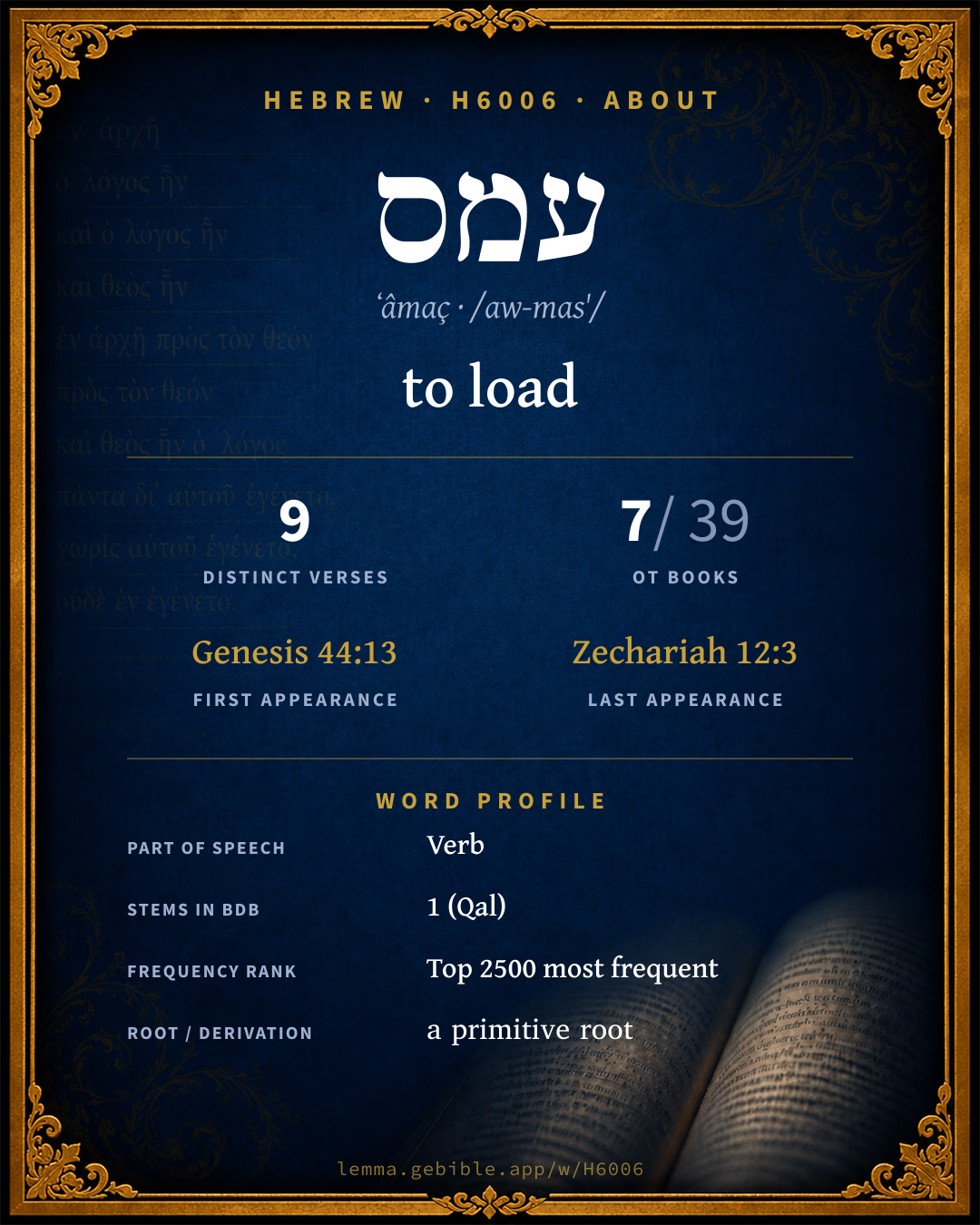
עָמַס
to load
also: carry, carry a load fuller range ↓
Full lexicon entry — Brown-Driver-Briggs (BDB)
From Brown-Driver-Briggs (BDB)
Where this word appears
Grammar key — what these labels mean
Part of speech
- Verb
- An action or state-of-being word.
Stem
- Hiphil
- The causative active stem (“he caused / brought about”).
- Qal
- The basic, simple active stem — the plain form of the verb (“he wrote”). Here: ‘load’
Form
- Perfect
- A completed action or state — Hebrew marks aspect (completeness) more than strict tense (“he wrote”).
- Participle Active
- A verbal adjective expressing ongoing or characteristic action (“writing / one who writes”).
- Sequential Imperfect
- An imperfect with prefixed waw — the standard past-narrative form (waw-consecutive imperfect).
- Participle Passive
- A verbal adjective expressing action received (“written”).
- Imperfect
- An incomplete, ongoing, or future action (“he will / would write”).
State
- Absolute
- The independent form of a noun, not bound to a following word.
- Construct
- A noun bound to a following noun in a possessive / “of” relationship (the construct chain).
Person
- 3rd Person
- The one spoken about (“he / she / it / they”).
Gender
- Masculine
- Grammatically masculine.
- Feminine
- Grammatically feminine.
Number
- Singular
- One.
- Plural
- More than one (in Hebrew, generally three or more).
Every verse where H6006 appears in the Book of Nehemiah — 2 distinct verses. Click any verse to open its interlinear word-by-word view. Verse text shown in the World English Bible for context — . Each verse’s Hebrew form is shown with its reference; the English is not keyword-highlighted, since the data carries no word-level English alignment. Use “Compare translations” on any verse to read it across multiple English versions. This concordance covers the Hebrew Bible; Septuagint (Greek Old Testament) occurrences are not indexed here.
Nehemiah
- Nehemiah 4:17 עֹמְשִׂ֑ים Qal ptcp.act mp They all built the wall and those who bore burdens loaded themselves; everyone with one of his hands worked in the work, and with the other held his weapon;
- Nehemiah 13:15 וְֽ/עֹמְסִ֪ים conj + Qal ptcp.act mp In those days saw I in Judah some men treading wine-presses on the Sabbath, and bringing in sheaves, and lading donkeys [therewith]; as also wine, grapes, and figs, and all manner of burdens, which they brought into Jerusalem on the Sabbath day: and I testified [against them] in the day in which they sold food.
About this entry
At a glance — auto-summarized from this page’s data, not written by a person. Every figure links to its source below. This summary describes the numbers; it doesn’t interpret them.
עמס — transliterated ʻâmaç — is a Hebrew verb carrying the sense “to load.” Its earliest occurrence is Genesis 44:13. Spanning 9 verses in 7 books, it ranks among the uncommon words of the Hebrew Bible. Alongside “to load” the lexicon also lists “carry” and “carry a load” — part of its full sense range. Sharing its root, it stands alongside מעמסה, עמוס and עמסיה. Each statement above links to its evidence; the full detail follows below.
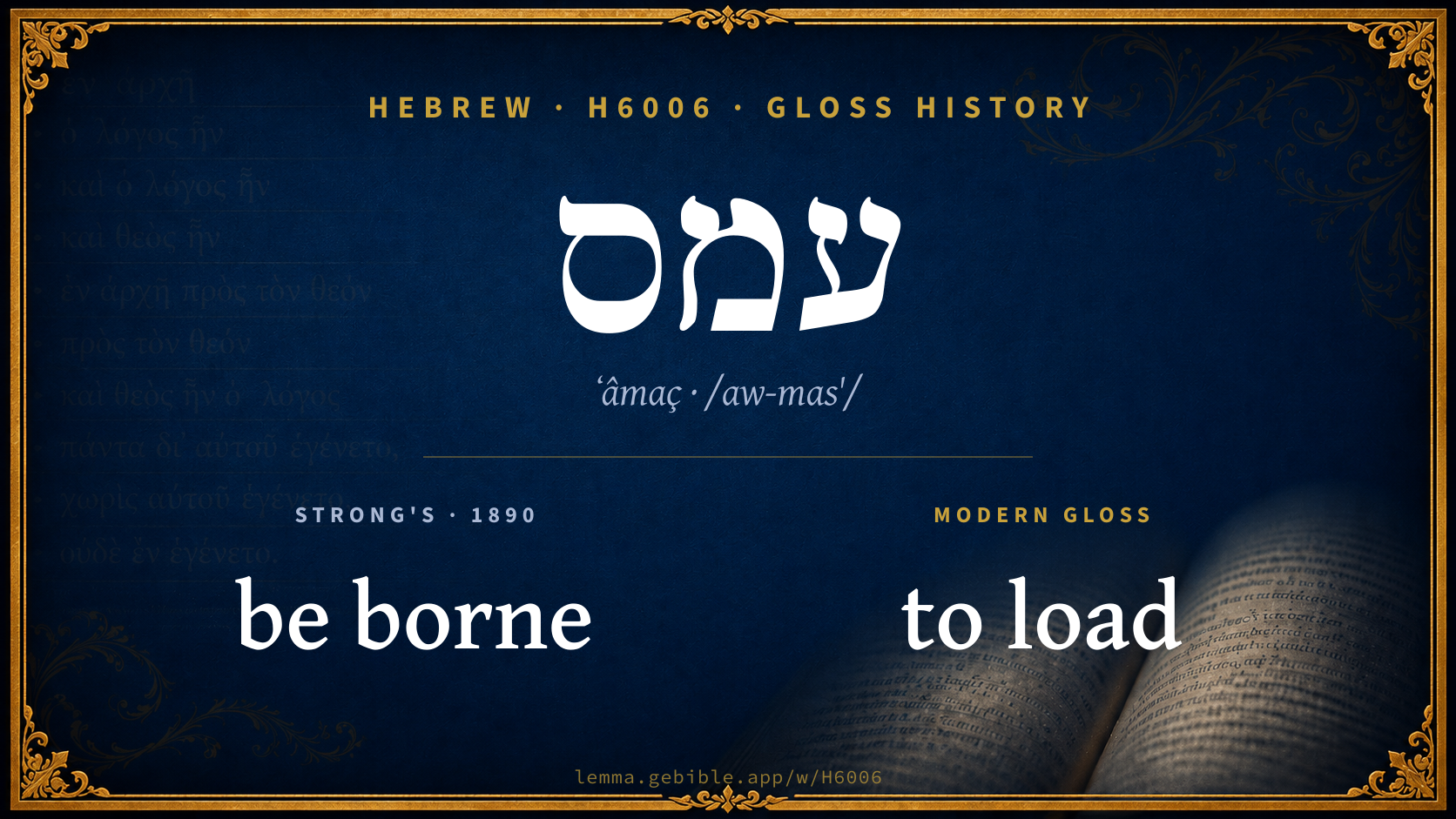
Gloss history
Strong's 1890 vs modern scholarship
About this word
Strong's H6006 catalogs a Hebrew word from the Hebrew Old Testament.
These counts are not copied from any lexicon or concordance. They are computed here, from the morphology-tagged Hebrew Old Testament. What Lemma adds →
- 9
- distinct verses
- The word appears in 9 distinct verses.
- 7 / 39
- OT books
- The word appears in 7 of 39 Old Testament books.
- #2,481
- by frequency
- Top 2500 most frequent Hebrew words (rank 2,481 of 8,640 Hebrew words by occurrence).
View all 9 occurrences in the concordance →
By section of the Old Testament
By traditional corpus
Conventional, traditional groupings — biblical authorship is debated, so this is a traditional corpus grouping, not an authorship claim. Each share is this word’s portion of its verses in that division of the Hebrew canon. Each figure is a share of the word’s 9 distinct verses.
- Prophets (Nevi'im) 4 verses · 44%
- Writings (Ketuvim) 4 verses · 44%
- Torah (Pentateuch) 1 verse · 11%
How translations render this word
Counts come from each version’s own published word-to-Strong’s tagging or interlinear alignment — an approximate guide to how each version renders this word, not a word-level alignment the data otherwise carries. Because each total is that version’s own tagged count, the per-version totals vary from one another and need not match the appearance or distinct-verse counts above. These counts may also differ from a printed concordance because Lemma counts each distinctly tagged rendering and does not collapse phrase taggings into a single head-word total. This is a fixed set of word-tagged versions (KJV, ASV, BSB, ULT) and does not change with the reading translation you choose elsewhere. Each version’s license is shown beside its name below (and on Sources).
- King James Version: Laded 2×
- American Standard Version: Did lade 2×, Laded 2×
- Berean Standard Bible: Burdened 2×
- unfoldingWord Literal Text: Loaded 3×
King James Version Public Domain
Renders H6006 across 9 tagged occurrences — most commonly:
Plus 7 renderings that appear only once — usually multi-word phrases or single function words the recovered tagging swept in, not distinct renderings.
American Standard Version Public Domain
Renders H6006 across 9 tagged occurrences — most commonly:
Plus 5 renderings that appear only once — usually multi-word phrases or single function words the recovered tagging swept in, not distinct renderings.
Berean Standard Bible Public Domain
Renders H6006 across 8 tagged occurrences — most commonly:
Plus 6 renderings that appear only once — usually multi-word phrases or single function words the recovered tagging swept in, not distinct renderings. Not rendered by a distinct English word in 1 further occurrence.
unfoldingWord Literal Text CC BY-SA 4.0
Renders H6006 across 10 tagged occurrences — most commonly:
Plus 7 renderings that appear only once — usually multi-word phrases or single function words the recovered tagging swept in, not distinct renderings.
Senses in the full BDB
What do BDB’s symbols mean?
BDB uses these scholarly abbreviations:
| Symbol | Meaning |
|---|---|
| 𝔊 | the Septuagint (the ancient Greek translation, LXX) |
| 𝔙 | the Vulgate (the Latin translation) |
| 𝔖 | the Syriac version (the Peshitta) |
| 𝔗 | the Targum (the Aramaic translation) |
| ψ | the Psalms |
| √ | root (the underlying root or stem) |
| ‖ | parallel passage (a synonymous or contrasted parallel) |
| † | the dagger: every passage where the word occurs is cited |
The 5 senses and sub-senses the full Brown-Driver-Briggs lexicon distinguishes for this word, in lexicon order (not ranked by frequency), with BDB’s own verbatim wording and sub-sense lettering. Shown in Hebrew script with BDB’s own scholarly abbreviations. The condensed entry is in the Lexicon Entry tab. See also the Forms in the corpus table below.
- 1. load.
- 2. carry a load (NH id.; Ph. עמס carry; cf. poss. Arabic عَمِسَ gravis et obscurus fuit dies (Frey));—
Qal
- Impf. 3 ms. וַיַּעֲמֹס Gn 44:13, יַעֲמָס־ ψ 68:20; Pt. act. עֹמְסִים Ne 13:15; עֹמְשִׂים 4:11 (but v. infr.); sf. עֹמְסֶיהָ Zc 12:3; pass. עֲמֻסִים Is 46:3, עֲמוּסוֹת v 1;— e.g. Genesis 44:13
- 1. load (obj. om.) upon (עַל) ass Gn 44:13 (E), Ne 13:15; so abs. 4:11, lit., si vera l. (v. Be-Ry Ryle); but read prob. חֲמֻשִׁים RyKau. e.g. Genesis 44:13
- 2. carry a load ψ 68:20 (י׳, for (ל) his people), carry as a load Zc 12:3 (fig.), pass. Is 46:1 (lit.), v 3 (fig.).* e.g. Psalms 68:20
Senses from the full Brown-Driver-Briggs lexicon (Brown, Driver, Briggs; Oxford 1906 — public domain), digitized via Sefaria, supplemented by the OpenScriptures HebrewLexicon (CC BY 4.0). Full attribution on Sources.
Word origin
Origin: a primitive root
Jastrow Dictionary
A second Hebrew/Aramaic lexicon for comparison, covering Aramaic and post-biblical (Talmudic, Targumic, Midrashic) usage that the biblical-Hebrew BDB does not. Matched by lemma rather than by Strong’s number, so a lemma may carry more than one Jastrow headword (shown separately below), and the entries cover usage well beyond the Bible.
עָמַס
- (b. h.) [to press, be pressed,] to carry a load. Cant. R. to VIII, 6 עוֹמְסֵי גרנות those who carry the crops to the granaries.—Part. pass. עָמוּס a) laden, heavy; ע׳ בלשונו of heavy tongue. Lev. R. s. 10, beg. למה נקרא שמו עמוס שהיה ע׳ בלשונו he was named Amos, because he was a stammerer; Yalk. Is. 307; (Pesik. Nah., p. 125ᵇ שהיה פסילוס וכ׳).—b) (in a secret letter) officer. Snh. 12ᵃ עֲמוּסי וכ׳, v. נַחְשׁוֹן.
- to load.—Part. pass. מְעוּמָּס. Tanḥ. P’ḳudé 3 והוא מע׳ מן בנים וכ׳ and he is laden (with troubles) on account of sons and daughters (depending upon him).
*עֲמַס
- to press (the teeth together). Targ. Job XVI, 9 ed. Lag. a. oth. (Ms. Var. עאס; ed. Wil. עסי); v. עֲסֵי.
A Dictionary of the Targumim, the Talmud Babli and Yerushalmi, and the Midrashic Literature (Marcus Jastrow; London, Luzac, 1903) — Public Domain. Digitized via Sefaria. Digitized via Sefaria. Full attribution on Sources.
Forms in the corpus
The 8 distinct written forms H6006 takes in the Hebrew Bible, most frequent first — each parse links to that stem’s occurrences in the concordance. Hebrew forms include their vowel points and cantillation, so a single lemma takes many written forms.
| Form | Parsing | Example | Uses |
|---|---|---|---|
| הֶעְמִ֤יס | Verb, Hiphil, Perfect, 3rd Person, Masculine, Singular | 1 Kings 12:11 | 2 |
| הַֽ/עֲמֻסִים֙ | Verb, Qal, Participle Passive, Masculine, Plural, Absolute | Isaiah 46:3 | 1 |
| וְֽ/עֹמְסִ֪ים | Verb, Qal, Participle Active, Masculine, Plural, Absolute | Nehemiah 13:15 | 1 |
| וַֽ/יַּעֲמֹס֙ | Verb, Qal, Sequential Imperfect, 3rd Person, Masculine, Singular | Genesis 44:13 | 1 |
| יַֽעֲמָס | Verb, Qal, Imperfect, 3rd Person, Masculine, Singular | Psalms 68:19 | 1 |
| עֲמוּס֔וֹת | Verb, Qal, Participle Passive, Feminine, Plural, Absolute | Isaiah 46:1 | 1 |
| עֹמְסֶ֖י/הָ | Verb, Qal, Participle Active, Masculine, Plural, Construct | Zechariah 12:3 | 1 |
| עֹמְשִׂ֑ים | Verb, Qal, Participle Active, Masculine, Plural, Absolute | Nehemiah 4:17 | 1 |
Same root — word family
Other BDB entries built from the same root as H6006, grouped by Strong’s listed origin. These share a root / origin per the lexicon — not necessarily a shared meaning. Each links to that word’s own entry.
Derived from this word
Proper names from this root
People and places named from this root — a name, not an additional meaning of the word.
- עמוס ʻÂmôwç H5986 Amos
- עמסיה ʻĂmaçyâh H6007 Amasiah
- עמשא ʻĂmâsâʼ H6021 Amasa
- עמשי ʻĂmâsay H6022 Amasai
- עמשסי ʻĂmashçay H6023 Amashai
Compare all same-root words → Showing 4 of 7 — not the complete family. 5 of the same-root words are proper names (people or places). They share a root, not necessarily a meaning.
Septuagint verse parallels
This word appears in 7 verses that also exist in the Greek Old Testament (Septuagint), out of the 9 Hebrew verses it occurs in. You can read those verses in Greek by switching the Old Testament edition to the Septuagint.
Read these verses in the Septuagint
This is a verse-level parallel only — the same verses exist in both the Hebrew and Greek Old Testaments. No word-level Hebrew↔Greek correspondence is claimed: the data carries no such alignment, so no Greek word is shown as this Hebrew word’s translation. Coverage is not total — the Septuagint omits the deuterocanon and renumbers the Psalms, so some Hebrew verses have no direct Greek parallel.