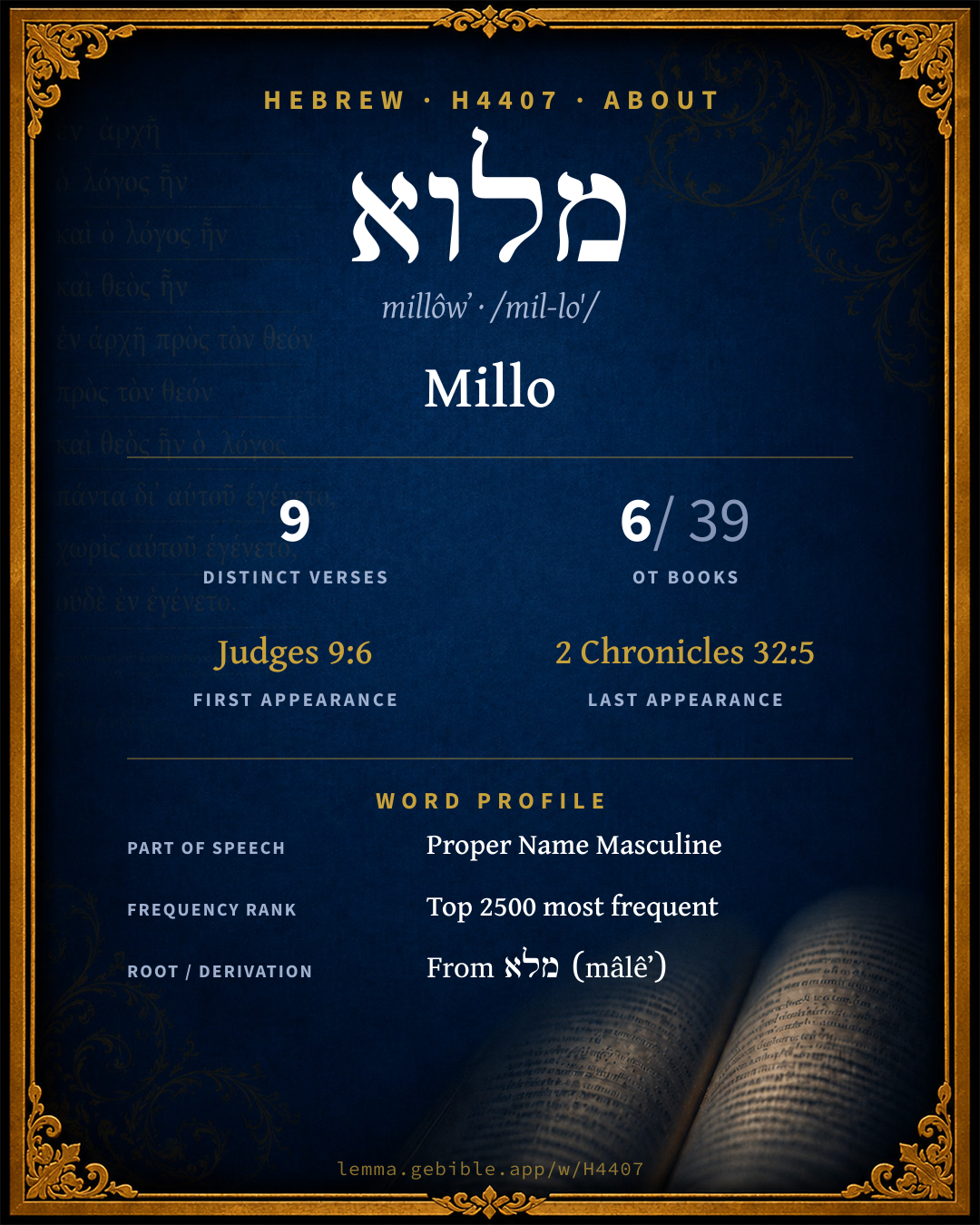
מִלּוֹא
Millo
BDB lists 3 entries for ‘Millo’ fuller range ↓
Full lexicon entry — Brown-Driver-Briggs (BDB)
From Brown-Driver-Briggs (BDB)
Where this word appears
Grammar key — what these labels mean
Part of speech
- Noun
- A naming word — a person, place, thing, or idea.
Noun type
- Proper
- A name of a specific person, place, or people (e.g. Abraham, Zion, Israel).
Every verse where H4407 appears in the Book of 2 Kings — 1 distinct verse. Click any verse to open its interlinear word-by-word view. Verse text shown in the World English Bible for context — . Each verse’s Hebrew form is shown with its reference; the English is not keyword-highlighted, since the data carries no word-level English alignment. Use “Compare translations” on any verse to read it across multiple English versions. This concordance covers the Hebrew Bible; Septuagint (Greek Old Testament) occurrences are not indexed here.
2 Kings
About this entry
At a glance — auto-summarized from this page’s data, not written by a person. Every figure links to its source below. This summary describes the numbers; it doesn’t interpret them.
מלוא (millôwʼ) is a Hebrew name most often rendered “Millo.” It first appears in Judges 9:6. Spanning 9 verses in 6 books, it ranks among the uncommon words of the Hebrew Bible. 1 Kings dominates its distribution — 3 of 9 verses. See 9-verse concordance and the renderings breakdown below.
Gloss history
Strong's 1890 vs modern scholarship
About this word
Strong's H4407 catalogs a Hebrew word from the Hebrew Old Testament.
These counts are not copied from any lexicon or concordance. They are computed here, from the morphology-tagged Hebrew Old Testament. What Lemma adds →
- 9
- distinct verses
- The word appears in 9 distinct verses.
- 6 / 39
- OT books
- The word appears in 6 of 39 Old Testament books.
- #2,342
- by frequency
- Top 2500 most frequent Hebrew words (rank 2,342 of 8,640 Hebrew words by occurrence).
View all 9 occurrences in the concordance →
By section of the Old Testament
By traditional corpus
Conventional, traditional groupings — biblical authorship is debated, so this is a traditional corpus grouping, not an authorship claim. Each share is this word’s portion of its verses in that division of the Hebrew canon. Each figure is a share of the word’s 9 distinct verses.
- Prophets (Nevi'im) 7 verses · 78%
- Writings (Ketuvim) 2 verses · 22%
How translations render this word
Counts come from each version’s own published word-to-Strong’s tagging or interlinear alignment — an approximate guide to how each version renders this word, not a word-level alignment the data otherwise carries. Because each total is that version’s own tagged count, the per-version totals vary from one another and need not match the appearance or distinct-verse counts above. These counts may also differ from a printed concordance because Lemma counts each distinctly tagged rendering and does not collapse phrase taggings into a single head-word total. This is a fixed set of word-tagged versions (KJV, ASV, BSB, ULT) and does not change with the reading translation you choose elsewhere. Each version’s license is shown beside its name below (and on Sources).
- King James Version: Millo 10×
- American Standard Version: Millo 9×
- Berean Standard Bible: Supporting terraces 6×
- unfoldingWord Literal Text: Millo 9×
King James Version Public Domain
Renders H4407 across 10 tagged occurrences — most commonly:
American Standard Version Public Domain
Renders H4407 across 10 tagged occurrences — most commonly:
Plus 1 rendering that appears only once — usually multi-word phrases or single function words the recovered tagging swept in, not distinct renderings.
Berean Standard Bible Public Domain
Renders H4407 across 6 tagged occurrences — most commonly:
unfoldingWord Literal Text CC BY-SA 4.0
Renders H4407 across 10 tagged occurrences — most commonly:
Plus 1 rendering that appears only once — usually multi-word phrases or single function words the recovered tagging swept in, not distinct renderings.
Senses in the full BDB
What do BDB’s symbols mean?
BDB uses these scholarly abbreviations:
| Symbol | Meaning |
|---|---|
| 𝔊 | the Septuagint (the ancient Greek translation, LXX) |
| 𝔙 | the Vulgate (the Latin translation) |
| 𝔖 | the Syriac version (the Peshitta) |
| 𝔗 | the Targum (the Aramaic translation) |
| ψ | the Psalms |
| √ | root (the underlying root or stem) |
| ‖ | parallel passage (a synonymous or contrasted parallel) |
| † | the dagger: every passage where the word occurs is cited |
The 3 senses and sub-senses the full Brown-Driver-Briggs lexicon distinguishes for this word, in lexicon order (not ranked by frequency), with BDB’s own verbatim wording and sub-sense lettering. Shown in Hebrew script with BDB’s own scholarly abbreviations. The condensed entry is in the Lexicon Entry tab. See also the Forms in the corpus table below.
- 1. בֵּית מִלּוֹא Ju 9:6 (‖ בַּעֲלֵי שְׁכֶם) so v 20(×2); near Shechem, site unknown; 𝔊 οἶκος Βηθμααλων. e.g. Judges 9:6
- 2. citadel in Jerus. הַמִּלּוֹא 2 S 5:9 1 K 9:15, 24; 11:27; 1 Ch 11:8 2 Ch 32:5. 𝔊 usually ἡ ἄκρα (A 1 K 9:15, 24 also Μελω). e.g. 2 Samuel 5:9
- 3. בֵּית מִלֹּא 2 K 12:21 (+ הַיֹּרֵד סִלָּא) dub.; = 2? 𝔊 οἴκῳ Μααλω. e.g. 2 Kings 12:21
Senses from the full Brown-Driver-Briggs lexicon (Brown, Driver, Briggs; Oxford 1906 — public domain), digitized via Sefaria, supplemented by the OpenScriptures HebrewLexicon (CC BY 4.0). Full attribution on Sources.
Word origin
n.pr.loc. (Thes ‘fill’ of earth, earthwork, but v. GFM Ju 9:6) SchwallyZMG lii (1898), 137 cp. Assyrian mulû = earthwork, mound, terrace, Dl 411 M-A 544;—
— Brown-Driver-Briggs (Oxford 1906, public domain), digitized via Sefaria, supplemented by the OpenScriptures HebrewLexicon (CC BY 4.0). See Sources.
Derived from מלא (mâlêʼ) (H4390) — to fill.
Jastrow Dictionary
A second Hebrew/Aramaic lexicon for comparison, covering Aramaic and post-biblical (Talmudic, Targumic, Midrashic) usage that the biblical-Hebrew BDB does not. Matched by lemma rather than by Strong’s number, so a lemma may carry more than one Jastrow headword (shown separately below), and the entries cover usage well beyond the Bible.
מְלוֹא
- fulness, contents. Mikv. III, 1, sq. עד שיצא ממנו מְלוֹאוֹ ועוד until a quantity equal to its original contents and something besides have run off. Y. Succ. I, 51ᵈ top אכסדרה שנפרצה במְלוֹאָהּ וכ׳ an exedra which is (on one side) entirely open towards the public road. Ib. bot. כמְלוֹאוֹ של דלי as far as the bucket is let down into the water (for filling it). Ḥull. II, 3 אם יש בסכין מְלֹא צואר if the slaughtering knife has the length of the width of the neck. Kidd. 33ᵃ מ׳ עיניו as far as his eye can reach. Sabb. 30ᵃ, a. e. כמ׳ נימא as much as a hair’s breadth. Sifré Num. 160 (expl. אבן יד, Num. XXXV, 17) מ׳ יד as large as the grasp of the hand; a. fr.—[Tosef. Ohol. XVII, 3 מ׳ טימיא, v. לָטוֹמְיָא.] e.g. Numbers 35:17
מְלוֹא ²
- Targ. Y. Num. XXXV, 17. Targ. O. Deut. XXXIII, 16 (Y. ומַלְיָהּ, v. מַלְיָא II); a. e.—Ab. Zar. 29ᵃ מ׳ חמש אצבעתיה as much as one can pinch with five fingers; מ׳ אצבעיה … ומ׳ וכ׳ as much as one can pinch with thumb and little finger; a. e.
מִלּוּא
- same, full capacity. Gitt. 70ᵃ מִילּוּאֲךָ (Ar. מליאה), v. כָּעַס 2. Ohol. XIV, 2 מִלּוּאוֹ; Tosef. ib. XIV, 7 במִילּוּאוֹ the full extent of the hole which the carpenter’s borer is capable of making, opp. מְלֹא מקדח כל שהוא, v. מַקְדֵּחַ. Ib. 4, a. e.—Pl. מִלּוּאִים, מִי׳ (b. h.) [filling one’s hands,] investment, inauguration. Lev. R. s. 11, a. fr. שבעת ימי המ׳ the seven days of the inauguration of the priests (Lev. VIII). Y. Yoma I, 38I, 38ᵇ bot. מ׳ מה היו of what nature were the sacrifices at the inauguration?; a. e.—Milluim, name of the first division of Sifra Sh’mini.
A Dictionary of the Targumim, the Talmud Babli and Yerushalmi, and the Midrashic Literature (Marcus Jastrow; London, Luzac, 1903) — Public Domain. Digitized via Sefaria. Digitized via Sefaria. Full attribution on Sources.
Forms in the corpus
The 6 distinct written forms H4407 takes in the Hebrew Bible, most frequent first — each parse links to that state’s occurrences in the concordance. Hebrew forms include their vowel points and cantillation, so a single lemma takes many written forms.
| Form | Parsing | Example | Uses |
|---|---|---|---|
| הַ/מִּלּ֖וֹא | Noun, Proper | 1 Chronicles 11:8 | 3 |
| הַ/מִּלּ֔וֹא | Noun, Proper | 1 Kings 9:15 | 2 |
| מִלּ֔וֹא | Noun, Proper | Judges 9:6 | 2 |
| הַ/מִּלּֽוֹא | Noun, Proper | 1 Kings 9:24 | 1 |
| מִלּ֑וֹא | Noun, Proper | Judges 9:20 | 1 |
| מִלֹּ֖א | Noun, Proper | 2 Kings 12:20 | 1 |
Same root — word family
Other BDB entries built from the same root as H4407, grouped by Strong’s listed origin. These share a root / origin per the lexicon — not necessarily a shared meaning. Each links to that word’s own entry.
Derives from
Shares the same root
- מלא mᵉlâʼ H4391 to fill
- מלא mâlêʼ H4392 full
- מלא mᵉlôʼ H4393 fulness
- מלא milluʼ H4394 installation
- מלאת millêʼth H4402 fulness
Proper names from this root
People and places named from this root — a name, not an additional meaning of the word.
Compare all same-root words → Showing 4 of 8 — not the complete family. 1 of the same-root words is a proper name (a person or place). They share a root, not necessarily a meaning.
Bible dictionary
Public-domain dictionary articles matched to this entry by name (Millo). A biblical name can be shared by more than one person or place, so an article may treat several.
Easton's Bible Dictionary · M. G. Easton, 1897
(Heb. always with the article, "the" Millo). (1.) Probably the Canaanite name of some fortification, consisting of walls filled in with earth and stones, which protected Jerusalem on the north as its outermost defence. It is always rendered Akra i.e., "the citadel", in the LXX. It was already existing when David conquered Jerusalem (2 Sam. 5:9). He extended it to the right and left, thus completing the defence of the city. It was rebuilt by Solomon (1 Kings 9:15, 24; 11:27) and repaired by Hezekiah (2 Chr. 32:5).
(2.) In Judg. 9:6, 20 it is the name of a rampart in Shechem, probably the "tower of Shechem" (9:46, 49).
Smith's Bible Dictionary · William Smith, 1863
(a rampart, mound) a place in ancient Jerusalem. Both name and place seem to have been already in existence when the city was taken from the Jebusites by David. (2 Samuel 5:9; 1 Chronicles 11:8) Its repair or restoration was one of the great works for which Solomon raised his "levy," (1 Kings 9:15,24; 11:27) and it formed a prominent part of the fortifications by which Hezekiah prepared for the approach of the Assyrians. (2 Chronicles 32:5) The last passage seems to show that "the Milo" was part of the "city of David," that is, of Zion. Comp. (2 Kings 12:20)
Hitchcock's Bible Names Dictionary · Roswell D. Hitchcock, 1869
fullness
Classic public-domain reference works; full attribution on Sources.
Septuagint verse parallels
This word appears in 8 verses that also exist in the Greek Old Testament (Septuagint), out of the 9 Hebrew verses it occurs in. You can read those verses in Greek by switching the Old Testament edition to the Septuagint.
Read these verses in the Septuagint
This is a verse-level parallel only — the same verses exist in both the Hebrew and Greek Old Testaments. No word-level Hebrew↔Greek correspondence is claimed: the data carries no such alignment, so no Greek word is shown as this Hebrew word’s translation. Coverage is not total — the Septuagint omits the deuterocanon and renumbers the Psalms, so some Hebrew verses have no direct Greek parallel.