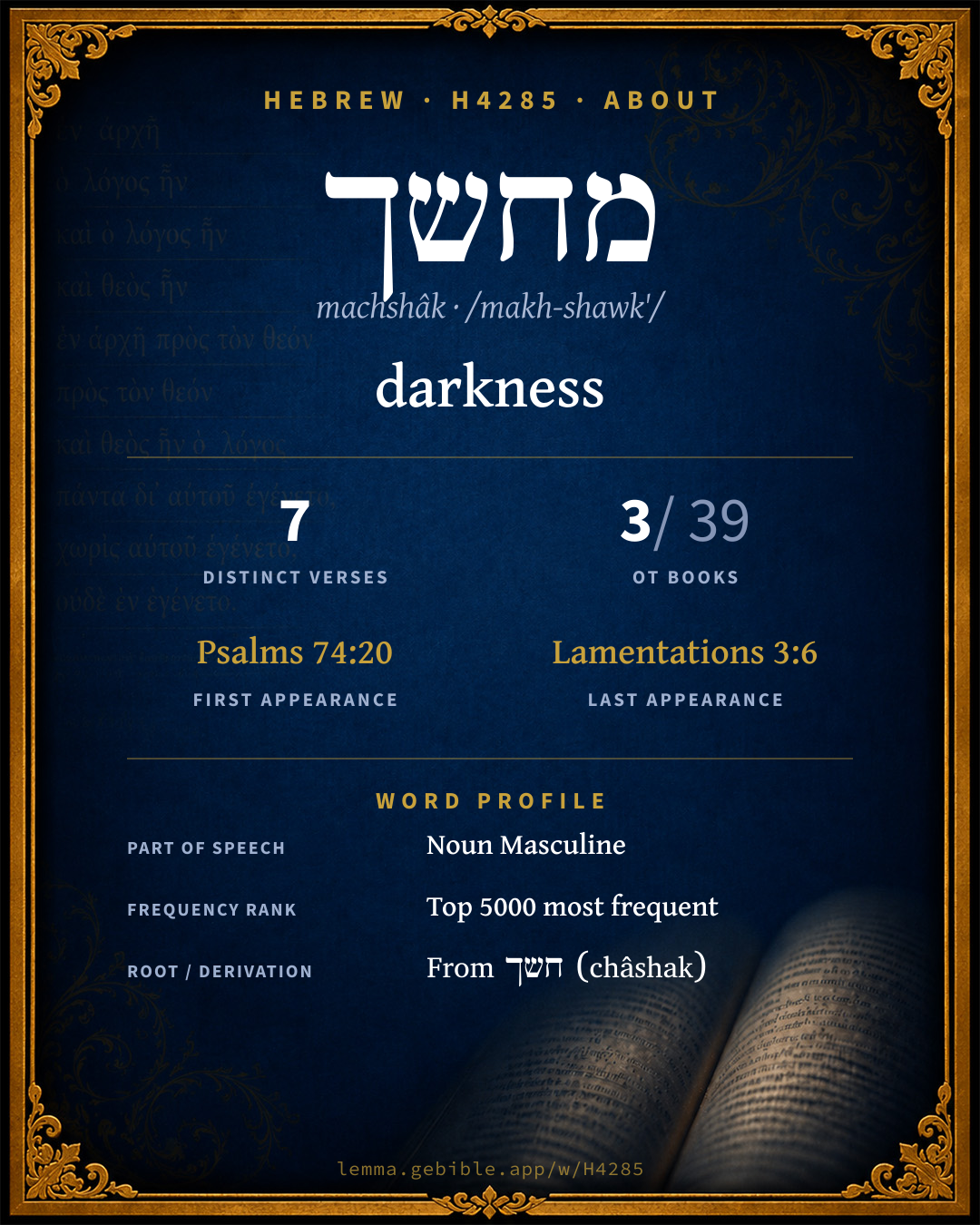
מַחְשָׁךְ
darkness
also: dark place, secrecy fuller range ↓
Full lexicon entry — Brown-Driver-Briggs (BDB)
From Brown-Driver-Briggs (BDB)
Where this word appears
See every Absolute-state word in the Hebrew Bible →
Grammar key — what these labels mean
Part of speech
- Noun
- A naming word — a person, place, thing, or idea.
Noun type
- Common
- A common noun — a general class of person, place, or thing (“king,” “city,” “water”), not a specific name.
State
- Absolute
- The independent form of a noun, not bound to a following word.
- Construct
- A noun bound to a following noun in a possessive / “of” relationship (the construct chain).
Gender
- Masculine
- Grammatically masculine.
Number
- Plural
- More than one (in Hebrew, generally three or more).
- Singular
- One.
1 verse where H4285 appears in the Construct state in the Book of Psalms. Filtered view — show all forms. Click any verse to open its interlinear word-by-word view. Verse text shown in the World English Bible for context — . Each verse’s Hebrew form is shown with its reference; the English is not keyword-highlighted, since the data carries no word-level English alignment. Use “Compare translations” on any verse to read it across multiple English versions. This concordance covers the Hebrew Bible; Septuagint (Greek Old Testament) occurrences are not indexed here.
Psalms
About this entry
At a glance — auto-summarized from this page’s data, not written by a person. Every figure links to its source below. This summary describes the numbers; it doesn’t interpret them.
מחשך — transliterated machshâk — is a Hebrew noun carrying the sense “darkness.” More than half of its appearances fall in Psalms. The Hebrew Bible uses it across 7 verses — uncommon. It first appears in Psalms 74:20. It also covers “dark place” and “secrecy”, alongside “darkness” — see its full sense range. Each statement above links to its evidence; the full detail follows below.
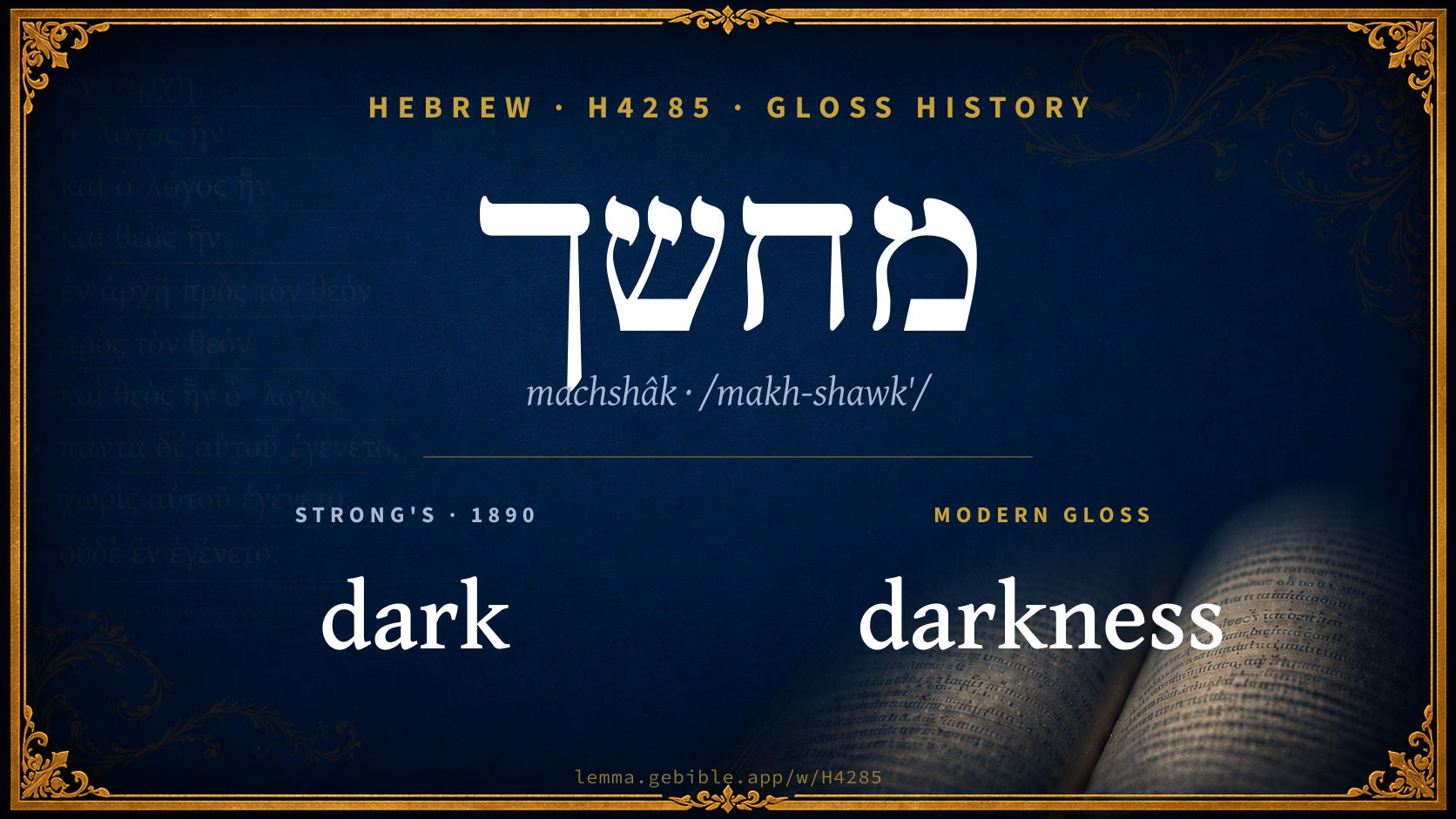
Gloss history
Strong's 1890 vs modern scholarship
About this word
Strong's H4285 catalogs a Hebrew word from the Hebrew Old Testament.
These counts are not copied from any lexicon or concordance. They are computed here, from the morphology-tagged Hebrew Old Testament. What Lemma adds →
- 7
- distinct verses
- The word appears in 7 distinct verses.
- 3 / 39
- OT books
- The word appears in 3 of 39 Old Testament books.
- #2,835
- by frequency
- Top 5000 most frequent Hebrew words (rank 2,835 of 8,640 Hebrew words by occurrence).
View all 7 occurrences in the concordance →
Most concentrated in
- Psalms 4 verses 57%
- Isaiah 2 verses 29%
- Lamentations 1 verse 14%
By section of the Old Testament
By traditional corpus
Conventional, traditional groupings — biblical authorship is debated, so this is a traditional corpus grouping, not an authorship claim. Each share is this word’s portion of its verses in that division of the Hebrew canon. Each figure is a share of the word’s 7 distinct verses.
- Writings (Ketuvim) 5 verses · 71%
- Prophets (Nevi'im) 2 verses · 29%
How translations render this word
Counts come from each version’s own published word-to-Strong’s tagging or interlinear alignment — an approximate guide to how each version renders this word, not a word-level alignment the data otherwise carries. Because each total is that version’s own tagged count, the per-version totals vary from one another and need not match the appearance or distinct-verse counts above. These counts may also differ from a printed concordance because Lemma counts each distinctly tagged rendering and does not collapse phrase taggings into a single head-word total. This is a fixed set of word-tagged versions (KJV, ASV, BSB, ULT) and does not change with the reading translation you choose elsewhere. Each version’s license is shown beside its name below (and on Sources).
- King James Version: Darkness 4×
- American Standard Version: Dark 3×
- Berean Standard Bible: Darkness 5×
- unfoldingWord Literal Text: Dark places 3×, Darkness 2×
King James Version Public Domain
Renders H4285 across 7 tagged occurrences — most commonly:
Plus 3 renderings that appear only once — usually multi-word phrases or single function words the recovered tagging swept in, not distinct renderings.
American Standard Version Public Domain
Renders H4285 across 7 tagged occurrences — most commonly:
Plus 4 renderings that appear only once — usually multi-word phrases or single function words the recovered tagging swept in, not distinct renderings.
Berean Standard Bible Public Domain
Renders H4285 across 7 tagged occurrences — most commonly:
Plus 2 renderings that appear only once — usually multi-word phrases or single function words the recovered tagging swept in, not distinct renderings.
unfoldingWord Literal Text CC BY-SA 4.0
Renders H4285 across 7 tagged occurrences — most commonly:
Plus 2 renderings that appear only once — usually multi-word phrases or single function words the recovered tagging swept in, not distinct renderings.
Senses in the full BDB
What do BDB’s symbols mean?
BDB uses these scholarly abbreviations:
| Symbol | Meaning |
|---|---|
| 𝔊 | the Septuagint (the ancient Greek translation, LXX) |
| 𝔙 | the Vulgate (the Latin translation) |
| 𝔖 | the Syriac version (the Peshitta) |
| 𝔗 | the Targum (the Aramaic translation) |
| ψ | the Psalms |
| √ | root (the underlying root or stem) |
| ‖ | parallel passage (a synonymous or contrasted parallel) |
| † | the dagger: every passage where the word occurs is cited |
The 4 senses and sub-senses the full Brown-Driver-Briggs lexicon distinguishes for this word, in lexicon order (not ranked by frequency), with BDB’s own verbatim wording and sub-sense lettering. Shown in Hebrew script with BDB’s own scholarly abbreviations. The condensed entry is in the Lexicon Entry tab. See also the Forms in the corpus table below.
- a. = hiding-place מח׳־ארץ 74:20. e.g. Psalms 74:20
- b. dark region, in which men may lose their way Is 42:16. e.g. Isaiah 42:16
- c. = grave, or שׁאול ψ 88:19 (v. Che); of dark place of God’s wrath (like Sheʾôl) 88:7; cf. 143:3 = La 3:6. e.g. Psalms 88:19
- d. = secret place, secrecy (of plots) Is 29:15. e.g. Isaiah 29:15
Senses from the full Brown-Driver-Briggs lexicon (Brown, Driver, Briggs; Oxford 1906 — public domain), digitized via Sefaria, supplemented by the OpenScriptures HebrewLexicon (CC BY 4.0). Full attribution on Sources.
Word origin
n.m. dark place (poet.)—abs. מ׳ Is 29:15; 42:16; מַחְשָׁ֑ךְ ψ 88:19; pl. מַחֲשַׁכִּים 88:7; 143:3 = La 3:6; cstr. מַחֲשַׁכֵּי ψ 74:20;—dark place:
— Brown-Driver-Briggs (Oxford 1906, public domain), digitized via Sefaria, supplemented by the OpenScriptures HebrewLexicon (CC BY 4.0). See Sources.
Derived from חשך (châshak) (H2821) — to be dark.
Jastrow Dictionary
A second Hebrew/Aramaic lexicon for comparison, covering Aramaic and post-biblical (Talmudic, Targumic, Midrashic) usage that the biblical-Hebrew BDB does not. Matched by lemma rather than by Strong’s number, so a lemma may carry more than one Jastrow headword (shown separately below), and the entries cover usage well beyond the Bible.
חָשַׂךְ
- , v. חָסַךְ
חֲשַׂךְ
- (v. חָסַךְ) to spare, withhold. Targ. Prov. XIII, 24 חָשֵׂךְ, חָשֵׂיךְ (part.). Ib. XVII, 27.
- to deduct. Y. Pes. IV, end, 31ᶜ מַחְשַׂכְנָא (not מחשב׳), v. גּוֹדְלָנָא.
חָשַׁךְ
- [to be pressed, thick,] to be dark. Sabb. 34ᵃ; 51ᵃ משחָשְׁכָה; ib. IV, 2 משתֶּחְשַׁךְ when it darkens (at nightfall, v. חֲשֵׁיכָה). Snh. 22ᵃ עולם ח׳ בעדו the world around him is dark; Ab. Zar. 8ᵃ (some ed. חָשׁוּךְ). Ber. 16ᵇ אל יֶחְשְׁכוּ וכ׳ let not our eyes be obscured; a. fr. V. חָשׁוּךְ.
- 1. to be overtaken by (the Sabbath) nightfall. Sabb. XXIV, 1 מי שה׳ בדרך he who is on the road at nightfall (on Friday).
- 2. to wait for the nightfall, to make preparations to be ready for work on the exit of the Sabbath, v. חֲשִׁיכָה. Ib. XXIII, 3 אין מַחְשִׁיכִין על וכ׳ you must not, during the day, walk to the extreme end of the Sabbath limit to await the night there for the purpose of hiring workmen etc.; אבל מַחְשִׁיךְ הוא וכ׳ but one may do so for the purpose of going at nightfall to watch his field, and then he may also take his fruits home. Ib. להַחְשִׁיךְ עליו to await the night at the Sabbath limit for the purpose of doing it. Ib. 4; a. fr.
- 3. to darken, obscure. Cant. R. to I, 1 (ref. to חשכים, Prov. XXII, 29) that is Potifar שה׳ הקב"ה וכ׳ whose eyes the Lord darkened etc. Ex. R. s. 51 (ref. to חשכה, Gen. XV, 12) that is Media שהֶחְשִׁיכָה וכ׳ who made Israel’s eyes dim (with tears) by her decrees. Pesik. R. s. 47 (ref. to Job XXXVIII, 2) הֶחְשַׁכְתָּ וכ׳ (not החשב׳) thou hast obscured the council which I held in heavens (when the Lord vouched for Job’s integrity); a. fr. e.g. Proverbs 22:29
- 4. to become dark. Midr. Till. to Ps. XVIII, 12 (ref. to the versions חשכת, Ps. l. c., and חשרת II Sam. XXII, 12) when the clouds are laden with the waters, הן מַחְשִׁיכִין מן המים וכ׳ they receive a dark color from the waters, and afterwards they drop them as through a sieve. e.g. 2 Samuel 22:12
חֲשַׁךְ
- Targ. Job. XVIII, 6. Targ. Ex. X, 15; a. fr.—Taan. 10ᵃ חֲשׁוּךְ ענני וכ׳ when the clouds are dark, they contain much water.
- 1. to darken, obscure. Targ. Ps. CV, 28; a. e.
- 2. to do something at night, to be late. Tam. 27ᵇ חַשֵּׁיךְ תקין נפשך וכ׳ at bed-time attend to thy body, and in the morning etc. Ber. 8ᵃ מקדמי ומְחַשְּׁכֵי וכ׳ they go to Synagogue early and late. Ib. קדימו וחַשִּׁיכוּ ועיילו וכ׳ (Ms. M. ואַחְשִׁיכוּ, Af., v. Rabb. D. S. a. l.) go ye early and late to etc. Targ. Y. Deut. XXVIII, 65, v. מַחַשְׁכָן.
- 1. to obscure. Targ. Job XXXVIII, 2; a. e.
- 2. to do something late. Targ. I Sam. XVII, 16.—Ber. l. c., v. supra.
- to grow dark. Targ. Ps. LXIX, 24; a. e.—Snh. 96ᵃ עד דאתא איח׳ by the time he came it had grown dark.
חֲשַׁךְ ²
- (cmp. חסך) to be reduced, lean. Targ. Ps. XXXI, 11 (h. text עששו, v. Rashi a. l.)
- same. Targ. Job XXXIII, 21 Ms. (ed. שפיין).
חשֶׁךְ
- darkness. Ex. R. s. 14. Ḥag. 12ᵃ; a. v. fr.—הָרֵי ח׳ Dark Mountains, behind which the Amazons live (Amazonici Mountes, v. Sm. Class. Dict. s. v.). Lev. R. s. 27; Pesik. Shor, p. 74ᵃ; Tam. 32ᵃ. [The Jewish legend relating the meeting of Alexander the Great with the Amazons seems to point to Africa, v. קרטגינא).
A Dictionary of the Targumim, the Talmud Babli and Yerushalmi, and the Midrashic Literature (Marcus Jastrow; London, Luzac, 1903) — Public Domain. Digitized via Sefaria. Digitized via Sefaria. Full attribution on Sources.
Forms in the corpus
The 7 distinct written forms H4285 takes in the Hebrew Bible, most frequent first — each parse links to that state’s occurrences in the concordance. Hebrew forms include their vowel points and cantillation, so a single lemma takes many written forms.
| Form | Parsing | Example | Uses |
|---|---|---|---|
| בְ/מַחְשָׁךְ֙ | Noun, Common, Masculine, Singular, Absolute | Isaiah 29:15 | 1 |
| בְ֝/מַחֲשַׁכִּ֗ים | Noun, Common, Masculine, Plural, Absolute | Psalms 143:3 | 1 |
| בְּ/מַחֲשַׁכִּ֥ים | Noun, Common, Masculine, Plural, Absolute | Lamentations 3:6 | 1 |
| בְּ֝/מַחֲשַׁכִּ֗ים | Noun, Common, Masculine, Plural, Absolute | Psalms 88:6 | 1 |
| מַחְשָׁ֨ךְ | Noun, Common, Masculine, Singular, Absolute | Isaiah 42:16 | 1 |
| מַחְשָֽׁךְ | Noun, Common, Masculine, Singular, Absolute | Psalms 88:18 | 1 |
| מַחֲשַׁכֵּי | Noun, Common, Masculine, Plural, Construct | Psalms 74:20 | 1 |
Same root — word family
Other BDB entries built from the same root as H4285, grouped by Strong’s listed origin. These share a root / origin per the lexicon — not necessarily a shared meaning. Each links to that word’s own entry.
Derives from
Shares the same root
- חשוך chăshôwk H2816 darkness
- חשך chôshek H2822 darkness
- חשך châshôk H2823 obscure
- חשכה cheshkâh H2824 darkness
- חשכה chăshêkâh H2825 darkness
Compare all same-root words → Showing 4 of 7 — not the complete family. They share a root, not necessarily a meaning.
Septuagint verse parallels
This word appears in 6 verses that also exist in the Greek Old Testament (Septuagint), out of the 7 Hebrew verses it occurs in. You can read those verses in Greek by switching the Old Testament edition to the Septuagint.
Read these verses in the Septuagint
This is a verse-level parallel only — the same verses exist in both the Hebrew and Greek Old Testaments. No word-level Hebrew↔Greek correspondence is claimed: the data carries no such alignment, so no Greek word is shown as this Hebrew word’s translation. Coverage is not total — the Septuagint omits the deuterocanon and renumbers the Psalms, so some Hebrew verses have no direct Greek parallel.