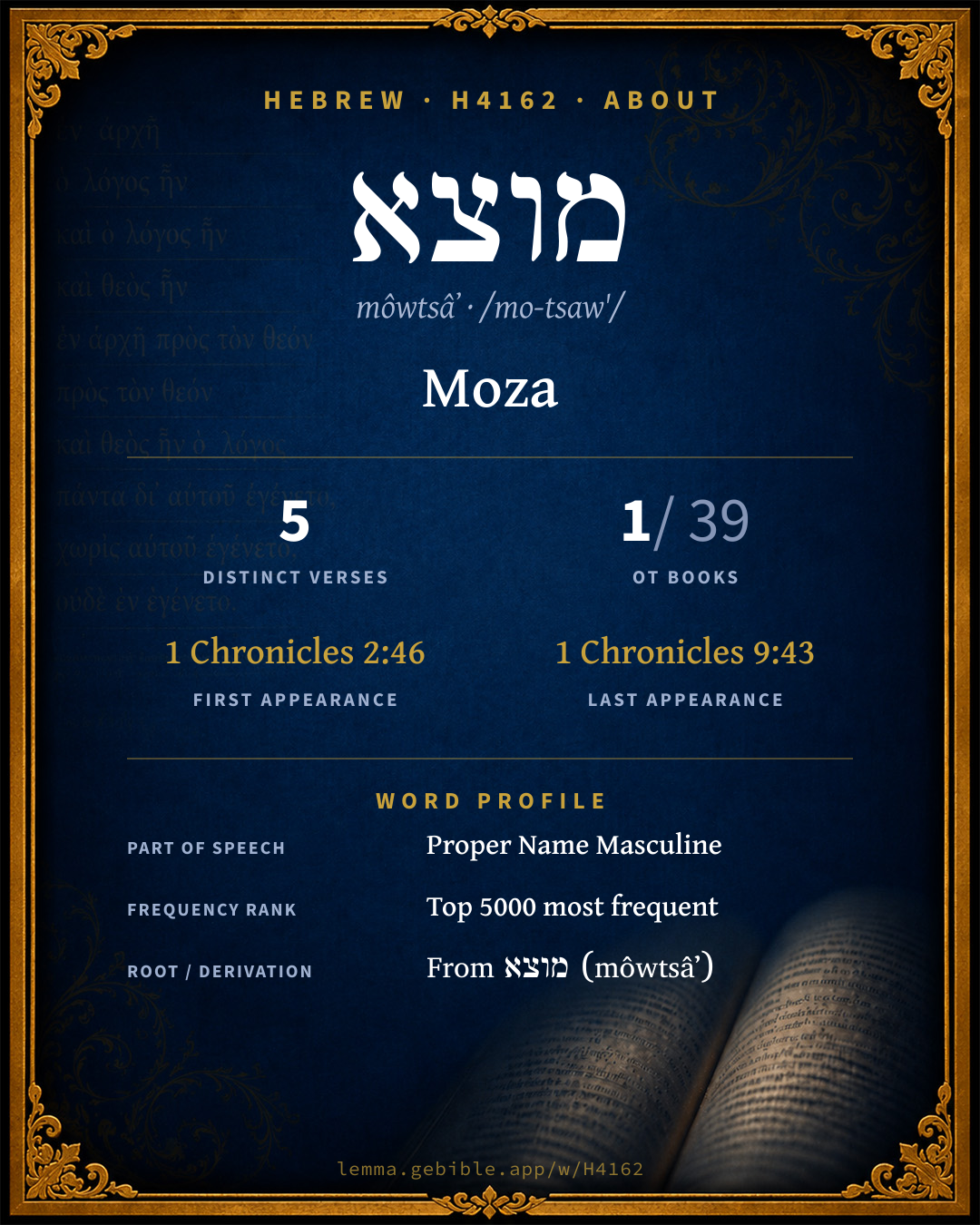
מוֹצָא
Moza
BDB lists 3 entries for ‘Moza’ fuller range ↓
Full lexicon entry — Brown-Driver-Briggs (BDB)
From Brown-Driver-Briggs (BDB)
Where this word appears
Grammar key — what these labels mean
Part of speech
- Noun
- A naming word — a person, place, thing, or idea.
Noun type
- Proper
- A name of a specific person, place, or people (e.g. Abraham, Zion, Israel).
Every verse where H4162 appears — 5 distinct verses across 1 book. Click any verse to open its interlinear word-by-word view. Verse text shown in the World English Bible for context — . Each verse’s Hebrew form is shown with its reference; the English is not keyword-highlighted, since the data carries no word-level English alignment. Use “Compare translations” on any verse to read it across multiple English versions. This concordance covers the Hebrew Bible; Septuagint (Greek Old Testament) occurrences are not indexed here.
1 Chronicles 5 verses
- 1 Chronicles 2:46 מוֹצָ֖א n Proper Ephah, Caleb's concubine, bore Haran, and Moza, and Gazez; and Haran became the father of Gazez.
- 1 Chronicles 8:36 מוֹצָֽא n Proper Ahaz became the father of Jehoaddah; and Jehoaddah became the father of Alemeth, and Azmaveth, and Zimri; and Zimri became the father of Moza.
- 1 Chronicles 8:37 וּ/מוֹצָ֖א conj + n Proper Moza became the father of Binea; Raphah was his son, Eleasah his son, Azel his son.
- 1 Chronicles 9:42 מוֹצָֽא n Proper Ahaz became the father of Jarah; and Jarah became the father of Alemeth, and Azmaveth, and Zimri; and Zimri became the father of Moza;
- 1 Chronicles 9:43 וּ/מוֹצָ֖א conj + n Proper and Moza became the father of Binea; and Rephaiah his son, Eleasah his son, Azel his son.
About this entry
At a glance — auto-summarized from this page’s data, not written by a person. Every figure links to its source below. This summary describes the numbers; it doesn’t interpret them.
At its core, מוצא (môwtsâʼ) means “Moza.” With only 5 verses it sits in the long tail of Hebrew Bible vocabulary. The word gravitates to 1 Chronicles (100%). Scripture first uses it in 1 Chronicles 2:46. Dig into 5-verse concordance and the renderings breakdown below.
Gloss history
Strong's 1890 vs modern scholarship
About this word
Strong's H4162 catalogs a Hebrew word from the Hebrew Old Testament.
These counts are not copied from any lexicon or concordance. They are computed here, from the morphology-tagged Hebrew Old Testament. What Lemma adds →
- 5
- distinct verses
- The word appears in 5 distinct verses.
- 1 / 39
- OT books
- The word appears in 1 of 39 Old Testament books.
- #3,337
- by frequency
- Top 5000 most frequent Hebrew words (rank 3,337 of 8,640 Hebrew words by occurrence).
View all 5 occurrences in the concordance →
Most concentrated in
- 1 Chronicles 5 verses 100%
By section of the Old Testament
By traditional corpus
Conventional, traditional groupings — biblical authorship is debated, so this is a traditional corpus grouping, not an authorship claim. Each share is this word’s portion of its verses in that division of the Hebrew canon. Each figure is a share of the word’s 5 distinct verses.
- Writings (Ketuvim) 5 verses · 100%
How translations render this word
Counts come from each version’s own published word-to-Strong’s tagging or interlinear alignment — an approximate guide to how each version renders this word, not a word-level alignment the data otherwise carries. Because each total is that version’s own tagged count, the per-version totals vary from one another and need not match the appearance or distinct-verse counts above. These counts may also differ from a printed concordance because Lemma counts each distinctly tagged rendering and does not collapse phrase taggings into a single head-word total. This is a fixed set of word-tagged versions (KJV, ASV, BSB, ULT) and does not change with the reading translation you choose elsewhere. Each version’s license is shown beside its name below (and on Sources).
BDB lists this Strong’s number as 2 distinct words (homographs). Each count above pools all of them and is not split by sense — see the Senses section below. A low-frequency rendering may belong to a different one of those words, not the primary meaning.
- King James Version†: Moza 5×
- American Standard Version†: Moza 5×
- Berean Standard Bible†: Moza 5×
- unfoldingWord Literal Text†: Moza 5×
King James Version Public Domain
Renders H4162 across 5† tagged occurrences — most commonly:
American Standard Version Public Domain
Renders H4162 across 5† tagged occurrences — most commonly:
Berean Standard Bible Public Domain
Renders H4162 across 5† tagged occurrences — most commonly:
unfoldingWord Literal Text CC BY-SA 4.0
Renders H4162 across 5† tagged occurrences — most commonly:
14 senses and sub-senses in the full BDB
What do BDB’s symbols mean?
BDB uses these scholarly abbreviations:
| Symbol | Meaning |
|---|---|
| 𝔊 | the Septuagint (the ancient Greek translation, LXX) |
| 𝔙 | the Vulgate (the Latin translation) |
| 𝔖 | the Syriac version (the Peshitta) |
| 𝔗 | the Targum (the Aramaic translation) |
| ψ | the Psalms |
| √ | root (the underlying root or stem) |
| ‖ | parallel passage (a synonymous or contrasted parallel) |
| † | the dagger: every passage where the word occurs is cited |
The 14 senses and sub-senses the full Brown-Driver-Briggs lexicon distinguishes for this word, in lexicon order (not ranked by frequency), with BDB’s own verbatim wording and sub-sense lettering. Shown in Hebrew script with BDB’s own scholarly abbreviations. The condensed entry is in the Lexicon Entry tab. See also the Forms in the corpus table below.
מוצא I
- 1. a going forth:
- a. the act, of י׳ Ho 6:3; of the sun = rising ψ 19:7 (v. יצא 1 f); of a man 2 S 3:25 (opp. מָבוֹא Kt); מ׳ דָּבָר Dn 9:25 going forth of a command. e.g. Hosea 6:3
- b. concrete, מוֹצָאֵי גּוֹלָה Ez 12:4 goings forth of exile, i.e. those going forth into exile (in sim.). e.g. Ezekiel 12:4
- c. way out, exit: concrete, of chambers in temple Ez 42:11; 43:11 (opp. מוֹבָאָיו); מוֹצָאֵי הַמִּקְדָּשׁ Ez 44:5 (opp. מְבוֹא הַבַּיִת). e.g. Ezekiel 42:11
- 2. that which goes forth:
- a. utterance of mouth or lips (especially of solemn or formal speech), מוֹצָא פִי־י׳ Dt 8:3; מ׳ שְׂפָתַי Je 17:16 ψ 89:35; so Dt 23:24 Nu 30:13 (P). e.g. Deuteronomy 8:3
- b. export of horses 1 K 10:28 = 2 Ch 1:16. e.g. 1 Kings 10:28
- 3. place of going forth:
- a. source or spring of water 2 K 2:21 Is 58:11 (in sim.), ψ 107:33 (‖ נְהָרוֹת) v 35 (‖ אֲגַם־מים) = Is 41:18 (‖ id.); מוֹצָא מֵימֵי גִיחוֹן הָעֶלְיוֹן 2 Ch 32:30. e.g. 2 Kings 2:21
- b. place of departure of Israel on march Nu 33:2(×2) (P). e.g. Numbers 33:2
- c. מוֹצָא = east (place of sun’s going forth) ψ 75:7 (opp. מַעֲרָב); zeugmatically, 65:9 מוֹצָאֵי בֹּקֶר וָעֶרֶב i.e. the east and the west (cf. the two Orients, Qor 43:37). e.g. Psalms 75:7
- d. place whence silver comes = mine Jb 28:1; וּלְהַצְמִיחַ מֹצָא דֶשֶׁא 38:27 and to cause the growing-place (others, the growth) of young grass to sprout. e.g. Job 28:1
מוצא II
- 1. son of Caleb by Ephah his concubine 1 Ch 2:46, 𝔊 Ιωσα(ν), 𝔊L Μουσα. e.g. 1 Chronicles 2:46
- 2. a descendant of Saul 1 Ch 8:36, 37 (𝔊 Μαισα) = 9:42, 43 (𝔊 Μασσα; 𝔊L in both Μωσα). e.g. 1 Chronicles 8:36
Senses from the full Brown-Driver-Briggs lexicon (Brown, Driver, Briggs; Oxford 1906 — public domain), digitized via Sefaria, supplemented by the OpenScriptures HebrewLexicon (CC BY 4.0). Full attribution on Sources.
Word origin
n.m. Ho 6:3 place or act of going forth, issue, export, source, spring;—abs. מ׳ Jb 28:1 ψ 75:7; cstr. מ׳ Nu 30:13 + 9 times; מֹצָא Jb 38:27; Dn 9:25; sf. מוֹצָאֲךָ 2 S 3:25; מֹצָאוֹ Ho 6:3; מוֹצָאוֹ ψ 19:7; pl. cstr. מוֹצָאֵי Is 41:18 + 5 times; sf. מוֹצָאָיו Ez 43:11; מוֹצָאֵיהֶם Nu 33:2(×2); מוֹצָאֵיהֶן Ez 42:11;—
— Brown-Driver-Briggs (Oxford 1906, public domain), digitized via Sefaria, supplemented by the OpenScriptures HebrewLexicon (CC BY 4.0). See Sources.
Derived from מוצא (môwtsâʼ) (H4161) — going forth.
Jastrow Dictionary
A second Hebrew/Aramaic lexicon for comparison, covering Aramaic and post-biblical (Talmudic, Targumic, Midrashic) usage that the biblical-Hebrew BDB does not. Matched by lemma rather than by Strong’s number, so a lemma may carry more than one Jastrow headword (shown separately below), and the entries cover usage well beyond the Bible.
מוֹץ ³
- Targ. Is. XXIX, 5 (ed. Lag. מֹץ). Targ. Hos. XIII, 3; a. fr.—[Targ. Ps. LXIX, 21 מוצא, some ed., read: מרעא, v. מְרַע II.]—Y. Snh. X, 27ᵈ bot. אהן מ׳ דבגויה וכ׳ the chaff which remains there (after the straw is removed) undermines the walls.
מוֹצָא II
- Motsa, near Jerusalem (also named Colonia). Succ. IV, 5. Y. ib. 54ᵇ bot. מהו מ׳ ממצייא וכ׳ what is Motsa? Mamtsia … named Colonia; Bab. ib. 45ᵃ מקום קלניא … קרי ליה מ׳ וכ׳ the place was named Colonia, but why does our Tanna call it Motsa? (Answ.: as if מוֹצִיא) איידי דמיפק וכ׳ because its inhabitants are exempt from royal taxes, he calls it M. (v. Sm. Ant. s. v. Colonia).
מוֹצָא III
- , pl. constr. מוֹצָאֵי (b. h.; exit; מ׳ שבת (abbrev. מו"ש, מוצ"ש) the night following the Sabbath; מ׳ יו"ט the night following a Holy Day. Tosef. Sabb. III, 5; Ḥull. 15ᵃ, a. e. יאכל במו"ש (or למו"ש) may be eaten after the Sabbath is past. Bets. 30ᵇ; Sabb. 45ᵃ עד מ׳ יו"ט האחרון וכ׳ not before the end of the last day of the (Succoth) festival; a. v. fr.—מ׳ שביעית the period beginning with the end of the Sabbatical year. Shebi. IV, 2. R. Hash. 9ᵃ; a. fr.
A Dictionary of the Targumim, the Talmud Babli and Yerushalmi, and the Midrashic Literature (Marcus Jastrow; London, Luzac, 1903) — Public Domain. Digitized via Sefaria. Digitized via Sefaria. Full attribution on Sources.
Forms in the corpus
The 3 distinct written forms H4162 takes in the Hebrew Bible, most frequent first — each parse links to that state’s occurrences in the concordance. Hebrew forms include their vowel points and cantillation, so a single lemma takes many written forms.
| Form | Parsing | Example | Uses |
|---|---|---|---|
| וּ/מוֹצָ֖א | Noun, Proper | 1 Chronicles 8:37 | 2 |
| מוֹצָֽא | Noun, Proper | 1 Chronicles 8:36 | 2 |
| מוֹצָ֖א | Noun, Proper | 1 Chronicles 2:46 | 1 |
Same root — word family
Other BDB entries built from the same root as H4162, grouped by Strong’s listed origin. These share a root / origin per the lexicon — not necessarily a shared meaning. Each links to that word’s own entry.
Derives from
Shares the same root
Compare all same-root words → They share a root, not necessarily a meaning.
Bible dictionary
Public-domain dictionary articles matched to this entry by name (Moza). A biblical name can be shared by more than one person or place, so an article may treat several.
Easton's Bible Dictionary · M. G. Easton, 1897
A going forth. (1.) One of the sons of Caleb (1 Chr. 2:46).
(2.) The son of Zimri, of the posterity of Saul (1 Chr. 8:36, 37; 9:42, 43).
Smith's Bible Dictionary · William Smith, 1863
(fountain).
+ Son of Caleb the son of Hezron. (1 Chronicles 2:46) + Son of Zimri and descendant of Saul. (1 Chronicles 8:36,37; 9:42,43)
Classic public-domain reference works; full attribution on Sources.
Septuagint verse parallels
This word appears in 5 verses that also exist in the Greek Old Testament (Septuagint), out of the 5 Hebrew verses it occurs in. You can read those verses in Greek by switching the Old Testament edition to the Septuagint.
Read these verses in the Septuagint
This is a verse-level parallel only — the same verses exist in both the Hebrew and Greek Old Testaments. No word-level Hebrew↔Greek correspondence is claimed: the data carries no such alignment, so no Greek word is shown as this Hebrew word’s translation. Coverage is not total — the Septuagint omits the deuterocanon and renumbers the Psalms, so some Hebrew verses have no direct Greek parallel.