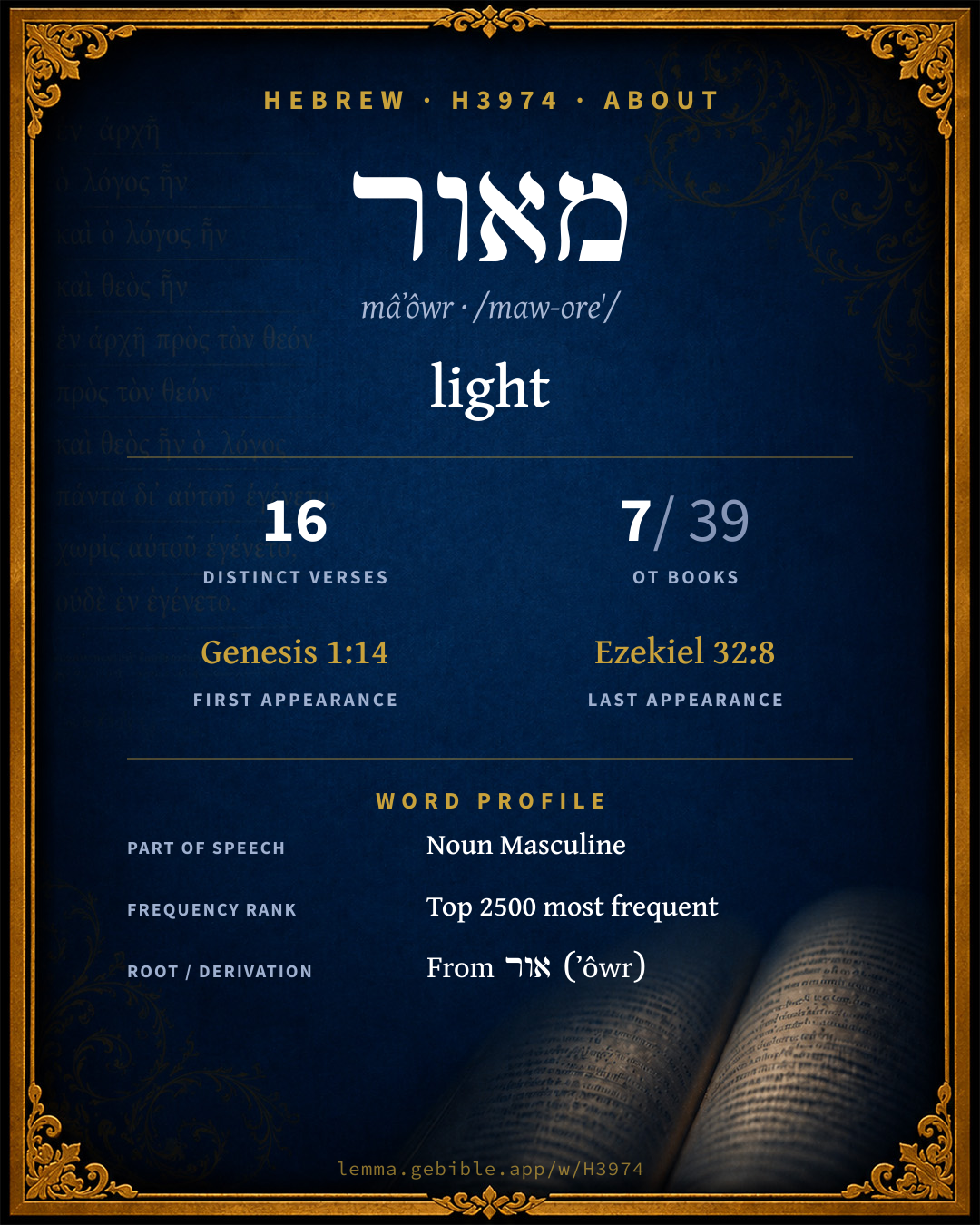
מָאוֹר
light
Full lexicon entry — Brown-Driver-Briggs (BDB)
From Brown-Driver-Briggs (BDB)
Where this word appears
See every Absolute-state word in the Hebrew Bible →
Grammar key — what these labels mean
Part of speech
- Noun
- A naming word — a person, place, thing, or idea.
Noun type
- Common
- A common noun — a general class of person, place, or thing (“king,” “city,” “water”), not a specific name.
State
- Absolute
- The independent form of a noun, not bound to a following word.
- Construct
- A noun bound to a following noun in a possessive / “of” relationship (the construct chain).
Gender
- Masculine
- Grammatically masculine.
Number
- Singular
- One.
- Plural
- More than one (in Hebrew, generally three or more).
1 verse where H3974 appears in the Absolute state in the Book of Psalms. Filtered view — show all forms. Click any verse to open its interlinear word-by-word view. Verse text shown in the World English Bible for context — . Each verse’s Hebrew form is shown with its reference; the English is not keyword-highlighted, since the data carries no word-level English alignment. Use “Compare translations” on any verse to read it across multiple English versions. This concordance covers the Hebrew Bible; Septuagint (Greek Old Testament) occurrences are not indexed here.
Psalms
About this entry
At a glance — auto-summarized from this page’s data, not written by a person. Every figure links to its source below. This summary describes the numbers; it doesn’t interpret them.
מאור — transliterated mâʼôwr — is a Hebrew noun carrying the sense “light.” It first appears in Genesis 1:14. With 16 verses in 7 books, it is an uncommon word in the Hebrew Bible. Its uses concentrate in Exodus (38% of all occurrences). From the same root come אור, אור and אור. See the sense tree, 16-verse concordance, and the renderings breakdown below.
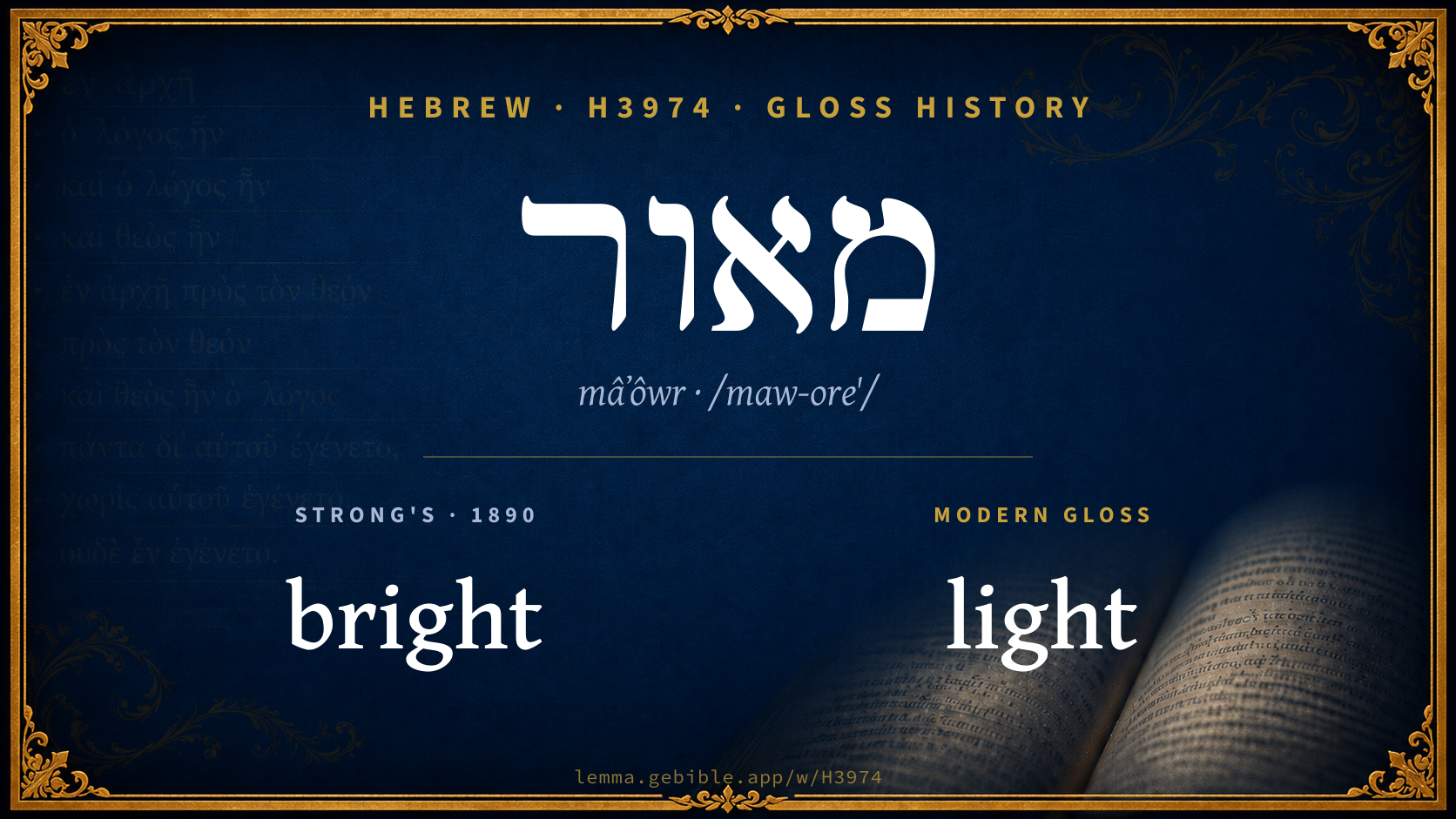
Gloss history
Strong's 1890 vs modern scholarship
About this word
Strong's H3974 catalogs a Hebrew word from the Hebrew Old Testament.
These counts are not copied from any lexicon or concordance. They are computed here, from the morphology-tagged Hebrew Old Testament. What Lemma adds →
- 16
- distinct verses
- The word appears in 16 distinct verses.
- 7 / 39
- OT books
- The word appears in 7 of 39 Old Testament books.
- #1,563
- by frequency
- Top 2500 most frequent Hebrew words (rank 1,563 of 8,640 Hebrew words by occurrence).
View all 16 occurrences in the concordance →
By section of the Old Testament
By traditional corpus
Conventional, traditional groupings — biblical authorship is debated, so this is a traditional corpus grouping, not an authorship claim. Each share is this word’s portion of its verses in that division of the Hebrew canon. Each figure is a share of the word’s 16 distinct verses.
- Torah (Pentateuch) 12 verses · 75%
- Writings (Ketuvim) 3 verses · 19%
- Prophets (Nevi'im) 1 verse · 6%
How translations render this word
Counts come from each version’s own published word-to-Strong’s tagging or interlinear alignment — an approximate guide to how each version renders this word, not a word-level alignment the data otherwise carries. Because each total is that version’s own tagged count, the per-version totals vary from one another and need not match the appearance or distinct-verse counts above. These counts may also differ from a printed concordance because Lemma counts each distinctly tagged rendering and does not collapse phrase taggings into a single head-word total. This is a fixed set of word-tagged versions (KJV, ASV, BSB, ULT) and does not change with the reading translation you choose elsewhere. Each version’s license is shown beside its name below (and on Sources).
- King James Version: Light 14×
- American Standard Version: Light 12×
- Berean Standard Bible: Light 13×, Lights 3×
- unfoldingWord Literal Text: Light 13×, Lights 4×, The 3×
King James Version Public Domain
Renders H3974 across 19 tagged occurrences — most commonly:
Plus 5 renderings that appear only once — usually multi-word phrases or single function words the recovered tagging swept in, not distinct renderings.
American Standard Version Public Domain
Renders H3974 across 19 tagged occurrences — most commonly:
Plus 7 renderings that appear only once — usually multi-word phrases or single function words the recovered tagging swept in, not distinct renderings.
Berean Standard Bible Public Domain
Renders H3974 across 19 tagged occurrences — most commonly:
Plus 3 renderings that appear only once — usually multi-word phrases or single function words the recovered tagging swept in, not distinct renderings.
unfoldingWord Literal Text CC BY-SA 4.0
Renders H3974 across 22 tagged occurrences — most commonly:
Plus 2 renderings that appear only once — usually multi-word phrases or single function words the recovered tagging swept in, not distinct renderings.
Senses in BDB
The 1 sense BDB distinguishes for this word, in lexicon order (not ranked by frequency or importance). The full entry — with sub-senses — is in the Lexicon Entry tab.
- light, luminary
Word origin
n.m. luminary—abs. Gn 1:16 +; cstr. מְאוֹר Pr 15:30 +; pl. מְאוֹרֹת Gn 1:15; מְאֹרֹת v 14, 16; cstr. מְאוֹרֵי Ez 32:8—light, light-bearer, luminary, lamp, of sun & moon Gn 1:14, 15, 16(×3) (P) Ez 32:8; moon ψ 74:16; מְנֹרַת הַמָּאוֹר the lamp-stand of the luminary or light (where הַמּ׳ is sum of seven sacred lamps on golden lamp-stand) Ex 35:14(×2), 28; 39:37 Nu 4:9, 16, cf. Ex 25:6; 27:20; 35:8 Lv 24:2 (all P); מְאוֹר־עֵינַיִם יְשַׂמַּח־לֵב֑ Pr 15:30 the luminary of the eyes (= the eyes as a lamp) gives the light of joy to the heart; מְאוֹר פָּנֶיךָ ψ 90:8 the luminary of thy face (thy face as a lamp) in the light of which the secrets are exposed.
— Brown-Driver-Briggs (Oxford 1906, public domain), digitized via Sefaria, supplemented by the OpenScriptures HebrewLexicon (CC BY 4.0). See Sources.
Derived from אור (ʼôwr) (H215) — to shine.
Jastrow Dictionary
A second Hebrew/Aramaic lexicon for comparison, covering Aramaic and post-biblical (Talmudic, Targumic, Midrashic) usage that the biblical-Hebrew BDB does not. Matched by lemma rather than by Strong’s number, so a lemma may carry more than one Jastrow headword (shown separately below), and the entries cover usage well beyond the Bible.
אוֹר I
- to perforate, break through, shine.—Denom. אַוִּיר, מְאוּרָה &c.
- to be broken through, grow light. Y. Ber. I, 2ᶜ משיֵאוֹר המזרח from the time the Eastern horizon is broken through, grows light.
- 1. (neut. v.) (neut. v.) to break through, shine. Y. ib. III, 6ᶜ bot. open thy lips ויָאִירוּ דבריך and let thy words come forth, speak out boldly. Yoma III, 1 ה׳ פני כל וכ׳ it has grown light all over the Eastern horizon.—פנים מֵאִירוֹת bright countenance. Num. R. s. 11; a. e.
- 2. (act. v.) to enlighten, brighten, make shine. Y. M. Kat. III, 83ᵇ ה׳ עיניו וכ׳ (the teacher had opened his (Samuel’s) eyes &c. B. Mets. 33ᵃ. Num. R. l. c. Ib. המזבח מֵאִירִים את (fr. Mal. I, 10) making the altar bright (with fire), feeding the fire on the altar. Yoma 73ᵇ, v. אוּר. e.g. Malachi 1:10
אוֹר
- Part. pass. נָאוֹר clear. Targ. Prov. IV, 25 נְאוֹרָן, נְאֹרָן, v. חֲוַר.
אוֹר II
- foreg.) breaking forth (cmp. Is. LVIII, 8) whence e.g. Isaiah 58:8
- 1. break of day, light, day; fire; trnsf. rise, glory, power, happiness. Ber. 2ᵇ ביאת אוֹרוֹ the entrance of his day-break (dawn of his eighth day; Tosaf. a. l. the sunset of his seventh day). Y. Pes. I, beg. 27ᵃ א׳ החמה sun-light. Ib. א׳ הנר candle light. Keth. 111ᵇ א׳ תורה light of the Law. B. Bath. 4ᵃ אוֹרוֹ של עולם intellectual light of the wold (a great man; the Law). Num. R. s. 15 אור של מעלן the celestial fire (believed to be the source of all light and fire); a. v. fr.
- 2. (breaking in of night) twilight, evening. Pes. I, 1 לארבעה וכ׳ א׳ on the evening (eve) of the fourteenth day of Nissan; v. discussion ibid. 2ᵃ sq., about the meaning of our w. R. Hash. 22ᵇ; Snh. 70ᵇ לא׳ עיבורו the evening following the eventual intercalation, i.e. the evening from the thirtieth of the past to the first of the beginning month.
- 3. (homil. = אוֹרָה II) rue. Gen. R. s. 20 in the Pentat. of R. M. it read כתנות אור וכ׳ (in place of עור Gen. III, 21) this alludes to the garments of Adam resembling the rue, wide below and narrow above; Ar. (Rashi diff.). e.g. Genesis 3:21
אוּר I
- foreg.) prop. light, flame; esp. Pl. אוּרִים ותומים the Urim and Tummim in the High-priest’s breast-plate. Yoma 73ᵇ א׳ שמאירים את דבריהם they are called Urim because they give their decisions in a clear way (not ambiguous as the oracles); cmp. Y. ib. VII, end, 44ᶜ. Sot. IX, 12. Y. Kidd. IV, beg. 65ᵇ
*אוּר II
- (= עוּר q. v.) chaff. Y. Ab. Zar. II, 40ᵈ א׳ דשערין chaff of barley; (Y. Sabb. XIV, 14ᵈ עור דסערין).
מָאוֹר
- 1. luminary, light. Ber. VIII, 5 Beth-Shammai reads שברא מאור האש (Blessed be &c.) who created the light of fire; Beth Hillel בורא מְאוֹרֵי האש the Creator of the lights (colors) of fire. Tosef. ib. VI (V), 6 they differ על המ׳ וכ׳ as to the order of the benedictions over light and over spices; Ber. 52ᵇ; Pes. 103ᵃ; a. fr.—מְ׳ עינים eye-sight. Ib. 62ᵇ. Y. Taan. IV, 68ᵈ top.—Ḥag. 5ᵇ (euphem.) ומ׳ עינים הוא he is blind (cmp. נְהוֹרָא).—Ber. 17ᵃ עיניך … במְ׳ תורה may thy eyes shine through the light of the Law. Midr. Till. to Ps. CXIX, 135 במ׳ פנים with a shining face (benevolence); a. fr.—Pl. מְאוֹרוֹת; constr. מְאוֹרֵי. Ber. 52ᵇ הרבה מ׳ יש באור there is a combination of lights (colors) in the artificial light. Ib. פליגי מאור ומאורי they differ as to (saying in the benediction) maor or m’oré, v. supra. Meg. IV, 6 כל שלא ראה מ׳ מימיו he who has never seen the luminaries (born blind). Ber. 12ᵃ (closing formula of a morning benediction) יוצר המ׳ the Creator of the luminaries; a. fr.
- 2. light-hole, opening, window. Ohol. XIII, 1 העושה מ׳ בתחילה he who leaves an opening (in the wall) from the start (when building). Tosef. ib. XIV, 1 פתח שעשאו למ׳ an opening which one made to serve as a window; הגיפו למ׳ if he filled the window up. Sabb. XXIV, 5; a. fr.
A Dictionary of the Targumim, the Talmud Babli and Yerushalmi, and the Midrashic Literature (Marcus Jastrow; London, Luzac, 1903) — Public Domain. Digitized via Sefaria. Digitized via Sefaria. Full attribution on Sources.
Forms in the corpus
The 14 distinct written forms H3974 takes in the Hebrew Bible, most frequent first — each parse links to that state’s occurrences in the concordance. Hebrew forms include their vowel points and cantillation, so a single lemma takes many written forms.
| Form | Parsing | Example | Uses |
|---|---|---|---|
| לַ/מָּא֑וֹר | Noun, Common, Masculine, Singular, Absolute | Exodus 27:20 | 3 |
| הַ/מָּא֤וֹר | Noun, Common, Masculine, Singular, Absolute | Genesis 1:16 | 2 |
| הַ/מָּאֽוֹר | Noun, Common, Masculine, Singular, Absolute | Exodus 35:14 | 2 |
| הַ/מָּאוֹר֙ | Noun, Common, Masculine, Singular, Absolute | Numbers 4:9 | 2 |
| הַ/מְּאֹרֹ֖ת | Noun, Common, Masculine, Plural, Absolute | Genesis 1:16 | 1 |
| הַ/מָּא֛וֹר | Noun, Common, Masculine, Singular, Absolute | Exodus 35:14 | 1 |
| לְ/מָא֕וֹר | Noun, Common, Masculine, Singular, Absolute | Exodus 35:28 | 1 |
| לִ/מְא֥וֹר | Noun, Common, Masculine, Singular, Construct | Psalms 90:8 | 1 |
| לִ/מְאוֹרֹת֙ | Noun, Common, Masculine, Plural, Absolute | Genesis 1:15 | 1 |
| לַ/מָּאֹ֑ר | Noun, Common, Masculine, Singular, Absolute | Exodus 25:6 | 1 |
| מְֽאוֹר | Noun, Common, Masculine, Singular, Construct | Proverbs 15:30 | 1 |
| מְא֤וֹרֵי | Noun, Common, Masculine, Plural, Construct | Ezekiel 32:8 | 1 |
| מְאֹרֹת֙ | Noun, Common, Masculine, Plural, Absolute | Genesis 1:14 | 1 |
| מָא֥וֹר | Noun, Common, Masculine, Singular, Absolute | Psalms 74:16 | 1 |
Same root — word family
Other BDB entries built from the same root as H3974, grouped by Strong’s listed origin. These share a root / origin per the lexicon — not necessarily a shared meaning. Each links to that word’s own entry.
Derives from
Shares the same root
Proper names from this root
People and places named from this root — a name, not an additional meaning of the word.
Compare all same-root words → Showing 4 of 6 — not the complete family. 1 of the same-root words is a proper name (a person or place). They share a root, not necessarily a meaning.
Septuagint verse parallels
This word appears in 12 verses that also exist in the Greek Old Testament (Septuagint), out of the 16 Hebrew verses it occurs in. You can read those verses in Greek by switching the Old Testament edition to the Septuagint.
Read these verses in the Septuagint
This is a verse-level parallel only — the same verses exist in both the Hebrew and Greek Old Testaments. No word-level Hebrew↔Greek correspondence is claimed: the data carries no such alignment, so no Greek word is shown as this Hebrew word’s translation. Coverage is not total — the Septuagint omits the deuterocanon and renumbers the Psalms, so some Hebrew verses have no direct Greek parallel.