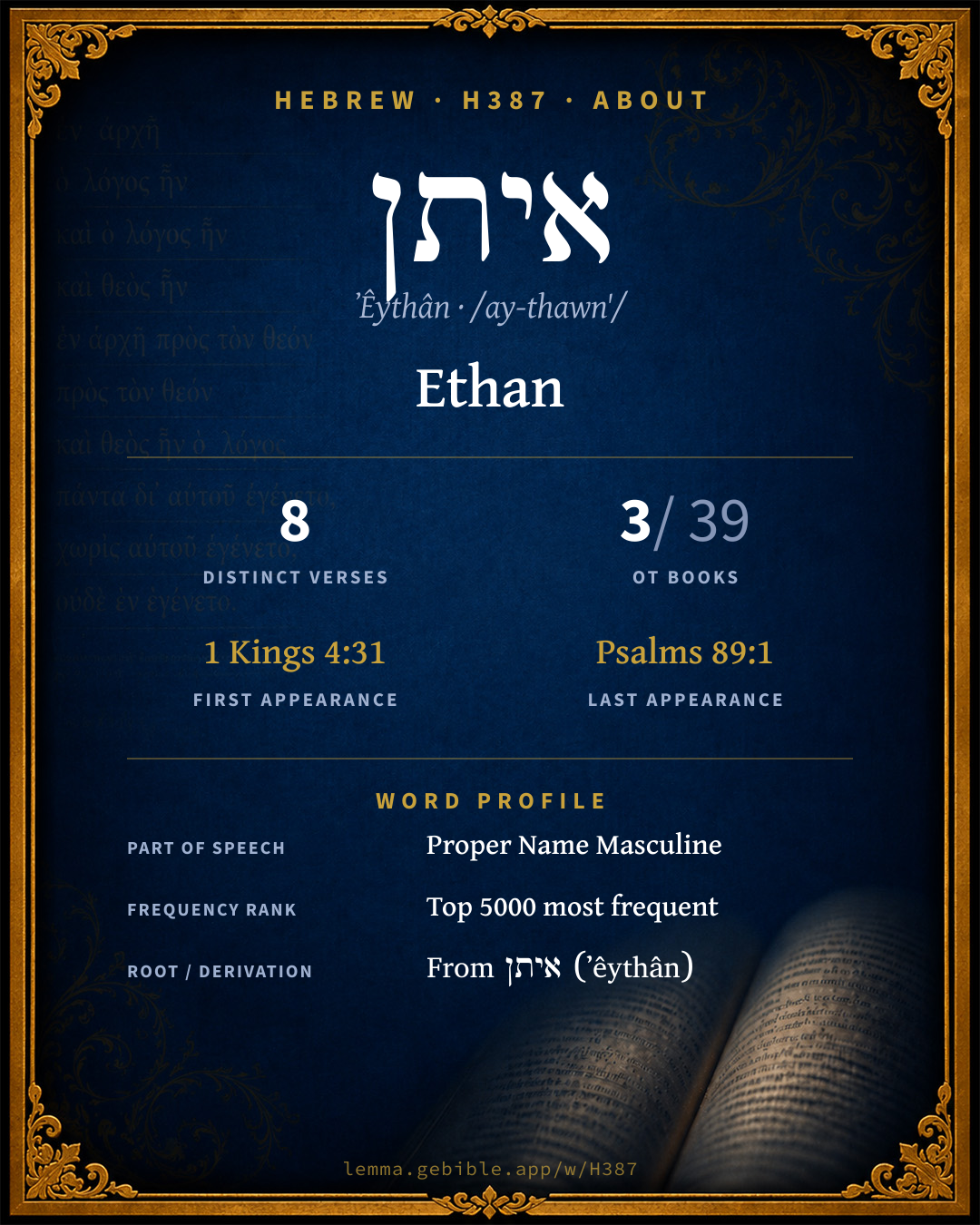
אֵיתָן
Ethan
BDB lists 5 entries for ‘Ethan’ fuller range ↓
Full lexicon entry — Brown-Driver-Briggs (BDB)
From Brown-Driver-Briggs (BDB)
Where this word appears
Grammar key — what these labels mean
Part of speech
- Noun
- A naming word — a person, place, thing, or idea.
Noun type
- Proper
- A name of a specific person, place, or people (e.g. Abraham, Zion, Israel).
Every verse where H387 appears — 8 distinct verses across 3 books. Click any verse to open its interlinear word-by-word view. Verse text shown in the World English Bible for context — . Each verse’s Hebrew form is shown with its reference; the English is not keyword-highlighted, since the data carries no word-level English alignment. Use “Compare translations” on any verse to read it across multiple English versions. This concordance covers the Hebrew Bible; Septuagint (Greek Old Testament) occurrences are not indexed here.
1 Kings 1 verse
1 Chronicles 6 verses
- 1 Chronicles 2:6 וְ/אֵיתָ֧ן conj + n Proper The sons of Zerah: Zimri, and Ethan, and Heman, and Calcol, and Dara; five of them in all.
- 1 Chronicles 2:8 אֵיתָ֖ן n Proper The sons of Ethan: Azariah.
- 1 Chronicles 6:42 אֵיתָ֥ן n Proper the son of Ethan, the son of Zimmah, the son of Shimei,
- 1 Chronicles 6:44 אֵיתָן֙ n Proper On the left hand their brothers the sons of Merari: Ethan the son of Kishi, the son of Abdi, the son of Malluch,
- 1 Chronicles 15:17 אֵיתָ֖ן n Proper So the Levites appointed Heman the son of Joel; and of his brothers, Asaph the son of Berechiah; and of the sons of Merari their brothers, Ethan the son of Kushaiah;
- 1 Chronicles 15:19 וְ/אֵיתָ֑ן conj + n Proper So the singers, Heman, Asaph, and Ethan, [were appointed] with cymbals of brass to sound aloud;
Psalms 1 verse
About this entry
At a glance — auto-summarized from this page’s data, not written by a person. Every figure links to its source below. This summary describes the numbers; it doesn’t interpret them.
The Hebrew name איתן centers on the idea of “Ethan.” The word gravitates to 1 Chronicles (75%), then 1 Kings and Psalms. It turns up in 8 verses across 3 books, an uncommon footprint. Its earliest occurrence is 1 Kings 4:31. For the data behind this summary, explore 8-verse concordance and the renderings breakdown below.
Gloss history
Strong's 1890 vs modern scholarship
About this word
Strong's H387 catalogs a Hebrew word from the Hebrew Old Testament.
These counts are not copied from any lexicon or concordance. They are computed here, from the morphology-tagged Hebrew Old Testament. What Lemma adds →
- 8
- distinct verses
- The word appears in 8 distinct verses.
- 3 / 39
- OT books
- The word appears in 3 of 39 Old Testament books.
- #2,625
- by frequency
- Top 5000 most frequent Hebrew words (rank 2,625 of 8,640 Hebrew words by occurrence).
View all 8 occurrences in the concordance →
Most concentrated in
- 1 Chronicles 6 verses 75%
- 1 Kings 1 verse 13%
- Psalms 1 verse 13%
By section of the Old Testament
By traditional corpus
Conventional, traditional groupings — biblical authorship is debated, so this is a traditional corpus grouping, not an authorship claim. Each share is this word’s portion of its verses in that division of the Hebrew canon. Each figure is a share of the word’s 8 distinct verses.
- Writings (Ketuvim) 7 verses · 88%
- Prophets (Nevi'im) 1 verse · 13%
How translations render this word
Counts come from each version’s own published word-to-Strong’s tagging or interlinear alignment — an approximate guide to how each version renders this word, not a word-level alignment the data otherwise carries. Because each total is that version’s own tagged count, the per-version totals vary from one another and need not match the appearance or distinct-verse counts above. These counts may also differ from a printed concordance because Lemma counts each distinctly tagged rendering and does not collapse phrase taggings into a single head-word total. This is a fixed set of word-tagged versions (KJV, ASV, BSB, ULT) and does not change with the reading translation you choose elsewhere. Each version’s license is shown beside its name below (and on Sources).
BDB lists this Strong’s number as 2 distinct words (homographs). Each count above pools all of them and is not split by sense — see the Senses section below. A low-frequency rendering may belong to a different one of those words, not the primary meaning.
- King James Version†: Ethan 7×
- American Standard Version†: Ethan 6×
- Berean Standard Bible†: Ethan 7×
- unfoldingWord Literal Text†: Ethan 6×
King James Version Public Domain
Renders H387 across 8† tagged occurrences — most commonly:
Plus 1 rendering that appears only once — usually multi-word phrases or single function words the recovered tagging swept in, not distinct renderings.
American Standard Version Public Domain
Renders H387 across 7† tagged occurrences — most commonly:
Plus 1 rendering that appears only once — usually multi-word phrases or single function words the recovered tagging swept in, not distinct renderings.
Berean Standard Bible Public Domain
Renders H387 across 8† tagged occurrences — most commonly:
Plus 1 rendering that appears only once — usually multi-word phrases or single function words the recovered tagging swept in, not distinct renderings.
unfoldingWord Literal Text CC BY-SA 4.0
Renders H387 across 7† tagged occurrences — most commonly:
Plus 1 rendering that appears only once — usually multi-word phrases or single function words the recovered tagging swept in, not distinct renderings.
Senses in the full BDB
What do BDB’s symbols mean?
BDB uses these scholarly abbreviations:
| Symbol | Meaning |
|---|---|
| 𝔊 | the Septuagint (the ancient Greek translation, LXX) |
| 𝔙 | the Vulgate (the Latin translation) |
| 𝔖 | the Syriac version (the Peshitta) |
| 𝔗 | the Targum (the Aramaic translation) |
| ψ | the Psalms |
| √ | root (the underlying root or stem) |
| ‖ | parallel passage (a synonymous or contrasted parallel) |
| † | the dagger: every passage where the word occurs is cited |
The 2 senses and sub-senses the full Brown-Driver-Briggs lexicon distinguishes for this word, in lexicon order (not ranked by frequency), with BDB’s own verbatim wording and sub-sense lettering. Shown in Hebrew script with BDB’s own scholarly abbreviations. The condensed entry is in the Lexicon Entry tab. See also the Forms in the corpus table below.
איתן I perennial, ever-flowing, fig. permanent, as subst. steady flow, permanence
- 1. 3 (opp. אַכְזָב), נַחַל אֵיתָן Am 5:24 an 3 wādy, Dt 21:4 (v. Dr); as subst. in נַהֲרוֹת אֵיתָן ψ 74:15 rivers of steady flow; as subst. also Ex 14:27 (J), the sea returned לְאֵיתָנוֹ to its steady flow, יֶרַח הָאֵיתָנִים 1 K 8:2 month of steady flowings = 7th mo., Oct.–Nov. (post-Bibl Tisri). e.g. Amos 5:24
- 2. fig. permanent, enduring גּוֹי אֵיתָן הוּא Je 5;15, i. e. a nation whose numbers never dwindle or fail, imperishable, וְרִיב עֲצָמָיו א׳ Jb 33:19 Kt the strife of his bones is constant, Gn 49:24 his bow abode בְּא׳ as an enduring, firm, one, א׳ מוֹשָֽׁבְךָ Nu 24:21 (‖ שִׂים בַּסֶּלַע), נְוֵה אֵיתָן Je 49:19 = 50:44 an abode of permanency (of Edom, and Babylon, suddenly depopulated by foe, figured as lion); האיתנים מוסדי ארץ Mi 6:2 ye ever-enduring ones, the foundations of the earth (but read prob. with We הַאֲזִינוּ), Jb 12:19 אֵיתָנִים יְסַלֵּף he subverteth them that are firmly seated (i.e. men established in hereditary offices or dignities). Very uncertain is Pr 13:15 דֶּרֶךְ בֹּגְדִים אֵיתָן, perhaps firm, hard, rugged (Ew De Hi Now: according to Str. the text is corrupt). e.g. Job 33:19
איתן II m. a wise man 1 K 5
Senses from the full Brown-Driver-Briggs lexicon (Brown, Driver, Briggs; Oxford 1906 — public domain), digitized via Sefaria, supplemented by the OpenScriptures HebrewLexicon (CC BY 4.0). Full attribution on Sources.
Word origin
II. adj. perennial, ever-flowing, fig. permanent, as subst. steady flow, permanence;—abs. אֵיתָן Gn 49:24 + 8 times; אֵתָן Jb 33:19; sf. אֵיתָנוֹ Ex 14:27; pl. אֵיתָנִים Jb 12:19; אֵתָנִים 1 K 8:2 Mi 6:2; (in form, an ‘elative,’ Ew§ 162 b = Arabic compar. and superl.;—
III. n.pr.m. a wise man 1 K 5:11 (where called הָאֶזְרָחִי) named with הֵימָן, כַּלְכֹּל, דַּרְדַּע; cf. 1 Ch 2:6 (where these 4 with זִמְרִי are בְּנֵי זֶרַח); also 2:8; 6:27; called בֶּן־קִישִׁי 6:29 = בֶּן־קוּשָׁיָ֫הוּ 15:17, where, and v 19, named as Levit. singer with הֵימָן and אָסָף (q.v.; יְדוּתוּן for אֵיתָן in this group 1 Ch 25:1, 6 2 Ch 5:12; 35:15, v. ידותון); לְאֵיתָן הָאֶזְרָחִי ψ 89:1 (title).
— Brown-Driver-Briggs (Oxford 1906, public domain), digitized via Sefaria, supplemented by the OpenScriptures HebrewLexicon (CC BY 4.0). See Sources.
Derived from איתן (ʼêythân) (H386) — perpetual.
Jastrow Dictionary
A second Hebrew/Aramaic lexicon for comparison, covering Aramaic and post-biblical (Talmudic, Targumic, Midrashic) usage that the biblical-Hebrew BDB does not. Matched by lemma rather than by Strong’s number, so a lemma may carry more than one Jastrow headword (shown separately below), and the entries cover usage well beyond the Bible.
אֵיתָן
- 1. essence, permanent or normal condition. Nidd. 48ᵇ חזר לאֵיתָנוֹ obtained again its normal condition. Sot. 36ᵇ שבה קשתו לא׳ his membrum resumed its normal condition. (Cmp. Ex. XIV, 27). e.g. Exodus 14:27
- 2. adj. essential, strong. R. Hash. 11ᵃ א׳ לישנא דתקיפי ethan means strong.— Pl. אֵיתָנִים. Ib. אֵיתָנֵי עולם the mighty of the world (patriarchs). Gen. R. s. 98 (play on ăthono Gen. XLIX, 11) בנים אֵתָנִים וכ׳ mighty sons (heroes) are destined to descend from him. e.g. Genesis 49:11
- 3. pr. n. river Ethan. Succ. 18ᵃ (Ms. M. נתן); a. e.
A Dictionary of the Targumim, the Talmud Babli and Yerushalmi, and the Midrashic Literature (Marcus Jastrow; London, Luzac, 1903) — Public Domain. Digitized via Sefaria. Digitized via Sefaria. Full attribution on Sources.
Forms in the corpus
The 7 distinct written forms H387 takes in the Hebrew Bible, most frequent first — each parse links to that state’s occurrences in the concordance. Hebrew forms include their vowel points and cantillation, so a single lemma takes many written forms.
| Form | Parsing | Example | Uses |
|---|---|---|---|
| אֵיתָ֖ן | Noun, Proper | 1 Chronicles 2:8 | 2 |
| אֵיתָ֥ן | Noun, Proper | 1 Chronicles 6:42 | 1 |
| אֵיתָן֙ | Noun, Proper | 1 Chronicles 6:44 | 1 |
| וְ/אֵיתָ֑ן | Noun, Proper | 1 Chronicles 15:19 | 1 |
| וְ/אֵיתָ֧ן | Noun, Proper | 1 Chronicles 2:6 | 1 |
| לְ/אֵיתָ֥ן | Noun, Proper | Psalms 89:1 | 1 |
| מֵ/אֵיתָ֣ן | Noun, Proper | 1 Kings 4:31 | 1 |
Same root — word family
Other BDB entries built from the same root as H387, grouped by Strong’s listed origin. These share a root / origin per the lexicon — not necessarily a shared meaning. Each links to that word’s own entry.
Derives from
Shares the same root
Proper names from this root
People and places named from this root — a name, not an additional meaning of the word.
Compare all same-root words → 1 of the same-root words is a proper name (a person or place). They share a root, not necessarily a meaning.
Bible dictionary
Public-domain dictionary articles matched to this entry by name (Ethan). A biblical name can be shared by more than one person or place, so an article may treat several.
Easton's Bible Dictionary · M. G. Easton, 1897
Firm. (1.) "The Ezrahite," distinguished for his wisdom (1 Kings 4:31). He is named as the author of the 89th Psalm. He was of the tribe of Levi.
(2.) A Levite of the family of Merari, one of the leaders of the temple music (1 Chr. 6:44; 15:17, 19). He was probably the same as Jeduthun. He is supposed by some to be the same also as (1).
Smith's Bible Dictionary · William Smith, 1863
(enduring).
+ Ethan the Ezrahite, one of the four sons of Mahol, whose wisdom was excelled by Solomon. (1 Kings 4:31; 1 Chronicles 2:6) His name is in the title of (Psalms 89:1) + Son of Kishi or Kushaiah; a Merarite Levite, head of that family in the time of King David, (1 Chronicles 6:44) and spoken of as a "singer." With Heman and Asaph, the heads of the other two families of Levites, Ethan was appointed to sound with cymbals. (1 Chronicles 15:17,19) + A Gershonite Levite, one of the ancestors of Asaph the singer. (1 Chronicles 6:42) Hebr 27. (B.C. 1420.)
Hitchcock's Bible Names Dictionary · Roswell D. Hitchcock, 1869
strong; the gift of the island
Classic public-domain reference works; full attribution on Sources.
Septuagint verse parallels
This word appears in 7 verses that also exist in the Greek Old Testament (Septuagint), out of the 8 Hebrew verses it occurs in. You can read those verses in Greek by switching the Old Testament edition to the Septuagint.
Read these verses in the Septuagint
This is a verse-level parallel only — the same verses exist in both the Hebrew and Greek Old Testaments. No word-level Hebrew↔Greek correspondence is claimed: the data carries no such alignment, so no Greek word is shown as this Hebrew word’s translation. Coverage is not total — the Septuagint omits the deuterocanon and renumbers the Psalms, so some Hebrew verses have no direct Greek parallel.