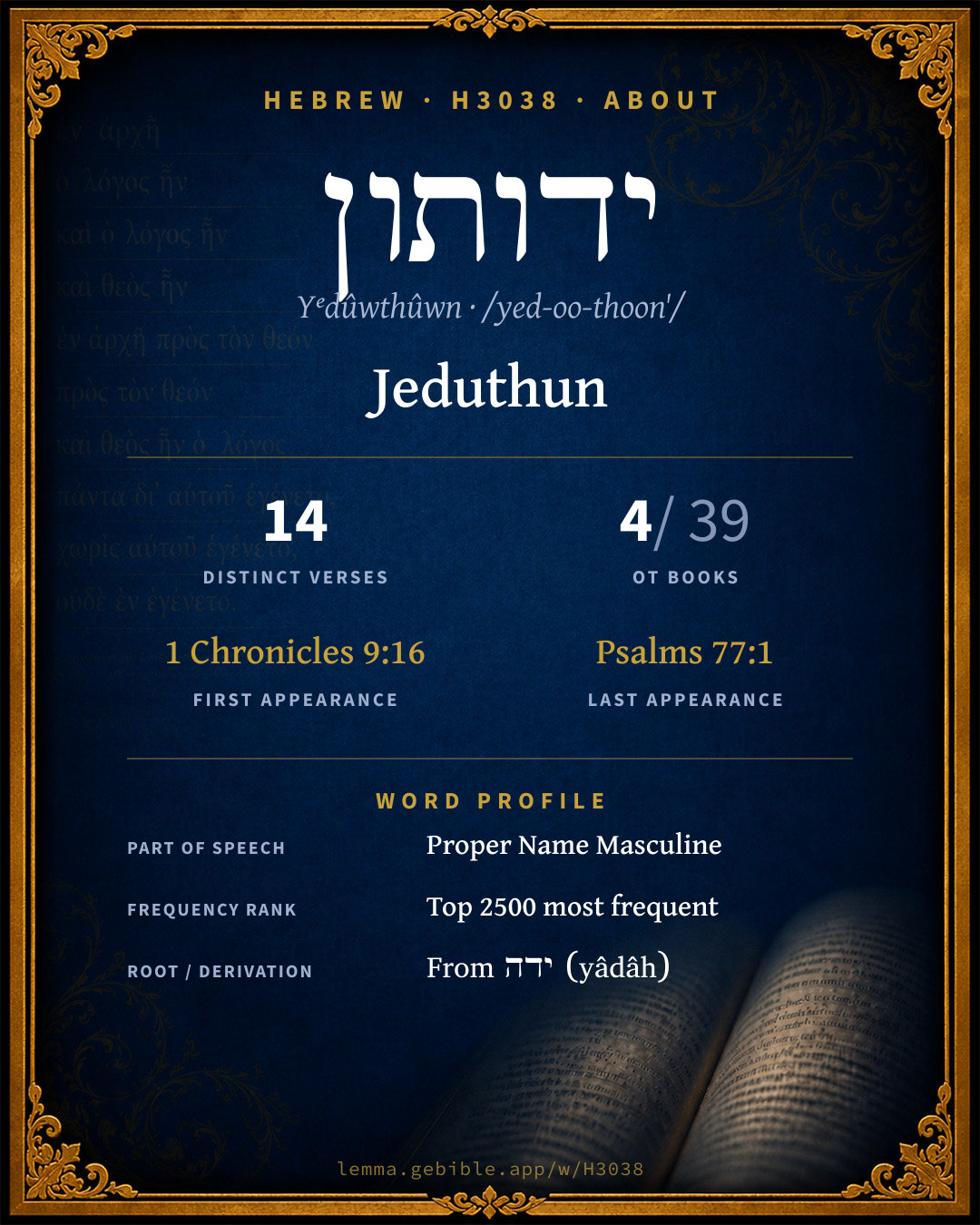
יְדוּתוּן
Jeduthun
BDB lists 2 entries for ‘Jeduthun’ fuller range ↓
Full lexicon entry — Brown-Driver-Briggs (BDB)
From Brown-Driver-Briggs (BDB)
Where this word appears
Grammar key — what these labels mean
Part of speech
- Noun
- A naming word — a person, place, thing, or idea.
Noun type
- Proper
- A name of a specific person, place, or people (e.g. Abraham, Zion, Israel).
Every verse where H3038 appears in the Book of 2 Chronicles — 3 distinct verses. Click any verse to open its interlinear word-by-word view. Verse text shown in the World English Bible for context — . Each verse’s Hebrew form is shown with its reference; the English is not keyword-highlighted, since the data carries no word-level English alignment. Use “Compare translations” on any verse to read it across multiple English versions. This concordance covers the Hebrew Bible; Septuagint (Greek Old Testament) occurrences are not indexed here.
2 Chronicles
- 2 Chronicles 5:12 לִֽ֠/ידֻתוּן prep + n Proper also the Levites who were the singers, all of them, even Asaph, Heman, Jeduthun, and their sons and their brothers, arrayed in fine linen, with cymbals and psalteries and harps, stood at the east end of the altar, and with them one hundred twenty priests sounding with trumpets;)
- 2 Chronicles 29:14 יְדוּת֔וּן n Proper and of the sons of Heman, Jehuel and Shimei; and of the sons of Jeduthun, Shemaiah and Uzziel.
- 2 Chronicles 35:15 וִֽ/ידֻתוּן֙ conj + n Proper The singers the sons of Asaph were in their place, according to the commandment of David, and Asaph, and Heman, and Jeduthun the king's seer; and the porters were at every gate: they didn't need to depart from their service; for their brothers the Levites prepared for them.
About this entry
At a glance — auto-summarized from this page’s data, not written by a person. Every figure links to its source below. This summary describes the numbers; it doesn’t interpret them.
The Hebrew name ידותון centers on the idea of “Jeduthun.” 1 Chronicles dominates its distribution — 7 of 14 verses. The Hebrew Bible uses it across 14 verses — uncommon. First canonically at 1 Chronicles 9:16, it enters the text early. For the data behind this summary, explore 14-verse concordance and the renderings breakdown below.
Gloss history
Strong's 1890 vs modern scholarship
About this word
Strong's H3038 catalogs a Hebrew word from the Hebrew Old Testament.
These counts are not copied from any lexicon or concordance. They are computed here, from the morphology-tagged Hebrew Old Testament. What Lemma adds →
- 14
- distinct verses
- The word appears in 14 distinct verses.
- 4 / 39
- OT books
- The word appears in 4 of 39 Old Testament books.
- #1,513
- by frequency
- Top 2500 most frequent Hebrew words (rank 1,513 of 8,640 Hebrew words by occurrence).
View all 14 occurrences in the concordance →
Most concentrated in
- 1 Chronicles 7 verses 50%
- 2 Chronicles 3 verses 21%
- Psalms 3 verses 21%
By section of the Old Testament
By traditional corpus
Conventional, traditional groupings — biblical authorship is debated, so this is a traditional corpus grouping, not an authorship claim. Each share is this word’s portion of its verses in that division of the Hebrew canon. Each figure is a share of the word’s 14 distinct verses.
- Writings (Ketuvim) 14 verses · 100%
How translations render this word
Counts come from each version’s own published word-to-Strong’s tagging or interlinear alignment — an approximate guide to how each version renders this word, not a word-level alignment the data otherwise carries. Because each total is that version’s own tagged count, the per-version totals vary from one another and need not match the appearance or distinct-verse counts above. These counts may also differ from a printed concordance because Lemma counts each distinctly tagged rendering and does not collapse phrase taggings into a single head-word total. This is a fixed set of word-tagged versions (KJV, ASV, BSB, ULT) and does not change with the reading translation you choose elsewhere. Each version’s license is shown beside its name below (and on Sources).
- King James Version: Jeduthun 17×
- American Standard Version: Jeduthun 14×
- Berean Standard Bible: Jeduthun 15×
- unfoldingWord Literal Text: Jeduthun 14×
King James Version Public Domain
Renders H3038 across 17 tagged occurrences — most commonly:
American Standard Version Public Domain
Renders H3038 across 14 tagged occurrences — most commonly:
Berean Standard Bible Public Domain
Renders H3038 across 15 tagged occurrences — most commonly:
Not rendered by a distinct English word in 2 further occurrences.
unfoldingWord Literal Text CC BY-SA 4.0
Renders H3038 across 14 tagged occurrences — most commonly:
Senses in BDB
The 2 senses BDB distinguishes for this word, in lexicon order (not ranked by frequency or importance). The full entry — with sub-senses — is in the Lexicon Entry tab.
- Jeduthun = "praising"
- a Levite of the family of Merari and the chief of one of the 3 choirs of the temple whose descendants also formed one of…
Word origin
n.pr.m. usually יְדוּתוּן; יְדֻתוּן 2 Ch 5:12; 35:15; יְדיּ֯תוּן ψ 39:1; 77:1; Ne 11:17; 1 Ch 16:38; chief of one of the three choirs of the temple (only Chr & ψ-titles) 1 Ch 9:16; 16:38, 41, 42; 25:3(×3), 6 2 Ch 5:12; the king’s seer 35:15; his descendants formed one of the perpetual temple choirs בְּנֵי יְדוּתוּן 1 Ch 16:42; 25:1, 3 2 Ch 29:14; בֶּן־יְדיּ֯תוּן Ne 11:17. In ψ-titles על ידותון ψ 62:1, 77:1 (Qr); לִידיּתוּן 39:1 (לְ error for על־), all = after the manner of (the choir of) Yeduthun (musical term according to RSOTJC 442, 2nd ed. 143).—v. also LagOr ii. 16ff. and n.pr. אָסָף, הֵימָן (sub אמן), אֵיתָן (sub יתן).
— Brown-Driver-Briggs (Oxford 1906, public domain), digitized via Sefaria, supplemented by the OpenScriptures HebrewLexicon (CC BY 4.0). See Sources.
Derived from ידה (yâdâh) (H3034) — to throw.
Forms in the corpus
The 17 distinct written forms H3038 takes in the Hebrew Bible, most frequent first — each parse links to that state’s occurrences in the concordance. Hebrew forms include their vowel points and cantillation, so a single lemma takes many written forms.
| Form | Parsing | Example | Uses |
|---|---|---|---|
| וִֽ/ידוּת֔וּן | Noun, Proper | 1 Chronicles 16:41 | 2 |
| יְדוּת֗וּן | Noun, Proper | Psalms 62:1 | 2 |
| ידיתון | Noun, Proper | Nehemiah 11:17 | 2 |
| וִ/ידוּת֖וּן | Noun, Proper | 1 Chronicles 25:6 | 1 |
| וִֽ/ידֻתוּן֙ | Noun, Proper | 2 Chronicles 35:15 | 1 |
| וִֽ/ידוּת֜וּן | Noun, Proper | 1 Chronicles 16:42 | 1 |
| יְדִית֛וּן | Noun, Proper | 1 Chronicles 16:38 | 1 |
| יְדוּת֑וּן | Noun, Proper | 1 Chronicles 9:16 | 1 |
| יְדוּת֔וּן | Noun, Proper | 2 Chronicles 29:14 | 1 |
| יְדוּת֖וּן | Noun, Proper | 1 Chronicles 16:42 | 1 |
| יְדוּת֡וּן | Noun, Proper | 1 Chronicles 25:3 | 1 |
| יְדוּתֽוּן | Noun, Proper | Nehemiah 11:17 | 1 |
| יְדוּתוּן֙ | Noun, Proper | 1 Chronicles 25:3 | 1 |
| ל/ידיתון | Noun, Proper | Psalms 39:1 | 1 |
| לִ/ידוּת֑וּן | Noun, Proper | 1 Chronicles 25:3 | 1 |
| לִֽ/ידוּת֗וּן | Noun, Proper | Psalms 39:1 | 1 |
| לִֽ֠/ידֻתוּן | Noun, Proper | 2 Chronicles 5:12 | 1 |
Same root — word family
Other BDB entries built from the same root as H3038, grouped by Strong’s listed origin. These share a root / origin per the lexicon — not necessarily a shared meaning. Each links to that word’s own entry.
Derives from
Shares the same root
Proper names from this root
People and places named from this root — a name, not an additional meaning of the word.
Compare all same-root words → Showing 4 of 9 — not the complete family. 4 of the same-root words are proper names (people or places). They share a root, not necessarily a meaning.
Bible dictionary
Public-domain dictionary articles matched to this entry by name (Jeduthun). A biblical name can be shared by more than one person or place, so an article may treat several.
Easton's Bible Dictionary · M. G. Easton, 1897
Lauder; praising, a Levite of the family of Merari, and one of the three masters of music appointed by David (1 Chr. 16:41, 42; 25:1-6). He is called in 2 Chr. 35:15 "the king's seer." His descendants are mentioned as singers and players on instruments (Neh. 11:17). He was probably the same as Ethan (1 Chr. 15:17, 19). In the superscriptions to Ps. 39, 62, and 77, the words "upon Jeduthun" probably denote a musical instrument; or they may denote the style or tune invented or introduced by Jeduthun, or that the psalm was to be sung by his choir.
Smith's Bible Dictionary · William Smith, 1863
(praising), a Levite of the family of Merari, is probably the same as Ethan. Comp. (1 Chronicles 15:17,19) with 1Chr 16:41,42; 25:1,3,6; 2Chr 35:15 His office was generally to preside over the music of the temple service, Jeduthun's name stands at the head of the 39th, 62d and 77th Psalms, indicating probably that they were to be sung by his choir. (B.C. 1014.)
Hitchcock's Bible Names Dictionary · Roswell D. Hitchcock, 1869
his law; giving praise
Classic public-domain reference works; full attribution on Sources.
Septuagint verse parallels
This word appears in 13 verses that also exist in the Greek Old Testament (Septuagint), out of the 14 Hebrew verses it occurs in. You can read those verses in Greek by switching the Old Testament edition to the Septuagint.
Read these verses in the Septuagint
This is a verse-level parallel only — the same verses exist in both the Hebrew and Greek Old Testaments. No word-level Hebrew↔Greek correspondence is claimed: the data carries no such alignment, so no Greek word is shown as this Hebrew word’s translation. Coverage is not total — the Septuagint omits the deuterocanon and renumbers the Psalms, so some Hebrew verses have no direct Greek parallel.