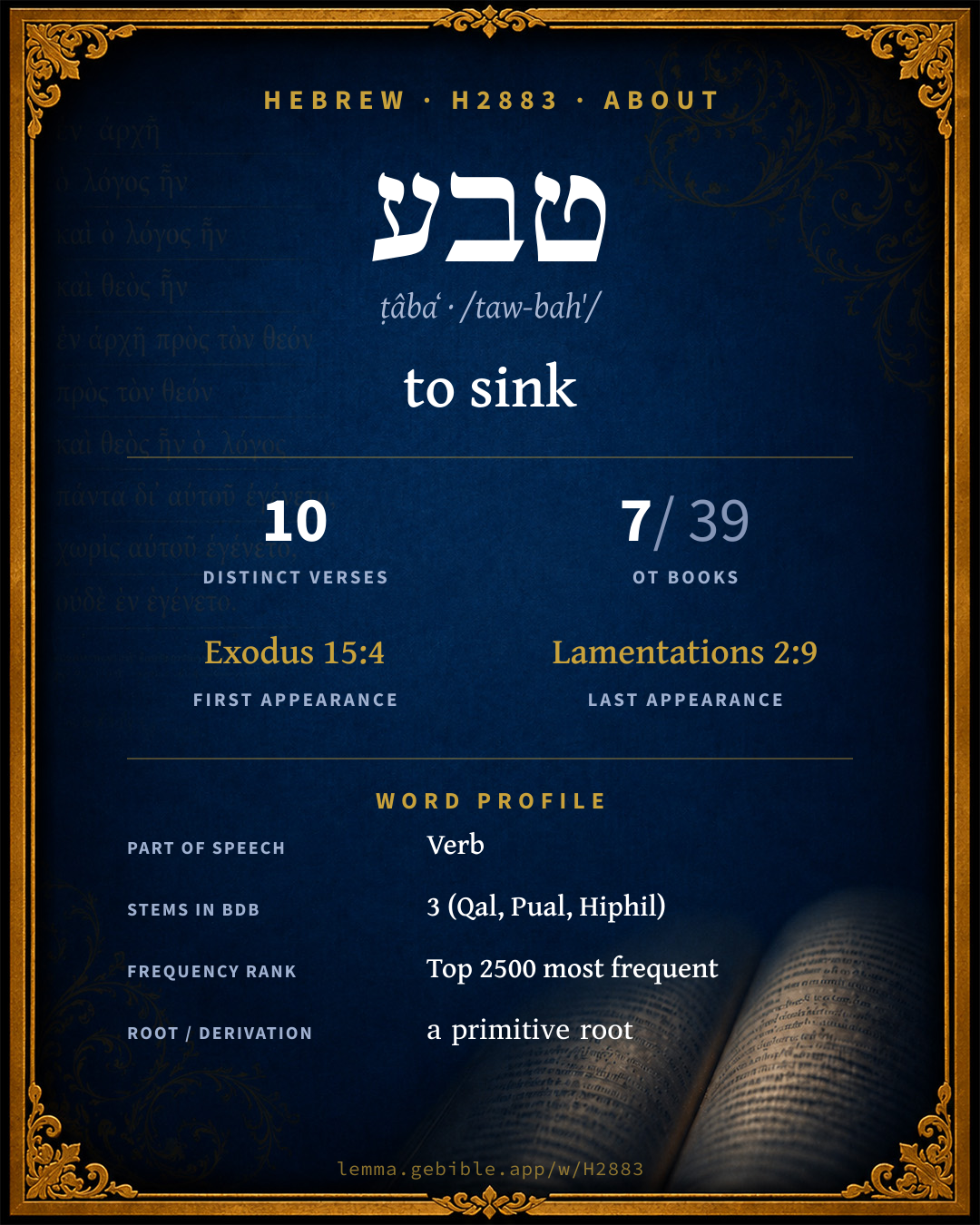
טָבַע
to sink
also: sink into, sink down, pierce, settle down fuller range ↓
Full lexicon entry — Brown-Driver-Briggs (BDB)
From Brown-Driver-Briggs (BDB)
Where this word appears
See every Hophal verb in the Hebrew Bible →
Grammar key — what these labels mean
Part of speech
- Verb
- An action or state-of-being word.
Stem
- Hophal
- The passive counterpart of the Hiphil (“he was caused to…”).
- Qal
- The basic, simple active stem — the plain form of the verb (“he wrote”). Here: ‘sink’
- Pual
- The passive counterpart of the Piel.
Form
- Perfect
- A completed action or state — Hebrew marks aspect (completeness) more than strict tense (“he wrote”).
- Sequential Imperfect
- An imperfect with prefixed waw — the standard past-narrative form (waw-consecutive imperfect).
- Cohortative
- A first-person volitional form expressing wish or resolve (“let me / let us write”).
Person
- 3rd Person
- The one spoken about (“he / she / it / they”).
- 1st Person
- The speaker (“I / we”).
Gender
- Common
- Either gender — not distinguished for this form.
- Feminine
- Grammatically feminine.
- Masculine
- Grammatically masculine.
Number
- Plural
- More than one (in Hebrew, generally three or more).
- Singular
- One.
1 verse where H2883 appears in the Hophal stem in the Book of Jeremiah. Filtered view — show all forms. Click any verse to open its interlinear word-by-word view. Verse text shown in the World English Bible for context — . Each verse’s Hebrew form is shown with its reference; the English is not keyword-highlighted, since the data carries no word-level English alignment. Use “Compare translations” on any verse to read it across multiple English versions. This concordance covers the Hebrew Bible; Septuagint (Greek Old Testament) occurrences are not indexed here.
Jeremiah
About this entry
At a glance — auto-summarized from this page’s data, not written by a person. Every figure links to its source below. This summary describes the numbers; it doesn’t interpret them.
At its core, טבע (ṭâbaʻ) means “to sink.” First canonically at Exodus 15:4, it enters the text early. It appears 10 verses across 7 books of the Hebrew Bible, among its uncommon vocabulary. The word gravitates to Psalms (30%), then Jeremiah and Exodus. Different stems carry different senses — BDB groups them under 3 stems, among them Qal and Pual. Dig into 10-verse concordance and the renderings breakdown below.
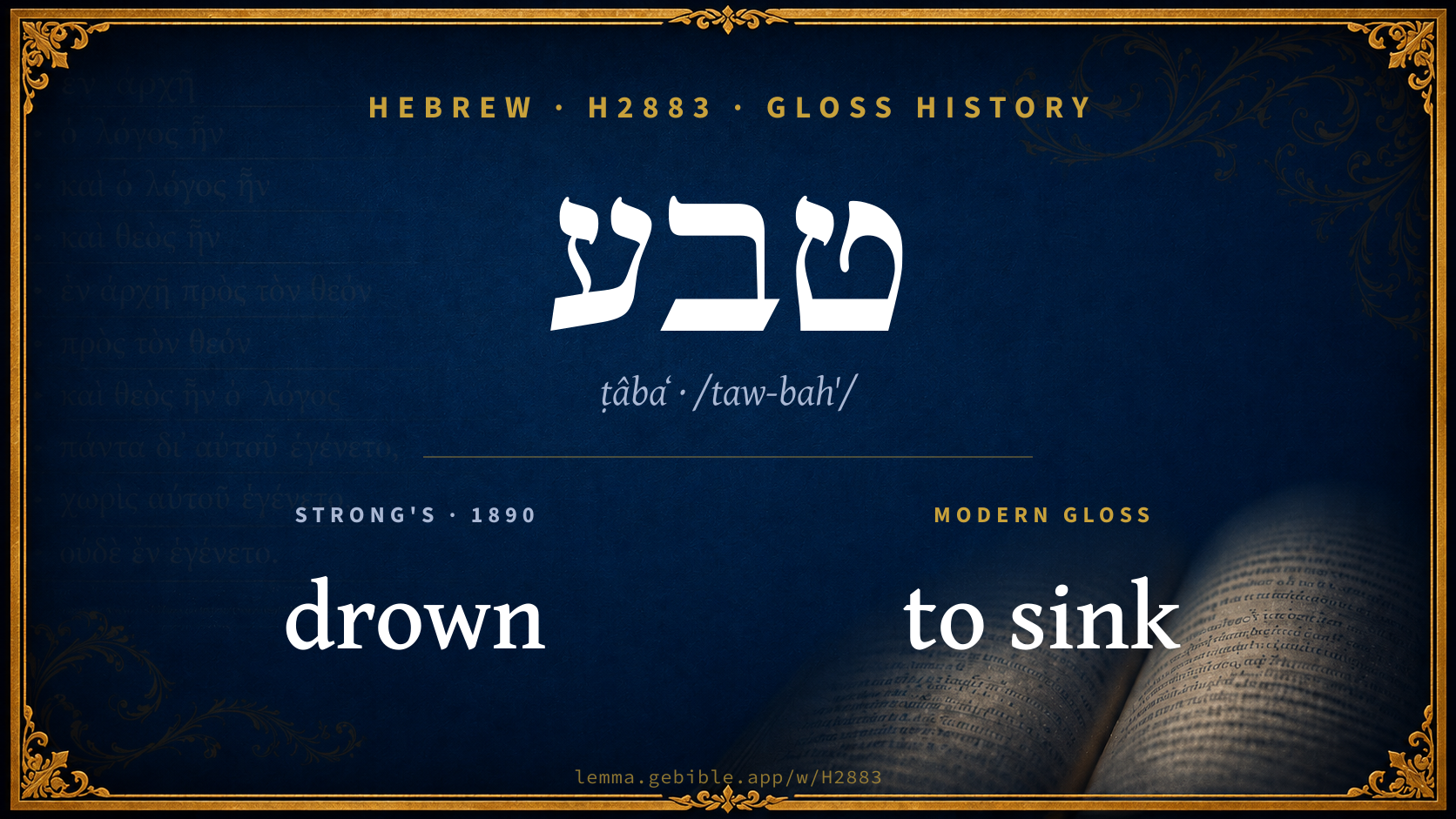
Gloss history
Strong's 1890 vs modern scholarship
About this word
Strong's H2883 catalogs a Hebrew word from the Hebrew Old Testament.
These counts are not copied from any lexicon or concordance. They are computed here, from the morphology-tagged Hebrew Old Testament. What Lemma adds →
- 10
- distinct verses
- The word appears in 10 distinct verses.
- 7 / 39
- OT books
- The word appears in 7 of 39 Old Testament books.
- #2,342
- by frequency
- Top 2500 most frequent Hebrew words (rank 2,342 of 8,640 Hebrew words by occurrence).
View all 10 occurrences in the concordance →
By section of the Old Testament
By traditional corpus
Conventional, traditional groupings — biblical authorship is debated, so this is a traditional corpus grouping, not an authorship claim. Each share is this word’s portion of its verses in that division of the Hebrew canon. Each figure is a share of the word’s 10 distinct verses.
- Writings (Ketuvim) 6 verses · 60%
- Prophets (Nevi'im) 3 verses · 30%
- Torah (Pentateuch) 1 verse · 10%
How translations render this word
Counts come from each version’s own published word-to-Strong’s tagging or interlinear alignment — an approximate guide to how each version renders this word, not a word-level alignment the data otherwise carries. Because each total is that version’s own tagged count, the per-version totals vary from one another and need not match the appearance or distinct-verse counts above. These counts may also differ from a printed concordance because Lemma counts each distinctly tagged rendering and does not collapse phrase taggings into a single head-word total. This is a fixed set of word-tagged versions (KJV, ASV, BSB, ULT) and does not change with the reading translation you choose elsewhere. Each version’s license is shown beside its name below (and on Sources).
- King James Version: Are sunk 2×, Sunk 2×
- American Standard Version: Are sunk 2×, Sank 2×
- Berean Standard Bible: Sank 2×
- unfoldingWord Literal Text: Sank 2×
King James Version Public Domain
Renders H2883 across 10 tagged occurrences — most commonly:
Plus 6 renderings that appear only once — usually multi-word phrases or single function words the recovered tagging swept in, not distinct renderings.
American Standard Version Public Domain
Renders H2883 across 10 tagged occurrences — most commonly:
Plus 6 renderings that appear only once — usually multi-word phrases or single function words the recovered tagging swept in, not distinct renderings.
Berean Standard Bible Public Domain
Renders H2883 across 10 tagged occurrences — most commonly:
Plus 8 renderings that appear only once — usually multi-word phrases or single function words the recovered tagging swept in, not distinct renderings.
unfoldingWord Literal Text CC BY-SA 4.0
Renders H2883 across 11 tagged occurrences — most commonly:
Plus 9 renderings that appear only once — usually multi-word phrases or single function words the recovered tagging swept in, not distinct renderings.
Senses in the full BDB
Hebrew verbs can shift meaning by stem (binyan): Qal is the basic action, Niphal is often passive or reflexive, Piel often intensifies or makes it factitive, and Hiphil is typically causative. The senses below are grouped under the stem BDB assigns to each. This entry also uses Pual (the passive of Piel).
What do BDB’s symbols mean?
BDB uses these scholarly abbreviations:
| Symbol | Meaning |
|---|---|
| 𝔊 | the Septuagint (the ancient Greek translation, LXX) |
| 𝔙 | the Vulgate (the Latin translation) |
| 𝔖 | the Syriac version (the Peshitta) |
| 𝔗 | the Targum (the Aramaic translation) |
| ψ | the Psalms |
| √ | root (the underlying root or stem) |
| ‖ | parallel passage (a synonymous or contrasted parallel) |
| † | the dagger: every passage where the word occurs is cited |
The 3 senses and sub-senses the full Brown-Driver-Briggs lexicon distinguishes for this word, in lexicon order (not ranked by frequency), with BDB’s own verbatim wording and sub-sense lettering. Shown in Hebrew script with BDB’s own scholarly abbreviations. The condensed entry is in the Lexicon Entry tab. See also the Forms in the corpus table below.
Qal
- sink, sink down, intrans.
Pual
- . be sunk
Hiphil
- . be sunk; of pedestals of the earth, as settled, planted
Senses from the full Brown-Driver-Briggs lexicon (Brown, Driver, Briggs; Oxford 1906 — public domain), digitized via Sefaria, supplemented by the OpenScriptures HebrewLexicon (CC BY 4.0). Full attribution on Sources.
Word origin
טָבַע vb. sink, sink down
— Brown-Driver-Briggs (Oxford 1906, public domain), digitized via Sefaria, supplemented by the OpenScriptures HebrewLexicon (CC BY 4.0). See Sources.
Origin: a primitive root
Jastrow Dictionary
A second Hebrew/Aramaic lexicon for comparison, covering Aramaic and post-biblical (Talmudic, Targumic, Midrashic) usage that the biblical-Hebrew BDB does not. Matched by lemma rather than by Strong’s number, so a lemma may carry more than one Jastrow headword (shown separately below), and the entries cover usage well beyond the Bible.
טָבַע I
- 1. (act. verb) to sink, drown. Gitt. 56ᵇ לטוֹבְעוֹ to drown him (sink his ship). Ib. טְבָעוֹ He drowned him; a. fr.
- 2. (neut. verb) to sink, be drowned. Ber. 16ᵇ טָבְעָה ספינתו וכ׳ if his ship went down &c. Meg. 10ᵇ; Snh. 39ᵇ מעשה ידי טוֹבְעִין וכ׳ my creatures (Egyptians) are perishing in the sea, and you want to sing?; a. e.
- to sink. Yalk. Gen. 120 ה׳ האבן He made the stone sink down to the depth &c.; (Pirké d’R. El. ch. XXXV, וטָבְעָה האבן; Midr. Till. to Ps. XCI, end וטבע אותה). Yalk. Ex. 241 להַטְבִּיעַ את מצרים to drown the Egyptians; a. e.
טְבַע
- Targ. Y. Gen. IV, 8.—Targ. I Sam. XVII, 49; a. e.—Pes. 40ᵇ ארבא … דטָבְעָא וכ׳ a ship with wheat sank &c. Sabb. 108ᵇ מעולם לא ט׳ וכ׳ never was yet a man drowned in the Lake of Sodom. B. Bath. 153ᵃ אמרה לִיטְבַּע ארביה (Ms. H. אמרה ליה טבאי וכ׳, Ar. אמרה לו טבאי) said she, May his (thy) ship go under; a. e.—[Targ. Y. Deut. XXVIII, 29 טביעין some ed., read. תב׳, v. תְּבַע.]
- to sink. B. Bath. 73ᵃ גלא דמְטַבַּע וכ׳ the wave which threatens to sink the ship. Ḥull. 60ᵃ אתא מיטרא טַבְּעֵיה בימא there came a rain and sank the provision into the sea.
- to be sunk. Targ. O. Ex. XV, 4.
טָבַע II
- [to round, shape, denom. טֶבַע, fr. which טָבַע]
- 1. to coin. Snh. IV, 5 (37ᵃ) אדם טוֹבֵעַ כמה מטבעות וכ׳, v. חוֹתָם; Y. ib. VI, 22ᵇ bot.; a. e.—Trnsf. to formulate. Gitt. 5ᵇ, a. e. כל המשנה ממטבע שטָבְעוּ וכ׳ he who deviates from the formula of the deed of divorce which the scholars have fixed. Ber. 40ᵇ כל המשנה … שט׳ … בברכות he who changes the formula of benedictions which &c.; a. fr.
- 2. to specify, mention explicitly. Num. R. s. 20 (ref. to Deut. XXVII, 12, sq.) בברכות היה מזכירן … לא היה טוֹבְעָן in ordering blessings He mentioned them (the people) …, but in ordering curses He did not mention them explicitly; (Tanḥ. Balak 12 לא היה מזכירם; ed. Bub. 18 תובען, Yalk. Num. 766 תובעין, incorr.) e.g. Deuteronomy 27:12
טְבַע ²
- , to assume shape. Targ. Prov. VIII, 25 נִטְבְּעוּן.
טֶבַע
- (v. טָבַע II)
- 1. coin, medal. טִבְעוֹ של פ׳ יצא one’s coin passes, i.e. one’s authority is recognized. Shebu. 6ᵇ זו רומי חייבת שטִיבְעָהּ וכ׳ Ms. M. (ed. פרס) that is wicked Rome whose government is recognized all over the world. Meg. 14ᵇ לא יצא טִבְעֲךָ בעולם thou art not yet the legitimate king; cmp. מוֹנִיטָא. [Y. Ber. V, 9ᵇ מטבעה של תפלה ed. Lehm., oth. ed. מטביעה, v. מַטְבֵּעַ.]
- 2. Tebʿa, a coin equal to half a Sela. Y. Shek. II, 46ᵈ top (the ten brothers) sold Rachel’s first-born for twenty silver pieces (denars) ונפל לכל א׳ וא׳ מהם ט׳ so that a Tebʿa came upon each (Bab. ed. טבעה, טיבעה, Ms. M. טובע).—Pl. טְבָעִים, טְבָעִין (טוֹבְעִין, fr. טוֹבַע). Shek. II, 4. Y. l. c. טו׳ פלגי סלעין (Bab. טבעין) tibʿin i.e. half-Shekels.
- 3. that which is to be shaped, substance, element.—Pl. as ab. Num. R. s. 14 כנגד ארבעה ט׳ וכ׳ corresponding to the four elements of which the Lord created &c. [In later Hebr.: nature, character; Nature.]
טְבַע II
- , coin;Tebʿa. Targ. Y. Gen. XXIV, 22 Levita (ed. דרכמונא; v. Y. Shek. II, 46ᵈ top, quot. in preced.). Targ. Y. Ex. XXX, 13 (ed. Amst. טַבְעָא). Targ. II Esth. VI, 10 טִבְעִי וטִבְעָךְ אזיל וכ׳, v. preced.—B. Mets. 46ᵃ דליכא עלייהו ט׳ which have no stamp. Ib. 44ᵇ הוי ט׳ is considered as coin (money), opp. to פירא merchandise. Shebu. 6ᵇ ט׳ דמאן וכ׳ the coin of which goes farther (whose power is greater)?—Nidd. 20ᵇ ט׳ דבבל וכ׳ the Babylonian coin (which I could not understand) was the cause &c.; a. fr.—Pl. טִבְעֵי. B. Mets. 25ᵃ ט׳ מכריז Ms. H. a. R. (ed. sing.). he publishes that he has found ‘coins’.
A Dictionary of the Targumim, the Talmud Babli and Yerushalmi, and the Midrashic Literature (Marcus Jastrow; London, Luzac, 1903) — Public Domain. Digitized via Sefaria. Digitized via Sefaria. Full attribution on Sources.
Forms in the corpus
The 9 distinct written forms H2883 takes in the Hebrew Bible, most frequent first — each parse links to that stem’s occurrences in the concordance. Hebrew forms include their vowel points and cantillation, so a single lemma takes many written forms.
| Form | Parsing | Example | Uses |
|---|---|---|---|
| הָטְבָּ֑עוּ | Verb, Hophal, Perfect, 3rd Person, Common, Plural | Job 38:6 | 2 |
| אֶטְבָּ֑עָה | Verb, Qal, Cohortative, 1st Person, Common, Singular | Psalms 69:14 | 1 |
| הָטְבְּע֥וּ | Verb, Hophal, Perfect, 3rd Person, Common, Plural | Jeremiah 38:22 | 1 |
| וַ/יִּטְבַּ֥ע | Verb, Qal, Sequential Imperfect, 3rd Person, Masculine, Singular | Jeremiah 38:6 | 1 |
| וַ/תִּטְבַּ֤ע | Verb, Qal, Sequential Imperfect, 3rd Person, Feminine, Singular | 1 Samuel 17:49 | 1 |
| טָבְע֣וּ | Verb, Qal, Perfect, 3rd Person, Common, Plural | Psalms 9:15 | 1 |
| טָבְע֤וּ | Verb, Qal, Perfect, 3rd Person, Common, Plural | Lamentations 2:9 | 1 |
| טָבַ֤עְתִּי | Verb, Qal, Perfect, 1st Person, Common, Singular | Psalms 69:2 | 1 |
| טֻבְּע֥וּ | Verb, Pual, Perfect, 3rd Person, Common, Plural | Exodus 15:4 | 1 |
Same root — word family
Other BDB entries built from the same root as H2883, grouped by Strong’s listed origin. These share a root / origin per the lexicon — not necessarily a shared meaning. Each links to that word’s own entry.
Derived from this word
Compare all same-root words → They share a root, not necessarily a meaning.
Septuagint verse parallels
This word appears in 8 verses that also exist in the Greek Old Testament (Septuagint), out of the 10 Hebrew verses it occurs in. You can read those verses in Greek by switching the Old Testament edition to the Septuagint.
Read these verses in the Septuagint
This is a verse-level parallel only — the same verses exist in both the Hebrew and Greek Old Testaments. No word-level Hebrew↔Greek correspondence is claimed: the data carries no such alignment, so no Greek word is shown as this Hebrew word’s translation. Coverage is not total — the Septuagint omits the deuterocanon and renumbers the Psalms, so some Hebrew verses have no direct Greek parallel.