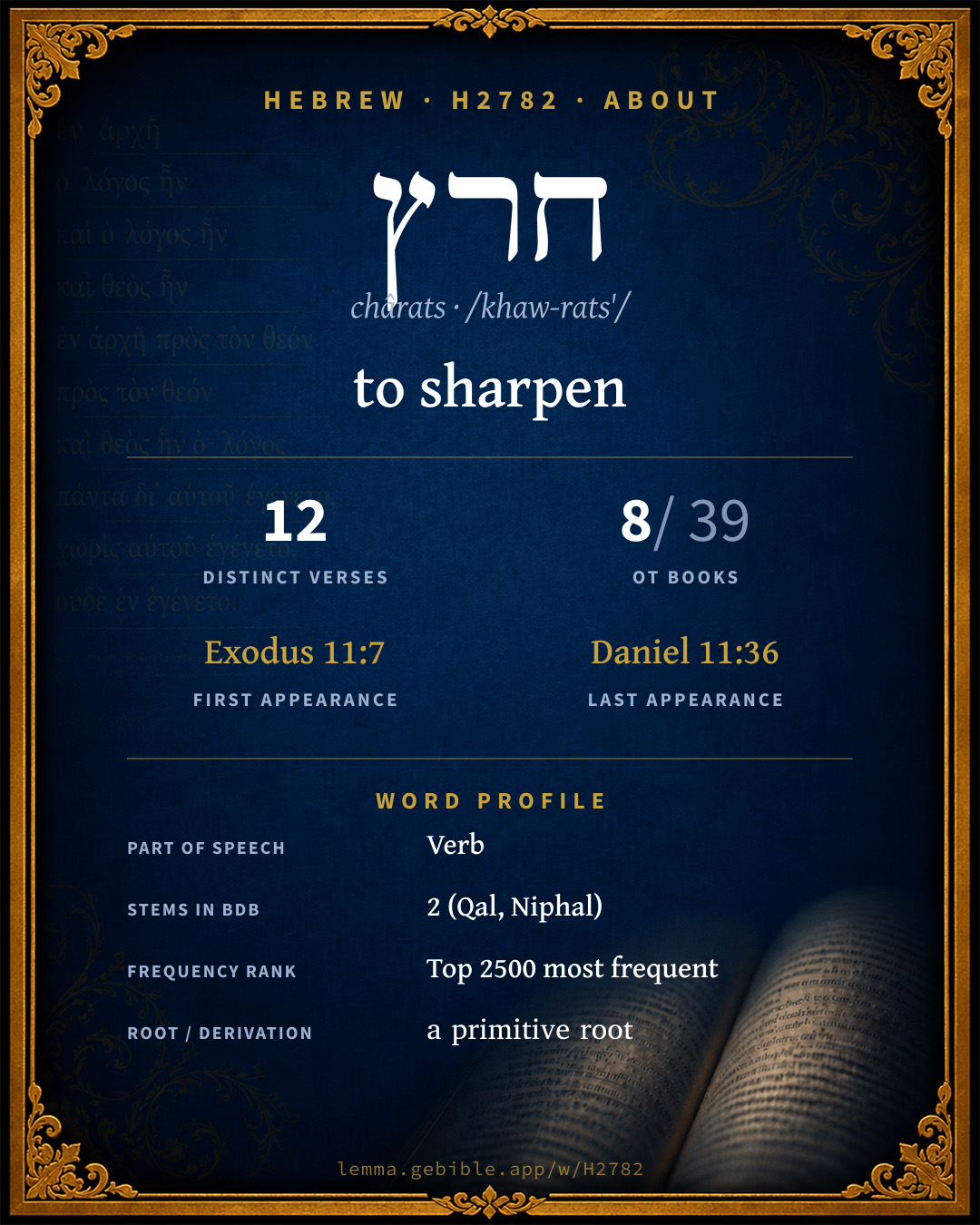
חָרַץ
to sharpen
‘to sharpen’ is one of 2 main senses fuller range ↓
Full lexicon entry — Brown-Driver-Briggs (BDB)
From Brown-Driver-Briggs (BDB)
Where this word appears
Grammar key — what these labels mean
Part of speech
- Verb
- An action or state-of-being word.
Stem
- Niphal
- Usually the simple passive or reflexive of the Qal (“he was written”).
- Qal
- The basic, simple active stem — the plain form of the verb (“he wrote”). Here: ‘cut’
Form
- Participle Active
- A verbal adjective expressing ongoing or characteristic action (“writing / one who writes”).
- Participle Passive
- A verbal adjective expressing action received (“written”).
- Imperfect
- An incomplete, ongoing, or future action (“he will / would write”).
- Perfect
- A completed action or state — Hebrew marks aspect (completeness) more than strict tense (“he wrote”).
State
- Absolute
- The independent form of a noun, not bound to a following word.
Person
- 2nd Person
- The one addressed (“you”).
- 3rd Person
- The one spoken about (“he / she / it / they”).
Gender
- Feminine
- Grammatically feminine.
- Masculine
- Grammatically masculine.
Number
- Singular
- One.
- Plural
- More than one (in Hebrew, generally three or more).
Every verse where H2782 appears in the Book of Daniel — 3 distinct verses. Click any verse to open its interlinear word-by-word view. Verse text shown in the World English Bible for context — . Each verse’s Hebrew form is shown with its reference; the English is not keyword-highlighted, since the data carries no word-level English alignment. Use “Compare translations” on any verse to read it across multiple English versions. This concordance covers the Hebrew Bible; Septuagint (Greek Old Testament) occurrences are not indexed here.
Daniel
- Daniel 9:26 נֶחֱרֶ֖צֶת Niphal ptcp.pass fs After the sixty-two weeks the Anointed One shall be cut off, and shall have nothing: and the people of the prince who shall come shall destroy the city and the sanctuary; and the end of it shall be with a flood, and even to the end shall be war; desolations are determined.
- Daniel 9:27 וְ/נֶ֣חֱרָצָ֔ה conj + Niphal ptcp.act fs He shall make a firm covenant with many for one week: and in the midst of the week he shall cause the sacrifice and the offering to cease; and on the wing of abominations [shall come] one who makes desolate; and even to the full end, and that determined, shall [wrath] be poured out on the desolate.
- Daniel 11:36 נֶחֱרָצָ֖ה Niphal ptcp.pass fs The king shall do according to his will; and he shall exalt himself, and magnify himself above every god, and shall speak marvelous things against the God of gods; and he shall prosper until the indignation be accomplished; for that which is determined shall be done.
About this entry
At a glance — auto-summarized from this page’s data, not written by a person. Every figure links to its source below. This summary describes the numbers; it doesn’t interpret them.
“to sharpen” is the headline sense of the Hebrew verb חרץ (chârats). First canonically at Exodus 11:7, it enters the text early. It turns up in 12 verses across 8 books, an uncommon footprint. It concentrates in Isaiah, which alone accounts for 25% of its uses. Across 2 stems, its meaning turns on the binyan (Qal, Niphal). See the sense tree, 12-verse concordance, and the renderings breakdown below.
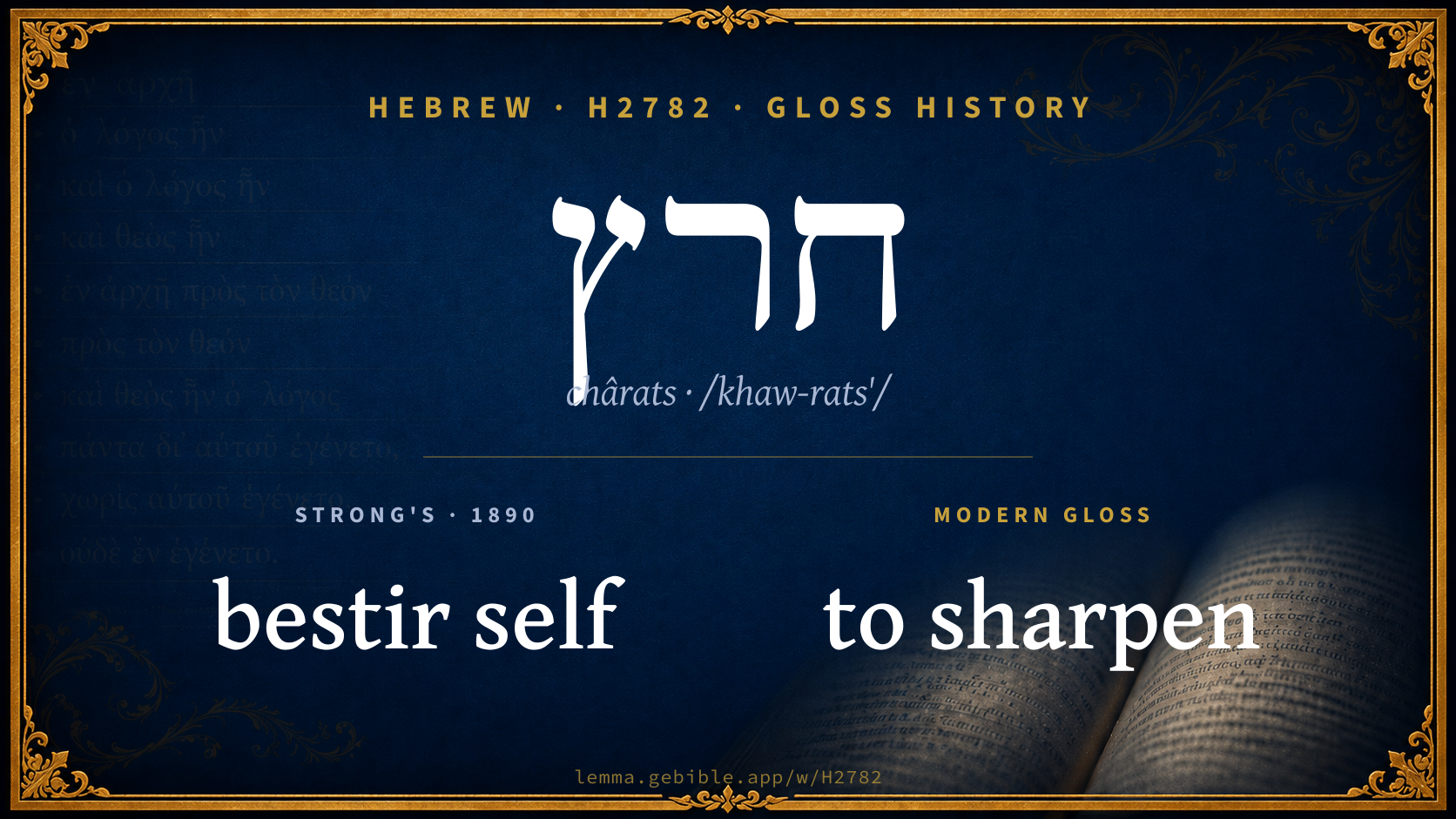
Gloss history
Strong's 1890 vs modern scholarship
About this word
Strong's H2782 catalogs a Hebrew word from the Hebrew Old Testament.
These counts are not copied from any lexicon or concordance. They are computed here, from the morphology-tagged Hebrew Old Testament. What Lemma adds →
- 12
- distinct verses
- The word appears in 12 distinct verses.
- 8 / 39
- OT books
- The word appears in 8 of 39 Old Testament books.
- #2,101
- by frequency
- Top 2500 most frequent Hebrew words (rank 2,101 of 8,640 Hebrew words by occurrence).
View all 12 occurrences in the concordance →
By section of the Old Testament
By traditional corpus
Conventional, traditional groupings — biblical authorship is debated, so this is a traditional corpus grouping, not an authorship claim. Each share is this word’s portion of its verses in that division of the Hebrew canon. Each figure is a share of the word’s 12 distinct verses.
- Prophets (Nevi'im) 6 verses · 50%
- Writings (Ketuvim) 4 verses · 33%
- Torah (Pentateuch) 2 verses · 17%
How translations render this word
Counts come from each version’s own published word-to-Strong’s tagging or interlinear alignment — an approximate guide to how each version renders this word, not a word-level alignment the data otherwise carries. Because each total is that version’s own tagged count, the per-version totals vary from one another and need not match the appearance or distinct-verse counts above. These counts may also differ from a printed concordance because Lemma counts each distinctly tagged rendering and does not collapse phrase taggings into a single head-word total. This is a fixed set of word-tagged versions (KJV, ASV, BSB, ULT) and does not change with the reading translation you choose elsewhere. Each version’s license is shown beside its name below (and on Sources).
BDB lists this Strong’s number as 6 distinct words (homographs). Each count above pools all of them and is not split by sense — see the Senses section below. A low-frequency rendering may belong to a different one of those words, not the primary meaning.
- King James Version†: Determined 3×, Are determined 2×
- American Standard Version†: Are determined 2×, Determined 2×, Is determined 2×
- Berean Standard Bible†: Decreed 2×, Has been decreed 2×
- unfoldingWord Literal Text†: Is decreed 3×
King James Version Public Domain
Renders H2782 across 12† tagged occurrences — most commonly:
Plus 7 renderings that appear only once — usually multi-word phrases or single function words the recovered tagging swept in, not distinct renderings.
American Standard Version Public Domain
Renders H2782 across 12† tagged occurrences — most commonly:
Plus 6 renderings that appear only once — usually multi-word phrases or single function words the recovered tagging swept in, not distinct renderings.
Berean Standard Bible Public Domain
Renders H2782 across 11† tagged occurrences — most commonly:
Plus 7 renderings that appear only once — usually multi-word phrases or single function words the recovered tagging swept in, not distinct renderings.
unfoldingWord Literal Text CC BY-SA 4.0
Renders H2782 across 13† tagged occurrences — most commonly:
Plus 10 renderings that appear only once — usually multi-word phrases or single function words the recovered tagging swept in, not distinct renderings.
7 senses and sub-senses in the full BDB
Hebrew verbs can shift meaning by stem (binyan): Qal is the basic action, Niphal is often passive or reflexive, Piel often intensifies or makes it factitive, and Hiphil is typically causative. The senses below are grouped under the stem BDB assigns to each.
What do BDB’s symbols mean?
BDB uses these scholarly abbreviations:
| Symbol | Meaning |
|---|---|
| 𝔊 | the Septuagint (the ancient Greek translation, LXX) |
| 𝔙 | the Vulgate (the Latin translation) |
| 𝔖 | the Syriac version (the Peshitta) |
| 𝔗 | the Targum (the Aramaic translation) |
| ψ | the Psalms |
| √ | root (the underlying root or stem) |
| ‖ | parallel passage (a synonymous or contrasted parallel) |
| † | the dagger: every passage where the word occurs is cited |
The 7 senses and sub-senses the full Brown-Driver-Briggs lexicon distinguishes for this word, in lexicon order (not ranked by frequency), with BDB’s own verbatim wording and sub-sense lettering. Shown in Hebrew script with BDB’s own scholarly abbreviations. The condensed entry is in the Lexicon Entry tab. See also the Forms in the corpus table below.
חרץ I cut, sharpen, decide (NH id., cut in, decide, Aramaic in deriv.
Qal
- Pf. 3 ms. ח׳ Jos 10:21; חָרָ֑צְתָּ 1 K 20:40; Impf. יֶחֱרַץ־ Ex 11:7; 2 ms. תֶּחֱרָ֑ץ 2 S 5:24; Pt. pass. חָרוּץ Is 10:22 Lv 22:22; pl. חֲרוּצִים Jb 14:5 (v. also חָרוּץ infr.)— e.g. Joshua 10:21
- 1. cut, mutilate Lv 22:22 (עַוֶּרֶת אוֹ שָׁבוּר אוֹ־חָרוּץ אוֹ יַבֶּלֶת). e.g. Leviticus 22:22
- 2. sharpen, fig. the tongue, לֹא יֶח׳־כֶּלֶב לְשֹׁנוֹ לְ Ex 11:7 (J), i.e. utter no sound against Isr., Jos 10:21. e.g. Exodus 11:7
- 3. decide 1 K 20:40 (abs.); so pt. pass. חרוצים ימיו Jb 14:5 his days are determined, fixed (‖ מִסְפַּר חדשׁיו), Is 10:22 כִּלָּיוֹן ח׳; act with decision 2 S 5:24. e.g. 1 Kings 20:40
Niphal
- Pt. נֶחֱרָצָה Is 10:23 + 3 times; נֶחֱרֶצֶת Dn 9:26 (both these forms inf. cstr. according to BaNB 90); decisive כָּלָה וְנֶח׳ Is 10:23; 28:22 Dn 9:27 a consumption and strict decision (i.e. that which is strictly determined), כי נ׳ נֶעֱשָׂ֑תָה Dn 11:36; נח׳ שֹׁמֵמוֹת Dn 9:26 strict determining of desolation. e.g. Isaiah 10:23
חרץ II sharp, diligent (on this and foll. v. BaNB 173)
- 1. sharp: of threshing instrument מוֹרָג ח׳ חָדָשׁ Is 41:15; without מ׳, as subst., 28:27 (where יוּדַשׁ); ח׳ הַבַּרְזֶל Am 1:3; Jb 41:22 (fig. of crocodile). e.g. Isaiah 41:15
- 2. fig. diligent: as subst. Pr 21:5; opp. רְמִיָּה Pr 10:4; 12:24, 27; opp. עָצֵל Pr 13:4.—Dn 9:25 v. iv. חרוץ. e.g. Proverbs 21:5
חרץ III [m.] strict decision, only עֵמֶק הֶחָרוּץ Jo 4
חרץ IV [m.] trench, moat (Aramaic חֲרִיצָא
חרץ V m. father of king Amon’s mother 2 K 21
Senses from the full Brown-Driver-Briggs lexicon (Brown, Driver, Briggs; Oxford 1906 — public domain), digitized via Sefaria, supplemented by the OpenScriptures HebrewLexicon (CC BY 4.0). Full attribution on Sources.
Word origin
I. vb. cut, sharpen, decide (NH id., cut in, decide, Aramaic in deriv.; Assyrian ḫarâṣu, dig, decide, ḫariṣu, trench, ZehnpfundBAS i. 502; Ph. חרץ decision, HoffmAGG xxxvi. May 1889, 11)—
I. adj. sharp, diligent (on this and foll. v. BaNB 173)—חָרוּץ Is 28:27 + 11 times; pl. חֲרוּצִים Pr 10:4; 12:24; חֲרֻצִים Pr 13:4; חֲרֻצוֹת Am 1:3;—
II. n.[m.] strict decision, only עֵמֶק הֶחָרוּץ Jo 4:14(×2) valley of strict decision (v. Bal. c.).
III. n.[m.] trench, moat (Aramaic חֲרִיצָא; Assyrian ḫariṣu, ḫiriṣu, id., DlHWB)—only in רְחוֹב וְח׳ Dn 9:25, si vera l.; as above Ges Herzf Ew Zö Meinh (q.v.); Gr רְחוֹב וחיץ; רְחוֹב וָחוּץ with public places and streets.
IV. n.pr.m. father of king Amon’s mother 2 K 21:19, 𝔊 Αρους.
V. n.m. Pr 8:10 gold, poet. (Ph. חרץ, v. DrSm xxviii.; Assyrian ḫurâṣu)—חָרוּץ ψ 68:14 + 5 times; gold, always ‖ כֶּסֶף; Zc 9:3, of dove’s wings ψ 68:14 בִּירַקְרַק ח׳; elsewhere in comparison with value of wisdom, etc. Pr 3:14; 8:10 (ח׳ נִבְחָר) v 19; 16:16.
— Brown-Driver-Briggs (Oxford 1906, public domain), digitized via Sefaria, supplemented by the OpenScriptures HebrewLexicon (CC BY 4.0). See Sources.
Origin: a primitive root
Jastrow Dictionary
A second Hebrew/Aramaic lexicon for comparison, covering Aramaic and post-biblical (Talmudic, Targumic, Midrashic) usage that the biblical-Hebrew BDB does not. Matched by lemma rather than by Strong’s number, so a lemma may carry more than one Jastrow headword (shown separately below), and the entries cover usage well beyond the Bible.
חָרַץ
- (b. h.)
- 1. to dig a cavity, to cut a trench of even width all through. Y. Kil. VII, 31ᵇ bot. חפר ח׳ נעץ וכ׳ if (on the Sabbath) one dug (a pit), made a trench, and cut a wedge-like ditch (narrow below), he is guilty of one act; Y. Sabb. VII, 9ᵈ bot.; a. fr.
- 2. to decree, designate. Tanḥ. B’ḥuck. 1 (ref. to Job XIV, 5) ח׳ ימיו וכ׳ He designated the duration of life of every creature.—Part. pass. חָרוּץ, f. חֲרוּצָה; pl. חֲרוּצִים, חֲרוּצוֹת a) grooved. Sabb. 98ᵇ ח׳ היו הקרשים וב׳ the boards of the Tabernacle were grooved, and the sockets hollowed out correspondingly.—b) decreed, decided; determined. Gen. R. s. 67 (ref. to Prov. XII, 27) the blessings שמעיקר העולם חרוצות לו which were designated to him from primeval days. Ib. חרוצה ביד וכ׳ it is a decided fact known to the righteous that they will in this world receive none &c. Deut. R. s. 1 שידיך חדות וח׳ that thy hands are quick and determined.—c) flat-nosed, v. חָרוּץ. e.g. Job 14:5
- to be cut into, dug, ploughed. Y. Nidd. I, 49ᵃ bot. a soil is called virgin כל שלא נ׳ בה מימיה when it has never been cut into; v. חֶרֶץ.
חֲרַץ
- , to cut into. Part. pass. חָרִיץ. Gitt. 20ᵃ רושמא מִיחֲרַץ ח׳ וכ׳ is the stamp of a coin dug into (are the devices formed with a loss of substance), or is it pressed into (by compressing the substance)?—Bekh. 41ᵃ מיחרץ ח׳ (a dry scab is) cut into (deeper than the surface).
- to be cut into, v. supra.
חֶרֶץ
- (preced.) incision, groove, mark of a seam. Y. Nidd. I, 49ᵃ bot. כל שאין בה ח׳ (a virgin soil is) such as shows no grooves. Y. Maasr. I, 48ᵈ bot. משיתמלא הח׳ from the time the incision in the growing fruits begins to fill up.—Y. Bets. II, end, 61ᵈ, a. e., v. חֲרִיץ.
חֶרֶץ ²
- loin, v. חַרְצָא II.
A Dictionary of the Targumim, the Talmud Babli and Yerushalmi, and the Midrashic Literature (Marcus Jastrow; London, Luzac, 1903) — Public Domain. Digitized via Sefaria. Digitized via Sefaria. Full attribution on Sources.
Forms in the corpus
The 12 distinct written forms H2782 takes in the Hebrew Bible, most frequent first — each parse links to that stem’s occurrences in the concordance. Hebrew forms include their vowel points and cantillation, so a single lemma takes many written forms.
Same root — word family
Other BDB entries built from the same root as H2782, grouped by Strong’s listed origin. These share a root / origin per the lexicon — not necessarily a shared meaning. Each links to that word’s own entry.
Derived from this word
- חרוץ chărûwts H2742 sharp
- חריץ chârîyts H2757 sharp instrument
- חרץ chărats H2783 loin
- חרצן chartsan H2785 kernels
Compare all same-root words → Showing 4 of 5 — not the complete family. They share a root, not necessarily a meaning.
Septuagint verse parallels
This word appears in 11 verses that also exist in the Greek Old Testament (Septuagint), out of the 12 Hebrew verses it occurs in. You can read those verses in Greek by switching the Old Testament edition to the Septuagint.
Read these verses in the Septuagint
This is a verse-level parallel only — the same verses exist in both the Hebrew and Greek Old Testaments. No word-level Hebrew↔Greek correspondence is claimed: the data carries no such alignment, so no Greek word is shown as this Hebrew word’s translation. Coverage is not total — the Septuagint omits the deuterocanon and renumbers the Psalms, so some Hebrew verses have no direct Greek parallel.