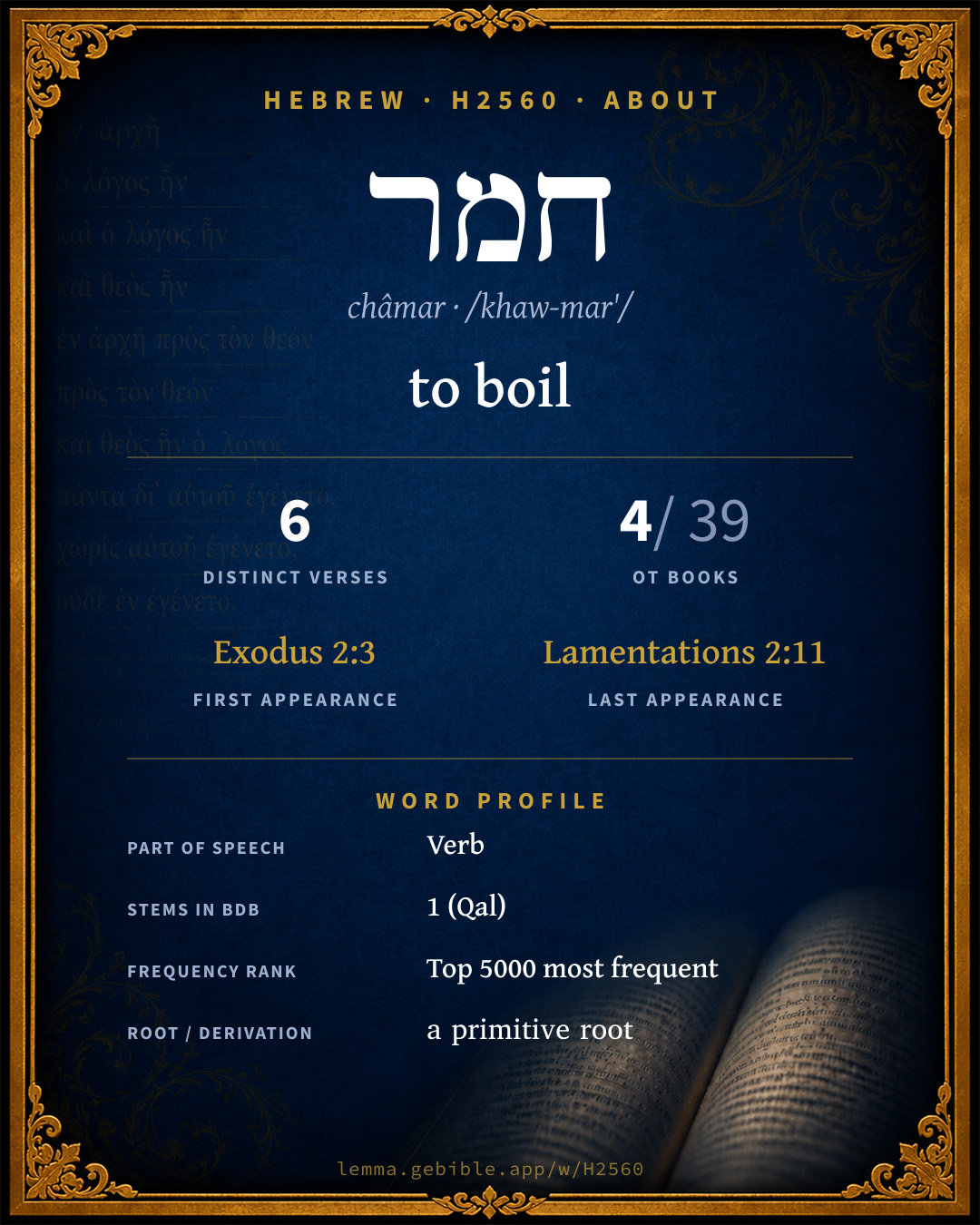
חָמַר
to boil
also: foam, foam up, ferment fuller range ↓
Full lexicon entry — Brown-Driver-Briggs (BDB)
From Brown-Driver-Briggs (BDB)
Where this word appears
See every Pealal verb in the Hebrew Bible →
Grammar key — what these labels mean
Part of speech
- Verb
- An action or state-of-being word.
Stem
- Qal
- The basic, simple active stem — the plain form of the verb (“he wrote”).
Form
- Perfect
- A completed action or state — Hebrew marks aspect (completeness) more than strict tense (“he wrote”).
- Sequential Imperfect
- An imperfect with prefixed waw — the standard past-narrative form (waw-consecutive imperfect).
- Imperfect
- An incomplete, ongoing, or future action (“he will / would write”).
Person
- 3rd Person
- The one spoken about (“he / she / it / they”).
Gender
- Common
- Either gender — not distinguished for this form.
- Feminine
- Grammatically feminine.
- Masculine
- Grammatically masculine.
Number
- Plural
- More than one (in Hebrew, generally three or more).
- Singular
- One.
3 distinct verses where H2560 appears in the Pealal stem, across 2 books. Filtered view — show all forms. Click any verse to open its interlinear word-by-word view. Verse text shown in the World English Bible for context — . Each verse’s Hebrew form is shown with its reference; the English is not keyword-highlighted, since the data carries no word-level English alignment. Use “Compare translations” on any verse to read it across multiple English versions. This concordance covers the Hebrew Bible; Septuagint (Greek Old Testament) occurrences are not indexed here.
Job 1 verse
Lamentations 2 verses
- Lamentations 1:20 חֳמַרְמָ֔רוּ Pealal pf 3cp See, Yahweh; for I am in distress; my heart is troubled; My heart is turned within me; for I have grievously rebelled: Abroad the sword bereaves, at home there is as death.
- Lamentations 2:11 חֳמַרְמְר֣וּ Pealal pf 3cp My eyes do fail with tears, my heart is troubled; My liver is poured on the earth, because of the destruction of the daughter of my people, Because the young children and the infants swoon in the streets of the city.
About this entry
At a glance — auto-summarized from this page’s data, not written by a person. Every figure links to its source below. This summary describes the numbers; it doesn’t interpret them.
חמר — transliterated châmar — is a Hebrew verb carrying the sense “to boil.” Debuting at Exodus 2:3, it then recurs through the corpus. With 6 verses in 4 books, it is an uncommon word in the Hebrew Bible. Its uses concentrate in Psalms (33% of all occurrences). Alongside “to boil” the lexicon also lists “foam”, “foam up”, and “ferment” — part of its full sense range. Each statement above links to its evidence; the full detail follows below.
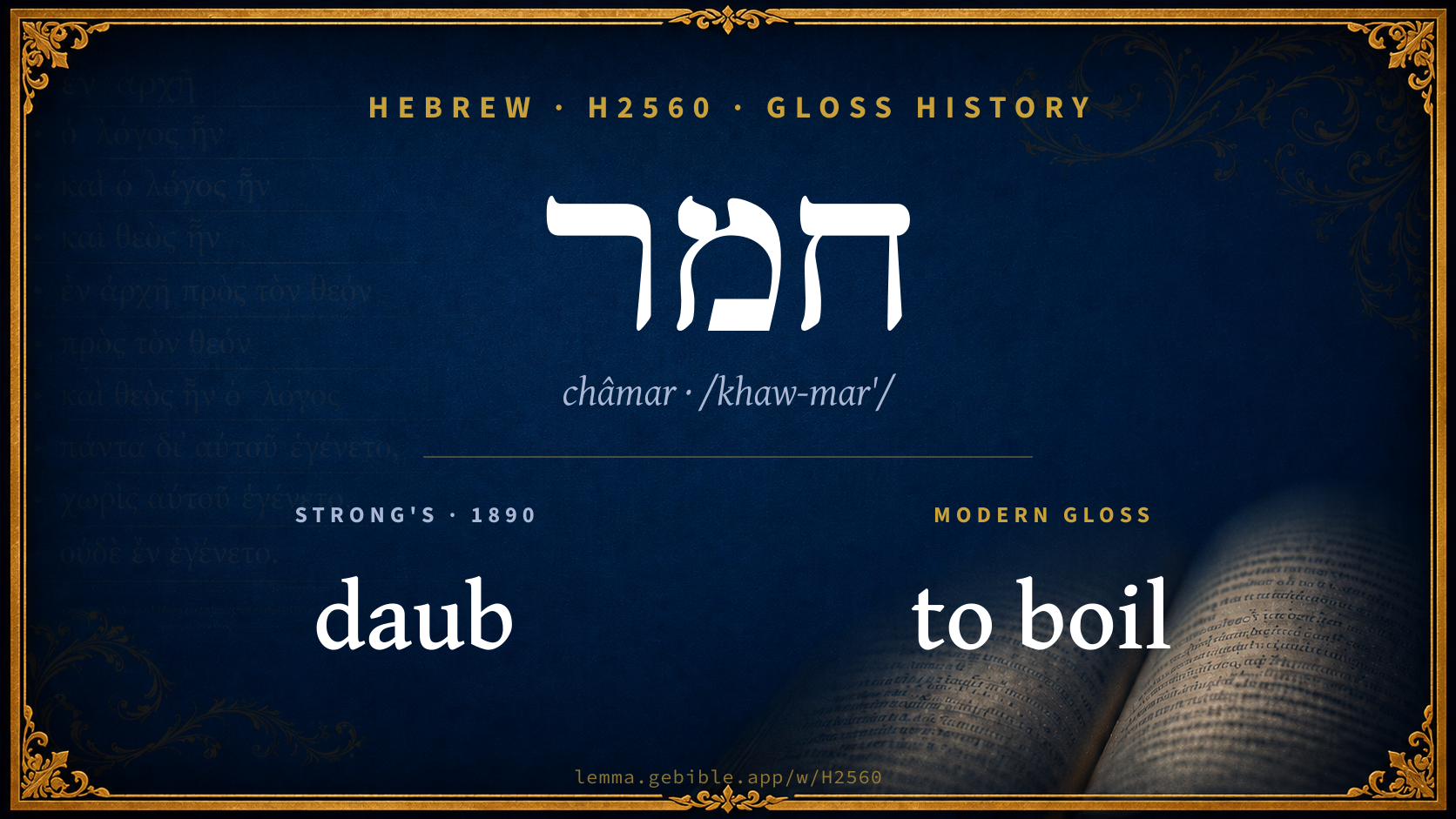
Gloss history
Strong's 1890 vs modern scholarship
About this word
Strong's H2560 catalogs a Hebrew word from the Hebrew Old Testament.
These counts are not copied from any lexicon or concordance. They are computed here, from the morphology-tagged Hebrew Old Testament. What Lemma adds →
- 6
- distinct verses
- The word appears in 6 distinct verses.
- 4 / 39
- OT books
- The word appears in 4 of 39 Old Testament books.
- #2,835
- by frequency
- Top 5000 most frequent Hebrew words (rank 2,835 of 8,640 Hebrew words by occurrence).
View all 6 occurrences in the concordance →
Most concentrated in
- Psalms 2 verses 33%
- Lamentations 2 verses 33%
- Exodus 1 verse 17%
By section of the Old Testament
By traditional corpus
Conventional, traditional groupings — biblical authorship is debated, so this is a traditional corpus grouping, not an authorship claim. Each share is this word’s portion of its verses in that division of the Hebrew canon. Each figure is a share of the word’s 6 distinct verses.
- Writings (Ketuvim) 5 verses · 83%
- Torah (Pentateuch) 1 verse · 17%
How translations render this word
Counts come from each version’s own published word-to-Strong’s tagging or interlinear alignment — an approximate guide to how each version renders this word, not a word-level alignment the data otherwise carries. Because each total is that version’s own tagged count, the per-version totals vary from one another and need not match the appearance or distinct-verse counts above. These counts may also differ from a printed concordance because Lemma counts each distinctly tagged rendering and does not collapse phrase taggings into a single head-word total. This is a fixed set of word-tagged versions (KJV, ASV, BSB, ULT) and does not change with the reading translation you choose elsewhere. Each version’s license is shown beside its name below (and on Sources).
BDB lists this Strong’s number as 2 distinct words (homographs). Each count above pools all of them and is not split by sense — see the Senses section below. A low-frequency rendering may belong to a different one of those words, not the primary meaning.
- King James Version†: Are troubled 2×
- American Standard Version†: Is troubled 2×
- Berean Standard Bible†: I am churning 2×
- unfoldingWord Literal Text†: Are churning 1×, Churn 1×, Foam 1×
King James Version Public Domain
Renders H2560 across 6† tagged occurrences — most commonly:
Plus 4 renderings that appear only once — usually multi-word phrases or single function words the recovered tagging swept in, not distinct renderings.
American Standard Version Public Domain
Renders H2560 across 6† tagged occurrences — most commonly:
Plus 4 renderings that appear only once — usually multi-word phrases or single function words the recovered tagging swept in, not distinct renderings.
Berean Standard Bible Public Domain
Renders H2560 across 6† tagged occurrences — most commonly:
Plus 4 renderings that appear only once — usually multi-word phrases or single function words the recovered tagging swept in, not distinct renderings.
unfoldingWord Literal Text CC BY-SA 4.0
Renders H2560 across 6† tagged occurrences — most commonly:
Senses in the full BDB
What do BDB’s symbols mean?
BDB uses these scholarly abbreviations:
| Symbol | Meaning |
|---|---|
| 𝔊 | the Septuagint (the ancient Greek translation, LXX) |
| 𝔙 | the Vulgate (the Latin translation) |
| 𝔖 | the Syriac version (the Peshitta) |
| 𝔗 | the Targum (the Aramaic translation) |
| ψ | the Psalms |
| √ | root (the underlying root or stem) |
| ‖ | parallel passage (a synonymous or contrasted parallel) |
| † | the dagger: every passage where the word occurs is cited |
The 2 senses and sub-senses the full Brown-Driver-Briggs lexicon distinguishes for this word, in lexicon order (not ranked by frequency), with BDB’s own verbatim wording and sub-sense lettering. Shown in Hebrew script with BDB’s own scholarly abbreviations. The condensed entry is in the Lexicon Entry tab. See also the Forms in the corpus table below.
חמר I ferment, boil or foam up (Arabic خَمَرَ ferment, leaven, خُمْرَةٌ, خَمِيرَةٌ, n. leaven
Qal
- Pf. 3 ms. וְיַיִן ח׳ ψ 75:9 and wine which foams, (others from IV. חמר be red); 3 pl. חָֽמְרוּ is suggested by We as poss. Hb 3:15 (for MT חֹמֶר q.v.) the great waters foamed; Impf. 3 mpl. יֶהֱמוּ יֶחְמְרוּ מֵימָיו ψ 46:4 let its water roar and foam. Peʿalʿal Pf. pass. 3 pl. מֵעַי חֳמַרְמָ֑רוּ La 1:20 my bowels are in a ferment (‖ נֶהְפַּךְ לִבִּי), of distress at calamities of Jerus.; so חֳמַרְמְרוּ מֵעַי La 2:11.—Jb 16:16 v. IV. חמר. e.g. Psalms 75:9
חמר II denom. cover or smear with asphalt, only
Qal
- Impf. 3 fs. sf. וַתַּחְמְרָה Ex 2:3 (E); on form of sf. v. Ges§ 58, 3, R. 1. e.g. Exodus 2:3
Senses from the full Brown-Driver-Briggs lexicon (Brown, Driver, Briggs; Oxford 1906 — public domain), digitized via Sefaria, supplemented by the OpenScriptures HebrewLexicon (CC BY 4.0). Full attribution on Sources.
Word origin
I. vb. ferment, boil or foam up (Arabic خَمَرَ ferment, leaven, خُمْرَةٌ, خَمِيرَةٌ, n. leaven; v. LagBN 207);—
II. vb.denom. cover or smear with asphalt, only
— Brown-Driver-Briggs (Oxford 1906, public domain), digitized via Sefaria, supplemented by the OpenScriptures HebrewLexicon (CC BY 4.0). See Sources.
Origin: a primitive root
Jastrow Dictionary
A second Hebrew/Aramaic lexicon for comparison, covering Aramaic and post-biblical (Talmudic, Targumic, Midrashic) usage that the biblical-Hebrew BDB does not. Matched by lemma rather than by Strong’s number, so a lemma may carry more than one Jastrow headword (shown separately below), and the entries cover usage well beyond the Bible.
חָמַר I
- (cmp. חָבַר)
- 1. to join; to pile up, to load. Ukts. II, 5 והבצלים שחֲמָרָן and the onions which one has piled up; v. אָמַן.—Zeb. 53ᵃ וחוֹמֵר בגודלו וכ׳ and loads (i.e. supports the index finger) with his thumb on top and the little finger below (like a balanced load, v. חֶבֶר a. אֵבֶר); [Var. סוֹמֵךְ, v. Rabb. D. S. a. l. note 3]; Yalk. Lev. 469.
- 2. (denom. of חָמוּר) to be weighty, stringent. Ohol. XIV, 3 אל יֶחְמוֹר זה וכ׳ this must not be made more stringent than &c.; [ed. Dehr. יַחְמִיר.]
- [to put a load on,] to pass a restrictive law, to incline to the stricter opinion, opp. היקל to make easy. Yeb. 88ᵃ מתיך חומר שהֶחְמַרְתָּ עליה וכ׳ on account of the restrictions under which the law puts her in the end (if she marries again and her first husband appears), it is made easy for her in the beginning (by allowing her to marry again), i.e. her heavy responsibility will make her cautious; Y. Gitt. I, beg. 43ᵃ (add: מתוך). Nidd. 66ᵃ, a. fr. הֶחְמִירוּ על עצמן they placed themselves under greater restrictions (than the law requires). Ned. I, 1 להחְמִיר, v. חָכַךְ II. Eduy. III, 10, a. e. מַחְמִיר כדברי וכ׳ he adopts the stricter opinion of &c.; a. v. fr.
- , v. חַמָּר II.]
חֲמַר
- as preced. Hif.—Y. Shek. VII, 50ᶜ bot. [read:] חמתון מקילין לון וחַ׳ וכ׳ he saw them to be lax in their practices, and he enjoined strictness on them. Yeb. 88ᵃ לא לִיחַמֵּיר וכ׳ let one not put her under heavy restrictions (in the end), and not make it too easy for her (in the beginning, v. preced.). Nidd. 66ᵃ היכא דאַחְמוּר וכ׳ in those cases in which they have placed themselves under greater restrictions (than the law requires, v. preced.), they have done so (and follow the usage like a law), but where they have not &c. (you cannot extend the adopted usage by analogy); a. fr.—Part. pass. מַחְמַר, מְחַמַּר piled up, ruins; v. מַחְמר a. דִּמְחַמְרָא.
- to be piled up, to form a pile of ruins (cmp. גַּל). Targ. Is. XVII, 9; XXX, 13.
חָמַר II
- (b. h.) [to be hot,]
- 1. to glow, to parch (cmp. כָּמַר). Snh. VII, 2 וחוֹמֶרֶת את וכ׳ and parches his entrails; (Ar., v. חָמַד).
- to be parched. Ḥull. III, 3 נפלה לאור ונֶחְמְרוּ וכ׳ if the bird fell into fire, and (on examination after slaughtering it was found that) its bowels were affected by inhaling heat (Ar., v. חָמַד). Gen. R. s. 38, end.
חֲמַר ²
- 1. to be hot, parched. Targ. Job XXX, 27 חֲמַרוּ (Var. חֲמָרוּ, Ms. חַמָּרוּ Pa.; h. text רתח׳).
- 2. to ferment, v. next w., a. חֲמִירָא.
חֲמַר III
- (preced.) wine(b. h.. Targ. Num. VI, 3; a. fr.—Targ. Hos. III, 1 בחַמְרֵיה ed. Lag. (ed. בחבריה, corr. acc.) in his wine (intoxication).—Sabb. 77ᵃ, a. e., v. דְּרֵי II. Ḥull. 112ᵃ קרי ליה חמר בשר (Ar. המר) called it (that juice) meat-wine.—Gen. R. s. 91 end ח׳ קטף wine mixed with resin.—Erub. 53ᵇ, v. אִימַּר; a. fr.—Pl. חַמְרִין. Targ. Y. Gen. L, 1.
חֲמָר
- 1. ass; trnsf. workingman’s contrivance, jack &c. Targ. Is. XXI, 7. Targ. Ex. XIII, 13; a. fr.—Sabb. 66ᵇ; Y. ib. VI, 8ᶜ, v. אָנְקִטְמִין; a. v. fr.—Pl. חֲמָרִין, חֲמָרַיָּא, חֲמָרֵי. Targ. Gen. XII, 16 (Y. ed. Amst. חַמְרִין). Ib. XXXVI, 24 (Y. ed. Amst. חַמְרַיָּא); a. e.—Gen. R. s. 38 (ref. to בני האדם, Gen. XI, 5) וכי מה נאמר בני ח׳ could we think young asses (built it)?—Y. Dem. I, 21ᵈ bot. Ib. 22ᵃ top; a. fr. e.g. Genesis 11:5
- 2. ח׳ דמיא sea-ass, name of a sea fish, hake (v. Sm. Ant. s. v. Onos). Ab. Zar. 39ᵃ
חַמָּר I
- (v. חֲמַר II; cmp. חָמַם) dark; trnsf. mourning. Targ. Ps. XXXV, 14; XXXVIII, 7 Ms. (ed. חַכִּיר, Lev. הביר; h. text קֹדֵר).
חַמָּר II
- (denom. of חֲמוֹר) ass-driver, attendant of beasts of burden. Kidd. IV, 14, a. e., v. גַּמָּל. Kel. XXVI, 5 (6) עור החמיר ועור הח׳ Maim. (v. comment. ed. Dehr.; Mish. ed. עור הח׳, Talm. ed. עור החמור) the ass’ leather cover and the ass-driver’s apron; a. fr.—ח׳ גמל, v. גַּמָּל.—Pl. חַמָּרִים, חַמָּרִין. Dem. IV, 7. Kidd. l. c. a. fr.—Denom.: חִמֵּר to direct a loaded beast’s motions by walking behind it, to load a beast. Sabb. 153ᵇ; Ab. Zar. 15ᵃ המְחַמֵּר אחר וכ׳ he who drives his beast of burden by walking behind it. Sabb. l. c. והלא מחמר but does he not violate the Sabbath as a driver (by placing his money bag on the ass)?—Pes. 66ᵇ מח׳ כלאחר יד הוא it is an act of driving in an unusual way (the lamb usually not being used as a beast of burden); a. fr.
חַמָּר
- Y. Taan. I, 64ᵇ bot. ח׳ אנא I am an ass-driver. Ib. פלן ח׳ יצלי let that certain ass-driver pray. [Ib. חמר עבין ההוא גוברא וכ׳, read: חמש עבירן וכ׳, v. margin ed. Krot.]—Y. Snh. VI, beg. 23ᵇ הא שאלתא דח׳ in that form it would be an ass-driver’s question.—Pl. חַמָּרַיָּיא. Y. Taan. IV, 67ᶜ bot.
A Dictionary of the Targumim, the Talmud Babli and Yerushalmi, and the Midrashic Literature (Marcus Jastrow; London, Luzac, 1903) — Public Domain. Digitized via Sefaria. Digitized via Sefaria. Full attribution on Sources.
Forms in the corpus
The 7 distinct written forms H2560 takes in the Hebrew Bible, most frequent first — each parse links to that stem’s occurrences in the concordance. Hebrew forms include their vowel points and cantillation, so a single lemma takes many written forms.
| Form | Parsing | Example | Uses |
|---|---|---|---|
| וַ/תַּחְמְרָ֥/ה | Verb, Qal, Sequential Imperfect, 3rd Person, Feminine, Singular | Exodus 2:3 | 1 |
| חֳ֭מַרְמְרוּ | Verb, Pealal, Perfect, 3rd Person, Common, Plural | Job 16:16 | 1 |
| חֳמַרְמְר֣וּ | Verb, Pealal, Perfect, 3rd Person, Common, Plural | Lamentations 2:11 | 1 |
| חֳמַרְמָ֔רוּ | Verb, Pealal, Perfect, 3rd Person, Common, Plural | Lamentations 1:20 | 1 |
| חָמַ֨ר | Verb, Qal, Perfect, 3rd Person, Masculine, Singular | Psalms 75:8 | 1 |
| חמרמרה | Verb, Pealal, Perfect, 3rd Person, Feminine, Plural | Job 16:16 | 1 |
| יֶחְמְר֣וּ | Verb, Qal, Imperfect, 3rd Person, Masculine, Plural | Psalms 46:3 | 1 |
Same root — word family
Other BDB entries built from the same root as H2560, grouped by Strong’s listed origin. These share a root / origin per the lexicon — not necessarily a shared meaning. Each links to that word’s own entry.
Derived from this word
- חמור chămôwr H2543 donkey
- חמר chemer H2561 wine
- חמר chômer H2563 mortar
- חמר chêmâr H2564 bitumen
- חמרה chămôrâh H2565 heap
- יחמור yachmûwr H3180 roebuck
Proper names from this root
People and places named from this root — a name, not an additional meaning of the word.
Compare all same-root words → Showing 4 of 8 — not the complete family. 1 of the same-root words is a proper name (a person or place). They share a root, not necessarily a meaning.
Septuagint verse parallels
This word appears in 6 verses that also exist in the Greek Old Testament (Septuagint), out of the 6 Hebrew verses it occurs in. You can read those verses in Greek by switching the Old Testament edition to the Septuagint.
Read these verses in the Septuagint
This is a verse-level parallel only — the same verses exist in both the Hebrew and Greek Old Testaments. No word-level Hebrew↔Greek correspondence is claimed: the data carries no such alignment, so no Greek word is shown as this Hebrew word’s translation. Coverage is not total — the Septuagint omits the deuterocanon and renumbers the Psalms, so some Hebrew verses have no direct Greek parallel.