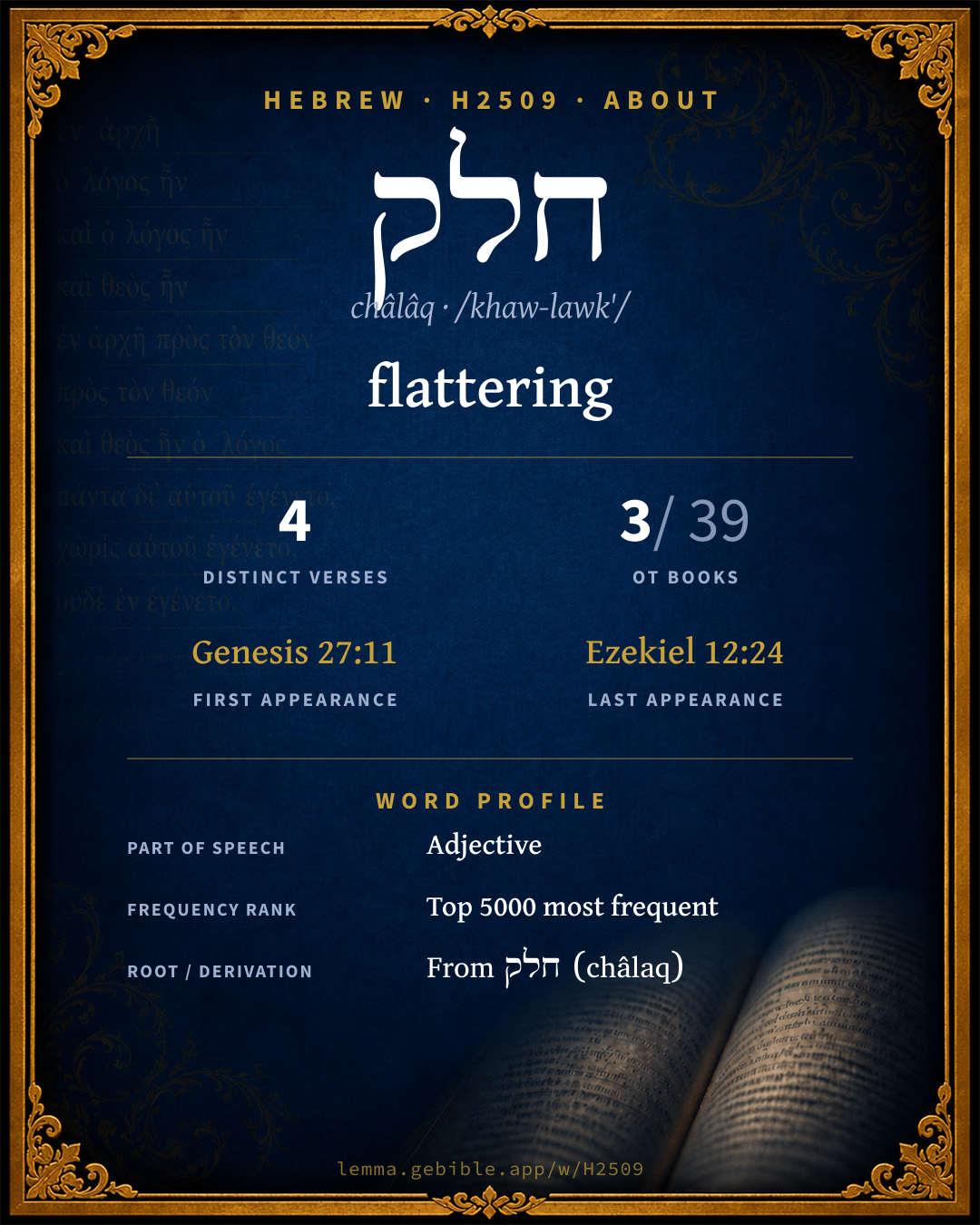
חָלָק
flattering
Full lexicon entry — Brown-Driver-Briggs (BDB)
From Brown-Driver-Briggs (BDB)
Where this word appears
Grammar key — what these labels mean
Part of speech
- Adjective
- A word that describes or qualifies a noun.
State
- Absolute
- The independent form of a noun, not bound to a following word.
Gender
- Masculine
- Grammatically masculine.
Number
- Singular
- One.
Every verse where H2509 appears in the Book of Genesis — 1 distinct verse. Click any verse to open its interlinear word-by-word view. Verse text shown in the World English Bible for context — . Each verse’s Hebrew form is shown with its reference; the English is not keyword-highlighted, since the data carries no word-level English alignment. Use “Compare translations” on any verse to read it across multiple English versions. This concordance covers the Hebrew Bible; Septuagint (Greek Old Testament) occurrences are not indexed here.
Genesis
About this entry
At a glance — auto-summarized from this page’s data, not written by a person. Every figure links to its source below. This summary describes the numbers; it doesn’t interpret them.
At its core, חלק (châlâq) means “flattering.” The Hebrew Bible uses it only 4 verses. Its uses cluster heavily in Proverbs (50% of all occurrences). Scripture first uses it in Genesis 27:11. From the same root come חלק, חלק and חלק. Each statement above links to its evidence; the full detail follows below.
Gloss history
Strong's 1890 vs modern scholarship
About this word
Strong's H2509 catalogs a Hebrew word from the Hebrew Old Testament.
These counts are not copied from any lexicon or concordance. They are computed here, from the morphology-tagged Hebrew Old Testament. What Lemma adds →
- 4
- distinct verses
- The word appears in 4 distinct verses.
- 3 / 39
- OT books
- The word appears in 3 of 39 Old Testament books.
- #3,696
- by frequency
- Top 5000 most frequent Hebrew words (rank 3,696 of 8,640 Hebrew words by occurrence).
View all 4 occurrences in the concordance →
By section of the Old Testament
By traditional corpus
Conventional, traditional groupings — biblical authorship is debated, so this is a traditional corpus grouping, not an authorship claim. Each share is this word’s portion of its verses in that division of the Hebrew canon. Each figure is a share of the word’s 4 distinct verses.
- Writings (Ketuvim) 2 verses · 50%
- Torah (Pentateuch) 1 verse · 25%
- Prophets (Nevi'im) 1 verse · 25%
How translations render this word
Counts come from each version’s own published word-to-Strong’s tagging or interlinear alignment — an approximate guide to how each version renders this word, not a word-level alignment the data otherwise carries. Because each total is that version’s own tagged count, the per-version totals vary from one another and need not match the appearance or distinct-verse counts above. These counts may also differ from a printed concordance because Lemma counts each distinctly tagged rendering and does not collapse phrase taggings into a single head-word total. This is a fixed set of word-tagged versions (KJV, ASV, BSB, ULT) and does not change with the reading translation you choose elsewhere. Each version’s license is shown beside its name below (and on Sources).
- King James Version: Flattering 2×
- American Standard Version: Flattering 2×
- Berean Standard Bible: Flattering 1×, Or flattering 1×, Smooth-skinned 1×
- unfoldingWord Literal Text: Smooth 2×
King James Version Public Domain
Renders H2509 across 4 tagged occurrences — most commonly:
Plus 2 renderings that appear only once — usually multi-word phrases or single function words the recovered tagging swept in, not distinct renderings.
American Standard Version Public Domain
Renders H2509 across 4 tagged occurrences — most commonly:
Plus 2 renderings that appear only once — usually multi-word phrases or single function words the recovered tagging swept in, not distinct renderings.
Berean Standard Bible Public Domain
Renders H2509 across 4 tagged occurrences — most commonly:
unfoldingWord Literal Text CC BY-SA 4.0
Renders H2509 across 4 tagged occurrences — most commonly:
Plus 2 renderings that appear only once — usually multi-word phrases or single function words the recovered tagging swept in, not distinct renderings.
Senses in the full BDB
What do BDB’s symbols mean?
BDB uses these scholarly abbreviations:
| Symbol | Meaning |
|---|---|
| 𝔊 | the Septuagint (the ancient Greek translation, LXX) |
| 𝔙 | the Vulgate (the Latin translation) |
| 𝔖 | the Syriac version (the Peshitta) |
| 𝔗 | the Targum (the Aramaic translation) |
| ψ | the Psalms |
| √ | root (the underlying root or stem) |
| ‖ | parallel passage (a synonymous or contrasted parallel) |
| † | the dagger: every passage where the word occurs is cited |
The 3 senses and sub-senses the full Brown-Driver-Briggs lexicon distinguishes for this word, in lexicon order (not ranked by frequency), with BDB’s own verbatim wording and sub-sense lettering. Shown in Hebrew script with BDB’s own scholarly abbreviations. The condensed entry is in the Lexicon Entry tab. See also the Forms in the corpus table below.
- 1. lit. אִישׁ חָלָק Gn 27:11 (J), smooth man (opp. אישׁ שָׂעִר); הָהָר הֶחָלָק Jos 11:17; 12:7 the bald mt. (both D); southern limit of Jos.’s conquest, identif. dub.; (1) white cliffs 8 m. S. of Dead Sea, and (2) Mt. Mâdara SW. from Pass es-Ṣafâ are proposed, v. Di.; as subst. חַלְּקֵי־נַחַל Is 57:6 (v. i. חֵלָק, 4) smooth (stones) of a brook-bed (ravine, wady), i.e. thou worshippest common round stones (contempt., v. Che Di). e.g. Genesis 27:11
- 2. fig. of mouth uttering smooth words וְחָלָק מִשֶּׁמֶן חִכָּהּ Pr 5:3 cf. 26:28. e.g. Proverbs 5:3
- 3. as subst. = flattery מִקְסַם חָלָק Ez 12:24 divination of flattery or of a flatterer. e.g. Ezekiel 12:24
Senses from the full Brown-Driver-Briggs lexicon (Brown, Driver, Briggs; Oxford 1906 — public domain), digitized via Sefaria, supplemented by the OpenScriptures HebrewLexicon (CC BY 4.0). Full attribution on Sources.
Word origin
Derived from חלק (châlaq) (H2505) — to divide.
Jastrow Dictionary
A second Hebrew/Aramaic lexicon for comparison, covering Aramaic and post-biblical (Talmudic, Targumic, Midrashic) usage that the biblical-Hebrew BDB does not. Matched by lemma rather than by Strong’s number, so a lemma may carry more than one Jastrow headword (shown separately below), and the entries cover usage well beyond the Bible.
חֵילֶק I
- ḥelek, name of a small fish preserved in brine, ḥelek-brine. [Latin: alec, alex, halec, allec, the variations indicating foreign origin; cmp. חֶילְקָא II.] Ab. Zar. II, 6 (Mish. Nap. חלק). Ib. 39ᵃ, expl. סוּלְתָּנִית. Ib. 34ᵇ ח׳ אומן ḥelek-brine prepared by a professional man.
חִילָּק
- Ḥillak, a fictitious name, v. בִּילָּק.
חָלַק
- (b. h.)
- 1. to be smooth, to be viscous. V. חָלָק.
- 2. (denom. of חֵלֶק) to assign, allot.—ח׳ כבוד to honor, pay regards. Ber. 19ᵇ, a. e. כל מקום … אין חוֹלְקִין וכ׳ wherever the desecration of the name of the Lord is threatened, no regards must be paid to a teacher. Zeb. 102ᵃ; a. fr.
- 3. (denom. of חֵלֶק) to divide (by lot); to part; to take a share. Peah III, 5 האחין שחָלְקוּ brothers who divided an estate. B. Mets. I, 1, a. fr. יַחֲלוֹקוּ they shall divide the object (equally). Zeb. XII, 1 אינן חוֹלְקִין וכ׳ take no share &c. Ḥull. 65ᵃ אם חוֹלֵק את רגליו וכ׳ if the birds parts its toes (on the rope) so that there be two on each side &c. Y. Sabb. VII, 9ᶜ bot. דבר … אינו חולק if a prohibition (included in a law) is specified again for a purpose, it does not intimate a division (that each single act of the class must be atoned for singly, v. הַבְעָרָה). Tosef. Dem. VI, 1 חוֹלְקָן he divides the fruits with the landlord. [Ib. 2 החולק, read: החוֹכֵר.] Y. ib. VI, beg. 25ᵃ מישראל חולק if the property is farmed from an Israelite, he divides the produces (before separating T’rumah); a. v. fr.
- 4. (with על) to differ with, object, oppose. Y. Sabb. XV, beg. 15ᵃ מה חוֹלְקִין על וכ׳ how is it? do they differ with &c.?—Ber. 27ᵇ החולק על ישיבתו וכ׳ וכ׳; Snh. 110ᵃ הח׳ על רבו (Ar. הנֶחְלַק, Nif.) he who opposes (the school of) his teacher. Ber. l. c. כלום יש אדם חוֹלֵק בדבר זה is there any one here differing from this opinion?; a. v. fr.—Part. pass. חָלוּק, pl. חֲלוּקִים, חֲלוּקִין divided, interrupted; disputed; of different opinion. Mikv. VIII, 2 מים ח׳ interrupted flow of urin.—B. Bath. 176ᵃ ח׳ היה ר׳ וכ׳ R. … differed &c. Ib. IX, 10 (158ᵇ) על החֲלוּקִין ואתה בא לחַלֵּק עלינו וכ׳ … we grieve over the divided opinions, and you come to assert a division for us on things on which they (the schools of Shammai and Hillel) agree?; (Y. Shek. III, beg. 47ᵇ לַחֲלוֹק). Y. Keth. I, end, 26ᵃ ח׳ על אביו differs with his father; a. fr.—Tosef. Yoma V (IV), 6, a. e. ארבעה חֲלוּקֵי כפרה there are four persons under different categories as to atonement. Arakh. 10ᵇ דחֲלוּקָה בקרבנותיה which differs (from other days) as regards sacrifices. Ib. חֲלוּקִין וכ׳ the numbers of sacrifices are different each day.
- 1. to be divided, distributed. Midr. Till. to Ps. XXVII (ref. to אחלק, Ex. XV, 9) אֵיחָלֵק I shall be divided (plundered). e.g. Exodus 15:9
- 2. to differ. Ḥag. 16ᵇ נֶחְלְקוּ בה וכ׳ the great men of the age differ about it. Ber. 27ᵇ; Snh. 110ᵃ, v. supra. Keth. XIII, 1; a. fr.
- 1. to smoothen, make even, level; to improve the appearance. Maasr. I, 8 משיַחֲלִיקֶנּוּ from the moment that he smoothens the cake of figs (by rubbing it with figs or grapes). Ib. המַחֲלִיק בענבים if one uses grapes for smoothening.—Shebi. IV, 4 במַחֲלִיק when one levels a field (by taking out plants); expl. ib. המח׳ ג׳ זה בצד זה levelling means taking out (at least) three plants next to each other, contrad. to המדל, taking out one or two plants.—Peah III, 3, v. אֶחָד; a. e.—Trnsf. to close a tune softly (piano). Arakh. II, 3 (10ᵃ) ולא היה מַחֲלִיק אלא … מפני שהוא מחליק יפה (Talm. ed. ולא היה מְחַלֵּק מחליק וכ׳ …) none but a flute solo was used for closing a tune, because it makes a pleasant finale.—3) to glide, slip. Erub. X, 14 בשביל שלא יַחֲלִיקוּ that the priests might not slip. B. Mets. VI, 3 אם הֶחֱלִיקָה if the animal injured herself by slipping.—4) to be smooth. Yeb. 80ᵇ בשרו מַחֲלִיק his flesh is smooth.
- 1. to be injured by slipping. B. Kam. 47ᵇ הוּחְלְקָה בהן the animal was injured by tripping over the fruits.
- 2. to be smoothed. Part. מוּחֲלָק, pl. מוּחֲלָקִין. B. Mets. 103ᵇ קנים המ׳ smoothed (peeled) poles.—[
- 3. to be divided up, v. infra.]
- to divide, distribute, part. Y. Keth. II, beg. 26ᵃ בוא וחַלֵּק וכ׳ come and divide with me &c. Y. Peah VIII, 20ᶜ top; Y. Shebi. VI, beg. 36ᵇ שבע שחִילְּקוּ the seven years during which they distributed the land (among the tribes); Zeb. 118ᵇ.—B. Bath. IX, 7 המְחַלֵּק נכסיו וכ׳ if one disposes (wills) … by word of mouth; a. fr.—Sabb. 70ᵃ, a. e. לחַלֵּק, v. הַבְעָרָה.—[Arakh. II, 3 (10ᵃ), v. supra.]—Part. pass. מְחוּלָּק a) divided up, plundered. Yalk. Ex. 249 (ref. to אחלק, Ex. XV, 9) מ׳ אני להם I shall be divided up among them, v. Nif.; Mekh. B’shall., Shirah, s. 7 מוחלק.—b) distinct, separate. Tanḥ. Ḥuck. 6 והן מְחוּלָּקִין זה מזה and they are different from one another (in the range of their intellects). e.g. Exodus 15:9
- to be divided, distributed; to part, separate. Par. III, 11 היה מִתְחַלֵּק וכ׳ was distributed among &c.—Snh. 34ᵃ, v. נִיצוֹץ.—Sifré Num. 132 ליוצאי מצרים נִתְחַלְּקָה וכ׳ the land was divided up according to the census taken at their going out from Egypt. Ib. לא נתח׳ … לכל שנט וכ׳ the land was allotted to each tribe (in a lump), according to its population. Ib. לא נתח׳ … אלא בשמיון it was divided according to value; B. Bath. 122ᵃ לא נ׳ אלא בכסף.—Midr. Till. to Ps. XVIII, 2 היה מתח׳ מחיילותיו he separated himself from his armies (for prayer). Ib. וכשהיה המחנה שלו מתח׳ and because his camp was thus divided (some praying, others not praying); a. fr.
חָלָק
- (preced.)
- 1. smooth, blank (paper); empty. Y. Sabb. VIII, 11ᵇ אם יש בו ח׳ וכ׳ if there is blank space on it enough for &c. Snh. 17ᵃ ושנים הניח ח׳ and two ballots he left blank; a. fr.—יצא ח׳ (= ריקם) to go out without having effected anything. Sifré Num. 131 חלוק ed.; Yalk. Lev. 631 (Yalk. Ex. 178 ריקם); Yalk. Hos. 517 חלוק.—Gen. R. s. 11 להוציאך ח׳ אי אפשר I cannot dismiss you without an answer; a. e.—Fem. חֲלָקָה. Kel. XXIV, 7 וח׳ and a plain board (without a receptacle). Midd. II, 5; Succ. 51ᵇ ח׳ היתה בראשונה formerly the compartment was plain (without a guarded balcony), v. בְּצוֹצְרָה.—Pl. חֲלָקוֹת. Tosef. Ohol. XV, 1.—
- *2. division. Kerith. 7ᵃ, a. fr. אך ח׳, v. אַךְ I [prob. to be read: חַלֵּק, divide!]
חֵלֶק
- preced. wds.) [smooth stone used for casting lots, v. I Sam. XVII, 40 חַלֻּקֵי; cmp. גורל, גווזא; cmp. Is. XXXIV, 17; Ps. XXII, 19,] lot, share, portion. Snh. X (XI), 1 ח׳ לעו"הב a share in the world to come. Sabb. 118ᵇ יהא חֶלְקִי מ־ Oh, that my lot fell among &c.; M. Kat. 18ᵇ יהא חלקי עם; a. fr.—Sifré Deut. 312 תנו לי חֶלְקִי give me my estate (my title) back, v. נָכַר.—Pl. חֲלָקִים. B. Mets. I, 1 שלשה ח׳ three portions (fourths). Sabb. 34ᵇ שלשה חֶלְקֵי מיל three parts of a mile, expl. three fourths; ב׳ ח׳ מיל two thirds; a. fr. e.g. 1 Samuel 17:40
חִלָּק
- , a fictitious name, v. חִילָּק
חֲלַק
- (b. h. חֶלְקָה, v. חֵלֶק) lot, field. Targ. Y. II, Gen. XLIX, 21 (Var. חַקְלָא).—Pl. constr. חַלְקֵי. Targ. I Chr. VIII, 8 Var. (ed. חקלי).
A Dictionary of the Targumim, the Talmud Babli and Yerushalmi, and the Midrashic Literature (Marcus Jastrow; London, Luzac, 1903) — Public Domain. Digitized via Sefaria. Digitized via Sefaria. Full attribution on Sources.
Forms in the corpus
The 4 distinct written forms H2509 takes in the Hebrew Bible, most frequent first — each parse links to that state’s occurrences in the concordance. Hebrew forms include their vowel points and cantillation, so a single lemma takes many written forms.
| Form | Parsing | Example | Uses |
|---|---|---|---|
| וְ/חָלָ֖ק | Adjective, Adjective, Masculine, Singular, Absolute | Proverbs 5:3 | 1 |
| חָ֝לָ֗ק | Adjective, Adjective, Masculine, Singular, Absolute | Proverbs 26:28 | 1 |
| חָלָ֑ק | Adjective, Adjective, Masculine, Singular, Absolute | Ezekiel 12:24 | 1 |
| חָלָֽק | Adjective, Adjective, Masculine, Singular, Absolute | Genesis 27:11 | 1 |
Same root — word family
Other BDB entries built from the same root as H2509, grouped by Strong’s listed origin. These share a root / origin per the lexicon — not necessarily a shared meaning. Each links to that word’s own entry.
Derives from
Shares the same root
- חלק chêleq H2506 portion
- חלק chălâq H2508 possession
- חלק challâq H2511 smooth
- חלק challuq H2512 smooth
- חלקה chălaqqâh H2514 flattery
- חלקלקה chălaqlaqqâh H2519 flattery
- מחלקת machălôqeth H4256 course
Proper names from this root
People and places named from this root — a name, not an additional meaning of the word.
Compare all same-root words → Showing 4 of 11 — not the complete family. 2 of the same-root words are proper names (people or places). They share a root, not necessarily a meaning.
Septuagint verse parallels
This word appears in 4 verses that also exist in the Greek Old Testament (Septuagint), out of the 4 Hebrew verses it occurs in. You can read those verses in Greek by switching the Old Testament edition to the Septuagint.
Read these verses in the Septuagint
This is a verse-level parallel only — the same verses exist in both the Hebrew and Greek Old Testaments. No word-level Hebrew↔Greek correspondence is claimed: the data carries no such alignment, so no Greek word is shown as this Hebrew word’s translation. Coverage is not total — the Septuagint omits the deuterocanon and renumbers the Psalms, so some Hebrew verses have no direct Greek parallel.