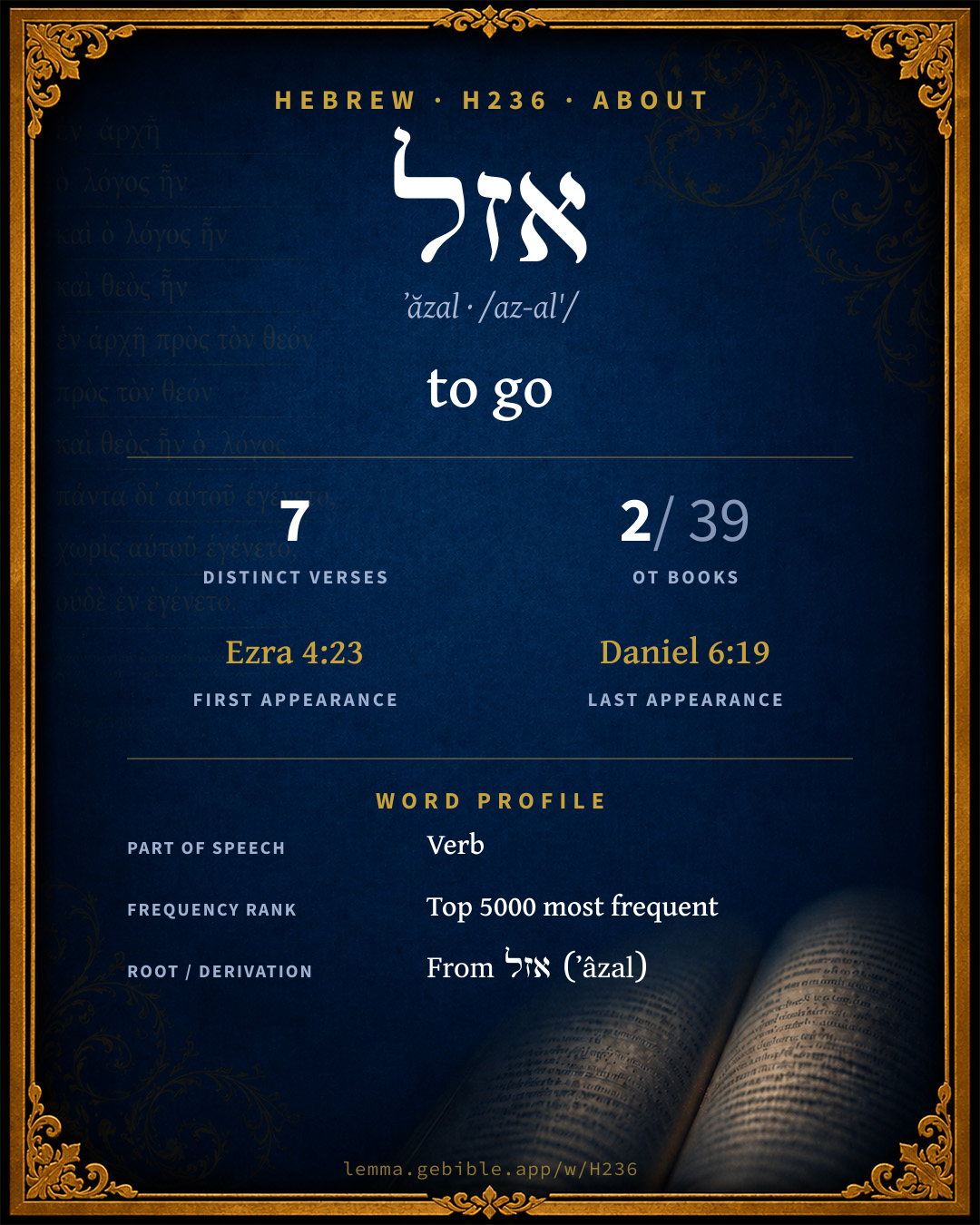
אֲזַל
to go
‘to go’ is one of 2 main senses fuller range ↓
Full lexicon entry — Brown-Driver-Briggs (BDB)
From Brown-Driver-Briggs (BDB)
Where this word appears
Grammar key — what these labels mean
Part of speech
- Verb
- An action or state-of-being word.
Stem
- Qal
- The basic, simple active stem — the plain form of the verb (“he wrote”).
Form
- Perfect
- A completed action or state — Hebrew marks aspect (completeness) more than strict tense (“he wrote”).
- Participle Active
- A verbal adjective expressing ongoing or characteristic action (“writing / one who writes”).
- Imperative
- A direct command (“write!”).
State
- Absolute
- The independent form of a noun, not bound to a following word.
Person
- 3rd Person
- The one spoken about (“he / she / it / they”).
- 1st Person
- The speaker (“I / we”).
- 2nd Person
- The one addressed (“you”).
Gender
- Masculine
- Grammatically masculine.
- Common
- Either gender — not distinguished for this form.
Number
- Singular
- One.
- Plural
- More than one (in Hebrew, generally three or more).
Every verse where H236 appears in the Book of Daniel — 4 distinct verses. Click any verse to open its interlinear word-by-word view. Verse text shown in the World English Bible for context — . Each verse’s Hebrew form is shown with its reference; the English is not keyword-highlighted, since the data carries no word-level English alignment. Use “Compare translations” on any verse to read it across multiple English versions. This concordance covers the Hebrew Bible; Septuagint (Greek Old Testament) occurrences are not indexed here.
Daniel
- Daniel 2:17 אֲזַ֑ל Qal pf 3ms Then Daniel went to his house, and made the thing known to Hananiah, Mishael, and Azariah, his companions:
- Daniel 2:24 אֲזַ֣ל Qal ptcp.act ms Therefore Daniel went in to Arioch, whom the king had appointed to destroy the wise men of Babylon; he went and said thus to him: Don't destroy the wise men of Babylon; bring me in before the king, and I will show to the king the interpretation.
- Daniel 6:18 אֲזַ֨ל Qal pf 3ms Then the king went to his palace, and passed the night fasting; neither were instruments of music brought before him: and his sleep fled from him.
- Daniel 6:19 אֲזַֽל Qal pf 3ms Then the king arose very early in the morning, and went in haste to the den of lions.
About this entry
At a glance — auto-summarized from this page’s data, not written by a person. Every figure links to its source below. This summary describes the numbers; it doesn’t interpret them.
“to go” is the headline sense of the Hebrew verb אזל (ʼăzal). It clusters heavily in Daniel, which alone accounts for 57% of its uses. It turns up in 7 verses across 2 books, an uncommon footprint. First canonically at Ezra 4:23, it enters the text early. Catalogued under 2 senses, its meaning is not single-sense. See the sense tree, 7-verse concordance, and the renderings breakdown below.
Gloss history
Strong's 1890 vs modern scholarship
About this word
Strong's H236 catalogs a Hebrew word from the Hebrew Old Testament.
These counts are not copied from any lexicon or concordance. They are computed here, from the morphology-tagged Hebrew Old Testament. What Lemma adds →
- 7
- distinct verses
- The word appears in 7 distinct verses.
- 2 / 39
- OT books
- The word appears in 2 of 39 Old Testament books.
- #2,835
- by frequency
- Top 5000 most frequent Hebrew words (rank 2,835 of 8,640 Hebrew words by occurrence).
View all 7 occurrences in the concordance →
By traditional corpus
Conventional, traditional groupings — biblical authorship is debated, so this is a traditional corpus grouping, not an authorship claim. Each share is this word’s portion of its verses in that division of the Hebrew canon. Each figure is a share of the word’s 7 distinct verses.
- Writings (Ketuvim) 7 verses · 100%
How translations render this word
Counts come from each version’s own published word-to-Strong’s tagging or interlinear alignment — an approximate guide to how each version renders this word, not a word-level alignment the data otherwise carries. Because each total is that version’s own tagged count, the per-version totals vary from one another and need not match the appearance or distinct-verse counts above. These counts may also differ from a printed concordance because Lemma counts each distinctly tagged rendering and does not collapse phrase taggings into a single head-word total. This is a fixed set of word-tagged versions (KJV, ASV, BSB, ULT) and does not change with the reading translation you choose elsewhere. Each version’s license is shown beside its name below (and on Sources).
- King James Version: Went 3×
- American Standard Version: Went 3×
- Berean Standard Bible: Returned 1×, They went 1×, We went 1×
- unfoldingWord Literal Text: Went 3×
King James Version Public Domain
Renders H236 across 7 tagged occurrences — most commonly:
Plus 4 renderings that appear only once — usually multi-word phrases or single function words the recovered tagging swept in, not distinct renderings.
American Standard Version Public Domain
Renders H236 across 6 tagged occurrences — most commonly:
Plus 3 renderings that appear only once — usually multi-word phrases or single function words the recovered tagging swept in, not distinct renderings.
Berean Standard Bible Public Domain
Renders H236 across 4 tagged occurrences — most commonly:
Not rendered by a distinct English word in 2 further occurrences.
unfoldingWord Literal Text CC BY-SA 4.0
Renders H236 across 7 tagged occurrences — most commonly:
Plus 4 renderings that appear only once — usually multi-word phrases or single function words the recovered tagging swept in, not distinct renderings.
Senses in BDB
The 2 senses BDB distinguishes for this word, in lexicon order (not ranked by frequency or importance). The full entry — with sub-senses — is in the Lexicon Entry tab.
- to go, to go off
- (Peal) to go, go off
Word origin
אֲזַל vb. go, go off
— Brown-Driver-Briggs (Oxford 1906, public domain), digitized via Sefaria, supplemented by the OpenScriptures HebrewLexicon (CC BY 4.0). See Sources.
Derived from אזל (ʼâzal) (H235) — to go.
Jastrow Dictionary
A second Hebrew/Aramaic lexicon for comparison, covering Aramaic and post-biblical (Talmudic, Targumic, Midrashic) usage that the biblical-Hebrew BDB does not. Matched by lemma rather than by Strong’s number, so a lemma may carry more than one Jastrow headword (shown separately below), and the entries cover usage well beyond the Bible.
אֲזַל I
- to be gone, to leave; to go. Targ. Gen. XXXII, 1. Imper. אִיזֵּיל, אִזֵּיל. Targ. O. Num. XXII, 20; a. fr.—Y. Snh. X, 28ᵇ איזיל חמי וכ׳ go, show thy face &c. Ib. לינה מֵיזַל … דנא מיזל וכ׳ I will not go … for if I did go &c. Sabb. 116ᵃ א׳ כתב א׳ וכ׳ after the writing is gone, the sacredness of the scroll is gone (after the scroll has become unfit for sacred use, the material has lost its sacred character). Y. Dem. III, 23ᵇ bot. הא אזילא מיבלא וכ׳ that man’s load would soon be gone (if each were permitted to take a chip). Y. Ber. VIII, 12ᵃ הא אזילא ההיא דרב וכ׳ is the decision of Rab and Samuel gone (to be disregarded)? Y. Snh. X, 28ᵃ bot. הא א׳ הדא וכ׳ (ed. Krot. חדא) is that which was received from (is the tradition of) … to be disregarded? Y. Yeb. VIII, 9ᶜ bot. הא אזילא היא וכ׳ (ed. Krot. איזלא, corr. acc.; for היא read הדא or ההיא).—Trnsf. to depart life, die. Y. Ḥag. II, 77ᵈ bot. this one committed a sin וא׳ בה and died in it, and the other &c. M. Kat. 28ᵇ ווי לאזלא woe, for the departed one! Y. Keth. XII, 35ᵃ top אזיל to die, contrad. to אתי to resurrect.—Imperat. usu. זִיל = אזיל.—Ḥull. 11ᵇ ז׳ בתר רובא follow the majority of cases; a. fr.
אֲזַל II
- (= עזל; v. Ezek. XXVII, 19; √זל) to spin, weave. B. Mets. 24ᵇ קיבורא דאזלי ביה אזלויי a skein which the net-weavers had used; v. זוּל II. Denom. אִיזְלָא a. next w. e.g. Ezekiel 27:19
A Dictionary of the Targumim, the Talmud Babli and Yerushalmi, and the Midrashic Literature (Marcus Jastrow; London, Luzac, 1903) — Public Domain. Digitized via Sefaria. Digitized via Sefaria. Full attribution on Sources.
Forms in the corpus
The 7 distinct written forms H236 takes in the Hebrew Bible, most frequent first — each parse links to that stem’s occurrences in the concordance. Hebrew forms include their vowel points and cantillation, so a single lemma takes many written forms.
| Form | Parsing | Example | Uses |
|---|---|---|---|
| אֲזַ֑ל | Verb, Qal, Perfect, 3rd Person, Masculine, Singular | Daniel 2:17 | 1 |
| אֲזַ֜לְנָא | Verb, Qal, Perfect, 1st Person, Common, Plural | Ezra 5:8 | 1 |
| אֲזַ֣ל | Verb, Qal, Participle Active, Masculine, Singular, Absolute | Daniel 2:24 | 1 |
| אֲזַ֨ל | Verb, Qal, Perfect, 3rd Person, Masculine, Singular | Daniel 6:18 | 1 |
| אֲזַ֨לוּ | Verb, Qal, Perfect, 3rd Person, Masculine, Plural | Ezra 4:23 | 1 |
| אֲזַֽל | Verb, Qal, Perfect, 3rd Person, Masculine, Singular | Daniel 6:19 | 1 |
| אֵֽזֶל | Verb, Qal, Imperative, 2nd Person, Masculine, Singular | Ezra 5:15 | 1 |
Same root — word family
Other BDB entries built from the same root as H236, grouped by Strong’s listed origin. These share a root / origin per the lexicon — not necessarily a shared meaning. Each links to that word’s own entry.
Derives from
Proper names from this root
People and places named from this root — a name, not an additional meaning of the word.
Compare all same-root words → 1 of the same-root words is a proper name (a person or place). They share a root, not necessarily a meaning.
Septuagint verse parallels
This word appears in 7 verses that also exist in the Greek Old Testament (Septuagint), out of the 7 Hebrew verses it occurs in. You can read those verses in Greek by switching the Old Testament edition to the Septuagint.
Read these verses in the Septuagint
This is a verse-level parallel only — the same verses exist in both the Hebrew and Greek Old Testaments. No word-level Hebrew↔Greek correspondence is claimed: the data carries no such alignment, so no Greek word is shown as this Hebrew word’s translation. Coverage is not total — the Septuagint omits the deuterocanon and renumbers the Psalms, so some Hebrew verses have no direct Greek parallel.