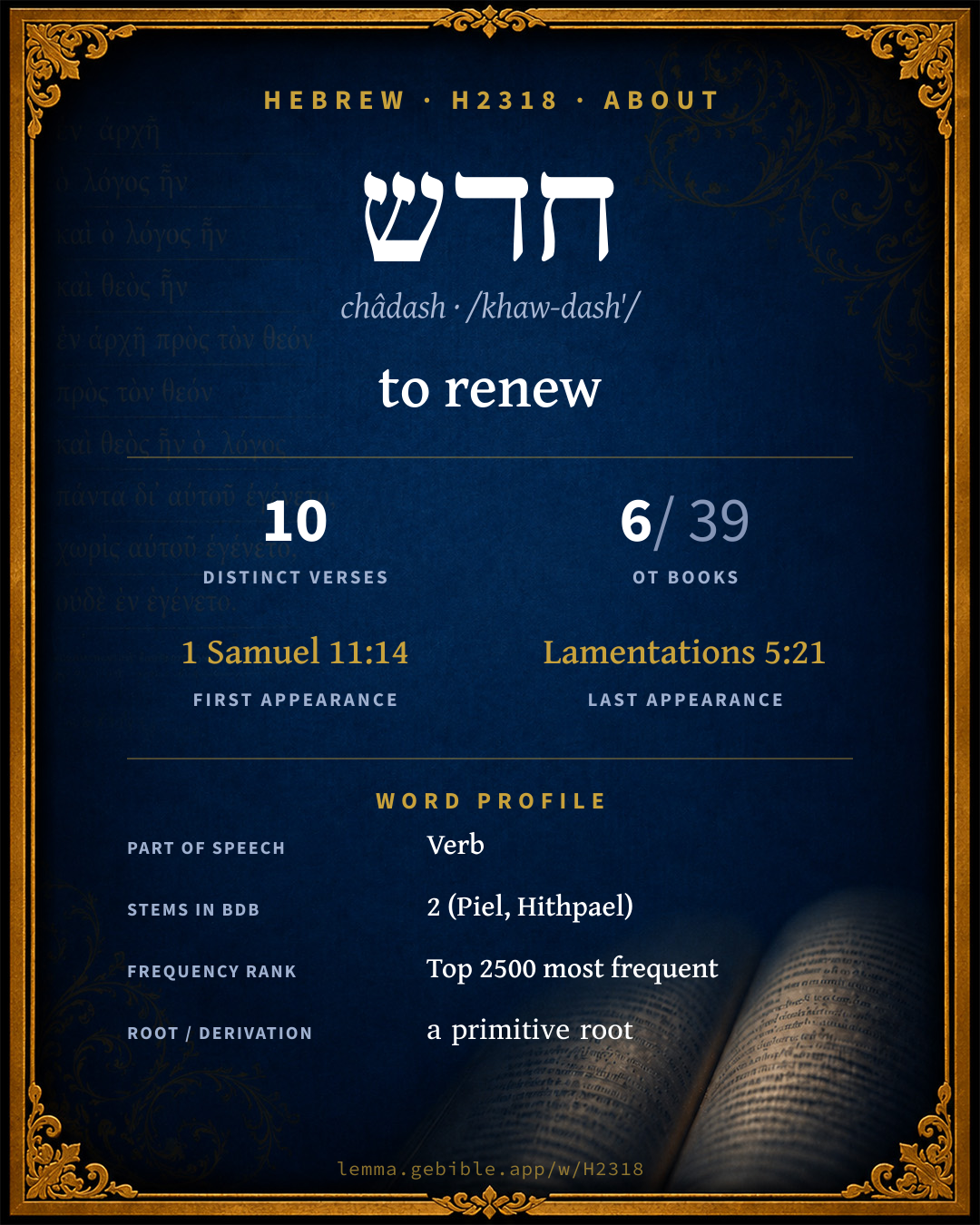
חָדַשׁ
to renew
‘to renew’ is one of 2 main senses fuller range ↓
Full lexicon entry — Brown-Driver-Briggs (BDB)
From Brown-Driver-Briggs (BDB)
Where this word appears
Grammar key — what these labels mean
Part of speech
- Verb
- An action or state-of-being word.
Stem
- Piel
- An intensive or resultative active stem. Here: ‘renew’
- Hithpael
- The reflexive or reciprocal stem (the subject acts on itself).
Form
- Infinitive Construct
- A bound verbal noun, frequently with prepositions (“to write / in writing”).
- Imperative
- A direct command (“write!”).
- Cohortative
- A first-person volitional form expressing wish or resolve (“let me / let us write”).
- Imperfect
- An incomplete, ongoing, or future action (“he will / would write”).
- Sequential Perfect
- A perfect with prefixed waw continuing a preceding imperfect or command (waw-consecutive perfect).
- Sequential Imperfect
- An imperfect with prefixed waw — the standard past-narrative form (waw-consecutive imperfect).
Person
- 2nd Person
- The one addressed (“you”).
- 1st Person
- The speaker (“I / we”).
- 3rd Person
- The one spoken about (“he / she / it / they”).
Gender
- Masculine
- Grammatically masculine.
- Common
- Either gender — not distinguished for this form.
- Feminine
- Grammatically feminine.
Number
- Singular
- One.
- Plural
- More than one (in Hebrew, generally three or more).
Every verse where H2318 appears in the Book of Job — 1 distinct verse. Click any verse to open its interlinear word-by-word view. Verse text shown in the World English Bible for context — . Each verse’s Hebrew form is shown with its reference; the English is not keyword-highlighted, since the data carries no word-level English alignment. Use “Compare translations” on any verse to read it across multiple English versions. This concordance covers the Hebrew Bible; Septuagint (Greek Old Testament) occurrences are not indexed here.
Job
About this entry
At a glance — auto-summarized from this page’s data, not written by a person. Every figure links to its source below. This summary describes the numbers; it doesn’t interpret them.
חדש (châdash) is a Hebrew verb most often rendered “to renew.” Debuting at 1 Samuel 11:14, it then recurs through the corpus. The Hebrew Bible uses it across 10 verses — uncommon. 2 Chronicles dominates its distribution — 3 of 10 verses. Read the stem: it spans 2 stems, including Piel and Hithpael. For the data behind this summary, explore the sense tree and the renderings breakdown below.
Gloss history
Strong's 1890 vs modern scholarship
About this word
Strong's H2318 catalogs a Hebrew word from the Hebrew Old Testament.
These counts are not copied from any lexicon or concordance. They are computed here, from the morphology-tagged Hebrew Old Testament. What Lemma adds →
- 10
- distinct verses
- The word appears in 10 distinct verses.
- 6 / 39
- OT books
- The word appears in 6 of 39 Old Testament books.
- #2,342
- by frequency
- Top 2500 most frequent Hebrew words (rank 2,342 of 8,640 Hebrew words by occurrence).
View all 10 occurrences in the concordance →
Most concentrated in
- 2 Chronicles 3 verses 30%
- Psalms 3 verses 30%
- 1 Samuel 1 verse 10%
By section of the Old Testament
By traditional corpus
Conventional, traditional groupings — biblical authorship is debated, so this is a traditional corpus grouping, not an authorship claim. Each share is this word’s portion of its verses in that division of the Hebrew canon. Each figure is a share of the word’s 10 distinct verses.
- Writings (Ketuvim) 8 verses · 80%
- Prophets (Nevi'im) 2 verses · 20%
How translations render this word
Counts come from each version’s own published word-to-Strong’s tagging or interlinear alignment — an approximate guide to how each version renders this word, not a word-level alignment the data otherwise carries. Because each total is that version’s own tagged count, the per-version totals vary from one another and need not match the appearance or distinct-verse counts above. These counts may also differ from a printed concordance because Lemma counts each distinctly tagged rendering and does not collapse phrase taggings into a single head-word total. This is a fixed set of word-tagged versions (KJV, ASV, BSB, ULT) and does not change with the reading translation you choose elsewhere. Each version’s license is shown beside its name below (and on Sources).
- King James Version: Renew 3×, Repair 2×, Thou renewest 2×
- American Standard Version: Renew 3×, Restore 2×, Thou renewest 2×
- Berean Standard Bible: Renew 3×
- unfoldingWord Literal Text: Renew 2×, Restore 2×
King James Version Public Domain
Renders H2318 across 10 tagged occurrences — most commonly:
Plus 3 renderings that appear only once — usually multi-word phrases or single function words the recovered tagging swept in, not distinct renderings.
American Standard Version Public Domain
Renders H2318 across 10 tagged occurrences — most commonly:
Plus 3 renderings that appear only once — usually multi-word phrases or single function words the recovered tagging swept in, not distinct renderings.
Berean Standard Bible Public Domain
Renders H2318 across 10 tagged occurrences — most commonly:
Plus 7 renderings that appear only once — usually multi-word phrases or single function words the recovered tagging swept in, not distinct renderings.
unfoldingWord Literal Text CC BY-SA 4.0
Renders H2318 across 10 tagged occurrences — most commonly:
Plus 6 renderings that appear only once — usually multi-word phrases or single function words the recovered tagging swept in, not distinct renderings.
Senses in the full BDB
Hebrew verbs can shift meaning by stem (binyan): Qal is the basic action, Niphal is often passive or reflexive, Piel often intensifies or makes it factitive, and Hiphil is typically causative. The senses below are grouped under the stem BDB assigns to each. This entry also uses Hithpael (reflexive or reciprocal).
What do BDB’s symbols mean?
BDB uses these scholarly abbreviations:
| Symbol | Meaning |
|---|---|
| 𝔊 | the Septuagint (the ancient Greek translation, LXX) |
| 𝔙 | the Vulgate (the Latin translation) |
| 𝔖 | the Syriac version (the Peshitta) |
| 𝔗 | the Targum (the Aramaic translation) |
| ψ | the Psalms |
| √ | root (the underlying root or stem) |
| ‖ | parallel passage (a synonymous or contrasted parallel) |
| † | the dagger: every passage where the word occurs is cited |
The 4 senses and sub-senses the full Brown-Driver-Briggs lexicon distinguishes for this word, in lexicon order (not ranked by frequency), with BDB’s own verbatim wording and sub-sense lettering. Shown in Hebrew script with BDB’s own scholarly abbreviations. The condensed entry is in the Lexicon Entry tab. See also the Forms in the corpus table below.
Piel
- Pf. וְחִדְּשׁוּ consec. Is 61:4; Impf. וַיְחַדֵּשׁ 2 Ch 15:8; 2 ms. תְּחַדֵּשׁ Jb 10:17 ψ 104:30; וּנְחַדֵּשׁ 1 S 11:14; Imv. חַדֵּשׁ ψ 51:12 La 5:21; Inf. לְחַדֵּשׁ 2 Ch 24:4, 12;— e.g. Isaiah 61:4
- 1. renew, make anew הַמְּלוּכָה 1 S 11:14 (editorial); פני אדמה ψ 104:30, רוּחַ 51:12 (‖ בּרא); = bring back יָמֵינוּ כְּקֶדֶם La 5:21; ח׳ עדיך Jb 10:17 i.e. bringest fresh (new) witnesses. e.g. 1 Samuel 11:14
- 2. repair, cities Is 61:4, temple 2 Ch 24:4, 12, altar 2 Ch 15:8. e.g. Isaiah 61:4
Hithpael
- Impf. 3 fs. תִּתְחַדֵּשׁ c. pl. subj. ת׳ כַּנֶּשֶׁר נְעוּרָ֑יְכִי ψ 103:5 thy youth reneweth itself, like the eagle. e.g. Psalms 103:5
Senses from the full Brown-Driver-Briggs lexicon (Brown, Driver, Briggs; Oxford 1906 — public domain), digitized via Sefaria, supplemented by the OpenScriptures HebrewLexicon (CC BY 4.0). Full attribution on Sources.
Word origin
vb. only Pi. (and Hithp.) renew, repair (poet. and late) (NH id., Ph. חדש; n. חדש new moon, also in קרתחדשת new-city = Carthage; Aramaic حَدَثَ and חַדֵּשׁ; Arabic ܚܰܕܶܬ be new, Ethiopic ሐደሰ i. 2. renew; Sab. החדתֿ, v. Os (Levy)ZMG 1865, 204 MordtZMG 1876, 30; Assyrian [adâšu], uddiš, renew, eššu, new, etc. DlW 199 ff.)—
— Brown-Driver-Briggs (Oxford 1906, public domain), digitized via Sefaria, supplemented by the OpenScriptures HebrewLexicon (CC BY 4.0). See Sources.
Origin: a primitive root
Jastrow Dictionary
A second Hebrew/Aramaic lexicon for comparison, covering Aramaic and post-biblical (Talmudic, Targumic, Midrashic) usage that the biblical-Hebrew BDB does not. Matched by lemma rather than by Strong’s number, so a lemma may carry more than one Jastrow headword (shown separately below), and the entries cover usage well beyond the Bible.
חָדַשׁ
- (b. h.) [to be bright,] to be new.
- 1. to renew, renovate, polish. Lev. R. s. 29 (ref. to בחדש, Ps. LXXXI, 4) תְּחַדְּשׁוּ מעשיכם ye shall polish (cleanse) your doings. Gen. R. s. 78, beg. (ref. to Lam. III, 23) אתה מְחַדְּשֵׁנוּ וכ׳ thou renewest our lives every morning; אתה מח׳ לבוקרן וכ׳ thou inspirest us with new life in the morning (rise to power) &c., v. בֹּקֶר; a. fr. e.g. Psalms 81:4
- 2. to commence anew, do again. R. Hash. 7ᵃ, a. e. (ref. to Num. XXVIII, 14) חַדֵּשׁ והבא וכ׳ commence a new account and offer T’rumah of the new produces. e.g. Numbers 28:14
- 3. to promulgate a new law, to establish a new interpretation of a Biblical law; to find a new point. Sabb. 104ᵃ, a. fr. (ref. to Lev. XXVI, 46) אין נביא רשאי לְחַדֵּשׁ וכ׳ (v. Rabb. D. S. a. l.) since the promulgation of these laws no prophet has a right to issue a new law. Y. Erub. V, 22ᶜ bot. it is called the New Gate, because there חִידְּשׁוּ וכ׳ (not חו׳) the Sof’rim instituted the interpretation (Halakhah); a. fr. e.g. Leviticus 26:46
- 1. to be renewed, to be established as a new interpretation (cmp. Lat. novellae); to be offered as a new point (דבר חדש). Y. Yeb. VIII, 9ᶜ top (ref. to I Chr. VIII, 9) שעל ידיה נִתְחַדְּשָׁה הלכה וכ׳ at her instance the new interpretation (of the law Deut. XXIII, 4) was established; Midr. Sam. ch. XXII; Ruth R. to II, 5 כבר נ׳ הלכה the law has been interpreted long before. Sot. 3ᵇ, a. fr. לא נשנית אלא בשביל דבר שנ׳ בה the section is repeated for the sake of a new point added. e.g. 1 Chronicles 8:9
- 2. to change turns. Yoma 26ᵃ משמרות מִתְחַדְּשׁוֹת the Temple attendants are relieved.
חָדָשׁ
- preced.) new, fresh, additional. Ber. IX, 3. Sifra introd. לידון בדבר ח׳ in order to be defined by a new point (not included in the general law); a. fr.—Esp. הֶחָ׳ or חָ׳ the new produces of the field not permitted for use before the Omer day (Lev. XXIII, 10—14). Kidd. I, 9 (37ᵃ) אף (מןּ) הח׳ also with the exception of the new produces (the law concerning which applies even to foreign countries). Ib. 39ᵃ תני ח׳ read ‘the new fruit’ (leaving out ‘also’). Dem. IV, 7 שלי ח׳ הוא mine is new fruit (not yet permitted); a. fr.—Pl. חֲדָשִׁים. Yoma II, 4 ח׳ לקטורת בֹּאוּ new men for offering incense (such as never before have performed that function), come and &c. Ib. ח׳ גם ישנים new men and also old ones (who have officiated before this). Lev. R. s. 2, end (ref. to Cant. VII, 14) ח׳ the later leaders, opp. to ישנים the patriarchs; a. fr.—Fem. חֲדָשָׁה. Lev. R. s. 13 תורה ח׳ a new law, expl. חִדּוּשׁ תורה a novel interpretation of the law (concerning slaughtering). Pesik. Baḥod., p. 102ᵃ פרוזדוגמא ח׳ a recent decree; a. fr. e.g. Leviticus 23:10
חֹדֶשׁ
- preced.)
- 1. new moon, i.e. the first appearance of the crescent. R. Hash. I, 9, a. e. מי שראה את הח׳ he who sees the new moon (when it was his duty to travel to the place of the Supreme Court to testify). Ib. יוצאין לעדות הח׳ they travel for the purpose of testifying to the sight of the new moon; a. fr.
- 2. month. Snh. V, 1 באיזה ח׳ in what month?; בכמה בַּח׳ on what day of the month?; a. v. fr.—ראש ח׳ (abbr. ר"ח) the first day of the month, the festival of New Moon. Meg. 21ᵇ פרשת ר"ח the section of the Law read on the New Moon Day (Num. XXVIII, 1—15); a. fr.—Pl. חֳדָשִׁים. Ib. III, 4 בראשי ח׳ on New Moon Days. R. Hash. I, 3 על ששה ח׳ וכ׳ for the proclamation of six New Moon Days messengers are sent abroad. Keth. 60ᵃ שלשה ח׳ at an age of three months; a. fr. [Pesik. Baḥod., p. 154ᵇ ניטש מח׳ וכ׳, read חוֹרֶשׁ.—Y. Shebi. IV, 35ᵇ bot. בחדשי׳, read בחרשי׳, v. חוֹרֶשׁ.] e.g. Numbers 28:1
A Dictionary of the Targumim, the Talmud Babli and Yerushalmi, and the Midrashic Literature (Marcus Jastrow; London, Luzac, 1903) — Public Domain. Digitized via Sefaria. Digitized via Sefaria. Full attribution on Sources.
Forms in the corpus
The 8 distinct written forms H2318 takes in the Hebrew Bible, most frequent first — each parse links to that stem’s occurrences in the concordance. Hebrew forms include their vowel points and cantillation, so a single lemma takes many written forms.
| Form | Parsing | Example | Uses |
|---|---|---|---|
| חַדֵּ֥שׁ | Verb, Piel, Imperative, 2nd Person, Masculine, Singular | Lamentations 5:21 | 2 |
| לְ/חַדֵּ֖שׁ | Verb, Piel, Infinitive Construct | 2 Chronicles 24:4 | 2 |
| וְ/חִדְּשׁוּ֙ | Verb, Piel, Sequential Perfect, 3rd Person, Common, Plural | Isaiah 61:4 | 1 |
| וַ/יְחַדֵּשׁ֙ | Verb, Piel, Sequential Imperfect, 3rd Person, Masculine, Singular | 2 Chronicles 15:8 | 1 |
| וּ/נְחַדֵּ֥שׁ | Verb, Piel, Cohortative, 1st Person, Common, Plural | 1 Samuel 11:14 | 1 |
| וּ֝/תְחַדֵּ֗שׁ | Verb, Piel, Imperfect, 2nd Person, Masculine, Singular | Psalms 104:30 | 1 |
| תְּחַדֵּ֬שׁ | Verb, Piel, Imperfect, 2nd Person, Masculine, Singular | Job 10:17 | 1 |
| תִּתְחַדֵּ֖שׁ | Verb, Hithpael, Imperfect, 3rd Person, Feminine, Singular | Psalms 103:5 | 1 |
Same root — word family
Other BDB entries built from the same root as H2318, grouped by Strong’s listed origin. These share a root / origin per the lexicon — not necessarily a shared meaning. Each links to that word’s own entry.
Derived from this word
Compare all same-root words → They share a root, not necessarily a meaning.
Septuagint verse parallels
This word appears in 10 verses that also exist in the Greek Old Testament (Septuagint), out of the 10 Hebrew verses it occurs in. You can read those verses in Greek by switching the Old Testament edition to the Septuagint.
Read these verses in the Septuagint
This is a verse-level parallel only — the same verses exist in both the Hebrew and Greek Old Testaments. No word-level Hebrew↔Greek correspondence is claimed: the data carries no such alignment, so no Greek word is shown as this Hebrew word’s translation. Coverage is not total — the Septuagint omits the deuterocanon and renumbers the Psalms, so some Hebrew verses have no direct Greek parallel.