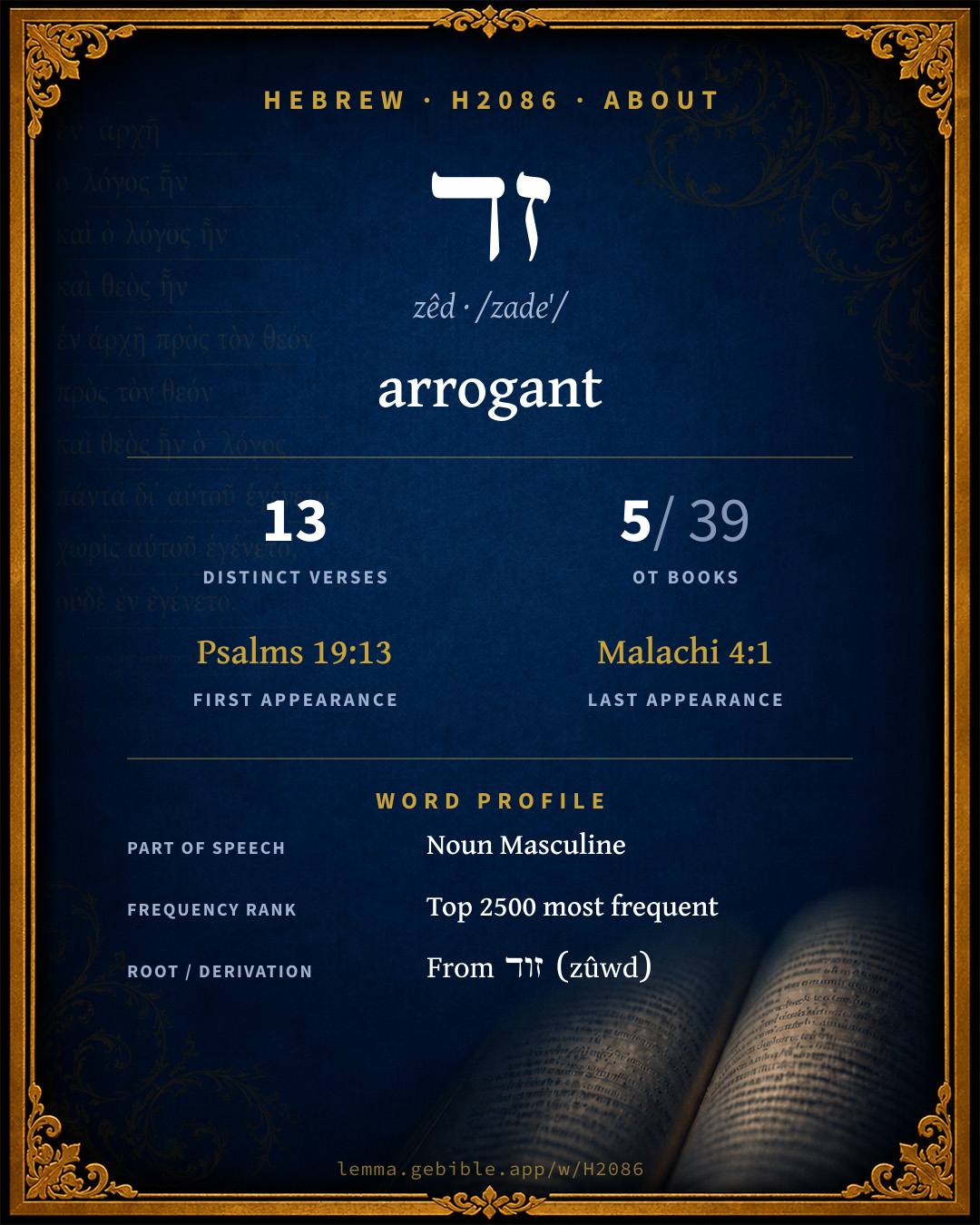
זֵד
arrogant
also: proud, insolent, presumptuous fuller range ↓
Full lexicon entry — Brown-Driver-Briggs (BDB)
From Brown-Driver-Briggs (BDB)
Where this word appears
Grammar key — what these labels mean
Part of speech
- Adjective
- A word that describes or qualifies a noun.
State
- Absolute
- The independent form of a noun, not bound to a following word.
Gender
- Masculine
- Grammatically masculine.
Number
- Plural
- More than one (in Hebrew, generally three or more).
- Singular
- One.
Every verse where H2086 appears in the Book of Isaiah — 1 distinct verse. Click any verse to open its interlinear word-by-word view. Verse text shown in the World English Bible for context — . Each verse’s Hebrew form is shown with its reference; the English is not keyword-highlighted, since the data carries no word-level English alignment. Use “Compare translations” on any verse to read it across multiple English versions. This concordance covers the Hebrew Bible; Septuagint (Greek Old Testament) occurrences are not indexed here.
Isaiah
About this entry
At a glance — auto-summarized from this page’s data, not written by a person. Every figure links to its source below. This summary describes the numbers; it doesn’t interpret them.
זד — transliterated zêd — is a Hebrew noun carrying the sense “arrogant.” Its uses cluster heavily in Psalms (62% of all occurrences). Spanning 13 verses in 5 books, it ranks among the uncommon words of the Hebrew Bible. The lexical range runs to 3 senses — “arrogant” plus “proud”, “insolent”, and “presumptuous”. The King James Version usually renders it “proud,” while modern versions prefer “arrogant” (Berean Standard Bible) — see the renderings breakdown. Each statement above links to its evidence; the full detail follows below.
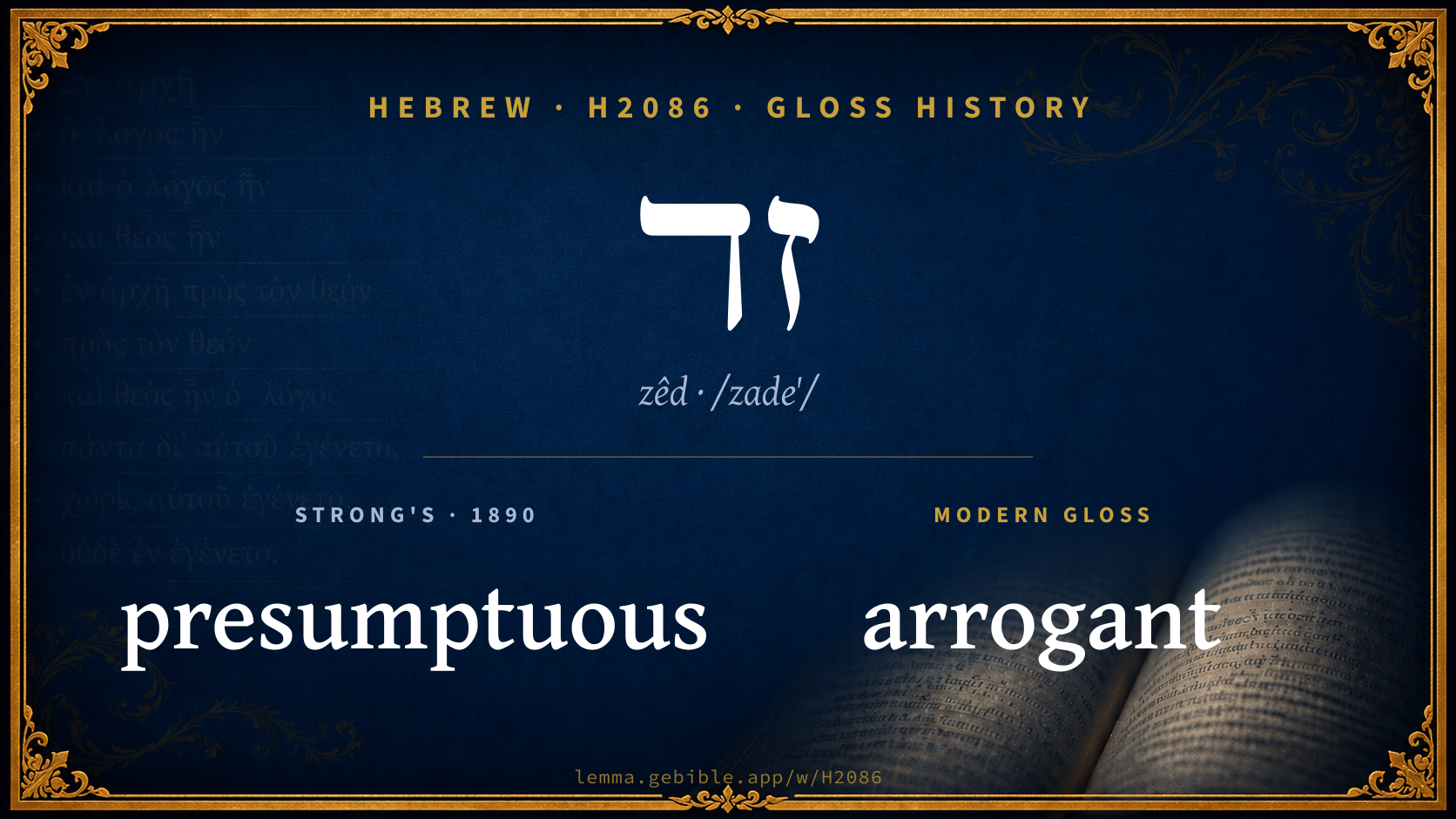
Gloss history
Strong's 1890 vs modern scholarship
About this word
Strong's H2086 catalogs a Hebrew word from the Hebrew Old Testament.
These counts are not copied from any lexicon or concordance. They are computed here, from the morphology-tagged Hebrew Old Testament. What Lemma adds →
- 13
- distinct verses
- The word appears in 13 distinct verses.
- 5 / 39
- OT books
- The word appears in 5 of 39 Old Testament books.
- #2,001
- by frequency
- Top 2500 most frequent Hebrew words (rank 2,001 of 8,640 Hebrew words by occurrence).
View all 13 occurrences in the concordance →
By section of the Old Testament
By traditional corpus
Conventional, traditional groupings — biblical authorship is debated, so this is a traditional corpus grouping, not an authorship claim. Each share is this word’s portion of its verses in that division of the Hebrew canon. Each figure is a share of the word’s 13 distinct verses.
- Writings (Ketuvim) 9 verses · 69%
- Prophets (Nevi'im) 4 verses · 31%
How translations render this word
Counts come from each version’s own published word-to-Strong’s tagging or interlinear alignment — an approximate guide to how each version renders this word, not a word-level alignment the data otherwise carries. Because each total is that version’s own tagged count, the per-version totals vary from one another and need not match the appearance or distinct-verse counts above. These counts may also differ from a printed concordance because Lemma counts each distinctly tagged rendering and does not collapse phrase taggings into a single head-word total. This is a fixed set of word-tagged versions (KJV, ASV, BSB, ULT) and does not change with the reading translation you choose elsewhere. Each version’s license is shown beside its name below (and on Sources).
- King James Version: Proud 8×, All the proud 2×
- American Standard Version: Proud 8×, All the proud 2×
- Berean Standard Bible: Arrogant 8×
- unfoldingWord Literal Text: Arrogant 6×, Proud 4×
King James Version Public Domain
Renders H2086 across 13 tagged occurrences — most commonly:
Plus 3 renderings that appear only once — usually multi-word phrases or single function words the recovered tagging swept in, not distinct renderings.
American Standard Version Public Domain
Renders H2086 across 14 tagged occurrences — most commonly:
Plus 4 renderings that appear only once — usually multi-word phrases or single function words the recovered tagging swept in, not distinct renderings.
Berean Standard Bible Public Domain
Renders H2086 across 13 tagged occurrences — most commonly:
Plus 5 renderings that appear only once — usually multi-word phrases or single function words the recovered tagging swept in, not distinct renderings.
unfoldingWord Literal Text CC BY-SA 4.0
Renders H2086 across 12 tagged occurrences — most commonly:
Plus 2 renderings that appear only once — usually multi-word phrases or single function words the recovered tagging swept in, not distinct renderings.
Senses in BDB
The 3 senses BDB distinguishes for this word, in lexicon order (not ranked by frequency or importance). The full entry — with sub-senses — is in the Lexicon Entry tab.
- arrogant, proud, insolent, presumptuous
- the arrogant ones (as noun collective plural)
- presumptuous (as adjective)
Word origin
adj. insolent, presumptuous:—ז׳ Pr 21:24; pl. זֵדִים Je 43:2 + 11 times;—always masc., and always of opposition to י׳, wickedness; with qualified noun expressed, only הָאֲנָשִׁים הַזֵּדִים Je 43:2, of opponents of Jerem.; elsewhere used substantively, as term. techn. for godless, rebellious men; once sg. זֵד יָהִיר לֵץ שְׁמוֹ Pr 21:24 a haughty, insolent one, scorner is his name (‖ עוֹשֶׂה בְּעֶבְרַת זָדוֹן); usually pl. Is 13:11 (גְּאוֹן ז׳; ‖ גַּאֲוַת עָרִיצִים); Mal 3:13 (‖ עֹשֵׂי רִשְׁעָה), v Mal 3:19 (‖ עֹשֵׁה רִשְׁעָה); and in ψ 86:14 (‖ עָרִיצִים), 119:21 (‖ הַשֹּׁגִים מִמִּצְוֹתֶיךָ), v 51, 69, 78, 85, 122; so prob. also ψ 19:14 גַּם מִזֵּדִים חֲשׂךְ עַבְדֶּ֑ךָ also from presumptuous men hold back thy servant (Ew Ol Hup CheRVm); >presumptuous sins De al. (AV RV).
— Brown-Driver-Briggs (Oxford 1906, public domain), digitized via Sefaria, supplemented by the OpenScriptures HebrewLexicon (CC BY 4.0). See Sources.
Derived from זוד (zûwd) (H2102) — to act presumptuously.
Jastrow Dictionary
A second Hebrew/Aramaic lexicon for comparison, covering Aramaic and post-biblical (Talmudic, Targumic, Midrashic) usage that the biblical-Hebrew BDB does not. Matched by lemma rather than by Strong’s number, so a lemma may carry more than one Jastrow headword (shown separately below), and the entries cover usage well beyond the Bible.
זֵד
- wicked.—Pl. זֵדִים. Tanḥ. Korah 12 ברכת הז׳ the additional (twelfth) section of the Prayer of Benedictions, also called ב׳ הצדוקים or המינים, v. מִין.
A Dictionary of the Targumim, the Talmud Babli and Yerushalmi, and the Midrashic Literature (Marcus Jastrow; London, Luzac, 1903) — Public Domain. Digitized via Sefaria. Digitized via Sefaria. Full attribution on Sources.
Forms in the corpus
The 10 distinct written forms H2086 takes in the Hebrew Bible, most frequent first — each parse links to that state’s occurrences in the concordance. Hebrew forms include their vowel points and cantillation, so a single lemma takes many written forms.
| Form | Parsing | Example | Uses |
|---|---|---|---|
| זֵ֭דִים | Adjective, Adjective, Masculine, Plural, Absolute | Psalms 119:51 | 2 |
| זֵדִ֑ים | Adjective, Adjective, Masculine, Plural, Absolute | Malachi 3:15 | 2 |
| זֵדִ֣ים | Adjective, Adjective, Masculine, Plural, Absolute | Psalms 119:21 | 2 |
| הַ/זֵּדִ֑ים | Adjective, Adjective, Masculine, Plural, Absolute | Jeremiah 43:2 | 1 |
| זֵ֘דִ֤ים | Adjective, Adjective, Masculine, Plural, Absolute | Psalms 86:14 | 1 |
| זֵ֣ד | Adjective, Adjective, Masculine, Singular, Absolute | Proverbs 21:24 | 1 |
| זֵדִ֔ים | Adjective, Adjective, Masculine, Plural, Absolute | Isaiah 13:11 | 1 |
| זֵדִ֜ים | Adjective, Adjective, Masculine, Plural, Absolute | Malachi 4:1 | 1 |
| זֵדִֽים | Adjective, Adjective, Masculine, Plural, Absolute | Psalms 119:122 | 1 |
| מִ/זֵּדִ֨ים | Adjective, Adjective, Masculine, Plural, Absolute | Psalms 19:13 | 1 |
Same root — word family
Other BDB entries built from the same root as H2086, grouped by Strong’s listed origin. These share a root / origin per the lexicon — not necessarily a shared meaning. Each links to that word’s own entry.
Derives from
Shares the same root
- זדון zâdôwn H2087 arrogance
- זוד zûwd H2103 to act presumptuously
- זידון zêydôwn H2121 proud
- נזיד nâzîyd H5138 pottage
Compare all same-root words → Showing 4 of 6 — not the complete family. They share a root, not necessarily a meaning.
Septuagint verse parallels
This word appears in 4 verses that also exist in the Greek Old Testament (Septuagint), out of the 13 Hebrew verses it occurs in. You can read those verses in Greek by switching the Old Testament edition to the Septuagint.
Read these verses in the Septuagint
This is a verse-level parallel only — the same verses exist in both the Hebrew and Greek Old Testaments. No word-level Hebrew↔Greek correspondence is claimed: the data carries no such alignment, so no Greek word is shown as this Hebrew word’s translation. Coverage is not total — the Septuagint omits the deuterocanon and renumbers the Psalms, so some Hebrew verses have no direct Greek parallel.