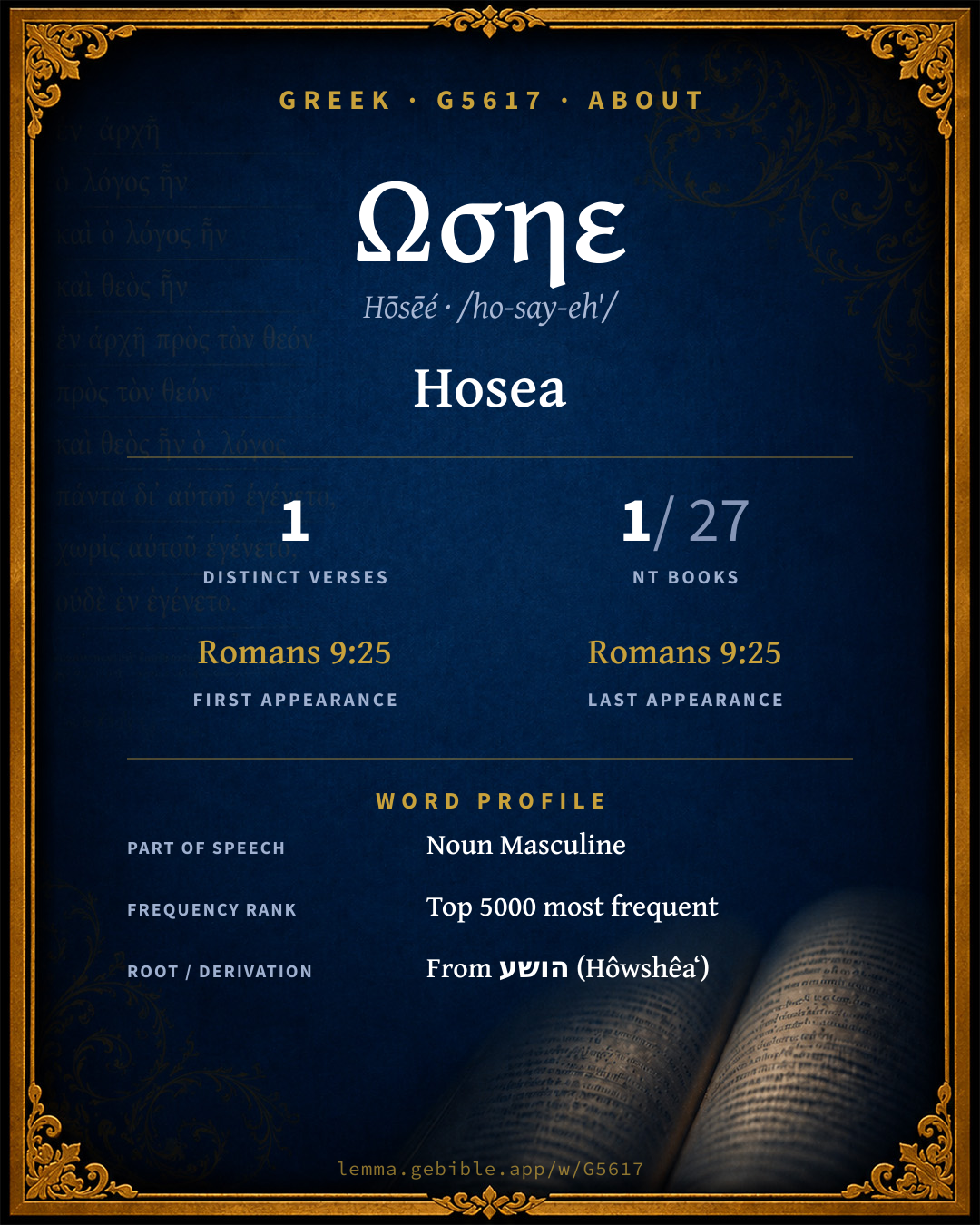
Ὡσηέ
Hosea
Thayer's lists 2 entries for ‘Hosea’ fuller range ↓
Full lexicon entry — Thayer's Greek Lexicon
From Thayer's Greek Lexicon
Where this word appears
Every verse where G5617 appears — 1 distinct verse across 1 book. Click any verse to open its interlinear word-by-word view. Verse text shown in the World English Bible for context — . Each verse’s Greek form is shown with its reference; the English is not keyword-highlighted, since the data carries no word-level English alignment. Use “Compare translations” on any verse to read it across multiple English versions. This concordance covers the Greek New Testament; Septuagint (Greek Old Testament) occurrences of this word are not indexed here.
Romans 1 verse
About this entry
At a glance — auto-summarized from this page’s data, not written by a person. Every figure links to its source below. This summary describes the numbers; it doesn’t interpret them.
Ωσηε (Hōsēé) is a Greek name most often rendered “Hosea.” The Greek New Testament uses it only 1 verse. Romans dominates its distribution — 1 of 1 verses. It occurs only once, in Romans 9:25. For the data behind this summary, explore 1-verse concordance and the renderings breakdown below.
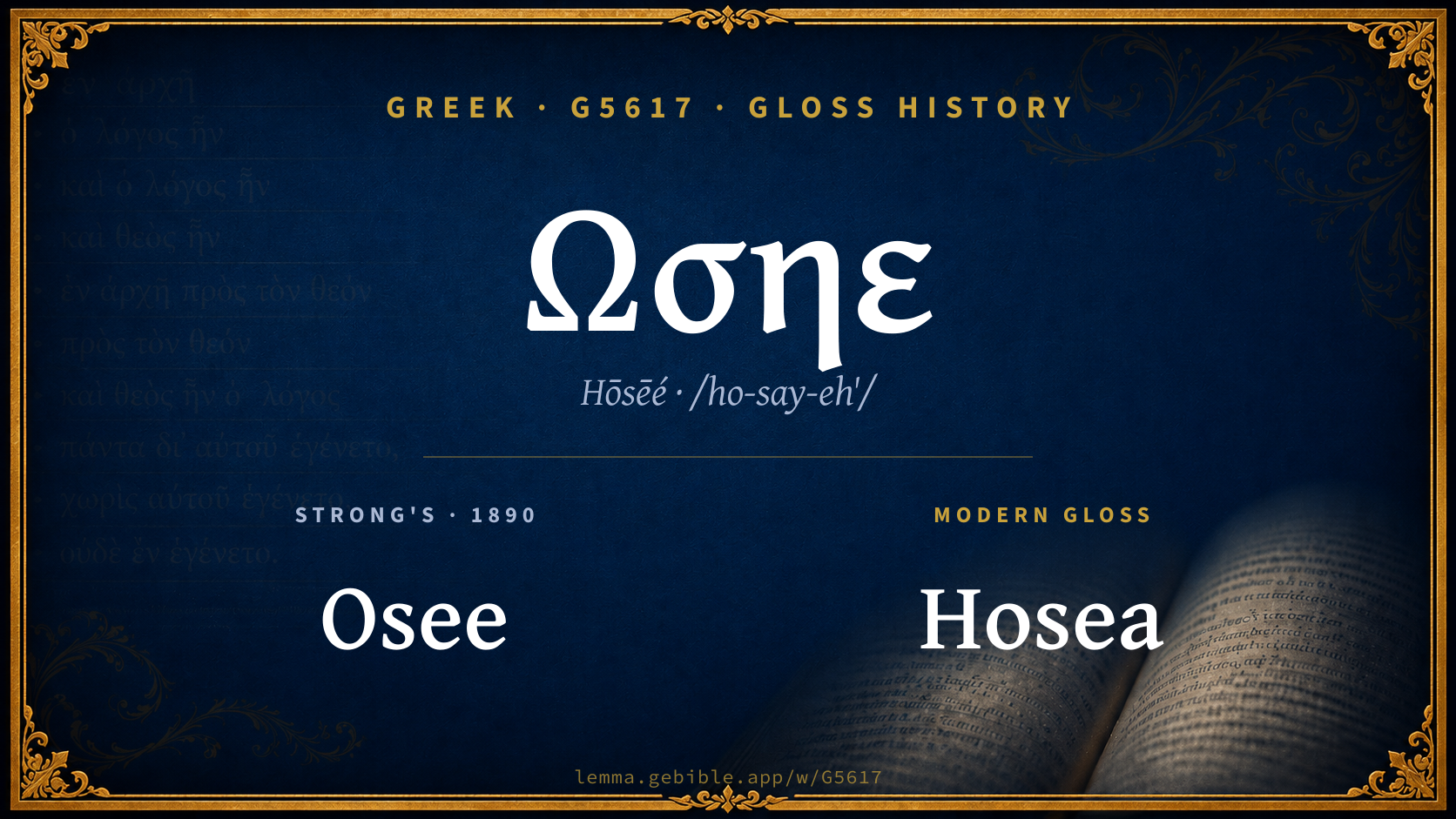
Gloss history
Strong's 1890 vs modern scholarship
About this word
Strong's G5617 catalogs a Greek word from the Greek New Testament.
These counts are not copied from any lexicon or concordance. They are computed here, from the morphology-tagged Greek New Testament. What Lemma adds →
- 1
- distinct verses
- The word appears in 1 distinct verse.
- 1 / 27
- NT books
- The word appears in 1 of 27 New Testament books.
- #3,503
- by frequency
- Top 5000 most frequent Greek words (rank 3,503 of 5,347 Greek words by occurrence).
View all 1 occurrence in the concordance →
Most concentrated in
- Romans 1 verse 100%
By section of the New Testament
By traditional corpus
Conventional, traditional groupings — biblical authorship is debated, so this is a traditional corpus grouping, not an authorship claim. Some books belong to more than one corpus (Luke is in both the Gospels and the Lukan corpus, and so on), so these shares overlap and need not total 100%. Each figure is a share of the word’s 1 distinct verse.
- Pauline corpus 1 verse · 100%
How translations render this word
Counts come from each version’s own published word-to-Strong’s tagging or interlinear alignment — an approximate guide to how each version renders this word, not a word-level alignment the data otherwise carries. Because each total is that version’s own tagged count, the per-version totals vary from one another and need not match the appearance or distinct-verse counts above. These counts may also differ from a printed concordance because Lemma counts each distinctly tagged rendering and does not collapse phrase taggings into a single head-word total. This is a fixed set of word-tagged versions (KJV, ASV, BSB, ULT) and does not change with the reading translation you choose elsewhere. Each version’s license is shown beside its name below (and on Sources).
- King James Version: Osee 1×
- American Standard Version: Hosea 1×
- Berean Standard Bible: Hosea 1×
- unfoldingWord Literal Text: Hosea 1×
King James Version Public Domain
Renders G5617 across 1 tagged occurrence — most commonly:
American Standard Version Public Domain
Renders G5617 across 1 tagged occurrence — most commonly:
Berean Standard Bible Public Domain
Renders G5617 across 1 tagged occurrence — most commonly:
unfoldingWord Literal Text CC BY-SA 4.0
Renders G5617 across 1 tagged occurrence — most commonly:
Senses in Thayer's
The 2 senses Thayer's distinguishes for this word, in lexicon order (not ranked by frequency or importance). The full entry — with sub-senses — is in the Lexicon Entry tab.
- Hosea = "salvation"
- the well known Hebrew prophet, son of Beeri and contemporary with Isaiah
Word origin
Derived from הושע (Hôwshêaʻ) (H1954) — Hosea.
Of hebrew origin [ H1954 ]; Hosee (that is Hoshea ) an Israelite : - Osee.
— Strong’s Exhaustive Concordance (1890), public domain.
Bible dictionary
Public-domain dictionary articles matched to this entry by name (Hosea). A biblical name can be shared by more than one person or place, so an article may treat several.
Easton's Bible Dictionary · M. G. Easton, 1897
Salvation, the son of Beeri, and author of the book of prophecies bearing his name. He belonged to the kingdom of Israel. "His Israelitish origin is attested by the peculiar, rough, Aramaizing diction, pointing to the northern part of Palestine; by the intimate acquaintance he evinces with the localities of Ephraim (5:1; 6:8, 9; 12:12; 14:6, etc.); by passages like 1:2, where the kingdom is styled the land', and 7:5, where the Israelitish king is designated as our' king." The period of his ministry (extending to some sixty years) is indicated in the superscription (Hos. 1:1, 2). He is the only prophet of Israel who has left any written prophecy.
Smith's Bible Dictionary · William Smith, 1863
(salvation), son of Beeri, and first of the minor prophets. Probably the life, or rather the prophetic career, of Hosea extended from B.C. 784 to 723, a period of fifty-nine years. The prophecies of Hosea were delivered in the kingdom of Israel. Jeroboam II was on the throne, and Israel was at the height of its earthly splendor. Nothing is known of the prophet's life excepting what may be gained from his book.
Hitchcock's Bible Names Dictionary · Roswell D. Hitchcock, 1869
Hoshea, savior; safety
Classic public-domain reference works; full attribution on Sources.
Septuagint usage
The same Greek word Ωσηε appears 14 times in the Greek Old Testament (Septuagint), across 13 verses in 4 books.
- 14
- LXX occurrences
- Tagged occurrences of this Greek word in the Septuagint.
- 13
- verses
- Distinct Septuagint verses containing this word.
- 4 / 39
- OT books
- The word appears in 4 of the 39 Old Testament books.
Sample Septuagint occurrences
- 1 Samuel 6:14 ωσηε
- 2 Kings 15:30 ωσηε
- Ezra 20:24 ωσηε
- Hosea 1:1 ωσηε
Septuagint occurrences (same lexeme)
Every verse where the same Strong’s number (G5617) appears in the Greek Septuagint. Verse text shown in the World English Bible for context; the Greek form is the matched word — the English is not keyword-highlighted.
- 1 Samuel 6:14 ωσηε The cart came into the field of Joshua the Beth-shemite, and stood there, where there was a great stone: and they split the wood of the cart, and offered up the cattle for a burnt offering to Yahweh.
- 1 Samuel 6:18 ωσηε and the golden mice, according to the number of all the cities of the Philistines belonging to the five lords, both of fortified cities and of country villages, even to the great stone, whereon they set down the ark of Yahweh, [which stone remains] to this day in the field of Joshua the Beth-shemite.
- 2 Kings 15:30 ωσηε Hoshea the son of Elah made a conspiracy against Pekah the son of Remaliah, and struck him, and killed him, and reigned in his place, in the twentieth year of Jotham the son of Uzziah.
- 2 Kings 17:1 ωσηε In the twelfth year of Ahaz king of Judah began Hoshea the son of Elah to reign in Samaria over Israel, [and reigned] nine years.
- 2 Kings 17:3 ωσηε Against him came up Shalmaneser king of Assyria; and Hoshea became his servant, and brought him tribute.
- 2 Kings 17:4 ωσηε The king of Assyria found conspiracy in Hoshea; for he had sent messengers to So king of Egypt, and offered no tribute to the king of Assyria, as he had done year by year: therefore the king of Assyria shut him up, and bound him in prison.
- 2 Kings 17:6 ωσηε In the ninth year of Hoshea the king of Assyria took Samaria, and carried Israel away to Assyria, and placed them in Halah, and on the Habor, the river of Gozan, and in the cities of the Medes.
- 2 Kings 18:1 ωσηε Now it happened in the third year of Hoshea son of Elah king of Israel, that Hezekiah the son of Ahaz king of Judah began to reign.
- 2 Kings 18:9 ωσηε It happened in the fourth year of king Hezekiah, which was the seventh year of Hoshea son of Elah king of Israel, that Shalmaneser king of Assyria came up against Samaria, and besieged it.
- 2 Kings 18:10 ωσηε At the end of three years they took it: in the sixth year of Hezekiah, which was the ninth year of Hoshea king of Israel, Samaria was taken.
- Ezra 20:24 ωσηε
- Hosea 1:1 ωσηε The word of Yahweh that came to Hosea the son of Beeri, in the days of Uzziah, Jotham, Ahaz, and Hezekiah, kings of Judah, and in the days of Jeroboam the son of Joash, king of Israel.
- Hosea 1:2 ωσηε When Yahweh spoke at the first by Hosea, Yahweh said to Hosea, "Go, take for yourself a wife of prostitution and children of unfaithfulness; for the land commits great adultery against from Yahweh."
These are occurrences of the same Greek lexeme (G5617) in the Septuagint — not a translation of any one Hebrew word. The store carries no word-level Hebrew↔Greek alignment, so no Hebrew original is asserted here. Counts come from the recovered LXX Strong's tagging — high-frequency vocabulary is well covered, while rare or late forms may be untagged — so they reflect tagged occurrences and may slightly undercount.