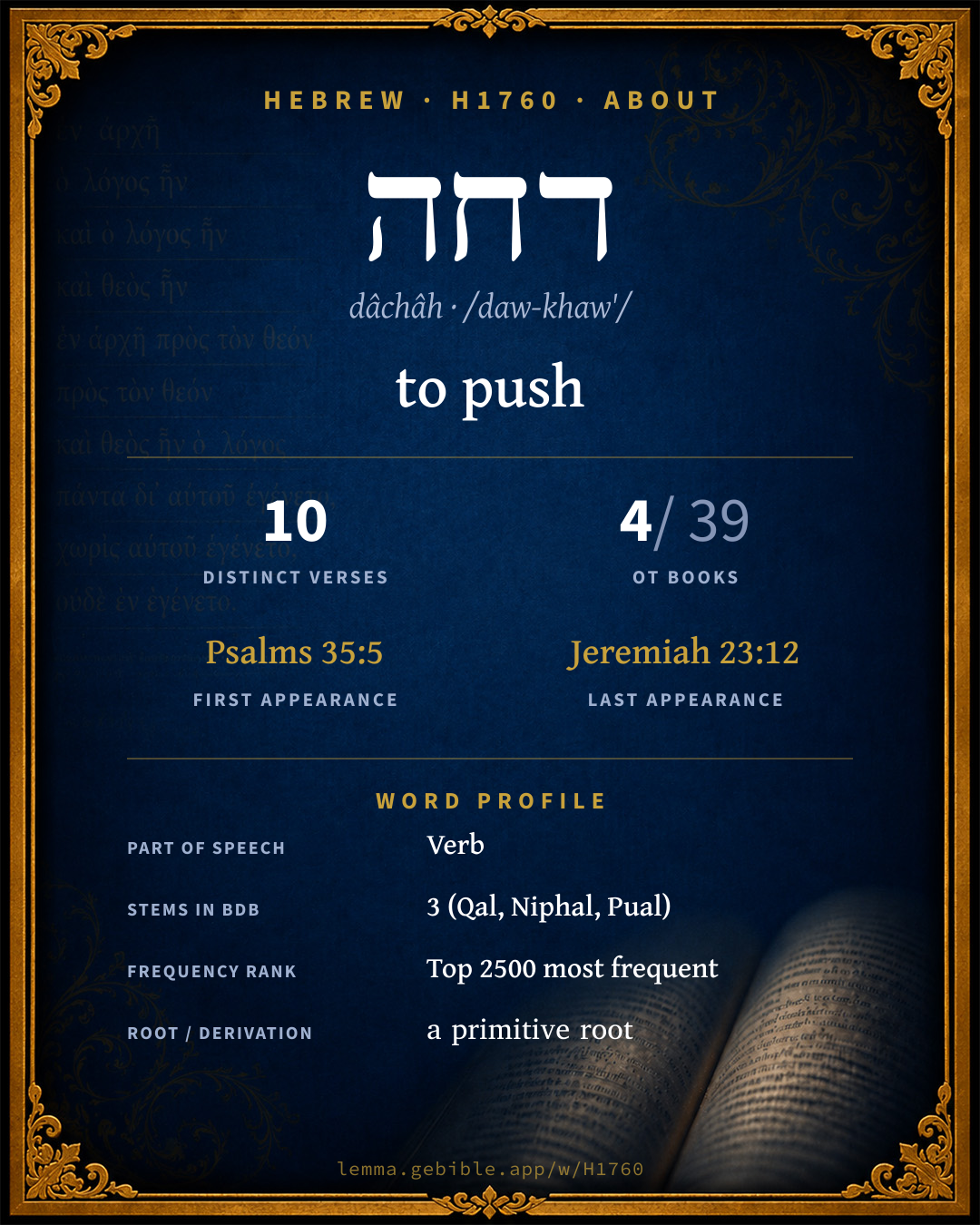
דָּחָה
to push
also: thrust, chase, overflow, totter fuller range ↓
Full lexicon entry — Brown-Driver-Briggs (BDB)
From Brown-Driver-Briggs (BDB)
Where this word appears
Grammar key — what these labels mean
Part of speech
- Verb
- An action or state-of-being word.
Stem
- Niphal
- Usually the simple passive or reflexive of the Qal (“he was written”).
- Qal
- The basic, simple active stem — the plain form of the verb (“he wrote”).
- Pual
- The passive counterpart of the Piel.
Form
- Participle Active
- A verbal adjective expressing ongoing or characteristic action (“writing / one who writes”).
- Infinitive Construct
- A bound verbal noun, frequently with prepositions (“to write / in writing”).
- Participle Passive
- A verbal adjective expressing action received (“written”).
- Imperfect
- An incomplete, ongoing, or future action (“he will / would write”).
- Perfect
- A completed action or state — Hebrew marks aspect (completeness) more than strict tense (“he wrote”).
- Infinitive Absolute
- An unbound verbal noun, often intensifying or standing in for a finite verb.
State
- Construct
- A noun bound to a following noun in a possessive / “of” relationship (the construct chain).
- Absolute
- The independent form of a noun, not bound to a following word.
Person
- 3rd Person
- The one spoken about (“he / she / it / they”).
- 2nd Person
- The one addressed (“you”).
Gender
- Masculine
- Grammatically masculine.
- Feminine
- Grammatically feminine.
- Common
- Either gender — not distinguished for this form.
Number
- Plural
- More than one (in Hebrew, generally three or more).
- Singular
- One.
Every verse where H1760 appears in the Book of Jeremiah — 1 distinct verse. Click any verse to open its interlinear word-by-word view. Verse text shown in the World English Bible for context — . Each verse’s Hebrew form is shown with its reference; the English is not keyword-highlighted, since the data carries no word-level English alignment. Use “Compare translations” on any verse to read it across multiple English versions. This concordance covers the Hebrew Bible; Septuagint (Greek Old Testament) occurrences are not indexed here.
Jeremiah
About this entry
At a glance — auto-summarized from this page’s data, not written by a person. Every figure links to its source below. This summary describes the numbers; it doesn’t interpret them.
“to push” is the headline sense of the Hebrew verb דחה (dâchâh). It clusters heavily in Psalms, which alone accounts for 60% of its uses. With 10 verses in 4 books, it is an uncommon word in the Hebrew Bible. First canonically at Psalms 35:5, it enters the text early. The verb spans 3 stems, from Qal to Niphal. See the sense tree, 10-verse concordance, and the renderings breakdown below.
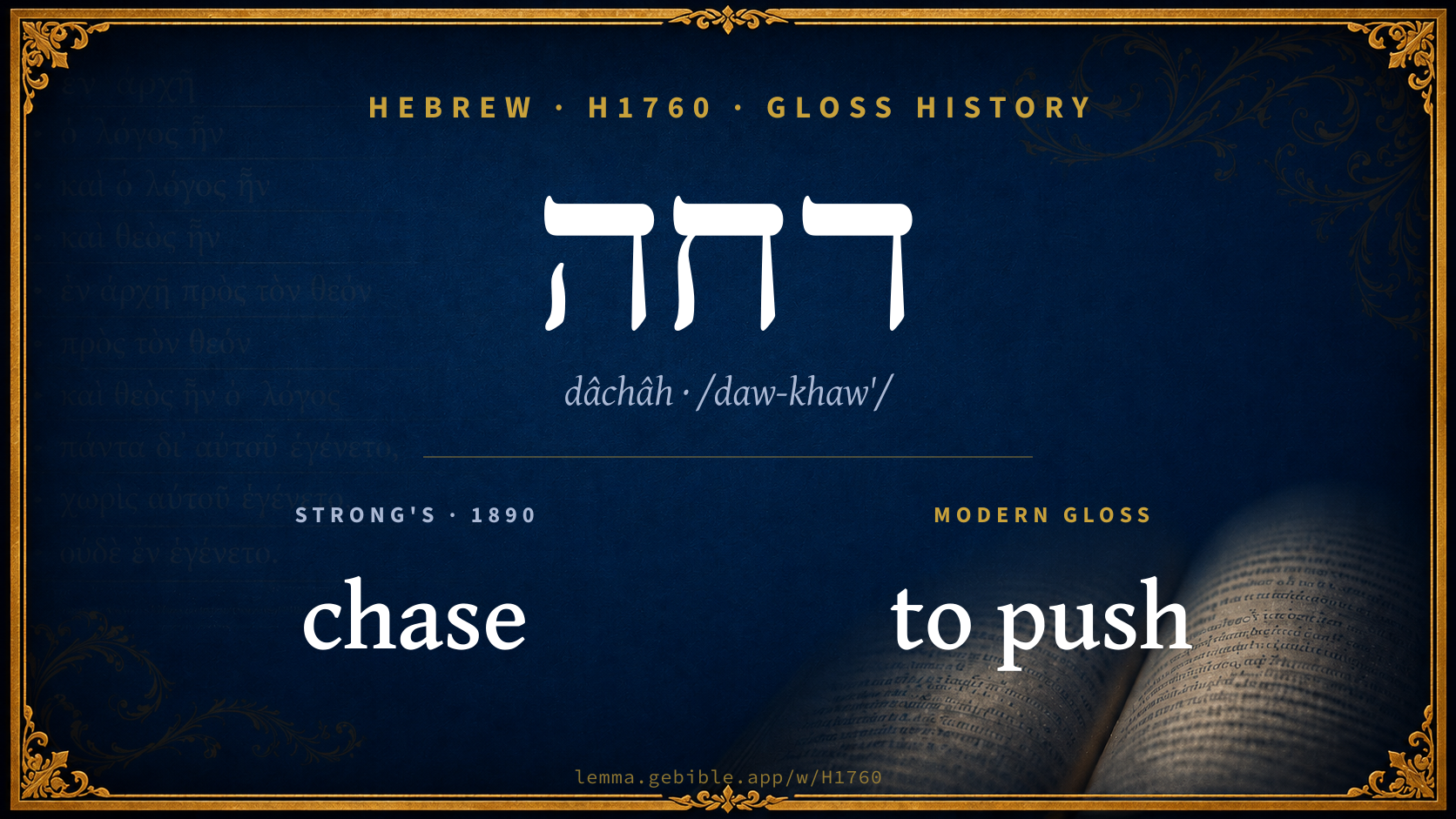
Gloss history
Strong's 1890 vs modern scholarship
About this word
Strong's H1760 catalogs a Hebrew word from the Hebrew Old Testament.
These counts are not copied from any lexicon or concordance. They are computed here, from the morphology-tagged Hebrew Old Testament. What Lemma adds →
- 10
- distinct verses
- The word appears in 10 distinct verses.
- 4 / 39
- OT books
- The word appears in 4 of 39 Old Testament books.
- #2,210
- by frequency
- Top 2500 most frequent Hebrew words (rank 2,210 of 8,640 Hebrew words by occurrence).
View all 10 occurrences in the concordance →
By section of the Old Testament
By traditional corpus
Conventional, traditional groupings — biblical authorship is debated, so this is a traditional corpus grouping, not an authorship claim. Each share is this word’s portion of its verses in that division of the Hebrew canon. Each figure is a share of the word’s 10 distinct verses.
- Writings (Ketuvim) 7 verses · 70%
- Prophets (Nevi'im) 3 verses · 30%
How translations render this word
Counts come from each version’s own published word-to-Strong’s tagging or interlinear alignment — an approximate guide to how each version renders this word, not a word-level alignment the data otherwise carries. Because each total is that version’s own tagged count, the per-version totals vary from one another and need not match the appearance or distinct-verse counts above. These counts may also differ from a printed concordance because Lemma counts each distinctly tagged rendering and does not collapse phrase taggings into a single head-word total. This is a fixed set of word-tagged versions (KJV, ASV, BSB, ULT) and does not change with the reading translation you choose elsewhere. Each version’s license is shown beside its name below (and on Sources).
BDB lists this Strong’s number as 2 distinct words (homographs). Each count above pools all of them and is not split by sense — see the Senses section below. A low-frequency rendering may belong to a different one of those words, not the primary meaning.
- King James Version†: Outcasts 3×
- American Standard Version†: Outcasts 3×
- Berean Standard Bible†: Drives them away 1×, I was pushed so hard 1×, Is thrown down 1×
- unfoldingWord Literal Text†: Push down 2×
King James Version Public Domain
Renders H1760 across 11† tagged occurrences — most commonly:
Plus 8 renderings that appear only once — usually multi-word phrases or single function words the recovered tagging swept in, not distinct renderings.
American Standard Version Public Domain
Renders H1760 across 11† tagged occurrences — most commonly:
Plus 8 renderings that appear only once — usually multi-word phrases or single function words the recovered tagging swept in, not distinct renderings.
Berean Standard Bible Public Domain
Renders H1760 across 7† tagged occurrences — most commonly:
Not rendered by a distinct English word in 1 further occurrence.
unfoldingWord Literal Text CC BY-SA 4.0
Renders H1760 across 13† tagged occurrences — most commonly:
Plus 11 renderings that appear only once — usually multi-word phrases or single function words the recovered tagging swept in, not distinct renderings.
Senses in the full BDB
Hebrew verbs can shift meaning by stem (binyan): Qal is the basic action, Niphal is often passive or reflexive, Piel often intensifies or makes it factitive, and Hiphil is typically causative. The senses below are grouped under the stem BDB assigns to each. This entry also uses Pual (the passive of Piel).
What do BDB’s symbols mean?
BDB uses these scholarly abbreviations:
| Symbol | Meaning |
|---|---|
| 𝔊 | the Septuagint (the ancient Greek translation, LXX) |
| 𝔙 | the Vulgate (the Latin translation) |
| 𝔖 | the Syriac version (the Peshitta) |
| 𝔗 | the Targum (the Aramaic translation) |
| ψ | the Psalms |
| √ | root (the underlying root or stem) |
| ‖ | parallel passage (a synonymous or contrasted parallel) |
| † | the dagger: every passage where the word occurs is cited |
The 4 senses and sub-senses the full Brown-Driver-Briggs lexicon distinguishes for this word, in lexicon order (not ranked by frequency), with BDB’s own verbatim wording and sub-sense lettering. Shown in Hebrew script with BDB’s own scholarly abbreviations. The condensed entry is in the Lexicon Entry tab. See also the Forms in the corpus table below.
דחה I push, thrust (NH id. Aramaic דְּחִי, דְּחָא, ܕܚܳܐ
Qal
- Pf. 2 ms. sf. דְּחִיתַנִי ψ 118:13; Inf. cstr. לִדְחוֹת ψ 140:5; abs. דָּחֹה ψ 118:13; Pt. act. דֹּחֶה ψ 35:5 (read דֹּחָם 𝔊 De Che); pass. f. הַדְּחוּיָה ψ 62:4;—push, דָּחֹה דָחָה push violently fig. c. acc. ψ 118:13 sq. cl. of purpose לִנְפֹּל, cf. לִדְחוֹת פעמי ψ 140:5 (Che trip up my feet), & ψ 35:5 (transp. דחה with רדפם v 6 and read דֹּחָם 𝔊; cf. יְהִי־דרכם חשׁך וַחֲלַקְלַקֹּת v a, and Je 23:12); pushed in (Che), in sim., pt. pass., said of גָּדֵר wall ψ 62:4 (‖ קיר נטוי). e.g. Psalms 118:13
Niphal
- Impf. יִדָּחֶה Pr 14:32; (3 mpl. יִדַּ֫חוּ Je 23:12 is from דחח, if rightly pointed; נִדְחֵי Is 11:12; 56:8 ψ 147:2, v. sub נדח);—be thrust or cast down, fig. of wicked Pr 14:32, cf. ψ 35:5 supr. e.g. Proverbs 14:32
Pual
- Pf. 3 pl. דֹּחוּ ψ 36:13 they are thrust down (‖נפלו & לא יכלו קום). e.g. Psalms 36:13
דחה II only
Niphal
- Impf. 3 mpl. יִדַּ֫חוּ (Köi 377) Je 23:12 they shall be thrust down, fig., of wicked; read perhaps יִדָּח֫וּ, from דחה q.v. e.g. Jeremiah 23:12
Senses from the full Brown-Driver-Briggs lexicon (Brown, Driver, Briggs; Oxford 1906 — public domain), digitized via Sefaria, supplemented by the OpenScriptures HebrewLexicon (CC BY 4.0). Full attribution on Sources.
Word origin
vb. push, thrust (NH id. Aramaic דְּחִי, דְּחָא, ܕܚܳܐ; cf. also Arabic دَحَا spread, extend, also throw, propel)—
— Brown-Driver-Briggs (Oxford 1906, public domain), digitized via Sefaria, supplemented by the OpenScriptures HebrewLexicon (CC BY 4.0). See Sources.
Origin: a primitive root
Jastrow Dictionary
A second Hebrew/Aramaic lexicon for comparison, covering Aramaic and post-biblical (Talmudic, Targumic, Midrashic) usage that the biblical-Hebrew BDB does not. Matched by lemma rather than by Strong’s number, so a lemma may carry more than one Jastrow headword (shown separately below), and the entries cover usage well beyond the Bible.
דָּחָה
- , v. דחי
דְּחַהּ
- (cmp. זָהַהּ) to be merry, wanton.—Denom.:
דחי
- 1. to push away, thrust. Tosef. Yoma IV (III), 14 דְּחָאוֹ ולא מת; Y. ib. VI, 43ᵃ bot. דְּחָייוֹ if the man thrust the goat down the precipice, and it did not die. Snh. 107ᵇ, a. e. תהא שמאל דּוֹחָה וכ׳ let the left hand repel them and the right invite; a. fr.—Transf. ד׳ בקש, or בקנה to dismiss with a vague or paltry reply. Ḥull. 27ᵇ. Tanḥ. Ḥuck. 8; Num. R. s. 19; a. fr.
- 2. to expel. Tosef. Dem. III, 4; Bekh. 31ᵃ; Y. Dem. II, 23ᵃ top, v. חֲבֵירוּת.
- 3. to suspend, make inoperative, supersede. Ohol. VII, 6 אין דּוֹחִין נפש מפני וכ׳ we dare not set aside the regard due to one human life for the sake of saving another human life; Gen. R. s. 94 כך עושין דוחים וכ׳ is it thus one must act? dare you sacrifice one life &c.?—Y. Snh. VIII, 26ᶜ top ד׳ את הספק to disregard the doubt the benefit of which is to be given to the criminal.—Y. Shek. IV, 47ᵈ bot. דָּחִינוּ אותו וכ׳ we postponed it (the fast) to the first day of the week; Meg. 5ᵇ דְחִינוּהוּ; Erub. 41ᵃ דְחִינֻהוּ.—Pes. VI, 1 אלו דברים … דוחין וכ׳ the following performances needed for the Passover offering take precedence of the Sabbath (cause a suspension of the Sabbath laws); a. v. fr.—Part. pass. דָּחוּי a) pushed, hurried. M. Kat. 28ᵃ מיתה דְחוּיָה a hurried death.—b) suspended, superseded. Yoma 7ᵇ, a. fr. טומאה דְּחוּיָה היא וכ׳ the law about levitical purity is only suspended for the sake of an entire community (and its suspension requires atonement), opp. טומאה הותרה the law &c. is inoperative. Zeb. 12ᵃ ד׳ מעיקרו unfit from the start, opp. נראה ונדחה, v. infra.—[Yeb. 80ᵇ; Gitt. 57ᵃ דוחה, v. דִּיהַּ.]
- to be pushed aside, suspended; to give way. Meg. 5ᵇ הואיל ונ׳ יִדָּחֶה the fast being once suspended (on account of the Sabbath), let it remain so (and not be taken up on Sunday). Pes. 66ᵇ איש נ׳ … ואין צבור נִידָּחִין an individual (if unclean on Passover) is suspended (postpones the celebration) until the second Passover (Num. IX, 10 sq.), but not a community. Yoma 64ᵃ בעלי חיים אינן נידחין animals (dedicated for sacrifices) cannot be removed forever from sacred use (as long as the obstacle lies not in their physical unfitness). Ib. נראה ונ׳ once fit and then discarded (on account of a temporary unfitness).—Ber. 64ᵃ כל הנ׳ … שעה נִדֶּחֶת מפניו to him who gives way to time (yielding patiently to circumstances), time will give way, v. דָּחַק. e.g. Numbers 9:10
- 1. to remove hurriedly. M. Kat. 22ᵃ מדְחֶה מיטתו he who is anxious to remove the bier of a relative (hurries the burial).
- 2. to thrust. Arakh. 30ᵇ אַדְחֶה אבן אחר וכ׳ Rashi (ed. אידחה, corrupt. of אֲיַדֶּה; Ar. דְּחֵה imperat. Kal) I will throw a stone after the fallen man (not give the sinner a chance to return). [Naz. 16ᵇ מדחין בה Ar., read with ed. כדהוינן בה.] [Tosef. Toh. VIII, 8 המדחה, v. יָּחַס.]
A Dictionary of the Targumim, the Talmud Babli and Yerushalmi, and the Midrashic Literature (Marcus Jastrow; London, Luzac, 1903) — Public Domain. Digitized via Sefaria. Digitized via Sefaria. Full attribution on Sources.
Forms in the corpus
The 10 distinct written forms H1760 takes in the Hebrew Bible, most frequent first — each parse links to that stem’s occurrences in the concordance. Hebrew forms include their vowel points and cantillation, so a single lemma takes many written forms.
| Form | Parsing | Example | Uses |
|---|---|---|---|
| נִדְחֵ֣י | Verb, Niphal, Participle Active, Masculine, Plural, Construct | Isaiah 11:12 | 2 |
| דְחִיתַ֣/נִי | Verb, Qal, Perfect, 2nd Person, Masculine, Singular | Psalms 118:13 | 1 |
| דַּחֹ֣ה | Verb, Qal, Infinitive Absolute | Psalms 118:13 | 1 |
| דֹּ֝ח֗וּ | Verb, Pual, Perfect, 3rd Person, Common, Plural | Psalms 36:12 | 1 |
| דּוֹחֶֽה | Verb, Qal, Participle Active, Masculine, Singular, Absolute | Psalms 35:5 | 1 |
| הַ/דְּחוּיָֽה | Verb, Qal, Participle Passive, Feminine, Singular, Absolute | Psalms 62:3 | 1 |
| יִדַּ֖חוּ | Verb, Niphal, Imperfect, 3rd Person, Masculine, Plural | Jeremiah 23:12 | 1 |
| יִדָּחֶ֣ה | Verb, Niphal, Imperfect, 3rd Person, Masculine, Singular | Proverbs 14:32 | 1 |
| לִ/דְח֥וֹת | Verb, Qal, Infinitive Construct | Psalms 140:4 | 1 |
| נִדְחֵ֖י | Verb, Niphal, Participle Active, Masculine, Plural, Construct | Psalms 147:2 | 1 |
Same root — word family
Other BDB entries built from the same root as H1760, grouped by Strong’s listed origin. These share a root / origin per the lexicon — not necessarily a shared meaning. Each links to that word’s own entry.
Derived from this word
Compare all same-root words → They share a root, not necessarily a meaning.
Septuagint verse parallels
This word appears in 10 verses that also exist in the Greek Old Testament (Septuagint), out of the 10 Hebrew verses it occurs in. You can read those verses in Greek by switching the Old Testament edition to the Septuagint.
Read these verses in the Septuagint
This is a verse-level parallel only — the same verses exist in both the Hebrew and Greek Old Testaments. No word-level Hebrew↔Greek correspondence is claimed: the data carries no such alignment, so no Greek word is shown as this Hebrew word’s translation. Coverage is not total — the Septuagint omits the deuterocanon and renumbers the Psalms, so some Hebrew verses have no direct Greek parallel.