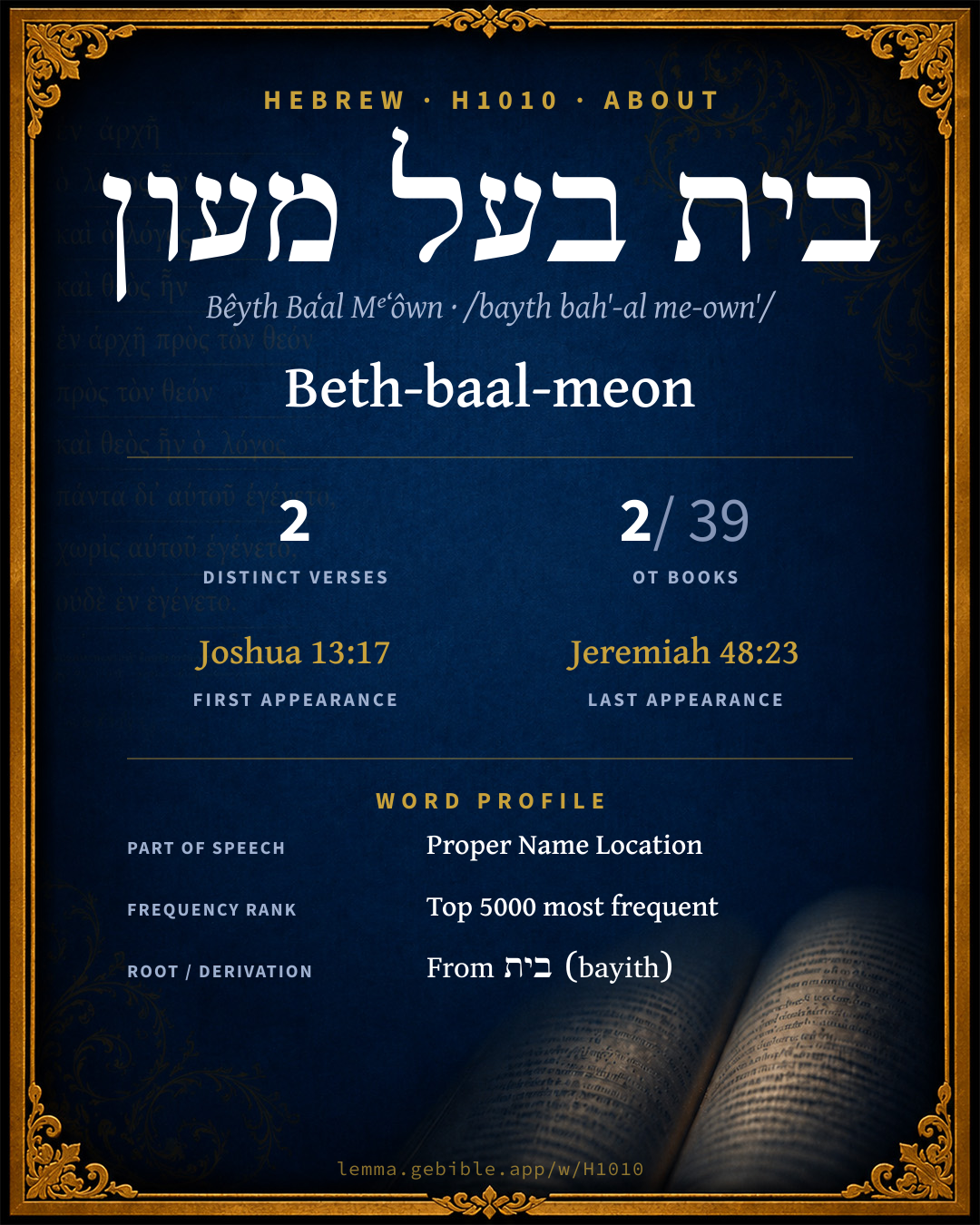
בֵּית בַּ֫עַל מְעוֹן
Beth-baal-meon
BDB lists 2 entries for ‘Beth-baal-meon’ fuller range ↓
Full lexicon entry — Brown-Driver-Briggs (BDB)
From Brown-Driver-Briggs (BDB)
Where this word appears
Grammar key — what these labels mean
Part of speech
- Noun
- A naming word — a person, place, thing, or idea.
Noun type
- Proper
- A name of a specific person, place, or people (e.g. Abraham, Zion, Israel).
Every verse where H1010 appears in the Book of Joshua — 1 distinct verse. Click any verse to open its interlinear word-by-word view. Verse text shown in the World English Bible for context — . Each verse’s Hebrew form is shown with its reference; the English is not keyword-highlighted, since the data carries no word-level English alignment. Use “Compare translations” on any verse to read it across multiple English versions. This concordance covers the Hebrew Bible; Septuagint (Greek Old Testament) occurrences are not indexed here.
Joshua
About this entry
At a glance — auto-summarized from this page’s data, not written by a person. Every figure links to its source below. This summary describes the numbers; it doesn’t interpret them.
At its core, בית בעל מעון (Bêyth Baʻal Mᵉʻôwn) means “Beth-baal-meon.” The Hebrew Bible uses it only 2 verses. The word gravitates to Joshua (50%), then Jeremiah. It first appears in Joshua 13:17. Each statement above links to its evidence; the full detail follows below.
Gloss history
Strong's 1890 vs modern scholarship
About this word
Strong's H1010 catalogs a Hebrew word from the Hebrew Old Testament.
These counts are not copied from any lexicon or concordance. They are computed here, from the morphology-tagged Hebrew Old Testament. What Lemma adds →
- 2
- distinct verses
- The word appears in 2 distinct verses.
- 2 / 39
- OT books
- The word appears in 2 of 39 Old Testament books.
- #3,337
- by frequency
- Top 5000 most frequent Hebrew words (rank 3,337 of 8,640 Hebrew words by occurrence).
View all 2 occurrences in the concordance →
By traditional corpus
Conventional, traditional groupings — biblical authorship is debated, so this is a traditional corpus grouping, not an authorship claim. Each share is this word’s portion of its verses in that division of the Hebrew canon. Each figure is a share of the word’s 2 distinct verses.
- Prophets (Nevi'im) 2 verses · 100%
How translations render this word
Counts come from each version’s own published word-to-Strong’s tagging or interlinear alignment — an approximate guide to how each version renders this word, not a word-level alignment the data otherwise carries. Because each total is that version’s own tagged count, the per-version totals vary from one another and need not match the appearance or distinct-verse counts above. These counts may also differ from a printed concordance because Lemma counts each distinctly tagged rendering and does not collapse phrase taggings into a single head-word total. This is a fixed set of word-tagged versions (KJV, ASV, BSB, ULT) and does not change with the reading translation you choose elsewhere. Each version’s license is shown beside its name below (and on Sources).
- King James Version: Bethbaalmeon 1×, Bethmeon 1×
- American Standard Version: Beth-baal 1×, Beth-meon 1×
- Berean Standard Bible: Beth-baal-meon 1×, Beth-meon 1×
- unfoldingWord Literal Text: Beth baal meon 3×
King James Version Public Domain
Renders H1010 across 2 tagged occurrences — most commonly:
American Standard Version Public Domain
Renders H1010 across 2 tagged occurrences — most commonly:
Berean Standard Bible Public Domain
Renders H1010 across 2 tagged occurrences — most commonly:
unfoldingWord Literal Text CC BY-SA 4.0
Renders H1010 across 3 tagged occurrences — most commonly:
Senses in BDB
The 2 senses BDB distinguishes for this word, in lexicon order (not ranked by frequency or importance). The full entry — with sub-senses — is in the Lexicon Entry tab.
- Beth-baal-meon = "house of Baal"
- a city in the territory of Reuben
Word origin
Derived from בית (bayith) (H1004) — house.
Jastrow Dictionary
A second Hebrew/Aramaic lexicon for comparison, covering Aramaic and post-biblical (Talmudic, Targumic, Midrashic) usage that the biblical-Hebrew BDB does not. Matched by lemma rather than by Strong’s number, so a lemma may carry more than one Jastrow headword (shown separately below), and the entries cover usage well beyond the Bible.
בִּית
- , inf. בּוּת (sec. r. of בוא) to go in, lodge, pass the night. Dan. VI, 19. Targ. Gen. XXXII, 22; a. fr.—Pes. 107ᵃ בת טוות (Dan. l. c.) he went to bed without tasting food. Snh. 95ᵃ (prov.) בת דינא וכ׳ if punishment is procrastinated, punishment is gone. Taan. 24ᵇ ביתו כולי וכ׳ go ye all to bed fasting. Pes. 42ᵃ מיא דביתו (Chald. transl. of the ambiguous מים שֶׁלָּנוּ) water kept in vessels over night. Ber. 60ᵇ בת בדברא he slept in the open field. Snh. 63ᵇ.—Ib. 109ᵃ top בעי למֵיבַת he wanted to stay over night; a. e.—Part. בָּאֵית. Targ. Is. LVIII, 5. e.g. Daniel 6:19
- same. Erub. 73ᵃ (opp. to taking meals).
- to keep over night, postpone burial. Snh. 47ᵃ מֵבִית ליה למת dare one postpone the burial of the dead?
בַּיִת
- cmp. preced.; v. Ges. H. Dict. s. v. as to various etymological attempts), constr. בֵּית, pl. בָּתִּים.
- 1. house, household, home. Yoma 11ᵇ ב׳ מיוחד לדירה bayith means a building intended for a dwelling. Ib. מי שמייחד ביתו לו (Var. v. Rabb. D. S. a. l. note) he who devotes his house (its contents) to himself exclusively (unaccommodating); Arakh. 16ᵃ מי שמיוחד וכ׳.—בעל הב׳ (abbrev. בע"ה) owner, landlord; host; private man, opp. to trader, artisan &c. Ber. 46ᵃ בע"ה בוצע וכ׳ the host breaks the bread, and the guest says the blessing. Tosef. ib. IV, 14 של בע"ה home-made (bread), opp. גלוסקין; Y. ib. VI, 10ᵇ bot.—Sabb. I, 1 בע"ה the donor, opp. עני the recipient. Gen. R. s. 22; a. v. fr.—בן ב׳ inmate, attendant. Ab. I, 5; a. fr.—פסול הב׳ the degraded (slave) of the house. Gen. R. s. 70.
- 2. Esp. (הַ)בַּ׳ the Temple. בפני הב׳ in days when the Temple exists, שלא בפני הב׳ when it does not exist. Ḥull. V, 1; a. fr.—ב׳ שני or ב׳ אחרון the Second Temple. Cant. R. to VIII, 9; a. fr.—הר הב׳ Temple Mount, v. הַר.
- 3. school, college, (collect.) disciples; בֵּית הלל Hillelites &c. Bets. I, 1; a. fr. Treat. Sof’rim IV, 1 של ב׳ וכ׳ those of the house of &c. [Y. Shebi. II, 33ᵈ bot., a. e. דבית … ר׳, usu. דבי, v. בֵּי].
- 4. body. Ber. 44ᵇ אוי לו לב׳ וכ׳ that human body (Rashi: stomach) is to be pitied where vegetables are a constant guest (being the only food).
- 5. wife. Yoma I, 1 ביתו זו וכ׳ ‘his house’—that means his wife. Ib. 13ᵃ והך לאו ביתו היא but this one (designated for him in case of his wife’s death) cannot be called ‘his house’. Sabb. 118ᵇ; a. fr.
- 6. Euphem. pudenda; marital intercourse. Y. Sabb. IX, 12ᵃ top; Mikv. VIII, 4 שמשה את בֵּיתָהּ she had intercourse. Ib. כבדה את הב׳ she washed &c. Y. Sot. I, 16ᶜ bot. אסורה לביתה is forbidden to her husband. Nidd. 5ᵃ מהומת לביתה she hastens to perform her marital duty. Y. ib. I, beg. 48ᵈ. Cmp. חֶדֶר.
- 7. store-house, store-room. בֵּית העצים wood-room; ב׳ התבן straw-magazine; ב׳ הבקר stable; &c. Yoma 11ᵃ; a. fr.
- 8. (geogr.) place, town, in compounds (for which see the respective determinants), e.g. ב׳ בוקיא Beth-Bukya &c.
- 9. (anat.) limb, organ, in compounds (v. supra 8)), e.g. ב׳ הבליעה œsophagus, &c.
- 10. shed for plants, covering. Shebi. II, 4 (pl.). Y. ib. 33ᵈ.—Y. Sabb. VII, 10ᵃ.—1
- receptacle, cover &c., e.g. ב׳ הדיו inkstand. Tosef. Kel. B. Mets. IV, 11; ב׳ יד sleeve, v. אוּנְקְלַי II, &c.—Men. 34ᵇ, a. e. cases of the T’fillin
- , pl. בָּתֵּי אָבוֹת
- 1. paternal home, family. Snh. 38ᵃ שני ב׳ א׳ two families (dynasties); a. fr.—Tosef. Ter. II, 11 בתי אבות = אריסי ב׳ א׳ hereditary land-tenants; B. Bath. 46ᵇ
- 2. priest’s division. Taan. II, 6; a. fr.; v. אֱנוֹשׁ pl.
- 3. origin of a law, rule &c.; cmp. אָב II. Cant. R. to II, 4 ב׳ א׳ של הלכה the origin (principle) of a legal rule. Midr. Till. to Ps. CIV, 29 wherever the root רעש is used, it means cessation of government, ואיזהו ב׳ א׳ שלהם וכ׳ and where is the origin (determining the meaning) of all of them? (Answ. Jer. LI, 29). Lev. R. s. 1, beg. מב׳ א׳ שלהן וכ׳ from the chief passage (Hag. I, 13 ‘Haggai, the messenger’ &c.) we learn that prophets are called messengers (or angels).—בֵּית דִּין (abbr. ב"ד) court.—ב"ד של שבעים ואחד or ב"ד הגדול the Great Sanedrin of seventy one members. Snh. I, 5. Y. ib. 19ᵃ bot.; a. fr.—ב"ד נוטה court of an odd number of judges. ב"ד שקול of an even number of judges. Snh. 3ᵇ.—ב"ד שריא a permitting court, opprobrious name of a court too lax in religious affairs. Y. Gitt. VII, 48ᵈ top; Y. Nidd. III, 50ᵈ bot.—[For all other compounds not self-evident, v. respective determinants.] [בית תר, v. בִּיתֵּר.—Gen. R. s. 12 בית שלו, בית של עולם, v. בִּיָּא.] e.g. Jeremiah 51:29
בָּעַל
- , v. בָּעָה, to enter into, take possession) [in b. h. to be master, protect;] to have sexual intercourse (both legal or illicit), to embrace a woman. Kidd. 9ᵇ וּבְעָלָהּ מלמד וכ׳ ‘and he embraced her’ (Deut. XXIV, 1), this intimates that woman can be acquired as wife by intercourse, v. בִּיאָה.—בּוֹעֵל lover, adulterer, contrad. to בַּעַל husband. Sot. V, 1, a. fr. כשם שאסורה לַבַּעַל … לַבּוֹעֵל as well as the woman suspected of adultery is forbidden to her husband (who must separate himself from her), so is she forbidden to the lover (who cannot marry her after leaving her husband). Yeb. 103ᵃ שבע בעילות ב׳ וכ׳ that wicked man had seven sexual connections &c.; a. fr.—Part. pass. f. בְּעוּלָה one no longer a virgin, opp. to בתולה; married woman, opp. to ארוסה, v. אָרַס. Keth. 10ᵇ; a. fr.—Pl. בְּעוּלוֹת. Y. Kidd. I, 58ᵇ bot.; a. fr. e.g. Deuteronomy 24:1
- she had intercourse. Keth. 5ᵃ נישאת … ונִבְעֶלֶת וכ׳ is married on the fourth day and embraced in the night of the fifth day of the week. Ib. 3ᵇ תִּיבָּעֵל לטפסר וכ׳ must first be surrendered to the (Roman) officer (jus primæ noctis); a. fr.—Masc. נִבְעַל (of the hermaphrodite). Tosef. Bicc. II, 5; Y. Yeb. VIII, 9ᵈ bot.
בְּעַל
- Targ. O. Deut. XXI, 13; a. fr.—Keth. 6ᵇ דבעי למִיבְעַל because he is anxious to perform his marital duty. Ib. דטריד דלא בעיל he is excited because he has not &c.; a. fr.
- , part. pass. f. מְבַעֲלָא married, having had intercourse. Targ. Ruth I, 12; a. e.
- as preced. Nif. Yoma 19ᵇ ואִבְּעוּל כמה וכ׳, (Ms. M. ואיבעיל) and how many virgins have been seduced (to-day) in Nahardea!
בַּעַל
- preced.)
- 1. husband. Kidd. I, 1 and she becomes her own master בגט ובמיתת הב׳ through a letter of divorce or on the husband’s death; a. v. fr.
- 2. the idol Baal. Y. Ab. Zar. III, 43ᵃ bot. ב׳ ראש גוייה הוה וכ׳ the Baal was the phallus and had the shape of a bean [read וכאפון].
- 3. [the fructifier,] rain (v. Taan. 6ᵇ; cmp. Is. LV, 10). בֵּית בַּ׳ a field sufficiently watered by rain and requiring no artificial irrigation. Tosef. M. Kat. I, 1 שדה (בית) הב׳. B. Bath. III, 1. Tosef. Succ. II, 7 ערבה של ב׳ (sub. בית) a willow in a naturally watered field. Ib. Shebi. II, 4 בשל ב׳ (= בשדה של ב׳), opp. של שוקי. Num. R. s. 16 the Egyptian gods של שקר הם (read שקי) are gods of artificial drainage, but those of Canaan של ב׳ הם are gods of rain; (Tanḥ. Sh’laḥ 13, through misunderstanding, שקר … בעליכח. e.g. Isaiah 55:10
- 4. (mostly in compounds) owner of, master of, possessed of, given to &c.; e.g. ב׳ אבידה owner of a lost object; ב׳ אגדה master of Agadah, lecturer; ב׳ דין opponent in court; v. infra. Pes. 86ᵇ ב׳ השם אני I am so named.—Pl. בְּעָלִים, בְּעָלִין owners; mostly as sing. owner. B. Mets. VIII, 1; a. fr. [Y. Dem. III, 23ᵇ bot. לבלעין, read לבעלין.]
- He who knows man’s thoughts. Snh. 19ᵇ.—Ib. בעלי מ׳ those entertaining considerations (of fear), hesitating to do justice.—ב׳ שיבה gray-haired. Ned. III, 8.—ב׳ תשובה repentant sinner. Succ. 53ᵃ; a. fr.—ב׳ תשובות a man of many objections or excuses. Gen. R. s. 20 beg.—[For other compounds, not self-evident, see the respective determinants.]
מָעוֹן I
- 1. [selection; cmp. בִּירָה,] residence, esp. the Temple; המ׳ by the Temple! Tosef. Keth. III, 2. Tosef. Ker. IV, 4. Num. R. s. 12 שמת מְעוֹנְךָ בעליונים thou hast placed thy residence with the uppermost(angels). Koh. R. to XII, 7 מעוני טהור my residence (in heaven) is pure; a. e.
- 2. Maʿon, name of one of the heavens. Ḥag. 12ᵇ
- 3. [that which is looked for,] sustenance, support (v. I Sam. II, 29; 32). Gen. R. s. 68, a. e. הקב"ה מְעוֹנוֹ של עולמו the Lord is the support of his world; cmp. מָקוֹם.—[Ex. R. s. 24 מעון בתוך גרגרתו, some ed., read: מַעֲיָן.] e.g. 1 Samuel 2:29
מָעוֹן II
- 1. (b. h.) Maon, in Judaea. Mekh. Yithro, Baḥod. s. l. מ׳ יהודה.
- 2. מ׳, also בֵּית מ׳ Maon, Beth Maon, near Tiberias. Sabb. 139ᵃ bot. בי כנישתא דמ׳ the synagogue of M.; (Gen. R. s. 80, beg. בכנישתהון דמעונא, read דמְעוֹנָאֵי; Y. Snh. II, end, 20ᵈ בכ׳ בטיבריא). Y. Erub. V, 22ᵇ bot. בית מ׳; Y. Sot. I, 17ᵃ bot. בית מעיין (corr. acc.); Num. R. s. 9 (ed. Wil. p. 58).—[Tosef. Shebi. VII, 13 מעון אנא Var., ed. Zuck. שמעון; oth. ed. מען.]
עָוֹן
- 1. perversion, wrong. Deut. R. s. 3 לא חטא ולא ע׳ no sin or wrong. Sabb. 30ᵃ אותו ע׳ that sin (of David’s, against Uriah and Bathsheba); Snh. 107ᵃ מחול לי על אותו ע׳ כולו pardon me for that sin entirely. Sabb. 88ᵇ עֲוֹן גדי, v. כָּרַם. Snh. 44ᵇ אם יש בי ע׳ זה if I am guilty of that crime (for which I am to be put to death); a. fr.—ע׳ גליון, v. אָוֶן.—Pl. עֲוֹנוֹת, עֲווֹנוֹת. Ib. תהא … עֲווֹנוֹתַיי may my death be an atonement for all my wrong-doings. Ber. 5ᵇ מוחלין לו כל עֲוֹנוֹתָיו is forgiven all his sins. Yoma III, 8. Ib. 39ᵇ עְווֹנוֹתֵיהֶן של ישראל the sins of Israel; a. v. fr.
- 2. (sub. עוֹנֶשׁ) penalty. Yeb. 47ᵃ מודיעין אותו עֲוֹן לקט וכ׳ we acquaint him (the proselyte) with the consequences of a neglect of the laws concerning the share of the poor &c., v. עוֹנֶשׁ.—בַּעֲ׳ as a punishment for, in consequence of. Sabb. 32ᵇ בע׳ נדרים (sub. ביטול) as a punishment for the neglect of vows; בע׳ מזוזה for neglecting the law concerning the door-post inscription; בע׳ ביטול תורה for neglecting the study of the Law; בע׳ גילוי עריות for unchastity; a. fr.
עוּן
- to be round, curved; denom. עַיִן.
- (denom. of עַיִן)
- 1. to look in, read. Tanḥ. Ki Thissa 34 אסור … לעַיֵּין בתורה וכ׳ the interpreter must not look into the Torah (Hebrew text) and translate; (Pesik. R. s. 5 ליתן עיניו).
- 2. to look carefully; to search, investigate (cmp. דּוּק a. דִּקְדֵּק). B. Bath. 115ᵃ (ref. ובן אין לו, Num. XXVII, 8) עַיֵּין עליו (Ar. אַיֵּין) investigate his case (whether he has really no male issue); Yeb. 22ᵇ. Kidd. 4ᵃ (ref. to Lev. XXII, 13 וזרע אין לה) עיין לה; Yeb. 70ᵃ עיין עלה (Chald.). e.g. Numbers 27:8
- 3. to speculate, contemplate. Ber. 55ᵃ המאריך בתפלתו ומְעַיֵּין בה he who stays long in prayer and speculates on it (expecting its fulfillment as a reward for his lengthy prayer); Yalk. Prov. 950; Ber. 32ᵇ; a. e.
- 4. [to measure with the eye] to balance exactly, opp. הכריע (v. כָּרַע). B. Bath. 89ᵃ אין מְעַיְּינִין … במקום שמעיינין where it is customary to give overweight, you dare not sell by exact weight, and vice versa; a. e.—Part. pass. מְעוּיָּין a) (adv.) weighed exactly, even-balanced. Num. R. s. 16, end (ref. to עין בעין, Num. XIV, 14) הרי מאזנים מע׳ אתה וכ׳ behold the scales are evenly balanced, thou sayest …, and I say &c.; Deut. R. s. 5 הרי מדת הדין בכף מאזנים מע׳ judgment lies on evenly balanced scales. Tanḥ. Ki Thissa 34; Pesik. R. s. 5, beg. המאזניים מע׳ the claims on both sides are equal. Y. Snh. X, beg. 27ᶜ היה מע׳ if it (his sins and his merits) be even; Y. Peah I, 16ᵇ bot.; Y. Kidd. I, end, 61ᵈ מחציין (corr. acc.); Yalk. Ps. 784 כף מאזניים מע׳ [היה]; a. e.—b) having eyes (rings) or colors. Y. Kil. I, 27ᵃ, v. לְעוּנִים. e.g. Numbers 14:14
- (b. h.) [to contemplate; to augur;] to produce apparitions, to conjure. Snh. 65ᵇ, a. e. (interpret. מעונן, Deut. XVIII, 10) המעביר … על העין, v. זְכוּרוּ. Ib. (oth. interpret.) האוהז את העינים, v. אָחַז. Ib. (oth. interpret.; cmp. Pi.) המחשב עתים ושעות וכ׳ who calculates what times and hours are auspicious &c.; [Comment. on המחשב עתים explain עונן as denomin. of עוֹנָה I]; Tosef. Sabb. VII (VIII), 14 נותני עתים וכ׳. e.g. Deuteronomy 18:10
עוּן ²
- Pa. עֵיֵּין, עַיֵּן same,
- 1. to watch, guard. Targ. Y. II, Deut. XXXII, 10 עַיְּינֵי (Paeli).—B. Kam. 32ᵇ איבעי ליה עַיּוּנֵי (עַיּוּנֵיה) he ought to have been on his guard; Macc. 8ᵃ לעַיּיוּנֵיה.
- 2. to look out for, select. Targ. Job VIII, 17 יְעַיֵּין ed. Lag. (oth. ed. יְעוֹיִן).
- 3. to look into, meditate, study, speculate. M. Kat. 14ᵇ לעיוני בדיניה to study his case (not to decide it). Ib. אתו מצפרא ומְעַיְּינֵי בדיניה וכ׳ they meet in the morning and consider his case …, and then they come again at sunset &c. Ber. 25ᵃ עַיֵּין אי וכ׳ examine and see whether &c. Ib. 58ᵃ עד דמעייני ביה בדינא while they were arguing about him in court. Snh. 18ᵇ ומְעַיְּינִינָא וכ׳ and we argue on his case. Meg. 30ᵇ מְעַיְּינִינָן במילי דמתא we look into the affairs (the moral condition) of the town. Gitt. 60ᵃ; Tem. 14ᵇ מְעַיְּינֵי בספרא וכ׳ used to study the book of &c. R. Hash. 16ᵃ בחינה עיוני בעלמא היא ‘to probe’ (בחן) means merely to investigate (without decreeing). Ber. 55ᵃ דמְעַיּין בה when he thinks of his prayer (expecting its fulfilment), v. preced; a. fr.—[Pol. עוֹנֵן, v. עֲנַן.]
עֹל
- , v. עוֹל
A Dictionary of the Targumim, the Talmud Babli and Yerushalmi, and the Midrashic Literature (Marcus Jastrow; London, Luzac, 1903) — Public Domain. Digitized via Sefaria. Digitized via Sefaria. Full attribution on Sources.
Forms in the corpus
The 4 distinct written forms H1010 takes in the Hebrew Bible, most frequent first — each parse links to that state’s occurrences in the concordance. Hebrew forms include their vowel points and cantillation, so a single lemma takes many written forms.
| Form | Parsing | Example | Uses |
|---|---|---|---|
| מְעֽוֹן | Noun, Proper | Jeremiah 48:23 | 2 |
| בֵּ֥ית | Noun, Proper | Jeremiah 48:23 | 1 |
| בַּ֥עַל | Noun, Proper | Joshua 13:17 | 1 |
| וּ/בֵ֖ית | Noun, Proper | Joshua 13:17 | 1 |
Same root — word family
Other BDB entries built from the same root as H1010, grouped by Strong’s listed origin. These share a root / origin per the lexicon — not necessarily a shared meaning. Each links to that word’s own entry.
Derives from
Shares the same root
Proper names from this root
People and places named from this root — a name, not an additional meaning of the word.
- Βηθαβαρα Bēthabará G962 Bethabara
- בית Bayith H1006 Bajith
- בית און Bêyth ʼÂven H1007 Beth-aven
- ביתאל Bêyth-ʼÊl H1008 Bethel
- בית ארבאל Bêyth ʼArbêʼl H1009 Beth-Arbel
- בית בראי Bêyth Birʼîy H1011 Beth-birei
- בית ברה Bêyth Bârâh H1012 Beth-barah
- ביתגדר Bêyth-Gâdêr H1013 Beth-gader
- בית גמול Bêyth Gâmûwl H1014 Beth-gamul
- בית דבלתים Bêyth Diblâthayim H1015 Beth-diblathaim
- ביתדגון Bêyth-Dâgôwn H1016 Beth-dagon
- בית האצל Bêyth hâʼêtsel H1018 Beth-ezel
- בית הגלגל Bêyth hag-Gilgâl H1019 Beth-gilgal
- בית הישימות Bêyth ha-Yshîy-môwth H1020 Beth-jesimoth
- בית הכרם Bêyth hak-Kerem H1021 Beth-haccerem
- בית המרחק Bêyth ham-Merchâq H1023 Beth Ham-merchaq
- בית המרכבות Bêyth ham-Markâbôwth H1024 Beth-marcaboth
- בית העמק Bêyth hâ-ʻÊmeq H1025 Beth-emek
- בית הערבה Bêyth hâ-ʻĂrâbâh H1026 Beth-arabah
- בית הרם Bêyth hâ-Râm H1027 Beth-aram
- בית השטה Bêyth hash-Shiṭṭâh H1029 Beth-shittah
- בית חגלה Bêyth Choglâh H1031 Beth-hoglah
- בית חורון Bêyth Chôwrôwn H1032 Beth-horon
- בית כר Bêyth Kar H1033 Beth-car
- בען Bᵉʻôn H1194 Beon
+20 more proper names from this root (not shown).
Compare all same-root words → Showing 4 of 49 — not the complete family. 45 of the same-root words are proper names (people or places). They share a root, not necessarily a meaning.
Bible dictionary
Public-domain dictionary articles matched to this entry by name (Beth-baal-meon). A biblical name can be shared by more than one person or place, so an article may treat several.
Smith's Bible Dictionary · William Smith, 1863
(house of Baalmeon), a place in the possessions of Reuben, on the downs (Authorized Version "plain") east of the Jordan. (Joshua 13:17) At the Israelites' first approach is name was BAAL-MEON, (Numbers 32:38) or, in its contracted form, BEON (Numbers 32:3) to which the Beth was possibly a Hebrew addition. Later it would seem to have come into possession of Moab, and to be known either as Beth-meon, (Jeremiah 48:23) or Baal-meon. (Ezekiel 25:9) The name is still attached to a ruined place of considerable size a short distance to the southwest of Hesban, and bearing the name of "the fortress of Mi'un, " or Makin .
Hitchcock's Bible Names Dictionary · Roswell D. Hitchcock, 1869
an idol of the dwelling-place
Classic public-domain reference works; full attribution on Sources.
Septuagint verse parallels
This word appears in 1 verse that also exists in the Greek Old Testament (Septuagint), out of the 2 Hebrew verses it occurs in. You can read those verses in Greek by switching the Old Testament edition to the Septuagint.
Read these verses in the Septuagint
This is a verse-level parallel only — the same verses exist in both the Hebrew and Greek Old Testaments. No word-level Hebrew↔Greek correspondence is claimed: the data carries no such alignment, so no Greek word is shown as this Hebrew word’s translation. Coverage is not total — the Septuagint omits the deuterocanon and renumbers the Psalms, so some Hebrew verses have no direct Greek parallel.