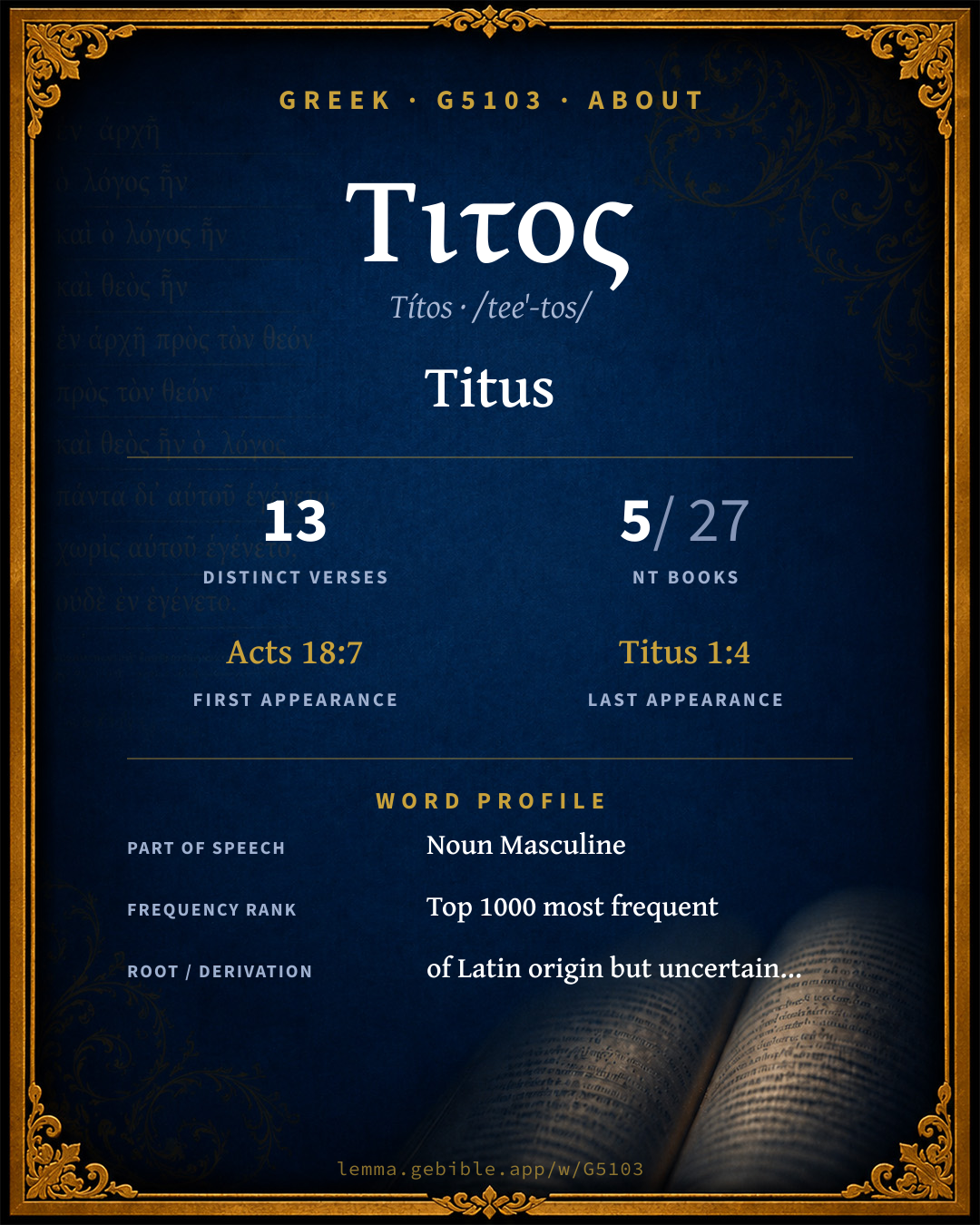
Τίτος
Titus
Thayer's lists 2 entries for ‘Titus’ fuller range ↓
Full lexicon entry — Thayer's Greek Lexicon
From Thayer's Greek Lexicon
Where this word appears
See every Genitive-case word in the Greek New Testament →
Grammar key — what these labels mean
Part of speech
- Noun
- A naming word — a person, place, thing, or idea.
Case
- Genitive
- The case of source, possession, or “of” — answers “whose / from what.”
- Accusative
- The case of the direct object and of extent.
- Nominative
- The case of the subject (and the predicate nominative).
- Dative
- The case of the indirect object, means, or location — “to / for / with / in.”
Gender
- Masculine
- Grammatically masculine.
Number
- Singular
- One.
Grammatical forms
- Noun, Genitive, Singular, Masculine 6 times (43%)
- Noun, Accusative, Singular, Masculine 4 times (29%)
- Noun, Nominative, Singular, Masculine 3 times (21%)
- Noun, Dative, Singular, Masculine 1 time (7%)
Parsed forms decoded from the imported morphology (Robinson–Tischendorf, public domain), counted across 14 parsed occurrences — not distinct verses.
Every verse where G5103 appears — 13 distinct verses across 5 books. Click any verse to open its interlinear word-by-word view. Verse text shown in the World English Bible for context — . Each verse’s Greek form is shown with its reference; the English is not keyword-highlighted, since the data carries no word-level English alignment. Use “Compare translations” on any verse to read it across multiple English versions. This concordance covers the Greek New Testament; Septuagint (Greek Old Testament) occurrences of this word are not indexed here.
Acts 1 verse
2 Corinthians 8 verses
- 2 Corinthians 2:13 Τίτον n acc sg masc I had no relief for my spirit, because I didn't find Titus, my brother, but taking my leave of them, I went out into Macedonia.
- 2 Corinthians 7:6 Τίτου n gen sg masc Nevertheless, he who comforts the lowly, God, comforted us by the coming of Titus;
- 2 Corinthians 7:13 Τίτου n gen sg masc Therefore we have been comforted. In our comfort we rejoiced the more exceedingly for the joy of Titus, because his spirit has been refreshed by you all.
- 2 Corinthians 7:14 Τίτου n gen sg masc For if in anything I have boasted to him on your behalf, I was not disappointed. But as we spoke all things to you in truth, so our glorying also which I made before Titus was found to be truth.
- 2 Corinthians 8:6 Τίτον n acc sg masc So we urged Titus, that as he made a beginning before, so he would also complete in you this grace.
- 2 Corinthians 8:16 Τίτου n gen sg masc But thanks be to God, who puts the same earnest care for you into the heart of Titus.
- 2 Corinthians 8:23 Τίτου n gen sg masc As for Titus, he is my partner and fellow worker for you. As for our brothers, they are the apostles of the assemblies, the glory of Christ.
- 2 Corinthians 12:18 Τίτον Τίτος n acc sg masc n nom sg masc I exhorted Titus, and I sent the brother with him. Did Titus take any advantage of you? Didn't we walk in the same spirit? Didn't we walk in the same steps?
Galatians 2 verses
2 Timothy 1 verse
Titus 1 verse
About this entry
At a glance — auto-summarized from this page’s data, not written by a person. Every figure links to its source below. This summary describes the numbers; it doesn’t interpret them.
“Titus” is the headline sense of the Greek name Τιτος (Títos). It clusters heavily in 2 Corinthians, which alone accounts for 62% of its uses. With 13 verses in 5 books, it is an uncommon word in the Greek New Testament. First canonically at Acts 18:7, it enters the text early. See 13-verse concordance and the renderings breakdown below.
Gloss history
Strong's 1890 vs modern scholarship
About this word
Strong's G5103 catalogs a Greek word from the Greek New Testament.
These counts are not copied from any lexicon or concordance. They are computed here, from the morphology-tagged Greek New Testament. What Lemma adds →
- 13
- distinct verses
- The word appears in 13 distinct verses.
- 5 / 27
- NT books
- The word appears in 5 of 27 New Testament books.
- #814
- by frequency
- Top 1000 most frequent Greek words (rank 814 of 5,347 Greek words by occurrence).
View all 13 occurrences in the concordance →
Most concentrated in
- 2 Corinthians 8 verses 62%
- Galatians 2 verses 15%
- Acts 1 verse 8%
By section of the New Testament
By traditional corpus
Conventional, traditional groupings — biblical authorship is debated, so this is a traditional corpus grouping, not an authorship claim. Some books belong to more than one corpus (Luke is in both the Gospels and the Lukan corpus, and so on), so these shares overlap and need not total 100%. Each figure is a share of the word’s 13 distinct verses.
- Pauline corpus 12 verses · 92%
- Lukan (Luke–Acts) 1 verse · 8%
How translations render this word
Counts come from each version’s own published word-to-Strong’s tagging or interlinear alignment — an approximate guide to how each version renders this word, not a word-level alignment the data otherwise carries. Because each total is that version’s own tagged count, the per-version totals vary from one another and need not match the appearance or distinct-verse counts above. These counts may also differ from a printed concordance because Lemma counts each distinctly tagged rendering and does not collapse phrase taggings into a single head-word total. This is a fixed set of word-tagged versions (KJV, ASV, BSB, ULT) and does not change with the reading translation you choose elsewhere. Each version’s license is shown beside its name below (and on Sources).
- King James Version: Titus 13×
- American Standard Version: Titus 13×
- Berean Standard Bible: Titus 12×
- unfoldingWord Literal Text: Titus 13×
King James Version Public Domain
Renders G5103 across 13 tagged occurrences — most commonly:
American Standard Version Public Domain
Renders G5103 across 13 tagged occurrences — most commonly:
Berean Standard Bible Public Domain
Renders G5103 across 14 tagged occurrences — most commonly:
Plus 2 renderings that appear only once — usually multi-word phrases or single function words the recovered tagging swept in, not distinct renderings.
unfoldingWord Literal Text CC BY-SA 4.0
Renders G5103 across 13 tagged occurrences — most commonly:
Senses in Thayer's
The 2 senses Thayer's distinguishes for this word, in lexicon order (not ranked by frequency or importance). The full entry — with sub-senses — is in the Lexicon Entry tab.
- Titus = "nurse"
- a Gentile Christian an Paul's companion in some of his journeys
Word origin
Origin: of Latin origin but uncertain signification
Of Latin origin but uncertain significance; Titus a Christian : - Titus.
— Strong’s Exhaustive Concordance (1890), public domain.
Forms in the corpus
The 5 distinct written forms G5103 takes in the Greek New Testament, most frequent first — each parse links to that case’s occurrences in the concordance.
| Form | Parsing | Example | Uses |
|---|---|---|---|
| Τίτου Títou | Noun, Genitive, Singular, Masculine | 2 Corinthians 7:6 | 5 |
| Τίτον Títon | Noun, Accusative, Singular, Masculine | 2 Corinthians 2:13 | 4 |
| Τίτος Títos | Noun, Nominative, Singular, Masculine | 2 Corinthians 12:18 | 3 |
| Τίτῳ Títō | Noun, Dative, Singular, Masculine | Titus 1:4 | 1 |
| Τιτίου Titíou | Noun, Genitive, Singular, Masculine | Acts 18:7 | 1 |
Bible dictionary
Public-domain dictionary articles matched to this entry by name (Titus). A biblical name can be shared by more than one person or place, so an article may treat several.
Easton's Bible Dictionary · M. G. Easton, 1897
Honourable, was with Paul and Barnabas at Antioch, and accompanied them to the council at Jerusalem (Gal. 2:1-3; Acts 15:2), although his name nowhere occurs in the Acts of the Apostles. He appears to have been a Gentile, and to have been chiefly engaged in ministering to Gentiles; for Paul sternly refused to have him circumcised, inasmuch as in his case the cause of gospel liberty was at stake. We find him, at a later period, with Paul and Timothy at Ephesus, whence he was sent by Paul to Corinth for the purpose of getting the contributions of the church there in behalf of the poor saints at Jerusalem sent forward (2 Cor. 8:6; 12:18). He rejoined the apostle when he was in Macedonia, and cheered him with the tidings he brought from Corinth (7:6-15). After this his name is not mentioned till after Paul's first imprisonment, when we find him engaged in the organization of the church in Crete, where the apostle had left him for this purpose (Titus 1:5). The last notice of him is in 2 Tim. 4:10, where we find him with Paul at Rome during his second imprisonment. From Rome he was sent into Dalmatia, no doubt on some important missionary errand. We have no record of his death. He is not mentioned in the Acts.
Smith's Bible Dictionary · William Smith, 1863
Our materials for the biography of this companion of St. Paul must be drawn entirely from the notices of him in the Second Epistle to the Corinthians, the Galatians, and to Titus himself, combined with the Second Epistle to Timothy. He is not mentioned in the Acts at all. Taking the passages in the epistles in the chronological order of the events referred to, we turn first to (Galatians 2:1,3) We conceive the journey mentioned here to be identical with that (recorded in Acts 15) in which Paul and Barnabas went from Antioch to Jerusalem to the conference which was to decide the question of the necessity of circumcision to the Gentiles. Here we see Titus in close association with Paul and Barnabas at Antioch. He goes with them to Jerusalem. His circumcision was either not insisted on at Jerusalem, or, if demanded, was firmly resisted. He is very emphatically spoken of as a Gentile by which is most probably meant that both his parents were Gentiles. Titus would seem on the occasion of the council to have been specially a representative of the church of the uncircumcision. It is to our purpose to remark that, in the passage cited above, Titus is so mentioned as apparently to imply that he had become personally known to the Galatian Christians. After leaving Galatia., (Acts 18:23) and spending a long time at Ephesus, (Acts 19:1; 20:1) the apostle proceeded to Macedonia by way of Troas. Here he expected to meet Titus, (2 Corinthians 2:13) who had been sent on a mission to Corinth. In this hope he was disappointed, but in Macedonia Titus joined him. (2 Corinthians 7:6,7,13-15) The mission to Corinth had reference to the immoralities rebuked in the First Epistle, and to the collection at that time in progress, for the poor Christians of Judea. (2 Corinthians 8:6) Thus we are prepared for what the apostle now proceeds to do after his encouraging conversations with Titus regarding the Corinthian church. He sends him back from Macedonia to Corinth, in company with two other trustworthy Christians, bearing the Second Epistle, and with an earnest request, ibid. (2 Corinthians 8:6,17) that he would see to the completion of the collection. ch. (2 Corinthians 8:6) A considerable interval now elapses before we come upon the next notices of this disciple. St. Paul's first imprisonment is concluded, and his last trial is impending. In the interval between the two, he and Titus were together in Crete. (Titus 1:5) We see Titus remaining in the island when St. Paul left it and receiving there a letter written to him by the apostle. From this letter we gather the following biographical details. In the first place we learn that he was originally converted through St. Paul's instrumentality. (Titus 1:4) Next we learn the various particulars of the responsible duties which he had to discharge. In Crete, he is to complete what St. Paul had been obliged to leave unfinished, ch. (Titus 1:5) and he is to organize the church throughout the island by appointing presbytery in every city. Next he is to control and bridle, ver. 11, the restless and mischievous Judaizers. He is also to look for the arrival in Crete of Artemas and Tychicus, ch. (Titus 3:12) and then is to hasten to join St. Paul at Nicopolis, where the apostle purposes to pass the winter. Zenas and Apollos are in Crete, or expected there; for Titus is to send them on their journey, and to supply them with whatever they need for it. Whether Titus did join the apostle at Nicopolis we cannot tell; but we naturally connect the mention of this place with what St. Paul wrote, at no great interval of time afterward, in the last of the Pastoral Epistles, (2 Timothy 4:10) for Dalmatia lay to the north of Nicopolis, at no great distance from it. From the form of the whole sentence, it seems probable that this disciple had been with St. Paul in Rome during his final imprisonment; but this cannot be asserted confidently. The traditional connection of Titus with Crete is much more specific and constant, though here again we cannot be certain of the facts. He said to have been permanent bishop in the island, and to have died there at an advanced age. The modern capital, Candia, appears to claim the honor of being his burial-place. In the fragment by the lawyer Zenas, Titus is called bishop of Gortyna. Lastly, the name of Titus was the watchword of the Cretans when they were invaded by the Venetians.
Hitchcock's Bible Names Dictionary · Roswell D. Hitchcock, 1869
pleasing
Classic public-domain reference works; full attribution on Sources.