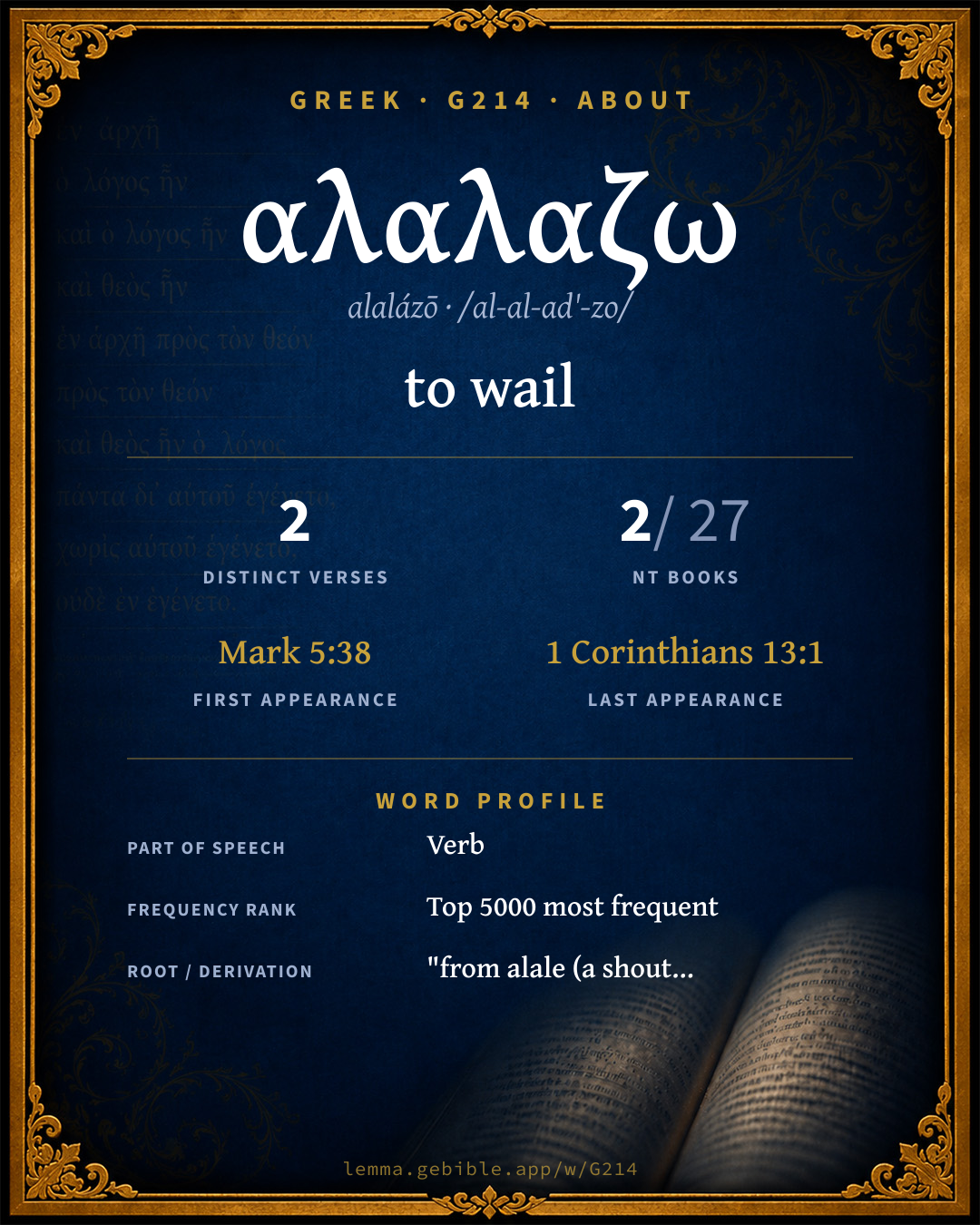
ἀλαλάζω
to wail
‘to wail’ is one of 4 main senses fuller range ↓
Full lexicon entry — Thayer's Greek Lexicon
From Thayer's Greek Lexicon
Where this word appears
Grammar key — what these labels mean
Part of speech
- Verb
- An action or state-of-being word.
Tense
- Present
- Ongoing or general action in present time (imperfective aspect).
Voice
- Active
- The subject performs the action.
Mood
- Participle
- A verbal adjective (“writing,” “having written”).
Case
- Accusative
- The case of the direct object and of extent.
- Nominative
- The case of the subject (and the predicate nominative).
Gender
- Masculine
- Grammatically masculine.
- Neuter
- Grammatically neuter.
Number
- Plural
- More than one.
- Singular
- One.
Every verse where G214 appears in the Book of Mark — 1 distinct verse. Click any verse to open its interlinear word-by-word view. Verse text shown in the World English Bible for context — . Each verse’s Greek form is shown with its reference; the English is not keyword-highlighted, since the data carries no word-level English alignment. Use “Compare translations” on any verse to read it across multiple English versions. This concordance covers the Greek New Testament; Septuagint (Greek Old Testament) occurrences of this word are not indexed here.
Mark
About this entry
At a glance — auto-summarized from this page’s data, not written by a person. Every figure links to its source below. This summary describes the numbers; it doesn’t interpret them.
αλαλαζω — transliterated alalázō — is a Greek verb carrying the sense “to wail.” A scarce word — 2 verses in all of the Greek New Testament. More than half of its appearances fall in Mark. Debuting at Mark 5:38, it then recurs through the corpus. Its lexical range runs to 4 senses. See the sense tree, 2-verse concordance, and the renderings breakdown below.
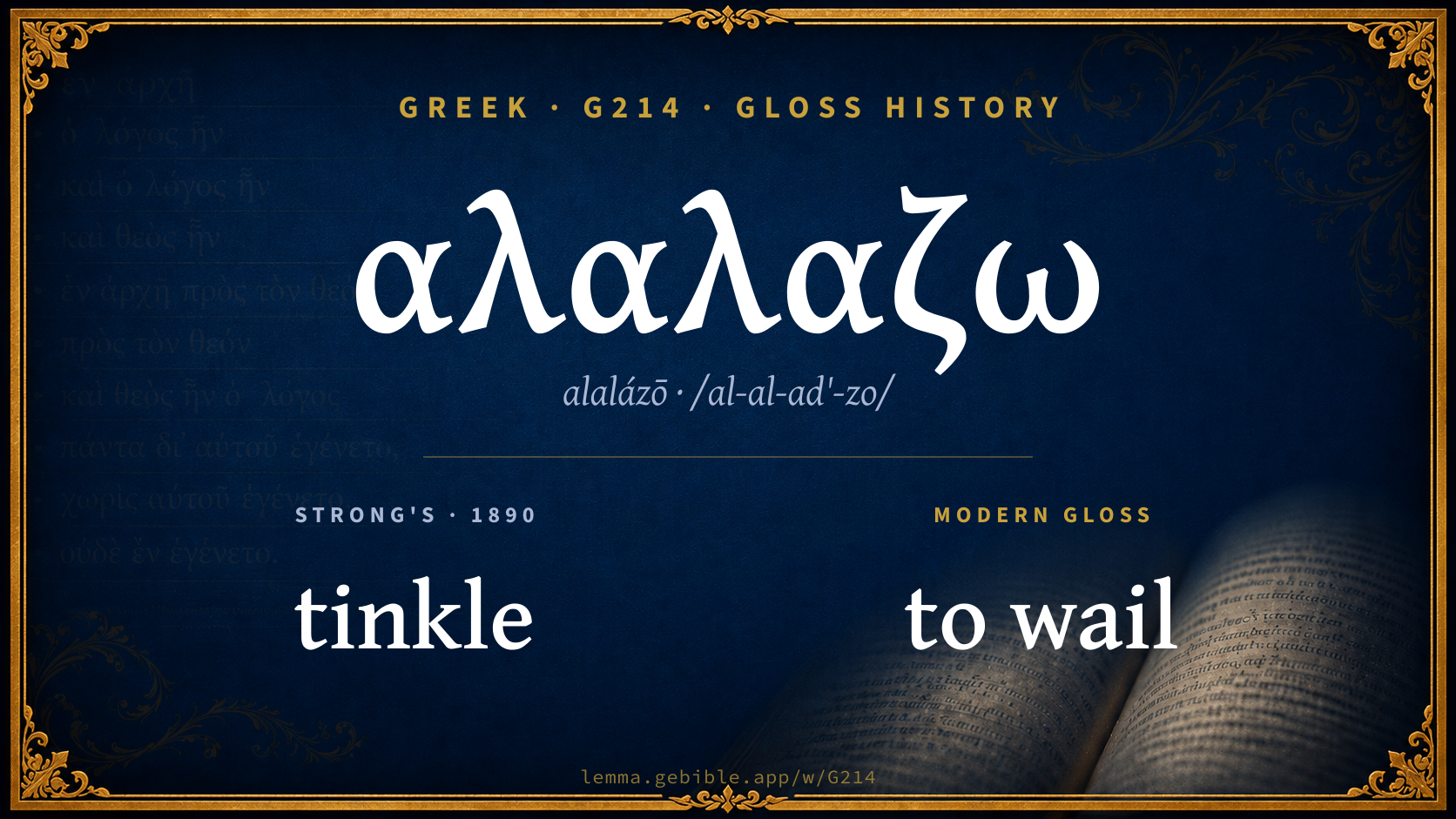
Gloss history
Strong's 1890 vs modern scholarship
About this word
Strong's G214 catalogs a Greek word from the Greek New Testament.
These counts are not copied from any lexicon or concordance. They are computed here, from the morphology-tagged Greek New Testament. What Lemma adds →
- 2
- distinct verses
- The word appears in 2 distinct verses.
- 2 / 27
- NT books
- The word appears in 2 of 27 New Testament books.
- #2,678
- by frequency
- Top 5000 most frequent Greek words (rank 2,678 of 5,347 Greek words by occurrence).
View all 2 occurrences in the concordance →
Most concentrated in
- Mark 1 verse 50%
- 1 Corinthians 1 verse 50%
By section of the New Testament
By traditional corpus
Conventional, traditional groupings — biblical authorship is debated, so this is a traditional corpus grouping, not an authorship claim. Some books belong to more than one corpus (Luke is in both the Gospels and the Lukan corpus, and so on), so these shares overlap and need not total 100%. Each figure is a share of the word’s 2 distinct verses.
- Gospels 1 verse · 50%
- Pauline corpus 1 verse · 50%
How translations render this word
Counts come from each version’s own published word-to-Strong’s tagging or interlinear alignment — an approximate guide to how each version renders this word, not a word-level alignment the data otherwise carries. Because each total is that version’s own tagged count, the per-version totals vary from one another and need not match the appearance or distinct-verse counts above. These counts may also differ from a printed concordance because Lemma counts each distinctly tagged rendering and does not collapse phrase taggings into a single head-word total. This is a fixed set of word-tagged versions (KJV, ASV, BSB, ULT) and does not change with the reading translation you choose elsewhere. Each version’s license is shown beside its name below (and on Sources).
- King James Version: Tinkling 1×, Wailed 1×
- American Standard Version: Clanging 1×, Wailing 1×
- Berean Standard Bible: Clanging 1×, Wailing 1×
- unfoldingWord Literal Text: Clanging 1×, Wailing 1×
King James Version Public Domain
Renders G214 across 2 tagged occurrences — most commonly:
American Standard Version Public Domain
Renders G214 across 2 tagged occurrences — most commonly:
Berean Standard Bible Public Domain
Renders G214 across 2 tagged occurrences — most commonly:
unfoldingWord Literal Text CC BY-SA 4.0
Renders G214 across 2 tagged occurrences — most commonly:
Senses in Thayer's
The 4 senses Thayer's distinguishes for this word, in lexicon order (not ranked by frequency or importance). The full entry — with sub-senses — is in the Lexicon Entry tab.
- to repeat frequently the cry "alala" as soldiers used to do on entering into battle
- to utter a joyful sound
- to wail, lament
- to ring loudly, to clang
Word origin
Origin: "from alale (a shout, "halloo")"
From ἀλαλή alalē (a shout halloo ); to vociferate that is (by implication) to wail ; figuratively to clang : - tinkle wail.
— Strong’s Exhaustive Concordance (1890), public domain.
Forms in the corpus
The 2 distinct written forms G214 takes in the Greek New Testament, most frequent first — each parse links to that tense’s occurrences in the concordance.
| Form | Parsing | Example | Uses |
|---|---|---|---|
| ἀλαλάζον alalázon | Verb, Present, Active, Participle, Nominative, Singular, Neuter | 1 Corinthians 13:1 | 1 |
| ἀλαλάζοντας alalázontas | Verb, Present, Active, Participle, Accusative, Plural, Masculine | Mark 5:38 | 1 |
Septuagint usage
The same Greek word αλαλαζω appears 16 times in the Greek Old Testament (Septuagint), across 16 verses in 6 books.
- 16
- LXX occurrences
- Tagged occurrences of this Greek word in the Septuagint.
- 16
- verses
- Distinct Septuagint verses containing this word.
- 6 / 39
- OT books
- The word appears in 6 of the 39 Old Testament books.
Sample Septuagint occurrences
- Joshua 6:20 ἀλαλάζω
- Judges 15:14 ἀλαλάζω
- 1 Samuel 17:32 ἀλαλάζω
- Psalms 46:2 ἀλαλάζω
- Jeremiah 4:8 ἀλαλάζω
- Ezekiel 27:30 ἀλαλάζω
Septuagint occurrences (same lexeme)
Every verse where the same Strong’s number (G214) appears in the Greek Septuagint. Verse text shown in the World English Bible for context; the Greek form is the matched word — the English is not keyword-highlighted.
- Joshua 6:20 ἀλαλάζω So the people shouted, and [the priests] blew the trumpets; and it happened, when the people heard the sound of the trumpet, that the people shouted with a great shout, and the wall fell down flat, so that the people went up into the city, every man straight before him, and they took the city.
- Judges 15:14 ἀλαλάζω When he came to Lehi, the Philistines shouted as they met him: and the Spirit of Yahweh came mightily on him, and the ropes that were on his arms became as flax that was burnt with fire, and his bands dropped from off his hands.
- 1 Samuel 17:32 ἀλαλάζω David said to Saul, Let no man's heart fail because of him; your servant will go and fight with this Philistine.
- Psalms 46:2 ἀλαλάζω Therefore we won't be afraid, though the earth changes, Though the mountains are shaken into the heart of the seas;
- Psalms 65:1 ἀλαλάζω Praise waits for you, God, in Zion. To you shall vows be performed.
- Psalms 80:2 ἀλαλάζω Before Ephraim and Benjamin and Manasseh, stir up your might! Come to save us!
- Psalms 94:1 ἀλαλάζω Yahweh, you God to whom vengeance belongs, You God to whom vengeance belongs, shine forth.
- Psalms 94:2 ἀλαλάζω Rise up, you judge of the earth. Pay back the proud what they deserve.
- Psalms 97:4 ἀλαλάζω His lightning lights up the world. The earth sees, and trembles.
- Psalms 97:6 ἀλαλάζω The heavens declare his righteousness. All the peoples have seen his glory.
- Psalms 99:1 ἀλαλάζω Yahweh reigns! Let the peoples tremble. He sits enthroned among the cherubim. Let the earth be moved.
- Jeremiah 4:8 ἀλαλάζω For this gird you with sackcloth, lament and wail; for the fierce anger of Yahweh hasn't turned back from us.
- Jeremiah 29:2 ἀλαλάζω (after that Jeconiah the king, and the queen-mother, and the eunuchs, [and] the princes of Judah and Jerusalem, and the craftsmen, and the smiths, were departed from Jerusalem),
- Jeremiah 30:19 ἀλαλάζω Out of them shall proceed thanksgiving and the voice of those who make merry: and I will multiply them, and they shall not be few; I will also glorify them, and they shall not be small.
- Jeremiah 32:21 ἀλαλάζω and brought forth your people Israel out of the land of Egypt with signs, and with wonders, and with a strong hand, and with an outstretched arm, and with great terror;
- Ezekiel 27:30 ἀλαλάζω and shall cause their voice to be heard over you, and shall cry bitterly, and shall cast up dust on their heads, they shall wallow themselves in the ashes:
These are occurrences of the same Greek lexeme (G214) in the Septuagint — not a translation of any one Hebrew word. The store carries no word-level Hebrew↔Greek alignment, so no Hebrew original is asserted here. Counts come from the recovered LXX Strong's tagging — high-frequency vocabulary is well covered, while rare or late forms may be untagged — so they reflect tagged occurrences and may slightly undercount.