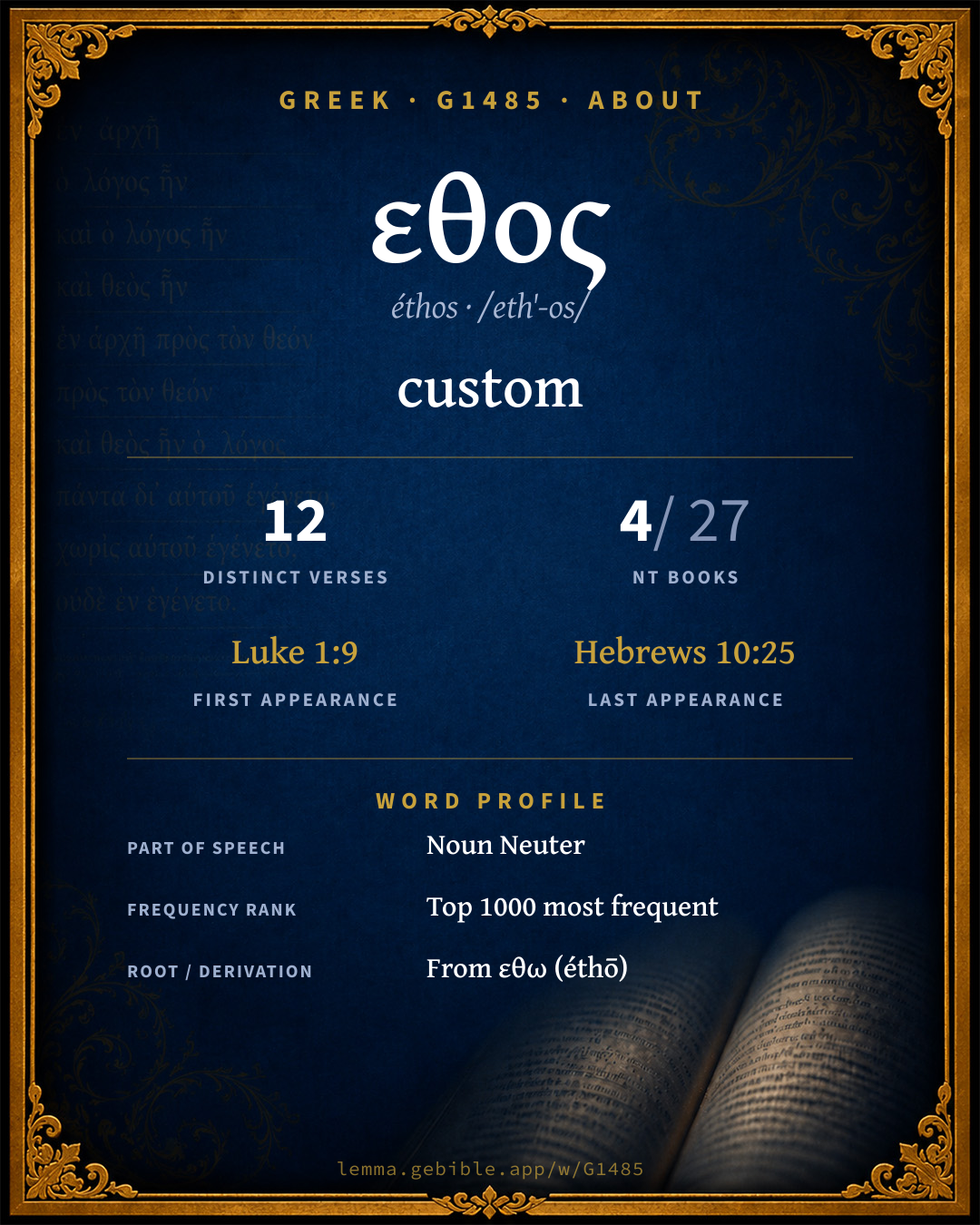
ἔθος
custom
‘custom’ is one of 2 main senses fuller range ↓
Full lexicon entry — Thayer's Greek Lexicon
From Thayer's Greek Lexicon
Where this word appears
See every Dative-case word in the Greek New Testament →
Grammar key — what these labels mean
Part of speech
- Noun
- A naming word — a person, place, thing, or idea.
Case
- Accusative
- The case of the direct object and of extent.
- Nominative
- The case of the subject (and the predicate nominative).
- Dative
- The case of the indirect object, means, or location — “to / for / with / in.”
- Genitive
- The case of source, possession, or “of” — answers “whose / from what.”
Gender
- Neuter
- Grammatically neuter.
Number
- Singular
- One.
- Plural
- More than one.
Every verse where G1485 appears in the Book of Acts — 7 distinct verses. Click any verse to open its interlinear word-by-word view. Verse text shown in the World English Bible for context — . Each verse’s Greek form is shown with its reference; the English is not keyword-highlighted, since the data carries no word-level English alignment. Use “Compare translations” on any verse to read it across multiple English versions. This concordance covers the Greek New Testament; Septuagint (Greek Old Testament) occurrences of this word are not indexed here.
Acts
- Acts 6:14 ἔθη n acc pl neut For we have heard him say that this Jesus of Nazareth will destroy this place, and will change the customs which Moses delivered to us."
- Acts 15:1 ἔθει n dat sg neut Some men came down from Judea and taught the brothers, "Unless you are circumcised after the custom of Moses, you can't be saved."
- Acts 16:21 ἔθη n acc pl neut and set forth customs which it is not lawful for us to accept or to observe, being Romans."
- Acts 21:21 ἔθεσιν n dat pl neut They have been informed about you, that you teach all the Jews who are among the Gentiles to forsake Moses, telling them not to circumcise their children neither to walk after the customs.
- Acts 25:16 ἔθος n nom sg neut To whom I answered that it is not the custom of the Romans to give up any man to destruction, before the accused has met the accusers face to face, and has had opportunity to make his defense concerning the matter laid against him.
- Acts 26:3 ἐθῶν n gen pl neut especially because you are expert in all customs and questions which are among the Jews. Therefore I beg you to hear me patiently.
- Acts 28:17 ἔθεσι n dat pl neut It happened that after three days Paul called together those who were the leaders of the Jews. When they had come together, he said to them, "I, brothers, though I had done nothing against the people, or the customs of our fathers, still was delivered prisoner from Jerusalem into the hands of the Romans,
About this entry
At a glance — auto-summarized from this page’s data, not written by a person. Every figure links to its source below. This summary describes the numbers; it doesn’t interpret them.
εθος — transliterated éthos — is a Greek noun carrying the sense “custom.” Its uses cluster heavily in Acts (58% of all occurrences). With 12 verses in 4 books, it is an uncommon word in the Greek New Testament. It first appears in Luke 1:9. Its lexical range runs to 2 senses. Each statement above links to its evidence; the full detail follows below.
Gloss history
Strong's 1890 vs modern scholarship
About this word
Strong's G1485 catalogs a Greek word from the Greek New Testament.
These counts are not copied from any lexicon or concordance. They are computed here, from the morphology-tagged Greek New Testament. What Lemma adds →
- 12
- distinct verses
- The word appears in 12 distinct verses.
- 4 / 27
- NT books
- The word appears in 4 of 27 New Testament books.
- #904
- by frequency
- Top 1000 most frequent Greek words (rank 904 of 5,347 Greek words by occurrence).
View all 12 occurrences in the concordance →
By section of the New Testament
By traditional corpus
Conventional, traditional groupings — biblical authorship is debated, so this is a traditional corpus grouping, not an authorship claim. Some books belong to more than one corpus (Luke is in both the Gospels and the Lukan corpus, and so on), so these shares overlap and need not total 100%. Each figure is a share of the word’s 12 distinct verses.
- Lukan (Luke–Acts) 10 verses · 83%
- Gospels 4 verses · 33%
- Johannine 1 verse · 8%
- Hebrews 1 verse · 8%
How translations render this word
Counts come from each version’s own published word-to-Strong’s tagging or interlinear alignment — an approximate guide to how each version renders this word, not a word-level alignment the data otherwise carries. Because each total is that version’s own tagged count, the per-version totals vary from one another and need not match the appearance or distinct-verse counts above. These counts may also differ from a printed concordance because Lemma counts each distinctly tagged rendering and does not collapse phrase taggings into a single head-word total. This is a fixed set of word-tagged versions (KJV, ASV, BSB, ULT) and does not change with the reading translation you choose elsewhere. Each version’s license is shown beside its name below (and on Sources).
- King James Version: Customs 4×, Manner 3×, Custom 2×
- American Standard Version: Custom 6×, Customs 4×
- Berean Standard Bible: Customs 5×, Custom 4×
- unfoldingWord Literal Text: Custom 6×, Customs 5×
King James Version Public Domain
Renders G1485 across 12 tagged occurrences — most commonly:
Plus 3 renderings that appear only once — usually multi-word phrases or single function words the recovered tagging swept in, not distinct renderings.
American Standard Version Public Domain
Renders G1485 across 12 tagged occurrences — most commonly:
Plus 2 renderings that appear only once — usually multi-word phrases or single function words the recovered tagging swept in, not distinct renderings.
Berean Standard Bible Public Domain
Renders G1485 across 11 tagged occurrences — most commonly:
Plus 2 renderings that appear only once — usually multi-word phrases or single function words the recovered tagging swept in, not distinct renderings. Not rendered by a distinct English word in 1 further occurrence.
unfoldingWord Literal Text CC BY-SA 4.0
Renders G1485 across 13 tagged occurrences — most commonly:
Plus 2 renderings that appear only once — usually multi-word phrases or single function words the recovered tagging swept in, not distinct renderings.
Senses in Thayer's
The 2 senses Thayer's distinguishes for this word, in lexicon order (not ranked by frequency or importance). The full entry — with sub-senses — is in the Lexicon Entry tab.
- custom
- usage prescribed by law, institute, prescription, rite
Word origin
Derived from εθω (éthō) (G1486) — to be accustomed.
From G1486 ; a usage (prescribed by habit or law): - custom manner be wont.
— Strong’s Exhaustive Concordance (1890), public domain.
Forms in the corpus
The 6 distinct written forms G1485 takes in the Greek New Testament, most frequent first — each parse links to that case’s occurrences in the concordance.
| Form | Parsing | Example | Uses |
|---|---|---|---|
| ἔθος éthos | Noun, Accusative, Singular, Neuter | Luke 1:9 | 6 |
| ἔθη éthē | Noun, Accusative, Plural, Neuter | Acts 6:14 | 2 |
| ἐθῶν ethō̂n | Noun, Genitive, Plural, Neuter | Acts 26:3 | 1 |
| ἔθει éthei | Noun, Dative, Singular, Neuter | Acts 15:1 | 1 |
| ἔθεσι éthesi | Noun, Dative, Plural, Neuter | Acts 28:17 | 1 |
| ἔθεσιν éthesin | Noun, Dative, Plural, Neuter | Acts 21:21 | 1 |
Same root — word family
Other Thayer's entries built from the same root as G1485, grouped by Strong’s listed origin. These share a root / origin per the lexicon — not necessarily a shared meaning. Each links to that word’s own entry.
Derives from
Shares the same root
Derived from this word
Compare all same-root words → Showing 4 of 5 — not the complete family. They share a root, not necessarily a meaning.