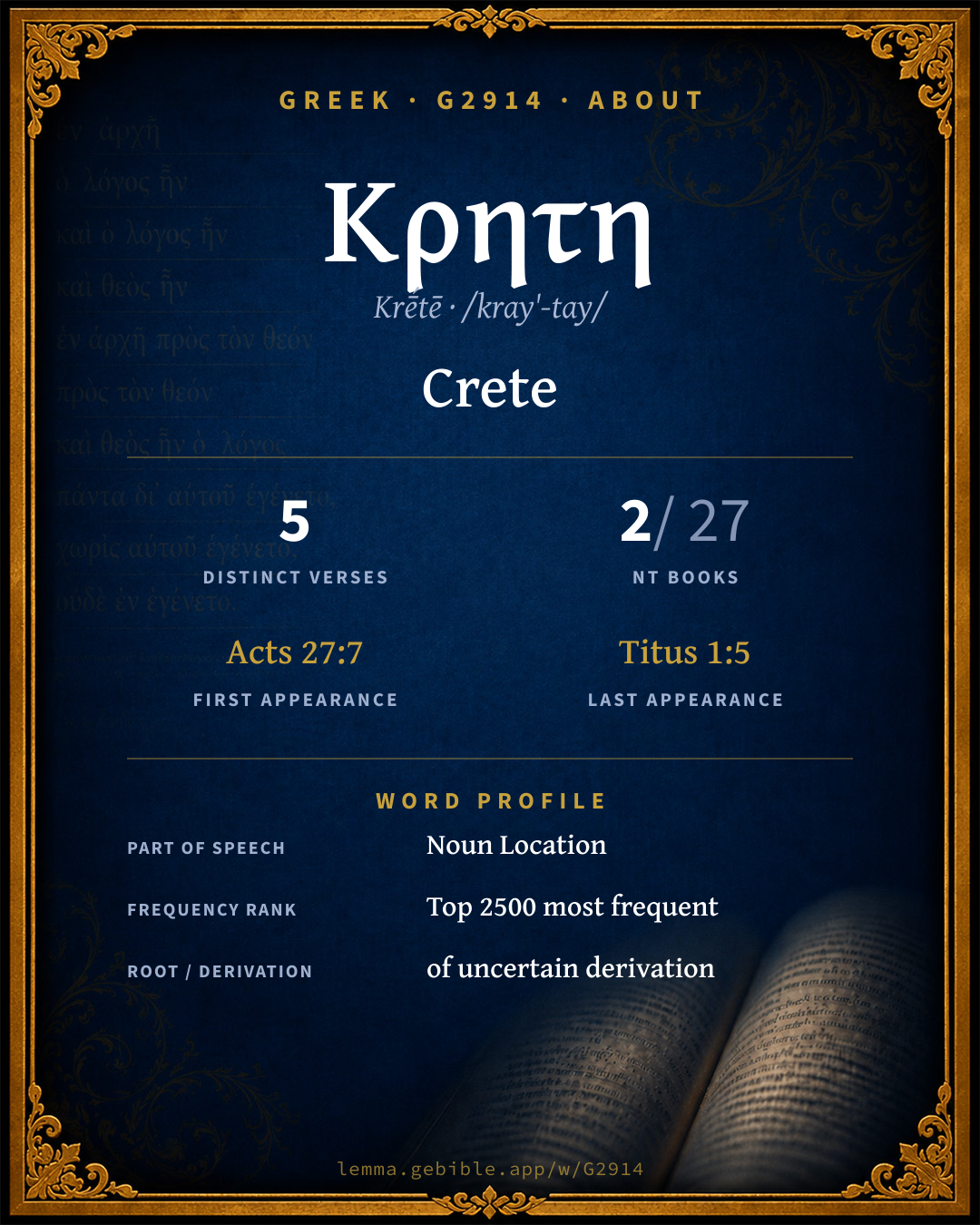
Κρήτη
Crete
Thayer's lists 2 entries for ‘Crete’ fuller range ↓
Full lexicon entry — Thayer's Greek Lexicon
From Thayer's Greek Lexicon
Where this word appears
See every Accusative-case word in the Greek New Testament →
Grammar key — what these labels mean
Part of speech
- Noun
- A naming word — a person, place, thing, or idea.
Case
- Accusative
- The case of the direct object and of extent.
- Genitive
- The case of source, possession, or “of” — answers “whose / from what.”
- Dative
- The case of the indirect object, means, or location — “to / for / with / in.”
Gender
- Feminine
- Grammatically feminine.
Number
- Singular
- One.
Grammatical forms
- Noun, Accusative, Singular, Feminine 2 times (40%)
- Noun, Genitive, Singular, Feminine 2 times (40%)
- Noun, Dative, Singular, Feminine 1 time (20%)
Parsed forms decoded from the imported morphology (Robinson–Tischendorf, public domain), counted across 5 parsed occurrences — not distinct verses.
Every verse where G2914 appears — 5 distinct verses across 2 books. Click any verse to open its interlinear word-by-word view. Verse text shown in the World English Bible for context — . Each verse’s Greek form is shown with its reference; the English is not keyword-highlighted, since the data carries no word-level English alignment. Use “Compare translations” on any verse to read it across multiple English versions. This concordance covers the Greek New Testament; Septuagint (Greek Old Testament) occurrences of this word are not indexed here.
Acts 4 verses
- Acts 27:7 Κρήτην n acc sg fem When we had sailed slowly many days, and had come with difficulty opposite Cnidus, the wind not allowing us further, we sailed under the lee of Crete, opposite Salmone.
- Acts 27:12 Κρήτης n gen sg fem Because the haven was not suitable to winter in, the majority advised going to sea from there, if by any means they could reach Phoenix, and winter there, which is a port of Crete, looking northeast and southeast.
- Acts 27:13 Κρήτην n acc sg fem When the south wind blew softly, supposing that they had obtained their purpose, they weighed anchor and sailed along Crete, close to shore.
- Acts 27:21 Κρήτης n gen sg fem When they had been long without food, Paul stood up in the middle of them, and said, "Sirs, you should have listened to me, and not have set sail from Crete, and have gotten this injury and loss.
Titus 1 verse
About this entry
At a glance — auto-summarized from this page’s data, not written by a person. Every figure links to its source below. This summary describes the numbers; it doesn’t interpret them.
Κρητη (Krḗtē) is a Greek name most often rendered “Crete.” It is rare — just 5 verses in the entire Greek New Testament. Acts dominates its distribution — 4 of 5 verses. Scripture first uses it in Acts 27:7. The sections below give every occurrence and version rendering.
Gloss history
Strong's 1890 vs modern scholarship
About this word
Strong's G2914 catalogs a Greek word from the Greek New Testament.
These counts are not copied from any lexicon or concordance. They are computed here, from the morphology-tagged Greek New Testament. What Lemma adds →
- 5
- distinct verses
- The word appears in 5 distinct verses.
- 2 / 27
- NT books
- The word appears in 2 of 27 New Testament books.
- #1,648
- by frequency
- Top 2500 most frequent Greek words (rank 1,648 of 5,347 Greek words by occurrence).
View all 5 occurrences in the concordance →
By traditional corpus
Conventional, traditional groupings — biblical authorship is debated, so this is a traditional corpus grouping, not an authorship claim. Some books belong to more than one corpus (Luke is in both the Gospels and the Lukan corpus, and so on), so these shares overlap and need not total 100%. Each figure is a share of the word’s 5 distinct verses.
- Lukan (Luke–Acts) 4 verses · 80%
- Pauline corpus 1 verse · 20%
How translations render this word
Counts come from each version’s own published word-to-Strong’s tagging or interlinear alignment — an approximate guide to how each version renders this word, not a word-level alignment the data otherwise carries. Because each total is that version’s own tagged count, the per-version totals vary from one another and need not match the appearance or distinct-verse counts above. These counts may also differ from a printed concordance because Lemma counts each distinctly tagged rendering and does not collapse phrase taggings into a single head-word total. This is a fixed set of word-tagged versions (KJV, ASV, BSB, ULT) and does not change with the reading translation you choose elsewhere. Each version’s license is shown beside its name below (and on Sources).
- King James Version: Crete 5×
- American Standard Version: Crete 2×
- Berean Standard Bible: Crete 5×
- unfoldingWord Literal Text: Crete 5×
King James Version Public Domain
Renders G2914 across 5 tagged occurrences — most commonly:
American Standard Version Public Domain
Renders G2914 across 5 tagged occurrences — most commonly:
Plus 3 renderings that appear only once — usually multi-word phrases or single function words the recovered tagging swept in, not distinct renderings.
Berean Standard Bible Public Domain
Renders G2914 across 5 tagged occurrences — most commonly:
unfoldingWord Literal Text CC BY-SA 4.0
Renders G2914 across 5 tagged occurrences — most commonly:
Senses in Thayer's
The 2 senses Thayer's distinguishes for this word, in lexicon order (not ranked by frequency or importance). The full entry — with sub-senses — is in the Lexicon Entry tab.
- Crete = "fleshy"
- the largest and most fertile island of the Mediterranean archipelago or Aegean Sea, now the modern Candia
Word origin
Origin: of uncertain derivation
Of uncertain derivation; Crete an island in the mediterranean : - Crete.
— Strong’s Exhaustive Concordance (1890), public domain.
Forms in the corpus
The 3 distinct written forms G2914 takes in the Greek New Testament, most frequent first — each parse links to that case’s occurrences in the concordance.
| Form | Parsing | Example | Uses |
|---|---|---|---|
| Κρήτην Krḗtēn | Noun, Accusative, Singular, Feminine | Acts 27:7 | 2 |
| Κρήτης Krḗtēs | Noun, Genitive, Singular, Feminine | Acts 27:12 | 2 |
| Κρήτῃ Krḗtē | Noun, Dative, Singular, Feminine | Titus 1:5 | 1 |
Same root — word family
Other Thayer's entries built from the same root as G2914, grouped by Strong’s listed origin. These share a root / origin per the lexicon — not necessarily a shared meaning. Each links to that word’s own entry.
Proper names from this root
People and places named from this root — a name, not an additional meaning of the word.
Compare all same-root words → 1 of the same-root words is a proper name (a person or place). They share a root, not necessarily a meaning.
Bible dictionary
Public-domain dictionary articles matched to this entry by name (Crete). A biblical name can be shared by more than one person or place, so an article may treat several.
Easton's Bible Dictionary · M. G. Easton, 1897
Now called Candia, one of the largest islands in the Meditterranean, about 140 miles long and 35 broad. It was at one time a very prosperous and populous island, having a "hundred cities." The character of the people is described in Paul's quotation from "one of their own poets" (Epimenides) in his epistle to Titus: "The Cretans are alway liars, evil beasts, slow bellies" (Titus 1:12). Jews from Crete were in Jerusalem on the day of Pentecost (Acts 2:11). The island was visited by Paul on his voyage to Rome (Acts 27). Here Paul subsequently left Titus (1:5) "to ordain elders." Some have supposed that it was the original home of the Caphtorim (q.v.) or Philistines.
Smith's Bible Dictionary · William Smith, 1863
the modern Candia. This large island, which closes int he Greek Archipelago on the south, extends through a distance of 140 miles between its extreme points. Though exceedingly bold and mountainous, this island has very fruitful valleys, and in early times it was celebrated for its hundred cities. It seems likely that a very early acquaintances existed between the Cretans and the Jews. Cretans, (Acts 2:11) were among those who were at Jerusalem at the great Pentecost. In [Acts 27:7-12 We have an account of Paul's shipwreck near this island; and it is evident from (Titus 1:5) that the apostle himself was here at no long interval of time before he wrote the letter. The Cretans were proverbial liars. (Titus 1:12)
Hitchcock's Bible Names Dictionary · Roswell D. Hitchcock, 1869
carnal; fleshly
Classic public-domain reference works; full attribution on Sources.
Septuagint usage
The same Greek word Κρητη appears 1 time in the Greek Old Testament (Septuagint), across 1 verse in 1 book.
- 1
- LXX occurrences
- Tagged occurrences of this Greek word in the Septuagint.
- 1
- verse
- Distinct Septuagint verses containing this word.
- 1 / 39
- OT books
- The word appears in 1 of the 39 Old Testament books.
Sample Septuagint occurrences
- Zephaniah 2:6 κρήτη
Septuagint occurrences (same lexeme)
Every verse where the same Strong’s number (G2914) appears in the Greek Septuagint. Verse text shown in the World English Bible for context; the Greek form is the matched word — the English is not keyword-highlighted.
These are occurrences of the same Greek lexeme (G2914) in the Septuagint — not a translation of any one Hebrew word. The store carries no word-level Hebrew↔Greek alignment, so no Hebrew original is asserted here. Counts come from the recovered LXX Strong's tagging — high-frequency vocabulary is well covered, while rare or late forms may be untagged — so they reflect tagged occurrences and may slightly undercount.