
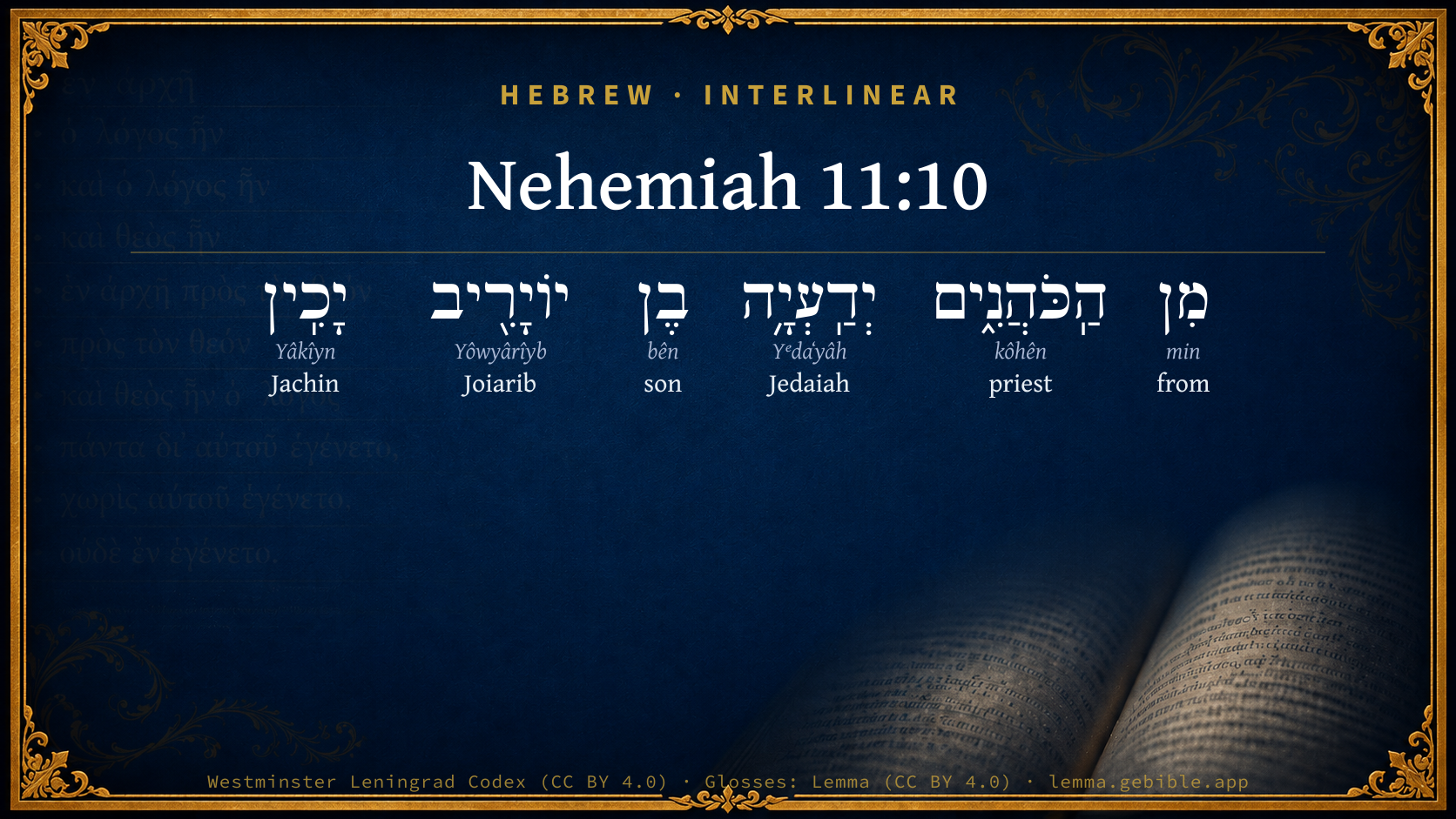
Nehemiah 11:10

Hebrew (Westminster Leningrad Codex) Nehemiah 11:10 appears in the Hebrew Old Testament. The text above is from the Westminster Leningrad Codex. Each word links to its Strong’s number, a concise gloss, and parsing drawn from the Open Scriptures Hebrew Bible morphology. Click any word for its full Brown-Driver-Briggs (BDB) entry.
Download image
Cite this verse

Nehemiah 11:10 (World English Bible). Public Domain. Lemma interlinear Bible study tool, https://lemma.gebible.app/v/nehemiah/11/10.

Show BibTeX & RIS
BibTeX
RIS
English Translation
Of the priests: Jedaiah the son of Joiarib, Jachin,
World English Bible · Public Domain
Download a study sheet

One document with this verse’s original text, its word-by-word gloss line, the meaning frame, cross-references with their text, attributed commentary, and full source and license credits — printable, and it pastes into notes with its structure intact.

This verse Autodidact and up

Study sheet (.html) Plain text (.txt)

A passage Seminary Student

Up to 50 verses in one chapter. A passage sheet keeps up to 6 commentary sources and 12 cross-references per verse, in the order this page ranks them, and says so on the sheet whenever that leaves anything out. Ask for a single verse and you get the Autodidact verse sheet above.

Everything on this page stays free to read, with no account — the sheet is a download of what is already on screen, not access to it.

Want to remove ads? Support Godless Engineer
Compare translations 3

The same verse in 3 English versions, stacked beneath the original-language interlinear above. Click any original word for its lexicon entry.

Each is an independent rendering of the whole verse — the interlinear is not word-aligned to these translations.

Highlighted words mark where these versions differ — a whole-verse word diff, not a word-by-word alignment.

  • World English Bible Public Domain
    Of the priests: Jedaiah the son of Joiarib, Jachin,
  • King James Version Public Domain
    Of the priests: Jedaiah the son of Joiarib, Jachin.
  • unfoldingWord Literal Text CC BY-SA 4.0
    From the priests: Jedaiah the son of Joiarib; Jakin;

unfoldingWord Literal Text — © unfoldingWord, licensed CC BY-SA 4.0. Word-aligned USFM3 via Door43 (git.door43.org/unfoldingWord/en_ult).

Versions to compare (up to 4)

3 of 4 selected

Show all 18 translations

Every available English version of this verse, each an independent rendering of the whole verse.

  • World English Bible Public Domain
    Of the priests: Jedaiah the son of Joiarib, Jachin,
  • Berean Standard Bible Public Domain
    From the priests: Jedaiah son of Joiarib; Jachin;
  • Majority Standard Bible Public Domain
    From the priests: Jedaiah son of Joiarib; Jachin;
  • King James Version Public Domain
    Of the priests: Jedaiah the son of Joiarib, Jachin.
  • American Standard Version (1901) Public Domain
    Of the priests: Jedaiah the son of Joiarib, Jachin,
  • Revised Version (1885) Public Domain
    Of the priests: Jedaiah the son of Joiarib, Jachin,
  • Geneva Bible (1599) Public Domain
    Of the Priestes, Iedaiah, the sonne of Ioiarib, Iachin.
  • Douay-Rheims (1899) Public Domain
    And of the priests Idaia the son of Joarib, Jachin,
  • Young's Literal Translation Public Domain
    Of the priests: Jedaiah son of Joiarib, Jachin,
  • Literal Standard Version CC BY-SA 4.0
    Of the priests: Jedaiah son of Joiarib, Jachin,
  • Unlocked Literal Bible CC BY-SA 4.0
    From the priests: Jedaiah son of Joiarib, Jakin,
  • unfoldingWord Literal Text CC BY-SA 4.0
    From the priests: Jedaiah the son of Joiarib; Jakin;
  • Darby Bible Public Domain
    Of the priests: Jedaiah [the son of] Joiarib, Jachin,
  • World Messianic Bible Public Domain
    Of the priests: Jedaiah the son of Joiarib, Jachin,
  • Webster's Bible Public Domain
    Of the priests: Jedaiah the son of Joiarib, Jachin.
  • Free Bible Version CC BY-SA 4.0
    From the priests: Jedaiah, son of Joiarib, Jachin;
  • Bible in Basic English Public Domain
    Of the priests: Jedaiah, the son of Joiarib, Jachin,
  • JPS Tanakh (1917) Public Domain
    Of the priests: Jedaiah the son of Joiarib, Jachin,

Literal Standard Version (2020), Covenant Press — licensed CC BY-SA 4.0. Text via the HelloAO Bible API (eBible.org). Unlocked Literal Bible (unfoldingWord) — licensed CC BY-SA 4.0. Text via the HelloAO Bible API (eBible.org). unfoldingWord Literal Text — © unfoldingWord, licensed CC BY-SA 4.0. Word-aligned USFM3 via Door43 (git.door43.org/unfoldingWord/en_ult). Free Bible Version, Dr. Jonathan Gallagher — licensed CC BY-SA 4.0. Text via the HelloAO Bible API (eBible.org).

Word by word

More ways to search: Search by grammar → Find every occurrence → Compare this word →

Practice this passage: Drill this verse → Learn its vocabulary →

About this verse

These counts appear in no published source. They are computed here, from the morphology-tagged text and Lemma’s own curated glosses. What Lemma adds →

6
words
6
distinct lemmas
Historical
section

Notable vocabulary

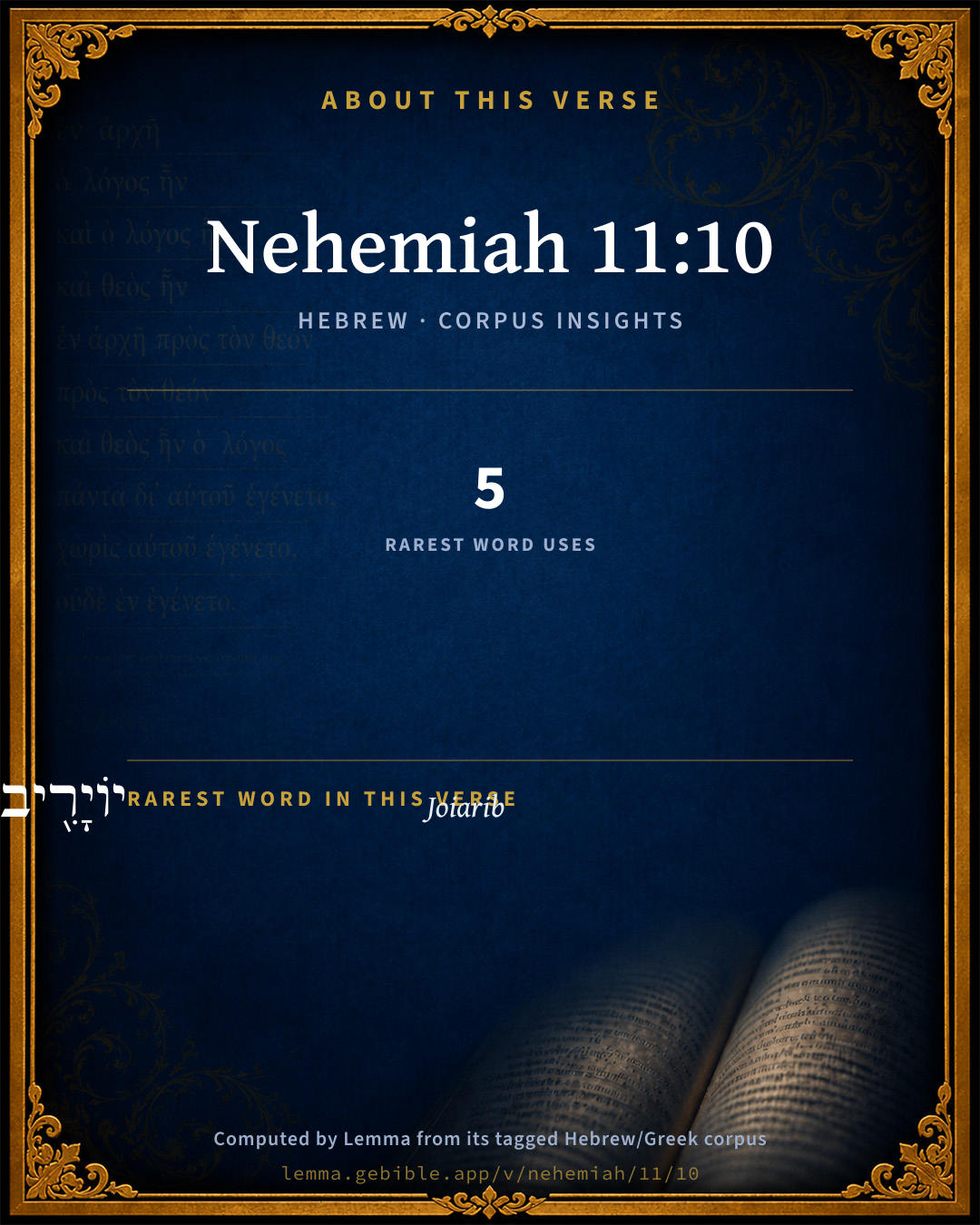
The rarest word here is יוֹיָרִ֖יב Joiarib H3114 — appearing just 5 times in the whole Hebrew Bible.

Shared distinctive vocabulary

יוֹיָרִ֖יב Joiarib H3114 occurs in 5 verses of the Hebrew Bible. Also found in:

Grammatical profile

  • 5 nouns
  • 1 preposition

Cross-references

6

Topical passages linked to Nehemiah 11:10 in the Treasury of Scripture Knowledge — connected by theme and wording, ordered by reader-vote popularity; previews shown in the World English Bible.

  • 1 Chronicles 9:10 Of the priests: Jedaiah, and Jehoiarib, Jachin,
  • Ezra 2:36 The priests: the children of Jedaiah, of the house of Jeshua, nine hundred seventy-three.
  • Ezra 8:16 Then sent I for Eliezer, for Ariel, for Shemaiah, and for Elnathan, and for Jarib, and for Elnathan, and for Nathan, and for Zechariah, and for Meshullam, chief men; also for Joiarib, and for Elnathan, who were teachers.
  • Nehemiah 7:39 The priests: The children of Jedaiah, of the house of Jeshua, nine hundred seventy-three.
  • Nehemiah 12:6 Shemaiah, and Joiarib, Jedaiah.
  • Nehemiah 12:19 and of Joiarib, Mattenai; of Jedaiah, Uzzi;

Cross-references courtesy of OpenBible.info (CC BY 4.0).

Hebrew and Greek witnesses Masoretic Hebrew ↔ Greek Septuagint

The same verse in the two great witnesses to the Old Testament, shown verse-for-verse.

These are two independent witnesses, not word-aligned to each other, and the Septuagint is shown in lemma (dictionary) form.

Hebrew Nehemiah 11:10 Masoretic · Westminster Leningrad Codex

מִן הַֽכֹּהֲנִ֑ים יְדַֽעְיָ֥ה בֶן יוֹיָרִ֖יב יָכִֽין

Of the priests: Jedaiah the son of Joiarib, Jachin,

World English Bible · Public Domain

Greek LXX Structure differs

The Septuagint has no separate book of Nehemiah. Its Greek text is the second half of Esdras B (2 Esdras), chapters 11–23; Ezra is the first half (1–10).

A verse-for-verse comparison isn’t shown here because the chapters and verses don’t line up. Switch to the LXX edition with the MT / LXX toggle above to read the Greek directly.

On this verse, Keil & Delitzsch discusses the Septuagint’s reading. Read the note in Commentary ↓

Hebrew: Westminster Leningrad Codex (CC BY 4.0). Greek: Septuagint (public domain); English from a public-domain English Septuagint. How the Septuagint differs from the Hebrew →

Commentary

Notes on Nehemiah 11:10 from classic Christian and Jewish commentators (each source and its license shown beneath its notes). The classic Christian expositions comment on the surrounding passage and are grouped to its opening verse, so a note may address several verses; the Jewish commentaries on the Tanakh (Rashi and others) are per-verse, so they appear only where the commentator wrote on this verse.

Lemma curates 59 commentaries, every one of them public domain or Creative Commons licensed, each selected and text-cleaned for this edition rather than reprinted as found. About our sources →

Ellicott's Commentary for English Readers

(10) This should be read Jedaiah, Joiarib, Jachin, three priestly families (1Ch_9:10).

A Bible Commentary for English Readers, edited by Charles John Ellicott (1878–1897) — public domain. Text from a community e-Sword module.

The Cambridge Bible for Schools and Colleges

gen. ed. J. J. S. Perowne

10. Jedaiah the son of Joiarib, Jachin] The parallel passage in 1Ch_9:10 has ‘Jedaiah, and Jehoiarib, Jachin.’ As these three are the names of well-known priestly houses (cf. 1Ch_24:7, Jehoiarib the first, Jedaiah the second, Jachin the one and twentieth in the twenty-four), ‘the son of’ may possibly be an interpolation. If the text is correct, ‘Jedaiah’ must here represent a branch of the house of Joiarib.

The Cambridge Bible for Schools and Colleges (gen. ed. J. J. S. Perowne; Cambridge University Press, 1878–1918) — public domain. Text from a community e-Sword module.

John Gill's Exposition

And their brethren, mighty men of valour, an hundred twenty and eight,.... The brethren of Adaiah and Amashai, who were able men to do the work of their office as priests, and men of courage to fight the enemy, and defend the city upon occasion:

and their overseer was Zabdiel, the son of one of the great men; or the son of Hagedolim, or Gedolim, as some, who take it to be the proper name of a man.

John Gill's Exposition of the Whole Bible (1746–1763) — public domain (CC PDM 1.0). Text via the HelloAO Bible API.

The Pulpit Commentary

Of the priests: Jedaiah the son of Joiarib, Jachin. Rather, "Of the priests, Jedaiah, Joiarib, Jachin." The word ben, "son," has once more accidentally crept in. (comp. 1Ch_9:10) The writer here passes from personal to famfiy names. Jedaiah and Joiarib were two of the chief priestly families, and are usually mentioned together. (1Ch_24:7 Neh_12:6, Neh_12:19, etc.) Jachin was a priestly family of much less distinction, descended probably from the head of the twenty-first course in David"s time. (1Ch_24:17)

The Pulpit Commentary (1880–1919), ed. H.D.M. Spence-Jones & Joseph S. Exell — public domain. Text from a community e-Sword module.

Keil & Delitzsch

C. F. Keil & F. Delitzsch

Of the priests: Jedaiah, Joiarib, and Jachin, three heads of houses, therefore of orders of priests (for בּן before Joiarib probably crept into the text by a clerical error; see rem. on Ch1 9:10); Seraiah, a descendant of Ahitub, as ruler of the house of God, and their brethren, i.e., the eight hundred and twenty-two ministering priests belonging to these three orders. Also Adaiah, of the house or order of Malchiah, and his brethren, two hundred and forty-two fathers of families; and lastly, Amashai, of the order of Immer, with one hundred and twenty-eight brethren, i.e., priests. And their chief was Zabdiel ben Haggedolim (lxx υἱὸς τῶν μεγάλων). עליהם refers to all the before-named priests. לעבות ראשׁים heads of fathers, i.e., of families, Neh 11:13, is striking, for the brethren of Adaiah (אחיו), in number two hundred and forty-two, could not be heads of houses, but only fathers of families. The words seem to have come into the text only by comparing it with Ch1 9:13. If they were genuine, we should be obliged to understand לעבות ראשׁים of fathers of families, contrary to general usage.

Keil & Delitzsch — Biblical Commentary on the Old Testament (1861–1891) — public domain (CC PDM 1.0). Text via the HelloAO Bible API. (Old Testament only.)

unfoldingWord translationNotes

Door43 World Missions Community

Jedaiah ... Joiarib ... Jakin ... Seraiah ... Hilkiah ... Meshullam ... Zadok ... Meraioth ... Ahitub ... Adaiah ... Jeroham ... Pelaliah ... Amzi ... Zechariah ... Pashhur ... Malchijah

These are the names of men. (See: How to Translate Names)

their associates

"their brothers" or "their kinsmen"

who did the work for the house

"who worked in the temple." The "house" referred to here is the "house of God" mentioned in the previous verse.

822 men

"eight hundred and twenty-two men" (See: Numbers)

translationWords

priest

son

Zadok

house of God

works

unfoldingWord translationNotes — © Distant Shores Media and the Door43 World Missions Community, licensed CC BY-SA 4.0. Source: git.door43.org/Door43/en_tn.

Lesson kit

Teaching starters — assembled from the data on this page, not authored interpretation. Every prompt links to the verse data it draws on. Edit before teaching.

Nehemiah, in the Historical, opens this verse with 6 words (6 distinct Hebrew lemmas). Its most distinctive word is Yôwyârîyb (“Joiarib”). A historical commentator’s framing appears above. Read the whole chapter for the surrounding context.

Discussion questions

  1. The word Yôwyârîyb carries the sense “Joiarib.” How does it shape the verse?
  2. Ezra 8:16 shares the word «Joiarib» with this verse. How do the two illuminate each other?
  3. These translations render this verse differently; the difference is in the English rendering, not the original. What questions does that raise?
  4. Reading how Ellicott's Commentary for English Readers and The Cambridge Bible for Schools and Colleges read this verse, where do the two commentators agree and where do they part?

Things to notice

Reading settings

Reading text

Shown beneath each verse's original-language words.

Old Testament
Old Testament edition

Read the OT as the Masoretic Hebrew (MT) or the Greek Septuagint (LXX).

English shown for the Greek Septuagint (in the Hebrew ↔ Greek comparison).

Comparing translations? Open the Compare panel on any verse page to stack up to four side by side.