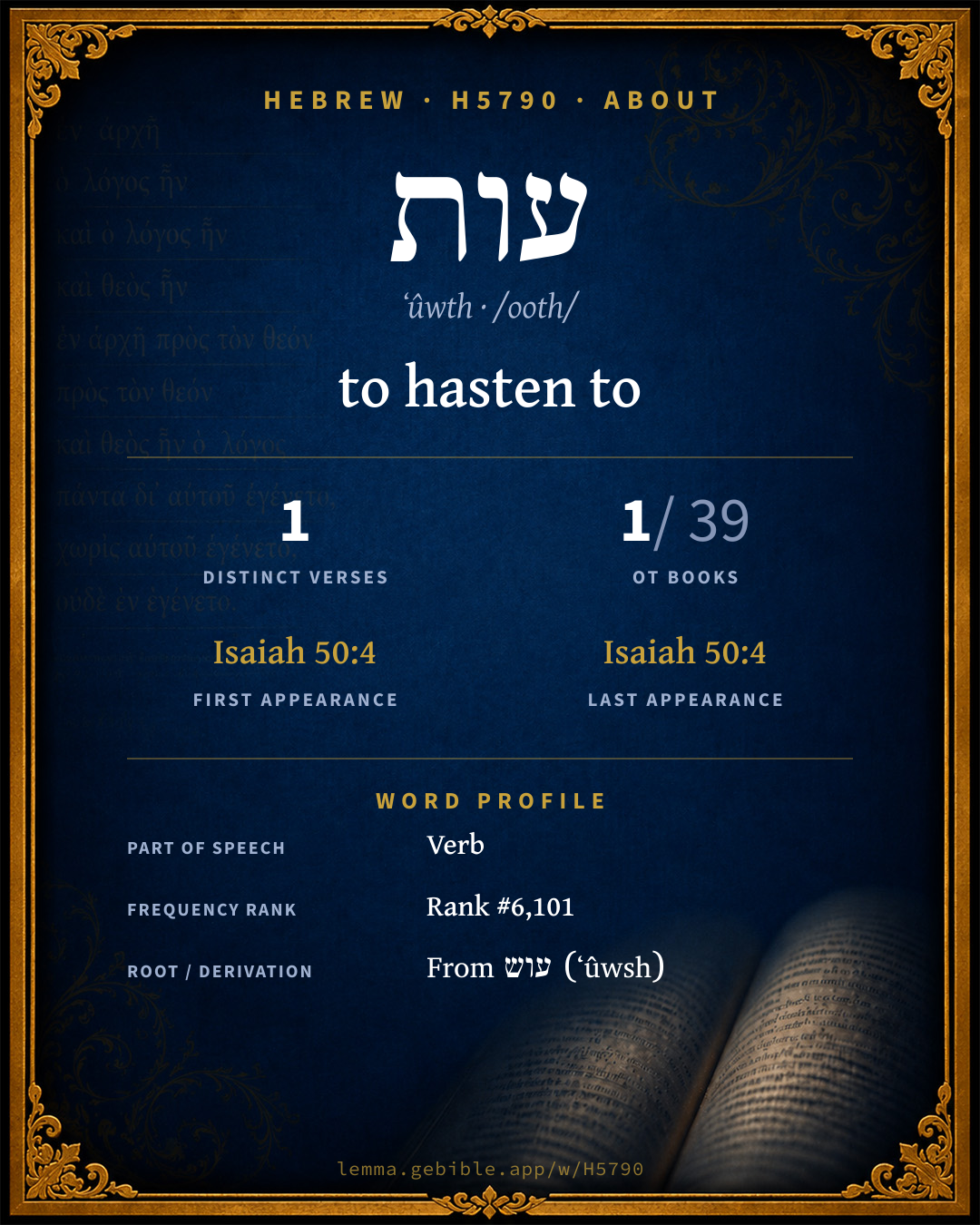
עוּת
to hasten to
also: help, succour fuller range ↓
Full lexicon entry — Brown-Driver-Briggs (BDB)
From Brown-Driver-Briggs (BDB)
Where this word appears
Grammar key — what these labels mean
Stem
- Qal
- The basic, simple active stem — the plain form of the verb (“he wrote”).
Form
- Infinitive Construct
- A bound verbal noun, frequently with prepositions (“to write / in writing”).
Every verse where H5790 appears — 1 distinct verse across 1 book. Click any verse to open its interlinear word-by-word view. Verse text shown in the World English Bible for context — . Each verse’s Hebrew form is shown with its reference; the English is not keyword-highlighted, since the data carries no word-level English alignment. Use “Compare translations” on any verse to read it across multiple English versions. This concordance covers the Hebrew Bible; Septuagint (Greek Old Testament) occurrences are not indexed here.
Isaiah 1 verse
About this entry
At a glance — auto-summarized from this page’s data, not written by a person. Every figure links to its source below. This summary describes the numbers; it doesn’t interpret them.
עות — transliterated ʻûwth — is a Hebrew verb carrying the sense “to hasten to.” It is rare — just 1 verse in the entire Hebrew Bible. More than three-quarters of its appearances fall in Isaiah. A true hapax — its single appearance is Isaiah 50:4. The lexical range runs to 2 senses — “to hasten to” plus “help” and “succour”. Each statement above links to its evidence; the full detail follows below.
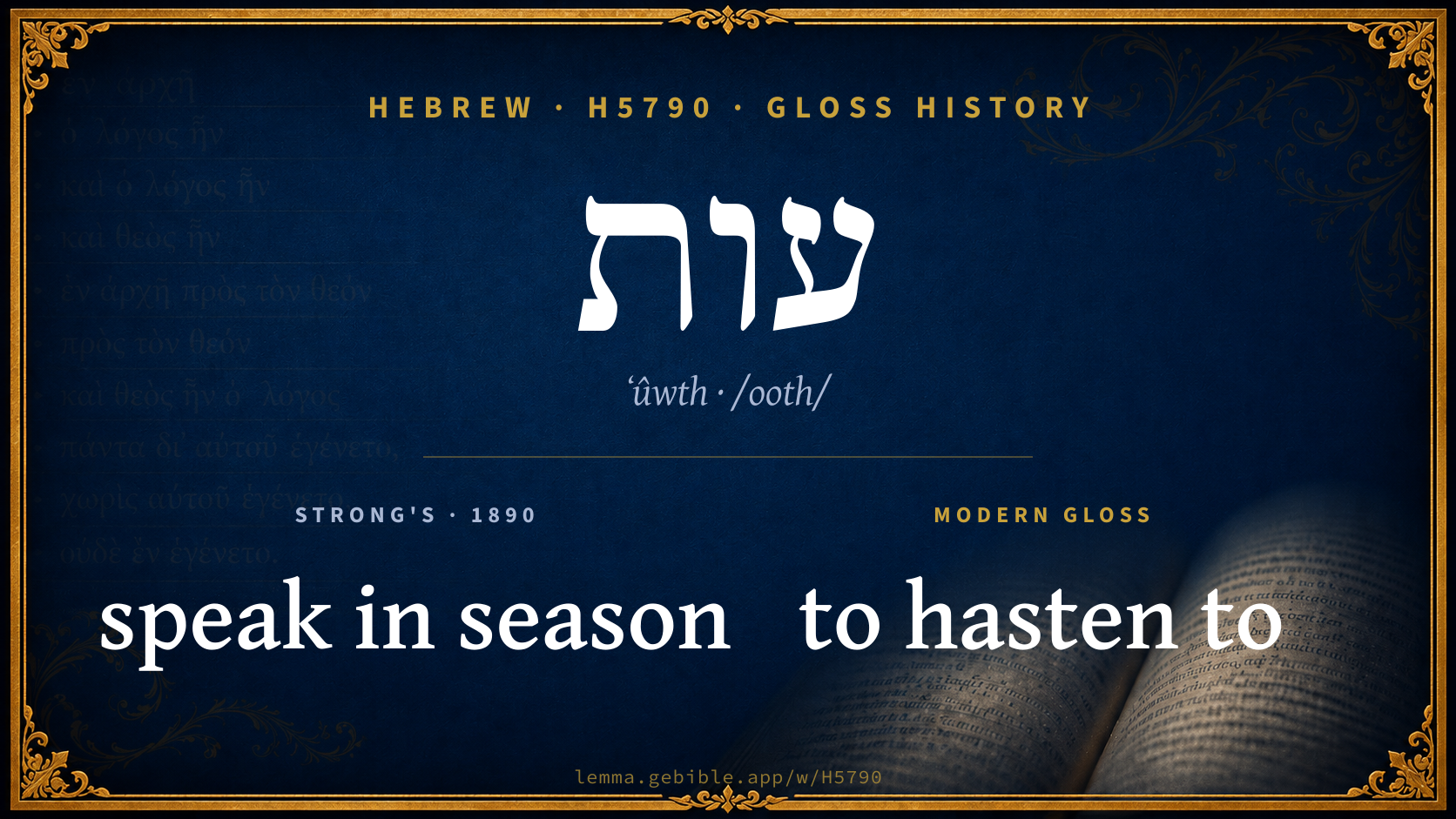
Gloss history
Strong's 1890 vs modern scholarship
About this word
Strong's H5790 catalogs a Hebrew word from the Hebrew Old Testament.
These counts are not copied from any lexicon or concordance. They are computed here, from the morphology-tagged Hebrew Old Testament. What Lemma adds →
- 1
- distinct verses
- The word appears in 1 distinct verse.
- 1 / 39
- OT books
- The word appears in 1 of 39 Old Testament books.
- #6,101
- by frequency
- Rank #6,101 (rank 6,101 of 8,640 Hebrew words by occurrence).
View all 1 occurrence in the concordance →
Most concentrated in
- Isaiah 1 verse 100%
By section of the Old Testament
By traditional corpus
Conventional, traditional groupings — biblical authorship is debated, so this is a traditional corpus grouping, not an authorship claim. Each share is this word’s portion of its verses in that division of the Hebrew canon. Each figure is a share of the word’s 1 distinct verse.
- Prophets (Nevi'im) 1 verse · 100%
How translations render this word
Counts come from each version’s own published word-to-Strong’s tagging or interlinear alignment — an approximate guide to how each version renders this word, not a word-level alignment the data otherwise carries. Because each total is that version’s own tagged count, the per-version totals vary from one another and need not match the appearance or distinct-verse counts above. These counts may also differ from a printed concordance because Lemma counts each distinctly tagged rendering and does not collapse phrase taggings into a single head-word total. This is a fixed set of word-tagged versions (KJV, ASV, BSB, ULT) and does not change with the reading translation you choose elsewhere. Each version’s license is shown beside its name below (and on Sources).
- King James Version: How to speak 1×
- American Standard Version: How to sustain 1×
- Berean Standard Bible: Sustain 1×
- unfoldingWord Literal Text: Sustain 1×
King James Version Public Domain
Renders H5790 across 1 tagged occurrence — most commonly:
American Standard Version Public Domain
Renders H5790 across 1 tagged occurrence — most commonly:
Berean Standard Bible Public Domain
Renders H5790 across 1 tagged occurrence — most commonly:
unfoldingWord Literal Text CC BY-SA 4.0
Renders H5790 across 1 tagged occurrence — most commonly:
Senses in BDB
The 2 senses BDB distinguishes for this word, in lexicon order (not ranked by frequency or importance). The full entry — with sub-senses — is in the Lexicon Entry tab.
- (Qal) to hasten to, help, succour
- meaning dubious
Word origin
עוּת vb. very dub.; only in Is 50:4 usu. to help
— Brown-Driver-Briggs (Oxford 1906, public domain), digitized via Sefaria, supplemented by the OpenScriptures HebrewLexicon (CC BY 4.0). See Sources.
Derived from עוש (ʻûwsh) (H5789) — to help.
Jastrow Dictionary
A second Hebrew/Aramaic lexicon for comparison, covering Aramaic and post-biblical (Talmudic, Targumic, Midrashic) usage that the biblical-Hebrew BDB does not. Matched by lemma rather than by Strong’s number, so a lemma may carry more than one Jastrow headword (shown separately below), and the entries cover usage well beyond the Bible.
עוּת
- (v. אוֹת I), Nif. נֵעוֹת to be gratified, enjoy. Y. Ab. Zar. I, 39ᶜ top, a. e. Samuel reads יֵעוֹתוּ (with ref. to לָעוּת, Is. L, 4). e.g. Isaiah 50:4
*עוּת
- Pa. עַיֵּית (preced.) to make suitable, adjust. Lam. R. to III, 9 Ar., v. צְמַד.
עות
- , pr. n. m., v. עַזָּת
עָוַת
- v. עָוָה) to be curved, crooked.
- 1. to pervert, wrest; to corrupt. Num. R. s. 10 מתוך כך … ומְעַוְּותִין את הדין in consequence (of drinking) they cause the Law to be forgotten, and they pervert judgment. Nidd. 10ᵇ אין בודקות … מפני שמְעַוְּותוֹת אותן (not בודקין) they (the women) must not examine them (the young girls) with the fingers, because they may corrupt them (teach them unnatural gratification; Rashi: they may wound them).—Koh. R. to I, 15 (ref. to מעות ib.) אם אין אדם מְעַוֵּות עצמו מדברי תורה וכ׳ as long as a person (though doing wrong) does not pervert himself through wilful misinterpretation of the Law, there is a remedy for him; משאדם מעוות וכ׳ but as soon as a person perverts himself &c.; a. fr.—Nidd. 12ᵇ (adapting Koh. l. c.) הן עִוְּתוּהָ הן תקנוה they make her crooked (the evidence on the cloths will make her unfit for marital intercourse), and they make her straight (if the evidence is favorable).
- 2. to offend, excite displeasure; wound the feelings of. Snh. 97ᵃ יְעַיֵּת; Der. Er. Zut. ch. X יְעַוֵּות shall be offensive, v. אָמַר II. Midr. Till. to Ps. CXIX, 78 אע"פ … מְעַוְּתִים אותי וכ׳ although the wicked insult me, I do not abandon the Law.
- 3. to render offensive, loathsome. Sifré Deut. 1; Yalk. ib. 792 למה אתה מְעַוֵּות עלינו וכ׳ why dost thou make the Scriptures loathsome to us (by absurd interpretations)?—Part. pass. מְעֻוָּת, מְעוּוָּת; f. מְעוֶּוּתֶת; pl. מְעוּוָּתִים, מְעוּוָּתִין; מְעִוּוָּתוֹת, מְעֻוָּ׳ crooked, perverted, perverse. Koh. R. l. c. בעולם הזה מי שהוא מע׳ וכ׳ in this world, he who is crooked may be straightened again (a sinner may amend his ways) &c. Ex. R. s. 2, beg. (ref. to עלילות, Ps. CIII, 7, in contrast to Deut. XXII, 14) [read:] בשר ודם עלילותיו מע׳ וכ׳ the ʿăliloth (machinations) of man are perverse …, but the ʿăliloth (dispositions) of the Lord are merciful; a. e. e.g. Psalms 103:7
- to be curved, wrested; to be perverted; to deteriorate. Koh. R. l. c. אין קורין מעוות … ונ׳ we do not call a thing perverted, unless it was at a time straight (right), and it became curved. Ib. משנִתְעַיְּותוּ המים וכ׳ when the waters dating from creation became deteriorated. Sot. 41ᵇ נִתְעַוְּותוּ הדינין (or הדַּיָּנִין, v. Rashi a. l.) the courts became depraved. Ib. 47ᵇ נתעוותו הדינין justice became corrupt; (Tosef. ib. XIV, 3 נתקלקל הדין).
עֲלִילָה
- preced.)
- 1. [bringing about, causation,] dealing, government, disposition.—Pl. עֲלִילוֹת. Ex. R. s. 2, v. עָוַת.
- 2. (v. עִילָה) [round about way,] circumvention, perverseness, insidiousness; pretext, false charge. Snh. 101ᵇ שלשה באו בע׳ three men (Biblical personages) came with indirectness (instead of praying in a straightforward manner). Gen. R. s. 93 מתחלה באת עלינו בע׳ from the start thou camest against us with insidiousness (trying to find charges against us); Tanḥ. Vayigg. 5; Yalk. Gen. 151. Esth. R. to III, 9 המן … בע׳ גדולה וכ׳ Haman, the wicked, came with great trickery against Israel (tempting them to sin). Ib. באו בע׳ וכ׳ they (the Israelites) came with a pretext, saying, let us go to sacrifice (Ex. V, 3). Pesik. R. s. 26 ראה היאך תמצא לו ע׳ וכ׳ see how thou canst find a charge against Jeremiah and be revenged on him; a. fr.—Pl. as ab. Ex. R. l. c., v. עָוַת. Num. R. s. 20 שלא ליתן לו ע׳ (not יתן) so as not to allow him any excuses. e.g. Exodus 5:3
A Dictionary of the Targumim, the Talmud Babli and Yerushalmi, and the Midrashic Literature (Marcus Jastrow; London, Luzac, 1903) — Public Domain. Digitized via Sefaria. Digitized via Sefaria. Full attribution on Sources.
Same root — word family
Other BDB entries built from the same root as H5790, grouped by Strong’s listed origin. These share a root / origin per the lexicon — not necessarily a shared meaning. Each links to that word’s own entry.
Derives from
Proper names from this root
People and places named from this root — a name, not an additional meaning of the word.
- יעוש Yᵉʻûwsh H3266 Jehush
- יעיש Yᵉʻîysh H3274 Jeush
- עיש ʻAyish H5906 Great Bear
- עותי ʻÛwthay H5793 Uthai
- עתיה ʻĂthâyâh H6265 Athaiah
Compare all same-root words → Showing 4 of 7 — not the complete family. 5 of the same-root words are proper names (people or places). They share a root, not necessarily a meaning.
Septuagint verse parallels
This word appears in 1 verse that also exists in the Greek Old Testament (Septuagint), out of the 1 Hebrew verse it occurs in. You can read those verses in Greek by switching the Old Testament edition to the Septuagint.
Read these verses in the Septuagint
This is a verse-level parallel only — the same verses exist in both the Hebrew and Greek Old Testaments. No word-level Hebrew↔Greek correspondence is claimed: the data carries no such alignment, so no Greek word is shown as this Hebrew word’s translation. Coverage is not total — the Septuagint omits the deuterocanon and renumbers the Psalms, so some Hebrew verses have no direct Greek parallel.