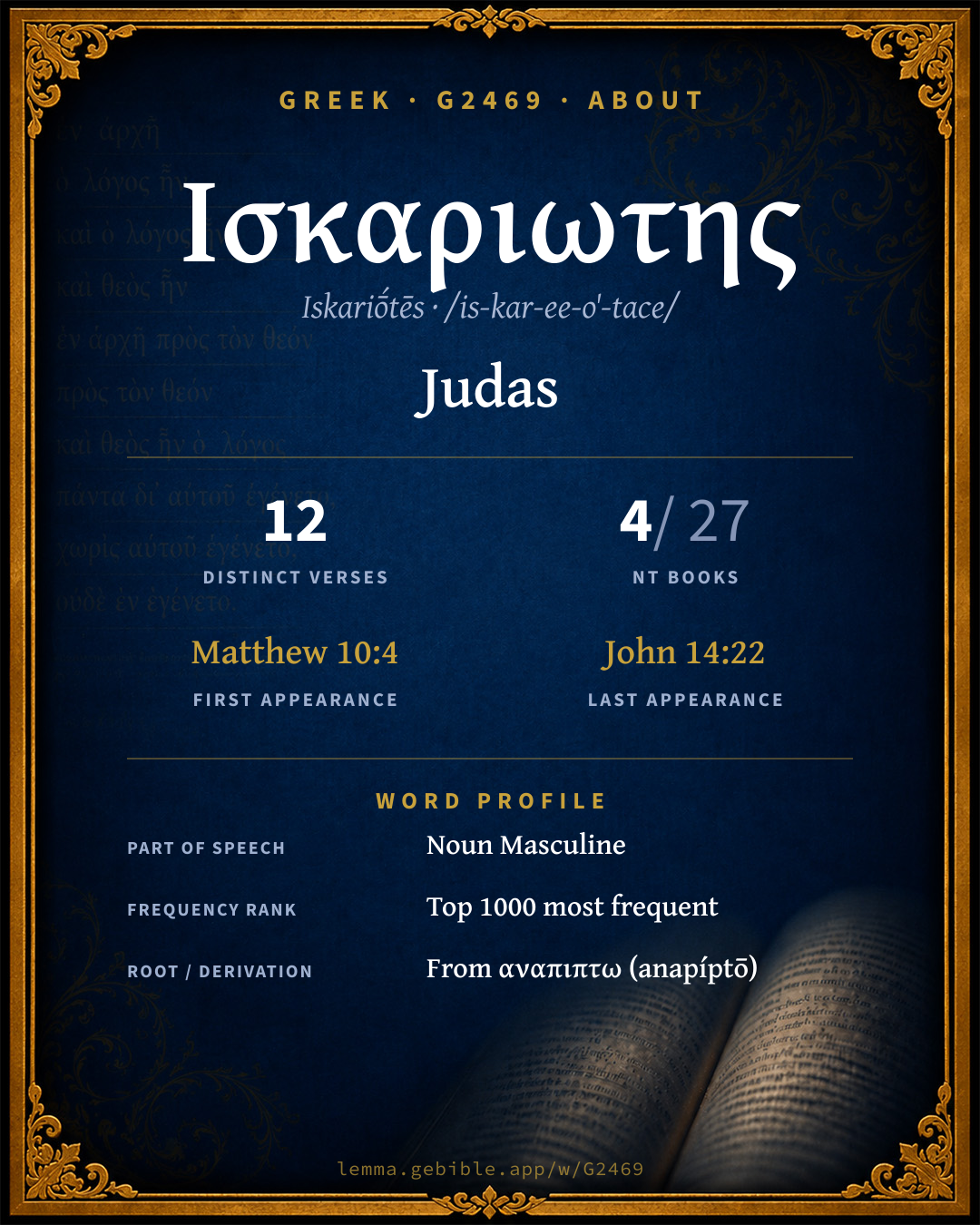
Ἰσκαριώτης
Judas
Thayer's lists 2 entries for ‘Judas’ fuller range ↓
Full lexicon entry — Thayer's Greek Lexicon
From Thayer's Greek Lexicon
Where this word appears
See every Nominative-case word in the Greek New Testament →
Grammar key — what these labels mean
Part of speech
- Noun
- A naming word — a person, place, thing, or idea.
Case
- Nominative
- The case of the subject (and the predicate nominative).
- Genitive
- The case of source, possession, or “of” — answers “whose / from what.”
- Accusative
- The case of the direct object and of extent.
Gender
- Masculine
- Grammatically masculine.
Number
- Singular
- One.
Grammatical forms
- Noun, Nominative, Singular, Masculine 6 times (50%)
- Noun, Proper, indeclinable 3 times (25%)
- Noun, Genitive, Singular, Masculine 2 times (17%)
- Noun, Accusative, Singular, Masculine 1 time (8%)
Parsed forms decoded from the imported morphology (Robinson–Tischendorf, public domain), counted across 12 parsed occurrences — not distinct verses.
Every verse where G2469 appears — 12 distinct verses across 4 books. Click any verse to open its interlinear word-by-word view. Verse text shown in the World English Bible for context — . Each verse’s Greek form is shown with its reference; the English is not keyword-highlighted, since the data carries no word-level English alignment. Use “Compare translations” on any verse to read it across multiple English versions. This concordance covers the Greek New Testament; Septuagint (Greek Old Testament) occurrences of this word are not indexed here.
Matthew 2 verses
Mark 3 verses
- Mark 3:19 Ἰσκαριώθ n proper indecl and Judas Iscariot, who also betrayed him. He came into a house.
- Mark 14:10 Ἰσκαριώθ n proper indecl Judas Iscariot, who was one of the twelve, went away to the chief priests, that he might deliver him to them.
- Mark 14:43 Ἰσκαριώτης n nom sg masc Immediately, while he was still speaking, Judas, one of the twelve, came--and with him a multitude with swords and clubs, from the chief priests, the scribes, and the elders.
Luke 2 verses
John 5 verses
- John 6:71 Ἰσκαριώτου n gen sg masc Now he spoke of Judas, the son of Simon Iscariot, for it was he who would betray him, being one of the twelve.
- John 12:4 Ἰσκαριώτης n nom sg masc Then Judas Iscariot, Simon's son, one of his disciples, who would betray him, said,
- John 13:2 Ἰσκαριώτης n nom sg masc After supper, the devil having already put into the heart of Judas Iscariot, Simon's son, to betray him,
- John 13:26 Ἰσκαριώτου n gen sg masc Jesus therefore answered, "It is he to whom I will give this piece of bread when I have dipped it." So when he had dipped the piece of bread, he gave it to Judas, the son of Simon Iscariot.
- John 14:22 Ἰσκαριώτης n nom sg masc Judas (not Iscariot) said to him, "Lord, what has happened that you are about to reveal yourself to us, and not to the world?"
About this entry
At a glance — auto-summarized from this page’s data, not written by a person. Every figure links to its source below. This summary describes the numbers; it doesn’t interpret them.
The Greek name Ισκαριωτης centers on the idea of “Judas.” Its earliest occurrence is Matthew 10:4. It turns up in 12 verses across 4 books, an uncommon footprint. The word gravitates to John (42%), then Mark and Matthew. Dig into 12-verse concordance and the renderings breakdown below.
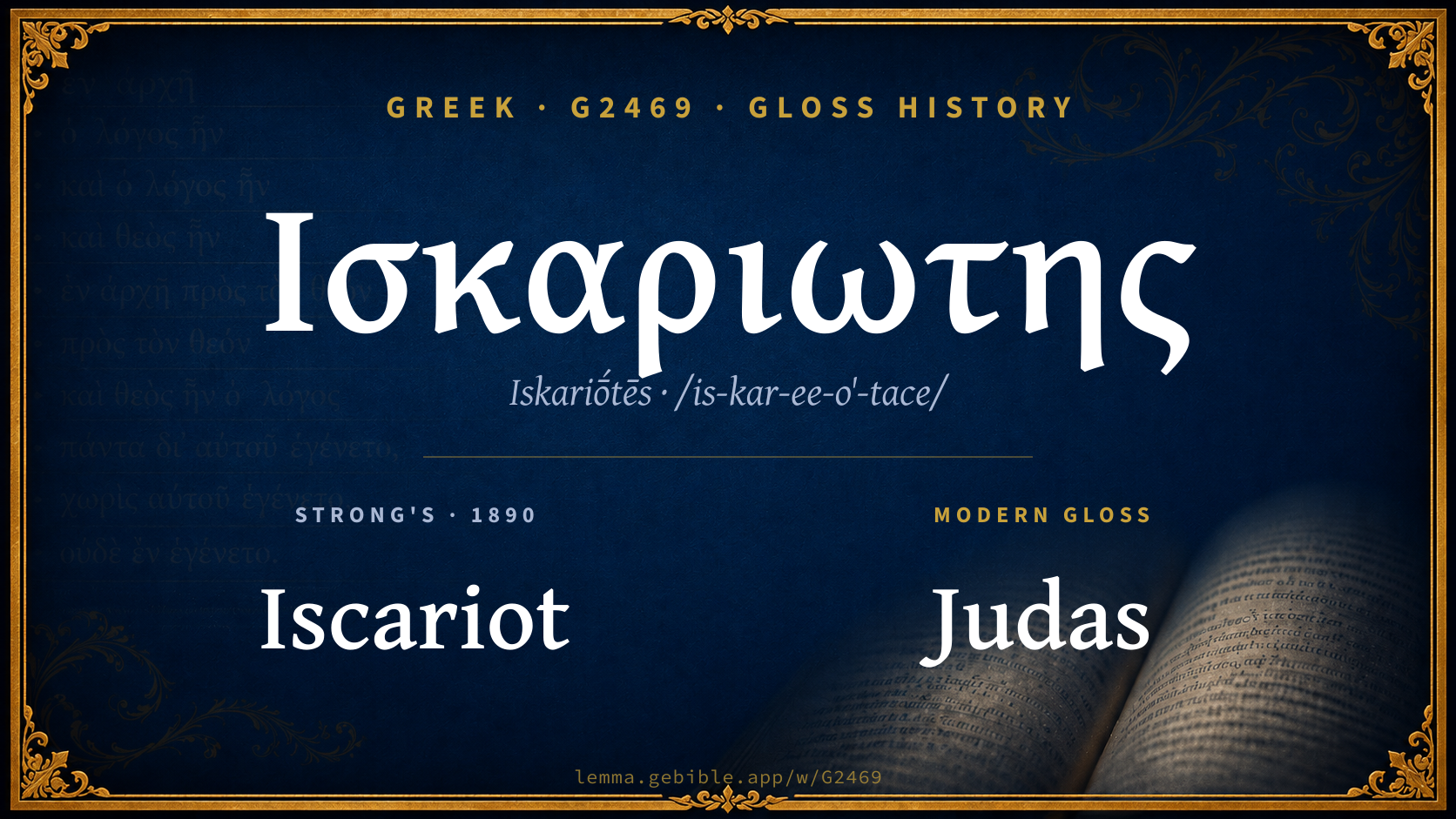
Gloss history
Strong's 1890 vs modern scholarship
About this word
Strong's G2469 catalogs a Greek word from the Greek New Testament.
These counts are not copied from any lexicon or concordance. They are computed here, from the morphology-tagged Greek New Testament. What Lemma adds →
- 12
- distinct verses
- The word appears in 12 distinct verses.
- 4 / 27
- NT books
- The word appears in 4 of 27 New Testament books.
- #904
- by frequency
- Top 1000 most frequent Greek words (rank 904 of 5,347 Greek words by occurrence).
View all 12 occurrences in the concordance →
By section of the New Testament
By traditional corpus
Conventional, traditional groupings — biblical authorship is debated, so this is a traditional corpus grouping, not an authorship claim. Some books belong to more than one corpus (Luke is in both the Gospels and the Lukan corpus, and so on), so these shares overlap and need not total 100%. Each figure is a share of the word’s 12 distinct verses.
- Gospels 12 verses · 100%
- Johannine 5 verses · 42%
- Lukan (Luke–Acts) 2 verses · 17%
How translations render this word
Counts come from each version’s own published word-to-Strong’s tagging or interlinear alignment — an approximate guide to how each version renders this word, not a word-level alignment the data otherwise carries. Because each total is that version’s own tagged count, the per-version totals vary from one another and need not match the appearance or distinct-verse counts above. These counts may also differ from a printed concordance because Lemma counts each distinctly tagged rendering and does not collapse phrase taggings into a single head-word total. This is a fixed set of word-tagged versions (KJV, ASV, BSB, ULT) and does not change with the reading translation you choose elsewhere. Each version’s license is shown beside its name below (and on Sources).
- King James Version: Iscariot 11×
- American Standard Version: Iscariot 11×
- Berean Standard Bible: Iscariot 11×
- unfoldingWord Literal Text: Iscariot 11×
King James Version Public Domain
Renders G2469 across 11 tagged occurrences — most commonly:
American Standard Version Public Domain
Renders G2469 across 11 tagged occurrences — most commonly:
Berean Standard Bible Public Domain
Renders G2469 across 11 tagged occurrences — most commonly:
unfoldingWord Literal Text CC BY-SA 4.0
Renders G2469 across 11 tagged occurrences — most commonly:
Senses in Thayer's
The 2 senses Thayer's distinguishes for this word, in lexicon order (not ranked by frequency or importance). The full entry — with sub-senses — is in the Lexicon Entry tab.
- Iscariot = "men of Kerioth"
- the apostle who betrayed Jesus
Word origin
Derived from αναπιπτω (anapíptō) (G377) — to recline.
Forms in the corpus
The 4 distinct written forms G2469 takes in the Greek New Testament, most frequent first — each parse links to that case’s occurrences in the concordance.
| Form | Parsing | Example | Uses |
|---|---|---|---|
| Ἰσκαριώτης Iskariṓtēs | Noun, Nominative, Singular, Masculine | Matthew 10:4 | 6 |
| Ἰσκαριώθ Iskariṓth | Noun, Proper, indeclinable | Mark 3:19 | 3 |
| Ἰσκαριώτου Iskariṓtou | Noun, Genitive, Singular, Masculine | John 6:71 | 2 |
| Ἰσκαριώτην Iskariṓtēn | Noun, Accusative, Singular, Masculine | Luke 22:3 | 1 |
Bible dictionary
Public-domain dictionary articles matched to this entry by name (Judas). A biblical name can be shared by more than one person or place, so an article may treat several.
Easton's Bible Dictionary · M. G. Easton, 1897
The Graecized form of Judah. (1.) The patriarch (Matt. 1:2, 3).
(2.) Son of Simon (John 6:71; 13:2, 26), surnamed Iscariot, i.e., a man of Kerioth (Josh. 15:25). His name is uniformly the last in the list of the apostles, as given in the synoptic (i.e., the first three) Gospels. The evil of his nature probably gradually unfolded itself till "Satan entered into him" (John 13:27), and he betrayed our Lord (18:3). Afterwards he owned his sin with "an exceeding bitter cry," and cast the money he had received as the wages of his iniquity down on the floor of the sanctuary, and "departed and went and hanged himself" (Matt. 27:5). He perished in his guilt, and "went unto his own place" (Acts 1:25). The statement in Acts 1:18 that he "fell headlong and burst asunder in the midst, and all his bowels gushed out," is in no way contrary to that in Matt. 27:5. The sucide first hanged himself, perhaps over the valley of Hinnom, "and the rope giving way, or the branch to which he hung breaking, he fell down headlong on his face, and was crushed and mangled on the rocky pavement below."
Why such a man was chosen to be an apostle we know not, but it is written that "Jesus knew from the beginning who should betray him" (John 6:64). Nor can any answer be satisfactorily given to the question as to the motives that led Judas to betray his Master. "Of the motives that have been assigned we need not care to fix on any one as that which simply led him on. Crime is, for the most part, the result of a hundred motives rushing with bewildering fury through the mind of the criminal."
(3.) A Jew of Damascus (Acts 9:11), to whose house Ananias was sent. The street called "Straight" in which it was situated is identified with the modern "street of bazaars," where is still pointed out the so-called "house of Judas."
(4.) A Christian teacher, surnamed Barsabas. He was sent from Jerusalem to Antioch along with Paul and Barnabas with the decision of the council (Acts 15:22, 27, 32). He was a "prophet" and a "chief man among the brethren."
Smith's Bible Dictionary · William Smith, 1863
surnamed Barsabas, a leading member of the apostolic church at Jerusalem, (Acts 15:22) endued with the gift of prophesy, ver. (Acts 15:32) chosen with Silas to accompany Paul and Barnabas as delegates to the church at Antioch. (A.D. 47.) Later, Judas went back to Jerusalem.
the Greek form of the Hebrew name Judah, occurring in the LXX, and the New Testament.
+ The patriarch Judah. (Matthew 1:2,3) + A man residing at Damascus, in "the street which is called Straight," in whose house Saul of Tarsus lodged after his miraculous conversion. (Acts 9:11)
Hitchcock's Bible Names Dictionary · Roswell D. Hitchcock, 1869
Jude, same as Judah
Classic public-domain reference works; full attribution on Sources.