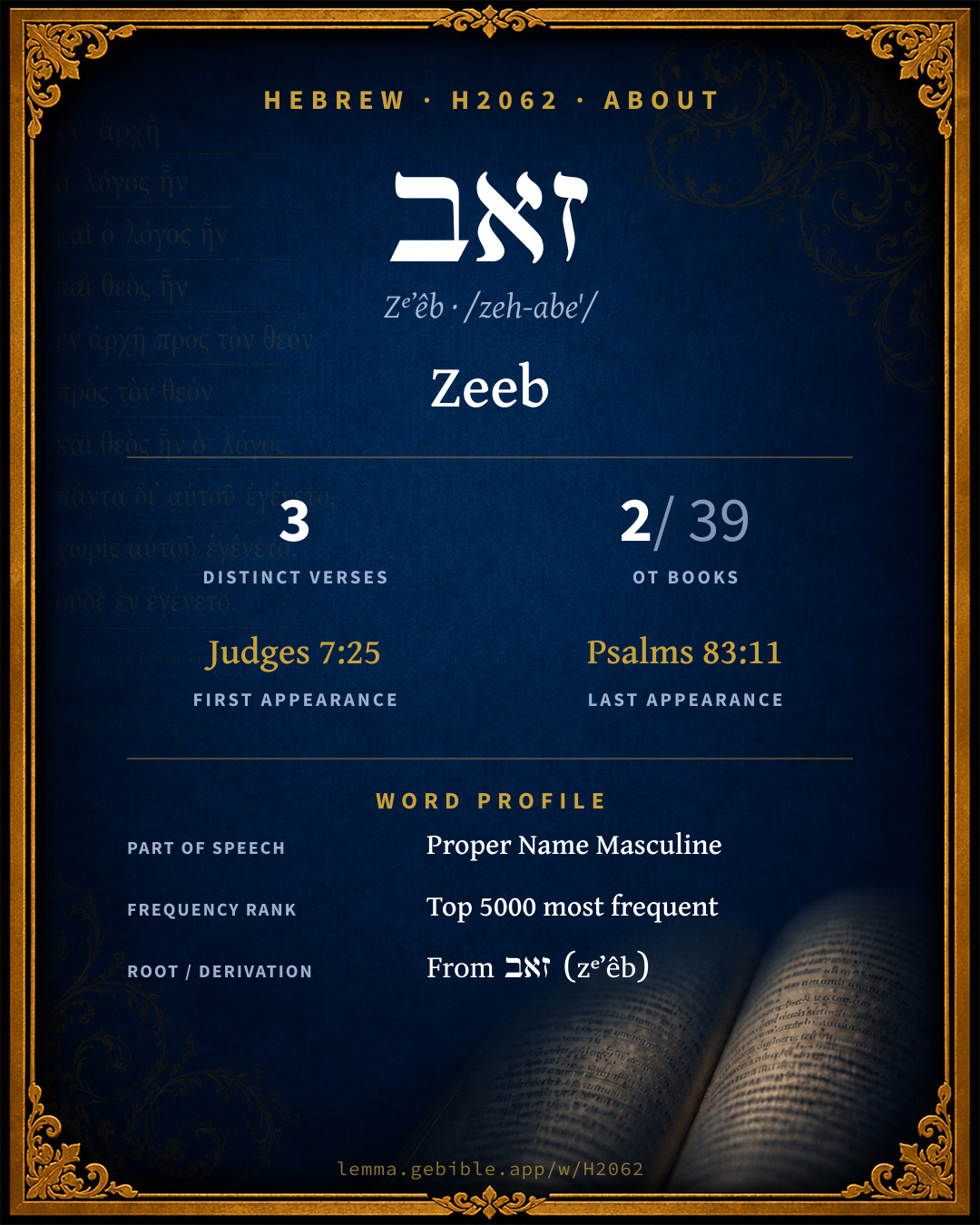
זְאֵב
Zeeb
BDB lists 2 entries for ‘Zeeb’ fuller range ↓
Full lexicon entry — Brown-Driver-Briggs (BDB)
From Brown-Driver-Briggs (BDB)
Where this word appears
Grammar key — what these labels mean
Part of speech
- Noun
- A naming word — a person, place, thing, or idea.
Noun type
- Proper
- A name of a specific person, place, or people (e.g. Abraham, Zion, Israel).
Every verse where H2062 appears — 3 distinct verses across 2 books. Click any verse to open its interlinear word-by-word view. Verse text shown in the World English Bible for context — . Each verse’s Hebrew form is shown with its reference; the English is not keyword-highlighted, since the data carries no word-level English alignment. Use “Compare translations” on any verse to read it across multiple English versions. This concordance covers the Hebrew Bible; Septuagint (Greek Old Testament) occurrences are not indexed here.
Judges 2 verses
- Judges 7:25 זְאֵ֗ב זְאֵב֙ זְאֵ֔ב וּ/זְאֵ֔ב n Proper n Proper n Proper conj + n Proper They took the two princes of Midian, Oreb and Zeeb; and they killed Oreb at the rock of Oreb, and Zeeb they killed at the winepress of Zeeb, and pursued Midian: and they brought the heads of Oreb and Zeeb to Gideon beyond the Jordan.
- Judges 8:3 זְאֵ֔ב n Proper God has delivered into your hand the princes of Midian, Oreb and Zeeb: and what was I able to do in comparison with you? Then their anger was abated toward him, when he had said that.
Psalms 1 verse
About this entry
At a glance — auto-summarized from this page’s data, not written by a person. Every figure links to its source below. This summary describes the numbers; it doesn’t interpret them.
“Zeeb” is the headline sense of the Hebrew name זאב (Zᵉʼêb). The Hebrew Bible uses it only 3 verses. It clusters heavily in Judges, which alone accounts for 67% of its uses. First canonically at Judges 7:25, it enters the text early. The sections below give every occurrence and version rendering.
Gloss history
Strong's 1890 vs modern scholarship
About this word
Strong's H2062 catalogs a Hebrew word from the Hebrew Old Testament.
These counts are not copied from any lexicon or concordance. They are computed here, from the morphology-tagged Hebrew Old Testament. What Lemma adds →
- 3
- distinct verses
- The word appears in 3 distinct verses.
- 2 / 39
- OT books
- The word appears in 2 of 39 Old Testament books.
- #3,040
- by frequency
- Top 5000 most frequent Hebrew words (rank 3,040 of 8,640 Hebrew words by occurrence).
View all 3 occurrences in the concordance →
By traditional corpus
Conventional, traditional groupings — biblical authorship is debated, so this is a traditional corpus grouping, not an authorship claim. Each share is this word’s portion of its verses in that division of the Hebrew canon. Each figure is a share of the word’s 3 distinct verses.
- Prophets (Nevi'im) 2 verses · 67%
- Writings (Ketuvim) 1 verse · 33%
How translations render this word
Counts come from each version’s own published word-to-Strong’s tagging or interlinear alignment — an approximate guide to how each version renders this word, not a word-level alignment the data otherwise carries. Because each total is that version’s own tagged count, the per-version totals vary from one another and need not match the appearance or distinct-verse counts above. These counts may also differ from a printed concordance because Lemma counts each distinctly tagged rendering and does not collapse phrase taggings into a single head-word total. This is a fixed set of word-tagged versions (KJV, ASV, BSB, ULT) and does not change with the reading translation you choose elsewhere. Each version’s license is shown beside its name below (and on Sources).
BDB lists this Strong’s number as 2 distinct words (homographs). Each count above pools all of them and is not split by sense — see the Senses section below. A low-frequency rendering may belong to a different one of those words, not the primary meaning.
- King James Version†: Zeeb 5×
- American Standard Version†: Zeeb 6×
- Berean Standard Bible†: Zeeb 6×
- unfoldingWord Literal Text†: Zeeb 5×
King James Version Public Domain
Renders H2062 across 6† tagged occurrences — most commonly:
Plus 1 rendering that appears only once — usually multi-word phrases or single function words the recovered tagging swept in, not distinct renderings.
American Standard Version Public Domain
Renders H2062 across 6† tagged occurrences — most commonly:
Berean Standard Bible Public Domain
Renders H2062 across 6† tagged occurrences — most commonly:
unfoldingWord Literal Text CC BY-SA 4.0
Renders H2062 across 6† tagged occurrences — most commonly:
Plus 1 rendering that appears only once — usually multi-word phrases or single function words the recovered tagging swept in, not distinct renderings.
Senses in BDB
The 2 senses BDB distinguishes for this word, in lexicon order (not ranked by frequency or importance). The full entry — with sub-senses — is in the Lexicon Entry tab.
- Zeeb = "wolf"
- one of the two princes of Midian mentioned in the conquest; brought to bay in a winepress
Word origin
I. n.m. Is 11:6 wolf (NH id., Arabic ذِئْبٌ (jackal according to HomNS 303 ff.; but see RSZMG 1880, 373 and DoughtyArabic Deserta i. 327; ii, 144, 145) Aramaic דֵּיבָה, ܕܺܐܒܳܐ, Assyrian zîbu DlS 47; Ethiopic ዝእብ hyena Di1056 (on format. cf. LagBN 58); Ph. in cpd.n.pr. זיבקם)—זְאֵב abs. Gn 49:27 + 2 times; cstr. Je 5:6; pl. זְאֵבִים Ez 22:27; cstr. זְאֵבֵי Hb 1:8 Zp 3:3;—wolf, never in narrative; in predictions of peace in Messian. age וְגָר זְאֵב עִם כֶּבֶשׂ Is 11:6 זְאֵב וְטָלֶה יִרְעוּ כְּאֶחָד Is 65:25; in simile, of Benjamin’s fierceness ב׳ זְאֵב יִטְרָ֑ף Gn 49:27; of fierce horses of Chaldeans חַדּוּ מִזְּאֵבֵי עֶרֶב Hb 1:8 (‖ קַלּוּ מִנְּמֵרִים); of princes of Judah כִּזְאֵבִים טֹרְפֵי טָ֑רֶף Ez 22:27; metaph. of enemies of Judah Je 5:6 זְאֵב עֲרָבוֹת (‖ אַרְיֵה, נָמֵר); of corrupt and oppressive judges שֹׁפְטֶיהָ זְאֵבֵי עֶרֶב Zp 3:3 (‖ אֲרָיוֹת שֹׁאֲגִים).
II. n.pr.m. (wolf)—a prince of Midian, Ju 7:25(×3); 8:3 ψ 83:12; also in n.pr.loc. יֶקֶב־זְאֵב Ju 7:25 wine-vat of Zeeb.
— Brown-Driver-Briggs (Oxford 1906, public domain), digitized via Sefaria, supplemented by the OpenScriptures HebrewLexicon (CC BY 4.0). See Sources.
Derived from זאב (zᵉʼêb) (H2061) — wolf.
Jastrow Dictionary
A second Hebrew/Aramaic lexicon for comparison, covering Aramaic and post-biblical (Talmudic, Targumic, Midrashic) usage that the biblical-Hebrew BDB does not. Matched by lemma rather than by Strong’s number, so a lemma may carry more than one Jastrow headword (shown separately below), and the entries cover usage well beyond the Bible.
זְאֵב
- (b. h.) wolf. B. Mets. VII, 9 ז׳ אחד וכ׳ the attack by one wolf is not considered an accident relieving from responsibility; a. fr.—Pl. זְאֵבִים, זְאֵיבִים. Ib. בשעת משלחת ז׳ at a time when wolves are coming forth in hordes, v. מִשְׁלַחַת; Y. Shebi. IV, 35ᵇ top; Y. Ter. XI, end, 48ᵇ. Esth. R. to IX, 2, v. כִּבְשָׂה; a. fr.—Fem. זְאֵבָה. Midr. Till. to Ps. X, 13 נזדמנה הז׳ וכ׳ a she-wolf was provided for them who gave them suck; v. רוֹמוֹס; ib. to XVII, 14 וזימנת להם ז׳ and Thou didst provide &c.; Yalk. Ps. 652.
A Dictionary of the Targumim, the Talmud Babli and Yerushalmi, and the Midrashic Literature (Marcus Jastrow; London, Luzac, 1903) — Public Domain. Digitized via Sefaria. Digitized via Sefaria. Full attribution on Sources.
Forms in the corpus
The 5 distinct written forms H2062 takes in the Hebrew Bible, most frequent first — each parse links to that state’s occurrences in the concordance. Hebrew forms include their vowel points and cantillation, so a single lemma takes many written forms.
| Form | Parsing | Example | Uses |
|---|---|---|---|
| זְאֵ֔ב | Noun, Proper | Judges 7:25 | 2 |
| וְ/כִ/זְאֵ֑ב | Noun, Proper | Psalms 83:11 | 1 |
| וּ/זְאֵ֔ב | Noun, Proper | Judges 7:25 | 1 |
| זְאֵ֗ב | Noun, Proper | Judges 7:25 | 1 |
| זְאֵב֙ | Noun, Proper | Judges 7:25 | 1 |
Bible dictionary
Public-domain dictionary articles matched to this entry by name (Zeeb). A biblical name can be shared by more than one person or place, so an article may treat several.
Easton's Bible Dictionary · M. G. Easton, 1897
The wolf, one of the two leaders of the great Midianite host which invaded Israel and was utterly routed by Gideon. The division of that host, which attempted to escape across the Jordan, under Oreb and Zeeb, was overtaken by the Ephraimites, who, in a great battle, completely vanquished them, their leaders being taken and slain (Judg. 7:25; Ps. 83:11; Isa. 10:26).
Smith's Bible Dictionary · William Smith, 1863
(wolf), one of the two "princes" of Midian in the great invasion of Israel. (B.C. about 1250.) He is always named with Oreb. (Judges 7:25; 8:3; Psalms 83:11) Zeeb and Oreb were not slain at the first rout of the Arabs, but at a later stage of the struggle, probably ill crossing the Jordan at a ford farther down the river. Zeeb, the wolf, was brought to bay in a wine-press which in later times bore his name--the "wine-press of Zeeb." [Oreb]
Hitchcock's Bible Names Dictionary · Roswell D. Hitchcock, 1869
wolf
Classic public-domain reference works; full attribution on Sources.
Septuagint verse parallels
This word appears in 3 verses that also exist in the Greek Old Testament (Septuagint), out of the 3 Hebrew verses it occurs in. You can read those verses in Greek by switching the Old Testament edition to the Septuagint.
Read these verses in the Septuagint
This is a verse-level parallel only — the same verses exist in both the Hebrew and Greek Old Testaments. No word-level Hebrew↔Greek correspondence is claimed: the data carries no such alignment, so no Greek word is shown as this Hebrew word’s translation. Coverage is not total — the Septuagint omits the deuterocanon and renumbers the Psalms, so some Hebrew verses have no direct Greek parallel.