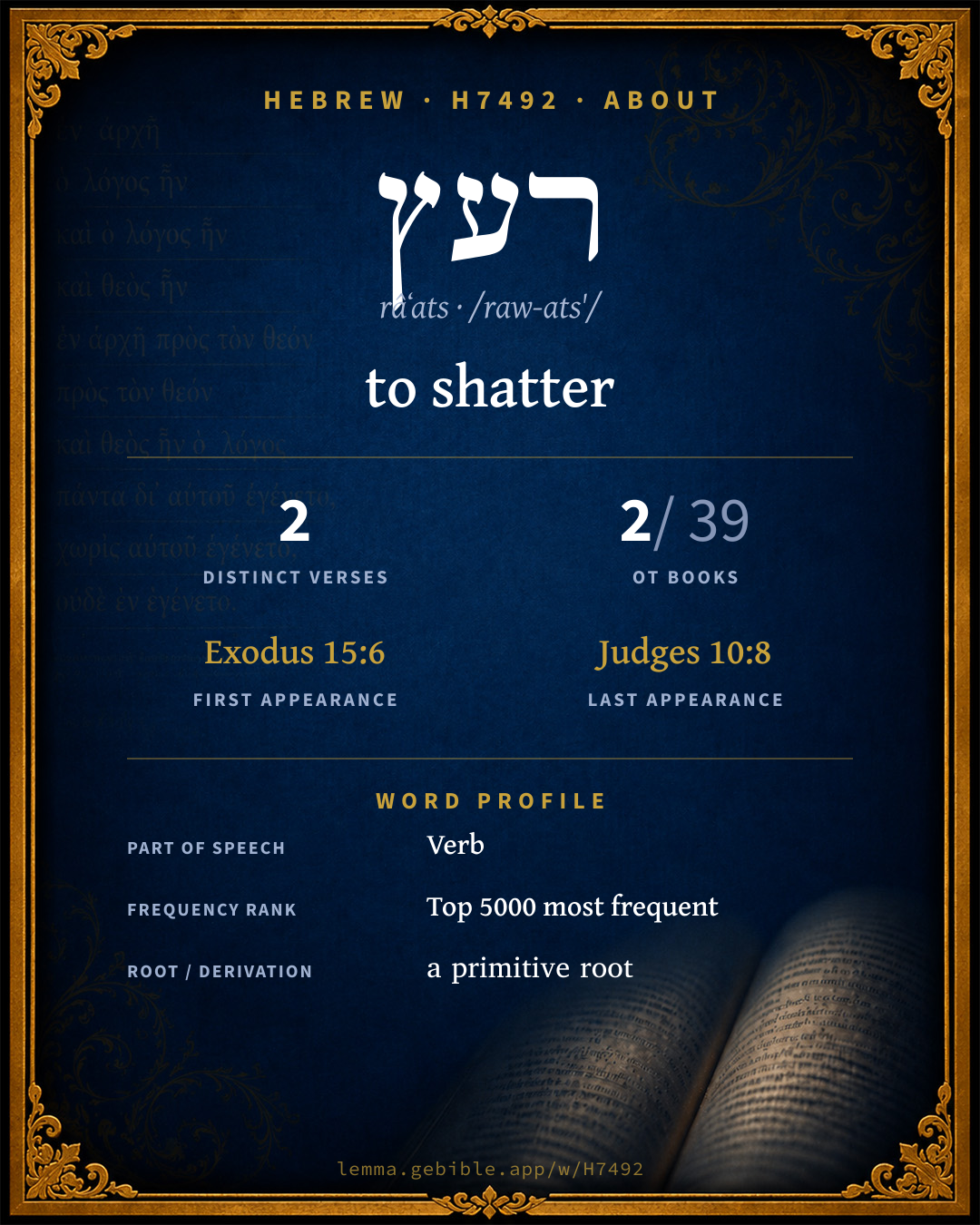
רָעַץ
to shatter
Full lexicon entry — Brown-Driver-Briggs (BDB)
From Brown-Driver-Briggs (BDB)
Where this word appears
Grammar key — what these labels mean
Part of speech
- Verb
- An action or state-of-being word.
Stem
- Qal
- The basic, simple active stem — the plain form of the verb (“he wrote”).
Form
- Sequential Imperfect
- An imperfect with prefixed waw — the standard past-narrative form (waw-consecutive imperfect).
- Imperfect
- An incomplete, ongoing, or future action (“he will / would write”).
Person
- 3rd Person
- The one spoken about (“he / she / it / they”).
Gender
- Masculine
- Grammatically masculine.
- Feminine
- Grammatically feminine.
Number
- Plural
- More than one (in Hebrew, generally three or more).
- Singular
- One.
Grammatical forms
- Verb, Qal, Sequential Imperfect, 3rd Person, Masculine, Plural 1 time (50%)
- Verb, Qal, Imperfect, 3rd Person, Feminine, Singular 1 time (50%)
Parsed forms decoded from the imported morphology (morphhb / Westminster Leningrad Codex — WLC text public domain, morphhb tagging CC BY 4.0), counted across 2 parsed occurrences — not distinct verses.
Every verse where H7492 appears — 2 distinct verses across 2 books. Click any verse to open its interlinear word-by-word view. Verse text shown in the World English Bible for context — . Each verse’s Hebrew form is shown with its reference; the English is not keyword-highlighted, since the data carries no word-level English alignment. Use “Compare translations” on any verse to read it across multiple English versions. This concordance covers the Hebrew Bible; Septuagint (Greek Old Testament) occurrences are not indexed here.
Exodus 1 verse
Judges 1 verse
About this entry
At a glance — auto-summarized from this page’s data, not written by a person. Every figure links to its source below. This summary describes the numbers; it doesn’t interpret them.
At its core, רעץ (râʻats) means “to shatter.” A scarce word — 2 verses in all of the Hebrew Bible. The word gravitates to Exodus (50%), then Judges. It first appears in Exodus 15:6. Dig into 2-verse concordance and the renderings breakdown below.
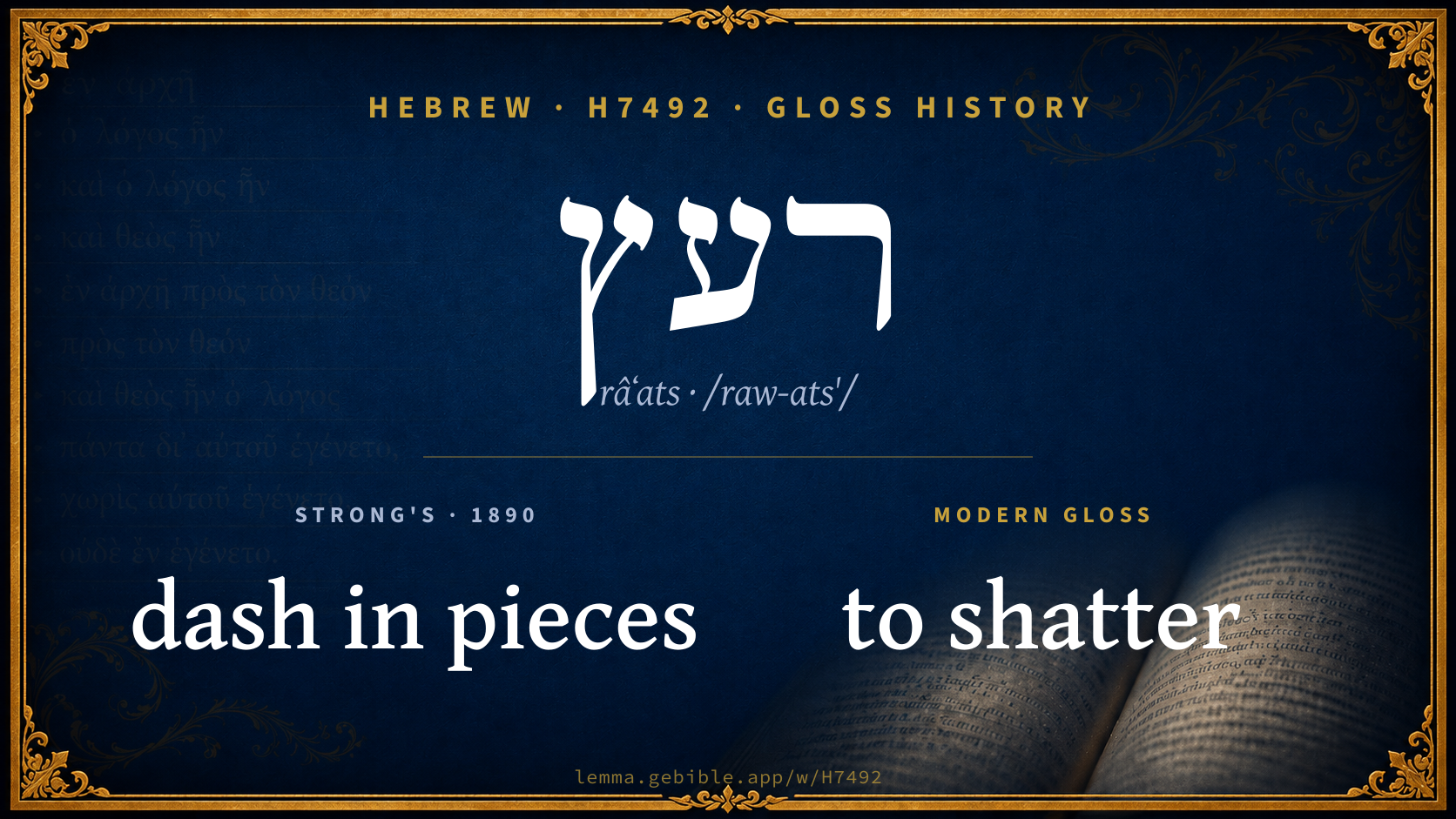
Gloss history
Strong's 1890 vs modern scholarship
About this word
Strong's H7492 catalogs a Hebrew word from the Hebrew Old Testament.
These counts are not copied from any lexicon or concordance. They are computed here, from the morphology-tagged Hebrew Old Testament. What Lemma adds →
- 2
- distinct verses
- The word appears in 2 distinct verses.
- 2 / 39
- OT books
- The word appears in 2 of 39 Old Testament books.
- #4,807
- by frequency
- Top 5000 most frequent Hebrew words (rank 4,807 of 8,640 Hebrew words by occurrence).
View all 2 occurrences in the concordance →
By traditional corpus
Conventional, traditional groupings — biblical authorship is debated, so this is a traditional corpus grouping, not an authorship claim. Each share is this word’s portion of its verses in that division of the Hebrew canon. Each figure is a share of the word’s 2 distinct verses.
- Torah (Pentateuch) 1 verse · 50%
- Prophets (Nevi'im) 1 verse · 50%
How translations render this word
Counts come from each version’s own published word-to-Strong’s tagging or interlinear alignment — an approximate guide to how each version renders this word, not a word-level alignment the data otherwise carries. Because each total is that version’s own tagged count, the per-version totals vary from one another and need not match the appearance or distinct-verse counts above. These counts may also differ from a printed concordance because Lemma counts each distinctly tagged rendering and does not collapse phrase taggings into a single head-word total. This is a fixed set of word-tagged versions (KJV, ASV, BSB, ULT) and does not change with the reading translation you choose elsewhere. Each version’s license is shown beside its name below (and on Sources).
- King James Version: Hath dashed in pieces 1×, They vexed 1×
- American Standard Version: Dasheth in pieces 1×, They vexed 1×
- Berean Standard Bible: Harassed 1×, Has shattered 1×
- unfoldingWord Literal Text: Shatters 1×, They shattered 1×
King James Version Public Domain
Renders H7492 across 2 tagged occurrences — most commonly:
American Standard Version Public Domain
Renders H7492 across 2 tagged occurrences — most commonly:
Berean Standard Bible Public Domain
Renders H7492 across 2 tagged occurrences — most commonly:
unfoldingWord Literal Text CC BY-SA 4.0
Renders H7492 across 2 tagged occurrences — most commonly:
Senses in BDB
The 1 sense BDB distinguishes for this word, in lexicon order (not ranked by frequency or importance). The full entry — with sub-senses — is in the Lexicon Entry tab.
- (Qal) to shatter
Word origin
Origin: a primitive root
Jastrow Dictionary
A second Hebrew/Aramaic lexicon for comparison, covering Aramaic and post-biblical (Talmudic, Targumic, Midrashic) usage that the biblical-Hebrew BDB does not. Matched by lemma rather than by Strong’s number, so a lemma may carry more than one Jastrow headword (shown separately below), and the entries cover usage well beyond the Bible.
רָעַץ
- to break, shatter. Yalk. Ex. 246 (ref. to Ex. XV, 6) רָעַצְתָּ אויב לא וכ׳ it does not read, thou hast shattered the enemy, but, thou wilt shatter, in the future. e.g. Exodus 15:6
רְעַץ
- Targ. Jud. IX, 53 Levita (ed. רָעַת, v. רְעַע).
- to be broken; trnsf. to be broken in, tamed. Targ. Y. Num. XIX, 2 לא אִירְעֲצָא בזקתא not broken in with the goad; [prob. to be read: אִירְצְעָא, v. רְצַע].
רַעַץ
- (preced.) [rugged,] Raʿats, the form of the Samaritan type, opp. אַשּׁוּרִית, q. v. Y. Meg. I, 71ᵇ bot. בר׳ ניתנה התורה the Torah was given in Raʿats characters. Ib. אשורית … נהפך להן לר׳ וכ׳ the Torah was given them in Asshurith, but when they sinned, it was changed for them into Raʿats, and when they improved in Ezra’s days, it was changed &c.; Snh. 22ᵃ לרועץ (Ms. F. לרעוץ, v. Rabb. D. S. a. l. note 200); Tosef. ib. IV, 7 לרועץ; Yalk. Ezra 1069 לרועץ. Y. Meg. I, 71ᶜ top מאן דאמר בר׳ … עי"ן מעשה נסים (not לר׳) according to him who says that the Torah was given in R., the letter ʿAyin (Δ, cut out on the tablets of stone) was a work of miracle (there being no connection left with the body of the stone).—[Ar. quotes a Var. דַּעַץ wedge-like.]
A Dictionary of the Targumim, the Talmud Babli and Yerushalmi, and the Midrashic Literature (Marcus Jastrow; London, Luzac, 1903) — Public Domain. Digitized via Sefaria. Digitized via Sefaria. Full attribution on Sources.
Forms in the corpus
The 2 distinct written forms H7492 takes in the Hebrew Bible, most frequent first — each parse links to that stem’s occurrences in the concordance. Hebrew forms include their vowel points and cantillation, so a single lemma takes many written forms.
| Form | Parsing | Example | Uses |
|---|---|---|---|
| וַֽ/יִּרְעֲצ֤וּ | Verb, Qal, Sequential Imperfect, 3rd Person, Masculine, Plural | Judges 10:8 | 1 |
| תִּרְעַ֥ץ | Verb, Qal, Imperfect, 3rd Person, Feminine, Singular | Exodus 15:6 | 1 |
Septuagint verse parallels
This word appears in 2 verses that also exist in the Greek Old Testament (Septuagint), out of the 2 Hebrew verses it occurs in. You can read those verses in Greek by switching the Old Testament edition to the Septuagint.
Read these verses in the Septuagint
This is a verse-level parallel only — the same verses exist in both the Hebrew and Greek Old Testaments. No word-level Hebrew↔Greek correspondence is claimed: the data carries no such alignment, so no Greek word is shown as this Hebrew word’s translation. Coverage is not total — the Septuagint omits the deuterocanon and renumbers the Psalms, so some Hebrew verses have no direct Greek parallel.