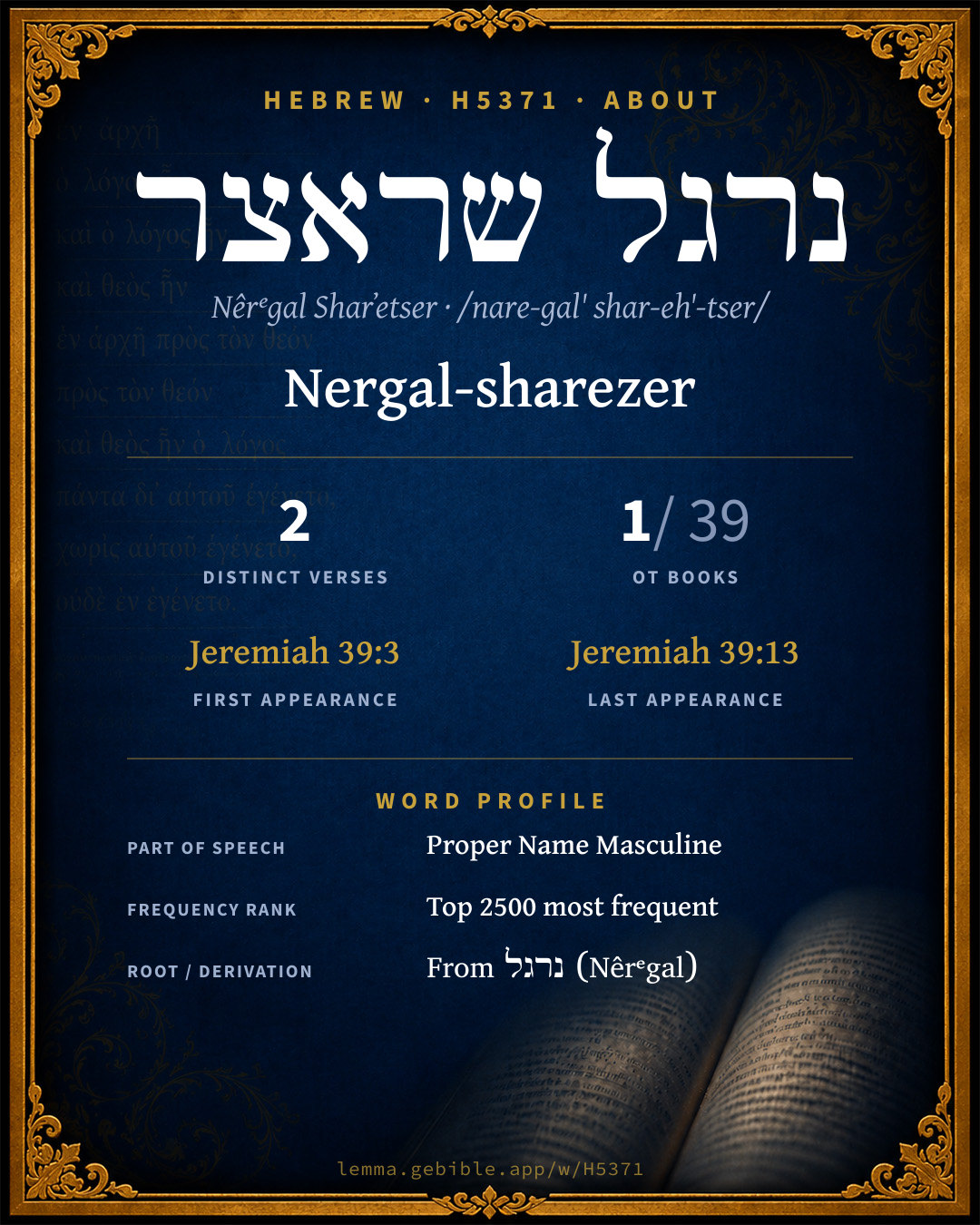
נֵרְגַּל שַׁרְאֶ֫צֶר
Nergal-sharezer
BDB lists 2 entries for ‘Nergal-sharezer’ fuller range ↓
Full lexicon entry — Brown-Driver-Briggs (BDB)
From Brown-Driver-Briggs (BDB)
Where this word appears
Grammar key — what these labels mean
Part of speech
- Noun
- A naming word — a person, place, thing, or idea.
Noun type
- Proper
- A name of a specific person, place, or people (e.g. Abraham, Zion, Israel).
Every verse where H5371 appears — 2 distinct verses across 1 book. Click any verse to open its interlinear word-by-word view. Verse text shown in the World English Bible for context — . Each verse’s Hebrew form is shown with its reference; the English is not keyword-highlighted, since the data carries no word-level English alignment. Use “Compare translations” on any verse to read it across multiple English versions. This concordance covers the Hebrew Bible; Septuagint (Greek Old Testament) occurrences are not indexed here.
Jeremiah 2 verses
- Jeremiah 39:3 נֵרְגַ֣ל שַׂר אֶ֠צֶר נֵרְגַ֤ל שַׂר אֶ֨צֶר֙ n Proper n Proper n Proper n Proper n Proper n Proper that all the princes of the king of Babylon came in, and sat in the middle gate, [to wit], Nergal Sharezer, Samgar-nebo, Sarsechim, Rabsaris, Nergal Sharezer, Rabmag, with all the rest of the princes of the king of Babylon.
- Jeremiah 39:13 וְ/נֵרְגַ֥ל שַׂר אֶ֖צֶר conj + n Proper n Proper n Proper So Nebuzaradan the captain of the guard sent, and Nebushazban, Rabsaris, and Nergal Sharezer, Rabmag, and all the chief officers of the king of Babylon;
About this entry
At a glance — auto-summarized from this page’s data, not written by a person. Every figure links to its source below. This summary describes the numbers; it doesn’t interpret them.
נרגל שראצר (Nêrᵉgal Sharʼetser) is a Hebrew name most often rendered “Nergal-sharezer.” It is rare — just 2 verses in the entire Hebrew Bible. It clusters heavily in Jeremiah, which alone accounts for 100% of its uses. It first appears in Jeremiah 39:3. The sections below give every occurrence and version rendering.
Gloss history
Strong's 1890 vs modern scholarship
About this word
Strong's H5371 catalogs a Hebrew word from the Hebrew Old Testament.
These counts are not copied from any lexicon or concordance. They are computed here, from the morphology-tagged Hebrew Old Testament. What Lemma adds →
- 2
- distinct verses
- The word appears in 2 distinct verses.
- 1 / 39
- OT books
- The word appears in 1 of 39 Old Testament books.
- #2,481
- by frequency
- Top 2500 most frequent Hebrew words (rank 2,481 of 8,640 Hebrew words by occurrence).
View all 2 occurrences in the concordance →
Most concentrated in
- Jeremiah 2 verses 100%
By section of the Old Testament
By traditional corpus
Conventional, traditional groupings — biblical authorship is debated, so this is a traditional corpus grouping, not an authorship claim. Each share is this word’s portion of its verses in that division of the Hebrew canon. Each figure is a share of the word’s 2 distinct verses.
- Prophets (Nevi'im) 2 verses · 100%
How translations render this word
Counts come from each version’s own published word-to-Strong’s tagging or interlinear alignment — an approximate guide to how each version renders this word, not a word-level alignment the data otherwise carries. Because each total is that version’s own tagged count, the per-version totals vary from one another and need not match the appearance or distinct-verse counts above. These counts may also differ from a printed concordance because Lemma counts each distinctly tagged rendering and does not collapse phrase taggings into a single head-word total. This is a fixed set of word-tagged versions (KJV, ASV, BSB, ULT) and does not change with the reading translation you choose elsewhere. Each version’s license is shown beside its name below (and on Sources).
- King James Version: Nergalsharezer 3×
- American Standard Version: Nergal-sharezer 2×
- Berean Standard Bible: Nergal-sharezer 3×
King James Version Public Domain
Renders H5371 across 3 tagged occurrences — most commonly:
American Standard Version Public Domain
Renders H5371 across 3 tagged occurrences — most commonly:
Plus 1 rendering that appears only once — usually multi-word phrases or single function words the recovered tagging swept in, not distinct renderings.
Berean Standard Bible Public Domain
Renders H5371 across 3 tagged occurrences — most commonly:
Senses in BDB
The 2 senses BDB distinguishes for this word, in lexicon order (not ranked by frequency or importance). The full entry — with sub-senses — is in the Lexicon Entry tab.
- Nergal-sharezer = "prince of fire"
- chief soothsayer and a ruler in the army of Nebuchadnezzar
Word origin
Derived from נרגל (Nêrᵉgal) (H5370) — Nergal.
Jastrow Dictionary
A second Hebrew/Aramaic lexicon for comparison, covering Aramaic and post-biblical (Talmudic, Targumic, Midrashic) usage that the biblical-Hebrew BDB does not. Matched by lemma rather than by Strong’s number, so a lemma may carry more than one Jastrow headword (shown separately below), and the entries cover usage well beyond the Bible.
נֵרְגַל
- (b. h.) pr. n. Nergal,
- 1. a deity of the Cutheans (v. Schr. KAT2, p. 282, sq.). Snh. 63ᵇ (quoting II Kings XVII, 30 נרגול), expl. תרנגול a cock; Y. Ab. Zar. III, 42ᵈ top ריגליה דיעקב וריגליה דיוסף וכ׳ Nergal has the meaning of luck in the sense in which the Scripture speaks of the luck of Jacob (Gen. XXX, 27 בגללך, for which לרגלו in verse 30) and the luck of Joseph (ib. XXXIX, 5 בגלל), v. רִגְלָא. e.g. 2 Kings 17:30
- 2. N. Sarezzar, one of the princes of Nebuchadnezzar. Targ. II Esth. I, 2 (3).
נִרְגָּל
- , v. רָגַל
רָגַל
- (b. h.) to move on, run.—[Part. pass., v. רָגוּל.]
- (v. רָגִיל) to be wont to. Nidd. 16ᵇ שרֹ הנִרְגָּל וכ׳ a magistrate (a scholar) who is an habitual visitor of drinking houses; v. רָגַז a. רָגַן.
- 1. (denom. of (denom. of רֶגֶל) to flay an animal from its feet upward (in order to use the skin as a bag, v. חֵמֶת). Ḥull. IX, 3 המַרְגִּיל וכ׳ if one flays from the feet upward, the entire skin is considered as connected (with the flesh, as long as the process lasts) for purposes of levitical cleanness. Tosef. Bets. II, 11 אין מַרְגִּילִין וכ׳ we must not flay from the feet on a Holy Day, nor on a week day when the animal is a firstborn &c.; Bekh. 33ᵃ; Tem. 24ᵃ
- 2. to make familiar, to accustom. Sabb. 13ᵃ שמא יַרְגִּילֶנּוּ אצלו lest he make him accustomed to associate with him. Ib. וכי מַרְגִּילוֹ וכ׳ and if he does accustom him, what of it? Ab. III, 13 שחוק … מַרְגִּילִין וכ׳, v. קַלּוּת; a. e.
- 3. to lead; to persuade. Ber. 60ᵇ ותַרְגִּילֵנִי לידי מצוה ואל תרגילני וכ׳ and lead me into the power (to the opportunity) of good deeds, and lead me not into the power of sin. Ib. שתרגילני בתורתך that thou mayest lead me by thy Law.—Yeb. 85ᵇ זהו מַרְגִּילוֹ וזוהי מַרְגִּילָתוֹ in the one case he leads (persuades) her to marry him, in the other case she persuades him; a. fr.
- 4. to bring about; cause. Ber. 22ᵃ, sq. המרגיל (sub. קרי) who causes an effusion of semen, opp. לאונסו.
- to accustom one’s self, get used to. Y. Sabb. I, 3ᶜ top שהוא מִתְרַגֵּל עמו וכ׳ when he gets used to associate with him when he is unclean himself, he is likely to associate with him when he is clean. Y. Ned. XI, end, 42ᵈ יעשו סעודה והן מִתְרַגְּלִין לַבָּא וכ׳ (some ed. לבוא) let a banquet be arranged, and they (the disaffected couple) will get used in future to associate with each other through the influence of the banquet.
A Dictionary of the Targumim, the Talmud Babli and Yerushalmi, and the Midrashic Literature (Marcus Jastrow; London, Luzac, 1903) — Public Domain. Digitized via Sefaria. Digitized via Sefaria. Full attribution on Sources.
Forms in the corpus
The 7 distinct written forms H5371 takes in the Hebrew Bible, most frequent first — each parse links to that state’s occurrences in the concordance. Hebrew forms include their vowel points and cantillation, so a single lemma takes many written forms.
| Form | Parsing | Example | Uses |
|---|---|---|---|
| שַׂר | Noun, Proper | Jeremiah 39:3 | 3 |
| אֶ֖צֶר | Noun, Proper | Jeremiah 39:13 | 1 |
| אֶ֠צֶר | Noun, Proper | Jeremiah 39:3 | 1 |
| אֶ֨צֶר֙ | Noun, Proper | Jeremiah 39:3 | 1 |
| וְ/נֵרְגַ֥ל | Noun, Proper | Jeremiah 39:13 | 1 |
| נֵרְגַ֣ל | Noun, Proper | Jeremiah 39:3 | 1 |
| נֵרְגַ֤ל | Noun, Proper | Jeremiah 39:3 | 1 |
Bible dictionary
Public-domain dictionary articles matched to this entry by name (Nergal-sharezer). A biblical name can be shared by more than one person or place, so an article may treat several.
Easton's Bible Dictionary · M. G. Easton, 1897
Nergal, protect the king! (1.) One of the "princes of the king of Babylon who accompanied him in his last expedition against Jerusalem" (Jer. 39:3, 13).
(2.) Another of the "princes," who bore the title of "Rabmag." He was one of those who were sent to release Jeremiah from prison (Jer. 39:13) by "the captain of the guard." He was a Babylonian grandee of high rank. From profane history and the inscriptions, we are led to conclude that he was the Neriglissar who murdered Evil-merodach, the son of Nebuchadnezzar, and succeeded him on the throne of Babylon (B.C. 559-556). He was married to a daughter of Nebuchadnezzar. The ruins of a palace, the only one on the right bank of the Euphrates, bear inscriptions denoting that it was built by this king. He was succeeded by his son, a mere boy, who was murdered after a reign of some nine months by a conspiracy of the nobles, one of whom, Nabonadius, ascended the vacant throne, and reigned for a period of seventeen years (B.C. 555-538), at the close of which period Babylon was taken by Cyrus. Belshazzar, who comes into notice in connection with the taking of Babylon, was by some supposed to have been the same as Nabonadius, who was called Nebuchadnezzar's son (Dan. 5:11, 18, 22), because he had married his daughter. But it is known from the inscriptions that Nabonadius had a son called Belshazzar, who may have been his father's associate on the throne at the time of the fall of Babylon, and who therefore would be the grandson of Nebuchadnezzar. The Jews had only one word, usually rendered "father," to represent also such a relationship as that of "grandfather" or "great-grandfather."
Smith's Bible Dictionary · William Smith, 1863
(prince of fire) occurs only in (Jeremiah 39:3) and Jere 39:13 There appear to have been two persons in the name among the "princes of the king of Babylon" who accompanied Nebuchadnezzar on his last expedition against Jerusalem. One of these is not marked by any additional title; but the other has the honorable distinction of Rab-mag, probably meaning chief of the Magi [see RAB-MAG], and it is to him alone that any particular interest attaches. In sacred Scripture he appears among the persons who, by command of Nebuchadnezzar, released Jeremiah from prison. Profane history gives us reason to believe that he was a personage of great importance, who not long afterward mounted the Babylonian throne. He is the same as the monarch called Neriglissar or Neriglissor, who murdered Evil-merodach, the son of Nebuchadnezzar and succeeded him upon the throne. His reign lasted from B.C. 559, to B.C. 556.
Hitchcock's Bible Names Dictionary · Roswell D. Hitchcock, 1869
treasurer of Nergal
Classic public-domain reference works; full attribution on Sources.
Septuagint verse parallels
This word appears in 2 verses that also exist in the Greek Old Testament (Septuagint), out of the 2 Hebrew verses it occurs in. You can read those verses in Greek by switching the Old Testament edition to the Septuagint.
Read these verses in the Septuagint
This is a verse-level parallel only — the same verses exist in both the Hebrew and Greek Old Testaments. No word-level Hebrew↔Greek correspondence is claimed: the data carries no such alignment, so no Greek word is shown as this Hebrew word’s translation. Coverage is not total — the Septuagint omits the deuterocanon and renumbers the Psalms, so some Hebrew verses have no direct Greek parallel.