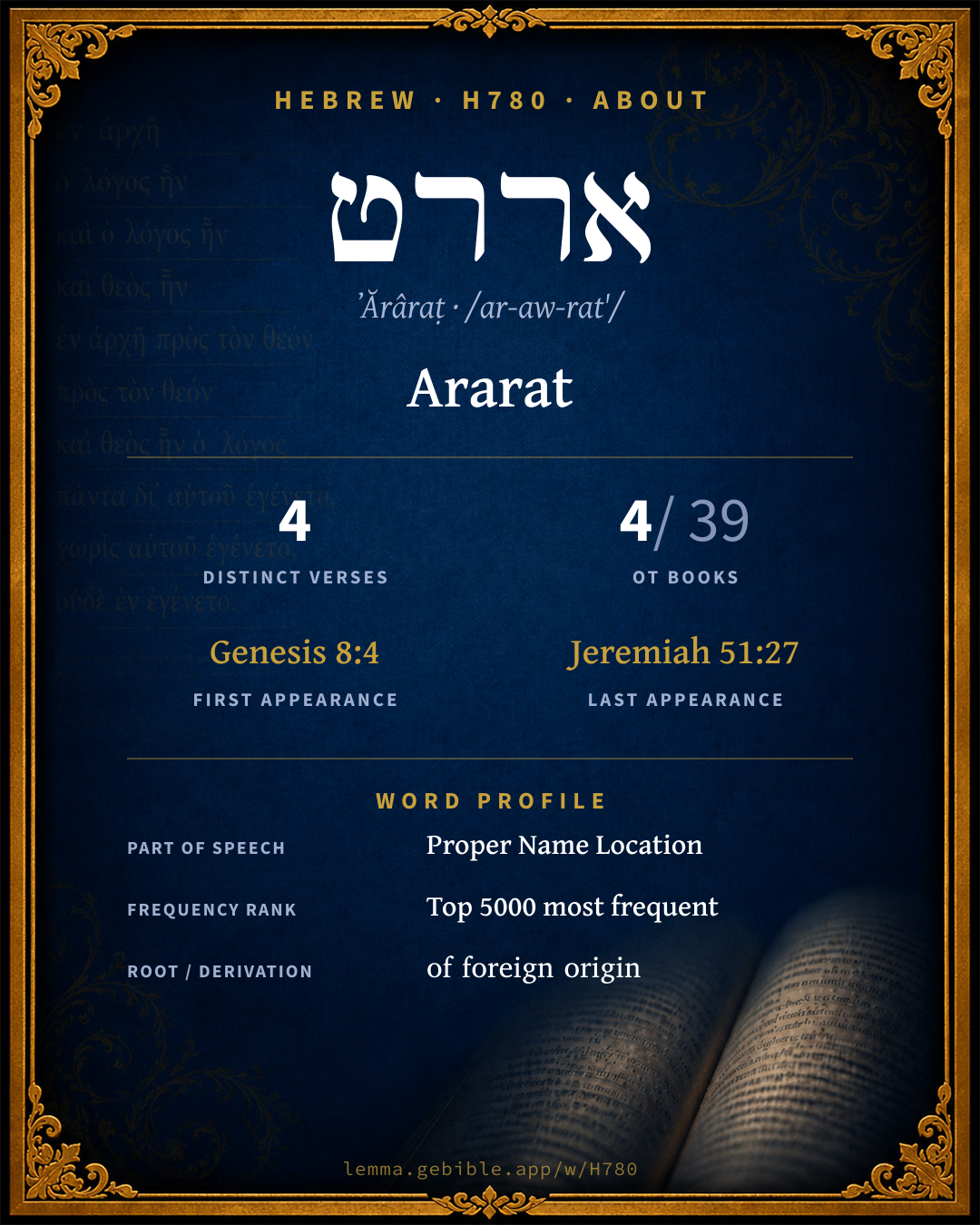
אֲרָרַט
Ararat
BDB lists 3 entries for ‘Ararat’ fuller range ↓
Full lexicon entry — Brown-Driver-Briggs (BDB)
From Brown-Driver-Briggs (BDB)
Where this word appears
Grammar key — what these labels mean
Part of speech
- Noun
- A naming word — a person, place, thing, or idea.
Noun type
- Proper
- A name of a specific person, place, or people (e.g. Abraham, Zion, Israel).
Every verse where H780 appears — 4 distinct verses across 4 books. Click any verse to open its interlinear word-by-word view. Verse text shown in the World English Bible for context — . Each verse’s Hebrew form is shown with its reference; the English is not keyword-highlighted, since the data carries no word-level English alignment. Use “Compare translations” on any verse to read it across multiple English versions. This concordance covers the Hebrew Bible; Septuagint (Greek Old Testament) occurrences are not indexed here.
Genesis 1 verse
2 Kings 1 verse
Isaiah 1 verse
Jeremiah 1 verse
About this entry
At a glance — auto-summarized from this page’s data, not written by a person. Every figure links to its source below. This summary describes the numbers; it doesn’t interpret them.
At its core, אררט (ʼĂrâraṭ) means “Ararat.” It occurs a mere 4 verses across Scripture. The word gravitates to Genesis (25%), then 2 Kings and Isaiah. Scripture first uses it in Genesis 8:4. Dig into 4-verse concordance and the renderings breakdown below.
Gloss history
Strong's 1890 vs modern scholarship
About this word
Strong's H780 catalogs a Hebrew word from the Hebrew Old Testament.
These counts are not copied from any lexicon or concordance. They are computed here, from the morphology-tagged Hebrew Old Testament. What Lemma adds →
- 4
- distinct verses
- The word appears in 4 distinct verses.
- 4 / 39
- OT books
- The word appears in 4 of 39 Old Testament books.
- #3,696
- by frequency
- Top 5000 most frequent Hebrew words (rank 3,696 of 8,640 Hebrew words by occurrence).
View all 4 occurrences in the concordance →
By section of the Old Testament
By traditional corpus
Conventional, traditional groupings — biblical authorship is debated, so this is a traditional corpus grouping, not an authorship claim. Each share is this word’s portion of its verses in that division of the Hebrew canon. Each figure is a share of the word’s 4 distinct verses.
- Prophets (Nevi'im) 3 verses · 75%
- Torah (Pentateuch) 1 verse · 25%
How translations render this word
Counts come from each version’s own published word-to-Strong’s tagging or interlinear alignment — an approximate guide to how each version renders this word, not a word-level alignment the data otherwise carries. Because each total is that version’s own tagged count, the per-version totals vary from one another and need not match the appearance or distinct-verse counts above. These counts may also differ from a printed concordance because Lemma counts each distinctly tagged rendering and does not collapse phrase taggings into a single head-word total. This is a fixed set of word-tagged versions (KJV, ASV, BSB, ULT) and does not change with the reading translation you choose elsewhere. Each version’s license is shown beside its name below (and on Sources).
- King James Version: Ararat 2×, Armenia 2×
- American Standard Version: Ararat 4×
- Berean Standard Bible: Ararat 4×
- unfoldingWord Literal Text: Ararat 3×
King James Version Public Domain
Renders H780 across 4 tagged occurrences — most commonly:
American Standard Version Public Domain
Renders H780 across 4 tagged occurrences — most commonly:
Berean Standard Bible Public Domain
Renders H780 across 4 tagged occurrences — most commonly:
unfoldingWord Literal Text CC BY-SA 4.0
Renders H780 across 3 tagged occurrences — most commonly:
Senses in BDB
The 3 senses BDB distinguishes for this word, in lexicon order (not ranked by frequency or importance). The full entry — with sub-senses — is in the Lexicon Entry tab.
- Ararat = "the curse reversed: precipitation of curse"
- a mountainous region of eastern Armenia…
- (TWOT) the mountain where Noah's ark came to rest
Word origin
n.pr.terr. Ararat (Assyrian Urarṭu COTGloss, cf. LagArmen. Stud. § 100)—א׳ Je 51:27; אֲרָרָ֑ט Gn 8:4 + 3 times—a district in Eastern Armenia between the river Araxes & lakes Van & Oroomiah, cf. KGF; to this prob. ref. in 2 K 19:37 = Is 37:38 אֶרֶץ א׳; also Gn 8:4 הָרֵי א׳, where the ark rested; used perhaps with wider ref. Je 51:27 מַמְלְכוֹת א׳ (‖ מִנִּי, אַשְׁכְּנַז).
— Brown-Driver-Briggs (Oxford 1906, public domain), digitized via Sefaria, supplemented by the OpenScriptures HebrewLexicon (CC BY 4.0). See Sources.
Origin: of foreign origin
Forms in the corpus
The 3 distinct written forms H780 takes in the Hebrew Bible, most frequent first — each parse links to that state’s occurrences in the concordance. Hebrew forms include their vowel points and cantillation, so a single lemma takes many written forms.
| Form | Parsing | Example | Uses |
|---|---|---|---|
| אֲרָרָ֑ט | Noun, Proper | 2 Kings 19:37 | 2 |
| אֲרָרַ֖ט | Noun, Proper | Jeremiah 51:27 | 1 |
| אֲרָרָֽט | Noun, Proper | Genesis 8:4 | 1 |
Bible dictionary
Public-domain dictionary articles matched to this entry by name (Ararat). A biblical name can be shared by more than one person or place, so an article may treat several.
Easton's Bible Dictionary · M. G. Easton, 1897
Sacred land or high land, the name of a country on one of the mountains of which the ark rested after the Flood subsided (Gen. 8:4). The "mountains" mentioned were probably the Kurdish range of South Armenia. In 2 Kings 19:37, Isa. 37:38, the word is rendered "Armenia" in the Authorized Version, but in the Revised Version, "Land of Ararat." In Jer. 51:27, the name denotes the central or southern portion of Armenia. It is, however, generally applied to a high and almost inaccessible mountain which rises majestically from the plain of the Araxes. It has two conical peaks, about 7 miles apart, the one 14,300 feet and the other 10,300 feet above the level of the plain. Three thousand feet of the summit of the higher of these peaks is covered with perpetual snow. It is called Kuh-i-nuh, i.e., "Noah's mountain", by the Persians. This part of Armenia was inhabited by a people who spoke a language unlike any other now known, though it may have been related to the modern Georgian. About B.C. 900 they borrowed the cuneiform characters of Nineveh, and from this time we have inscriptions of a line of kings who at times contended with Assyria. At the close of the seventh century B.C. the kingdom of Ararat came to an end, and the country was occupied by a people who are ancestors of the Armenians of the present day.
Hitchcock's Bible Names Dictionary · Roswell D. Hitchcock, 1869
the curse of trembling
Classic public-domain reference works; full attribution on Sources.
Septuagint verse parallels
This word appears in 4 verses that also exist in the Greek Old Testament (Septuagint), out of the 4 Hebrew verses it occurs in. You can read those verses in Greek by switching the Old Testament edition to the Septuagint.
Read these verses in the Septuagint
This is a verse-level parallel only — the same verses exist in both the Hebrew and Greek Old Testaments. No word-level Hebrew↔Greek correspondence is claimed: the data carries no such alignment, so no Greek word is shown as this Hebrew word’s translation. Coverage is not total — the Septuagint omits the deuterocanon and renumbers the Psalms, so some Hebrew verses have no direct Greek parallel.