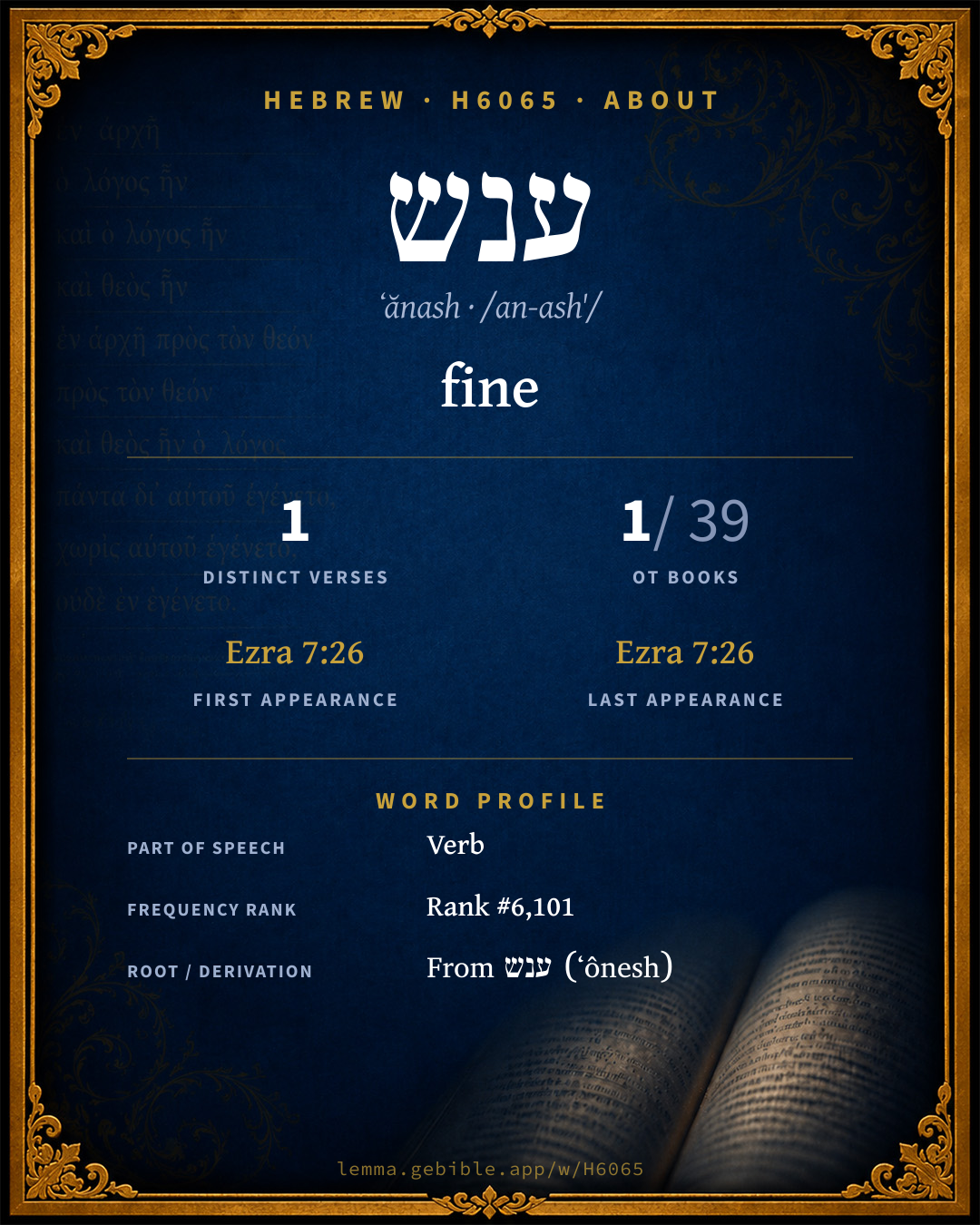
עֲנָשׁ
fine
‘fine’ is one of 2 main senses fuller range ↓
Full lexicon entry — Brown-Driver-Briggs (BDB)
From Brown-Driver-Briggs (BDB)
Where this word appears
Grammar key — what these labels mean
Noun type
- Common
- A common noun — a general class of person, place, or thing (“king,” “city,” “water”), not a specific name.
State
- Construct
- A noun bound to a following noun in a possessive / “of” relationship (the construct chain).
Gender
- Masculine
- Grammatically masculine.
Number
- Singular
- One.
Every verse where H6065 appears — 1 distinct verse across 1 book. Click any verse to open its interlinear word-by-word view. Verse text shown in the World English Bible for context — . Each verse’s Hebrew form is shown with its reference; the English is not keyword-highlighted, since the data carries no word-level English alignment. Use “Compare translations” on any verse to read it across multiple English versions. This concordance covers the Hebrew Bible; Septuagint (Greek Old Testament) occurrences are not indexed here.
Ezra 1 verse
About this entry
At a glance — auto-summarized from this page’s data, not written by a person. Every figure links to its source below. This summary describes the numbers; it doesn’t interpret them.
The Hebrew verb ענש centers on the idea of “fine.” A scarce word — 1 verse in all of the Hebrew Bible. Ezra dominates its distribution — 1 of 1 verses. Found nowhere else but Ezra 7:26. Lexicons map it across 2 senses. For the data behind this summary, explore the sense tree and the renderings breakdown below.
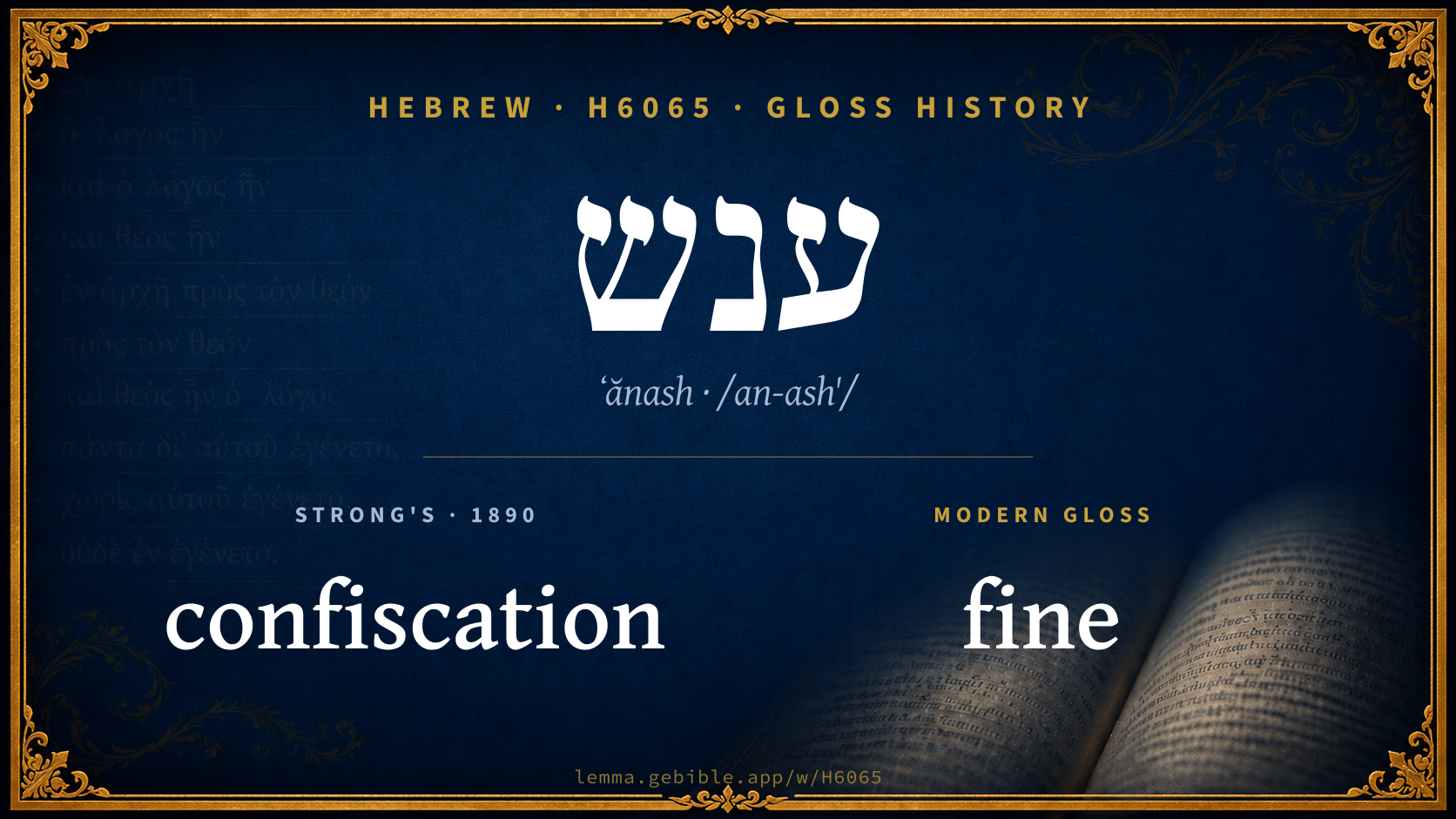
Gloss history
Strong's 1890 vs modern scholarship
About this word
Strong's H6065 catalogs a Hebrew word from the Hebrew Old Testament.
These counts are not copied from any lexicon or concordance. They are computed here, from the morphology-tagged Hebrew Old Testament. What Lemma adds →
- 1
- distinct verses
- The word appears in 1 distinct verse.
- 1 / 39
- OT books
- The word appears in 1 of 39 Old Testament books.
- #6,101
- by frequency
- Rank #6,101 (rank 6,101 of 8,640 Hebrew words by occurrence).
View all 1 occurrence in the concordance →
Most concentrated in
- Ezra 1 verse 100%
By section of the Old Testament
By traditional corpus
Conventional, traditional groupings — biblical authorship is debated, so this is a traditional corpus grouping, not an authorship claim. Each share is this word’s portion of its verses in that division of the Hebrew canon. Each figure is a share of the word’s 1 distinct verse.
- Writings (Ketuvim) 1 verse · 100%
How translations render this word
Counts come from each version’s own published word-to-Strong’s tagging or interlinear alignment — an approximate guide to how each version renders this word, not a word-level alignment the data otherwise carries. Because each total is that version’s own tagged count, the per-version totals vary from one another and need not match the appearance or distinct-verse counts above. These counts may also differ from a printed concordance because Lemma counts each distinctly tagged rendering and does not collapse phrase taggings into a single head-word total. This is a fixed set of word-tagged versions (KJV, ASV, BSB, ULT) and does not change with the reading translation you choose elsewhere. Each version’s license is shown beside its name below (and on Sources).
- King James Version: Confiscation 1×
- American Standard Version: Confiscation 1×
- Berean Standard Bible: Confiscation 1×
- unfoldingWord Literal Text: Confiscation of 1×
King James Version Public Domain
Renders H6065 across 1 tagged occurrence — most commonly:
American Standard Version Public Domain
Renders H6065 across 1 tagged occurrence — most commonly:
Berean Standard Bible Public Domain
Renders H6065 across 1 tagged occurrence — most commonly:
unfoldingWord Literal Text CC BY-SA 4.0
Renders H6065 across 1 tagged occurrence — most commonly:
Senses in BDB
The 2 senses BDB distinguishes for this word, in lexicon order (not ranked by frequency or importance). The full entry — with sub-senses — is in the Lexicon Entry tab.
- (CLBL) to fine
- (BDB/TWOT) confiscation, fining, amercing
Word origin
עֲנָשׁ n.[m.] amercing, confiscation;—cstr. Ezr 7:26.
— Brown-Driver-Briggs (Oxford 1906, public domain), digitized via Sefaria, supplemented by the OpenScriptures HebrewLexicon (CC BY 4.0). See Sources.
Derived from ענש (ʻônesh) (H6066) — penalty.
Jastrow Dictionary
A second Hebrew/Aramaic lexicon for comparison, covering Aramaic and post-biblical (Talmudic, Targumic, Midrashic) usage that the biblical-Hebrew BDB does not. Matched by lemma rather than by Strong’s number, so a lemma may carry more than one Jastrow headword (shown separately below), and the entries cover usage well beyond the Bible.
עָנַשׁ
- [to press,] to punish, fine. Zeb. 106ᵇ, a. e., לא ע׳ וכ׳, v. זָהַר. Snh. 54ᵃ, a. fr. אין עוֹנְשִׁין מן הדין, v. דִּין II.—Ib. 43ᵇ לא ע׳ על הנסתרות the Lord did not punish undiscovered transgressions (committed in Israel’s camps). Ib. 54ᵇ ע׳ והזהיר the text defines the penalty, and forbids the act; a. fr.—Part. pass. עָנוּשׁ punishable. Yeb. 47ᵃ ע׳ כרת doomed to extinction; ע׳ סקילה doomed to death by stoning; a. e.
- to be punished; to suffer. Sabb. 56ᵃ; Kidd. 43ᵃ (ref. to II Sam. XII, 9) מה חרב … אין אתה נ׳ עליו וכ׳ as well as thou art not to be punished for the use of the sword against the sons of Ammon, so shalt thou not be punished for the death of Uriah the Hittite. Sabb. 149ᵇ כל שחבירו נ׳ על ידו וכ׳ he through whose instrumentality a fellowman was punished (who was instrumental in causing a fellowman to sin), will not be entered within the precincts of the Lord. Yoma 22ᵇ מפני מה נ׳ שאול for what sin was Saul made to suffer? R. Hash. 16ᵇ; B. Kam. 93ᵃ, a. e. המוסר … הוא נ׳ תחלה he who appeals to the Lord for judgment against his neighbor, will himself be the first to be punished. Snh. 8ᵃ על דבר זה נ׳ משה for saying this (‘you shall bring to me’, Deut. I, 17) Moses had to suffer (by being compelled to admit his own incapability, Num. XXVII, 5); a. fr. e.g. 2 Samuel 12:9
עֲנַשׁ
- Men. 41ᵃ עַנְשִׁיתוּ אעשה do you (in heaven) punish a sin of omission? בזמן דאיכא ריתחא עַנְשִׁינָן when there is a time of divine anger, we do punish.
- to be punished. Erub. 63ᵃ ואי׳ רבי וכ׳ and R. Elazar … was punished (came to grief). Ib. bot. אפ"ה אי׳ nevertheless he came to grief (was degraded). Succ. 51ᵇ מ"ט אִיעַנְּשׁוּ why were they punished (to suffer execution under Hadrian)? Snh. 43ᵇ ועד השתא מ"ט לא אִיעֲנוּשׁ and up to that time why were they (the Israelites) not punished (for Achan’s misdeeds)? Ib. 44ᵃ top עכן מ"ט איענוש (supply עליה) why were they punished for Achan’s (undiscovered) sin?; Yalk. Josh. 18 עכן מ"ט איענש why was Achan’s sin visited (upon the people)? Bets. 16ᵃ לא לִיעַנְּשׁוּ וכ׳ (not לע׳) let gentiles not be punished for neglecting it; a. fr.
עֹנֶשׁ
- , v. עוֹנֶשׁ
עֲנָשׁ
- constr. = h. עוֹנֶשׁ, fine, confiscation. Ezra VII, 26, quot. M. Kat. 16ᵃ e.g. Ezra 7:26
A Dictionary of the Targumim, the Talmud Babli and Yerushalmi, and the Midrashic Literature (Marcus Jastrow; London, Luzac, 1903) — Public Domain. Digitized via Sefaria. Digitized via Sefaria. Full attribution on Sources.
Septuagint verse parallels
This word appears in 1 verse that also exists in the Greek Old Testament (Septuagint), out of the 1 Hebrew verse it occurs in. You can read those verses in Greek by switching the Old Testament edition to the Septuagint.
Read these verses in the Septuagint
This is a verse-level parallel only — the same verses exist in both the Hebrew and Greek Old Testaments. No word-level Hebrew↔Greek correspondence is claimed: the data carries no such alignment, so no Greek word is shown as this Hebrew word’s translation. Coverage is not total — the Septuagint omits the deuterocanon and renumbers the Psalms, so some Hebrew verses have no direct Greek parallel.