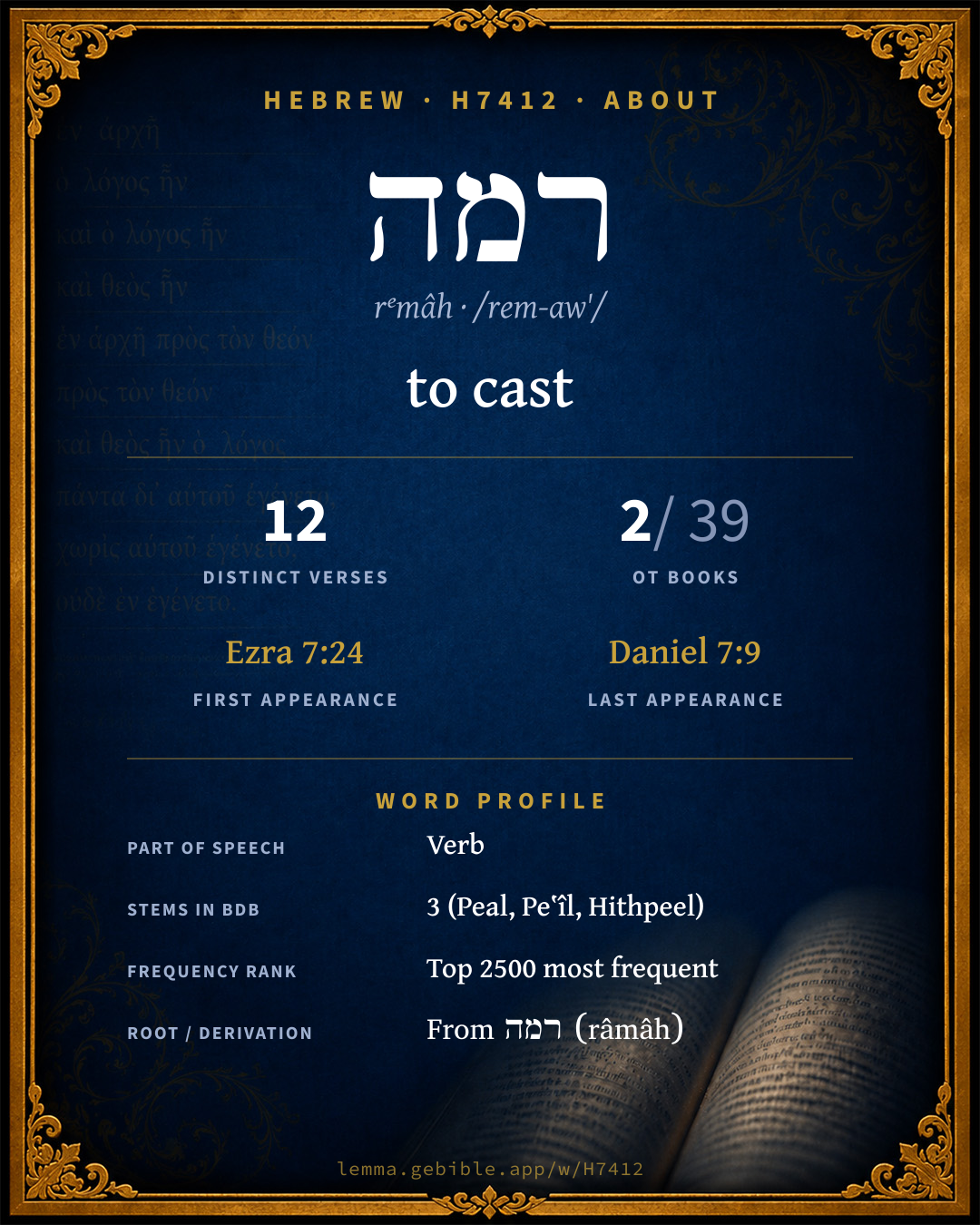
רְמָא
to cast
‘to cast’ is one of 2 main senses fuller range ↓
Full lexicon entry — Brown-Driver-Briggs (BDB)
From Brown-Driver-Briggs (BDB)
Where this word appears
See every Hothpaal verb in the Hebrew Bible →
Grammar key — what these labels mean
Part of speech
- Verb
- An action or state-of-being word.
Stem
- Qal
- The basic, simple active stem — the plain form of the verb (“he wrote”).
- Qal Passive
- An archaic passive of the Qal, preserved in a few forms.
Form
- Imperfect
- An incomplete, ongoing, or future action (“he will / would write”).
- Infinitive Construct
- A bound verbal noun, frequently with prepositions (“to write / in writing”).
- Perfect
- A completed action or state — Hebrew marks aspect (completeness) more than strict tense (“he wrote”).
Person
- 3rd Person
- The one spoken about (“he / she / it / they”).
- 1st Person
- The speaker (“I / we”).
- 2nd Person
- The one addressed (“you”).
Gender
- Masculine
- Grammatically masculine.
- Common
- Either gender — not distinguished for this form.
Number
- Singular
- One.
- Plural
- More than one (in Hebrew, generally three or more).
Grammatical forms
- Verb, Hothpaal, Imperfect, 3rd Person, Masculine, Singular 4 times (33%)
- Verb, Qal, Infinitive Construct 2 times (17%)
- Verb, Qal Passive, Perfect, 3rd Person, Masculine, Plural 2 times (17%)
- Verb, Qal, Perfect, 3rd Person, Masculine, Plural 2 times (17%)
- Verb, Qal, Perfect, 1st Person, Common, Plural 1 time (8%)
- Verb, Hothpaal, Imperfect, 2nd Person, Masculine, Plural 1 time (8%)
Parsed forms decoded from the imported morphology (morphhb / Westminster Leningrad Codex — WLC text public domain, morphhb tagging CC BY 4.0), counted across 12 parsed occurrences — not distinct verses.
Every verse where H7412 appears — 12 distinct verses across 2 books. Click any verse to open its interlinear word-by-word view. Verse text shown in the World English Bible for context — . Each verse’s Hebrew form is shown with its reference; the English is not keyword-highlighted, since the data carries no word-level English alignment. Use “Compare translations” on any verse to read it across multiple English versions. This concordance covers the Hebrew Bible; Septuagint (Greek Old Testament) occurrences are not indexed here.
Ezra 1 verse
Daniel 11 verses
- Daniel 3:6 יִתְרְמֵ֔א Hothpaal impf 3ms and whoever doesn't fall down and worships shall the same hour be cast into the midst of a burning fiery furnace.
- Daniel 3:11 יִתְרְמֵ֕א Hothpaal impf 3ms and whoever doesn't fall down and worship shall be cast into the midst of a burning fiery furnace.
- Daniel 3:15 תִתְרְמ֔וֹן Hothpaal impf 2mp Now if you are ready whenever you hear the sound of the horn, flute, zither, lyre, harp, pipe, and all kinds of music to you fall down and worship the image which I have made, [well]: but if you don't worship, you shall be cast the same hour into the midst of a burning fiery furnace; and who is that god that shall deliver you out of my hands?
- Daniel 3:20 לְ/מִרְמֵ֕א prep + Qal inf.cs He commanded certain mighty men who were in his army to bind Shadrach, Meshach, and Abednego, [and] to cast them into the burning fiery furnace.
- Daniel 3:21 וּ/רְמִ֕יו conj + Qal Passive pf 3mp Then these men were bound in their pants, their tunics, and their mantles, and their [other] garments, and were cast into the midst of the burning fiery furnace.
- Daniel 3:24 רְמֵ֤ינָא Qal pf 1cp Then Nebuchadnezzar the king was astonished, and rose up in haste: he spoke and said to his counselors, Didn't we cast three men bound into the midst of the fire? They answered the king, True, O king.
- Daniel 6:7 יִתְרְמֵ֕א Hothpaal impf 3ms All the presidents of the kingdom, the deputies and the satraps, the counselors and the governors, have consulted together to establish a royal statute, and to make a strong interdict, that whoever shall ask a petition of any god or man for thirty days, save of you, O king, he shall be cast into the den of lions.
- Daniel 6:12 יִתְרְמֵ֕א Hothpaal impf 3ms Then they came near, and spoke before the king concerning the king's interdict: Haven't you signed an interdict, that every man who shall make petition to any god or man within thirty days, save to you, O king, shall be cast into the den of lions? The king answered, The thing is true, according to the law of the Medes and Persians, which doesn't alter.
- Daniel 6:16 וּ/רְמ֕וֹ conj + Qal pf 3mp Then the king commanded, and they brought Daniel, and cast him into the den of lions. [Now] the king spoke and said to Daniel, Your God whom you serve continually, he will deliver you.
- Daniel 6:24 רְמ֔וֹ Qal pf 3mp The king commanded, and they brought those men who had accused Daniel, and they cast them into the den of lions, them, their children, and their wives; and the lions had the mastery of them, and broke all their bones in pieces, before they came to the bottom of the den.
- Daniel 7:9 רְמִ֔יו Qal Passive pf 3mp I saw until thrones were placed, and one who was ancient of days sat: his clothing was white as snow, and the hair of his head like pure wool; his throne was fiery flames, [and] the wheels of it burning fire.
About this entry
At a glance — auto-summarized from this page’s data, not written by a person. Every figure links to its source below. This summary describes the numbers; it doesn’t interpret them.
רמה (rᵉmâh) is a Hebrew verb most often rendered “to cast.” It clusters heavily in Daniel, which alone accounts for 92% of its uses. With 12 verses in 2 books, it is an uncommon word in the Hebrew Bible. Debuting at Ezra 7:24, it then recurs through the corpus. Across 3 stems, its meaning turns on the binyan (Peal, Pe‛îl). For the data behind this summary, explore the sense tree and the renderings breakdown below.
Gloss history
Strong's 1890 vs modern scholarship
About this word
Strong's H7412 catalogs a Hebrew word from the Hebrew Old Testament.
These counts are not copied from any lexicon or concordance. They are computed here, from the morphology-tagged Hebrew Old Testament. What Lemma adds →
- 12
- distinct verses
- The word appears in 12 distinct verses.
- 2 / 39
- OT books
- The word appears in 2 of 39 Old Testament books.
- #2,101
- by frequency
- Top 2500 most frequent Hebrew words (rank 2,101 of 8,640 Hebrew words by occurrence).
View all 12 occurrences in the concordance →
By traditional corpus
Conventional, traditional groupings — biblical authorship is debated, so this is a traditional corpus grouping, not an authorship claim. Each share is this word’s portion of its verses in that division of the Hebrew canon. Each figure is a share of the word’s 12 distinct verses.
- Writings (Ketuvim) 12 verses · 100%
How translations render this word
Counts come from each version’s own published word-to-Strong’s tagging or interlinear alignment — an approximate guide to how each version renders this word, not a word-level alignment the data otherwise carries. Because each total is that version’s own tagged count, the per-version totals vary from one another and need not match the appearance or distinct-verse counts above. These counts may also differ from a printed concordance because Lemma counts each distinctly tagged rendering and does not collapse phrase taggings into a single head-word total. This is a fixed set of word-tagged versions (KJV, ASV, BSB, ULT) and does not change with the reading translation you choose elsewhere. Each version’s license is shown beside its name below (and on Sources).
- King James Version: Cast 2×
- American Standard Version: Cast 2×, Shall be cast 2×
- Berean Standard Bible: Will be thrown 3×
- unfoldingWord Literal Text: Will be thrown 2×
King James Version Public Domain
Renders H7412 across 12 tagged occurrences — most commonly:
Plus 10 renderings that appear only once — usually multi-word phrases or single function words the recovered tagging swept in, not distinct renderings.
American Standard Version Public Domain
Renders H7412 across 12 tagged occurrences — most commonly:
Plus 8 renderings that appear only once — usually multi-word phrases or single function words the recovered tagging swept in, not distinct renderings.
Berean Standard Bible Public Domain
Renders H7412 across 12 tagged occurrences — most commonly:
Plus 9 renderings that appear only once — usually multi-word phrases or single function words the recovered tagging swept in, not distinct renderings.
unfoldingWord Literal Text CC BY-SA 4.0
Renders H7412 across 14 tagged occurrences — most commonly:
Plus 12 renderings that appear only once — usually multi-word phrases or single function words the recovered tagging swept in, not distinct renderings.
Senses in the full BDB
Hebrew verbs can shift meaning by stem (binyan): Qal is the basic action, Niphal is often passive or reflexive, Piel often intensifies or makes it factitive, and Hiphil is typically causative. The senses below are grouped under the stem BDB assigns to each. This entry also uses Peal (the basic Aramaic stem, parallel to Qal), Peil (the passive Aramaic stem), and Hithpeel (the reflexive or passive Aramaic stem).
What do BDB’s symbols mean?
BDB uses these scholarly abbreviations:
| Symbol | Meaning |
|---|---|
| 𝔊 | the Septuagint (the ancient Greek translation, LXX) |
| 𝔙 | the Vulgate (the Latin translation) |
| 𝔖 | the Syriac version (the Peshitta) |
| 𝔗 | the Targum (the Aramaic translation) |
| ψ | the Psalms |
| √ | root (the underlying root or stem) |
| ‖ | parallel passage (a synonymous or contrasted parallel) |
| † | the dagger: every passage where the word occurs is cited |
The 5 senses and sub-senses the full Brown-Driver-Briggs lexicon distinguishes for this word, in lexicon order (not ranked by frequency), with BDB’s own verbatim wording and sub-sense lettering. Shown in Hebrew script with BDB’s own scholarly abbreviations. The condensed entry is in the Lexicon Entry tab. See also the Forms in the corpus table below.
Peal
- 1. cast
- 2. fig. throw (burden of) tribute
Pe‛îl
- 1. were cast
- 2. were placed, set
Hithpeel
- . be cast
Senses from the full Brown-Driver-Briggs lexicon (Brown, Driver, Briggs; Oxford 1906 — public domain), digitized via Sefaria, supplemented by the OpenScriptures HebrewLexicon (CC BY 4.0). Full attribution on Sources.
Word origin
[ רְמָא ] vb. cast, throw
— Brown-Driver-Briggs (Oxford 1906, public domain), digitized via Sefaria, supplemented by the OpenScriptures HebrewLexicon (CC BY 4.0). See Sources.
Derived from רמה (râmâh) (H7411) — to throw.
Jastrow Dictionary
A second Hebrew/Aramaic lexicon for comparison, covering Aramaic and post-biblical (Talmudic, Targumic, Midrashic) usage that the biblical-Hebrew BDB does not. Matched by lemma rather than by Strong’s number, so a lemma may carry more than one Jastrow headword (shown separately below), and the entries cover usage well beyond the Bible.
רָמָה I
- 1. high, v. רָם.
- 2. height.—Pl. רָמוֹת. Meg. 14ᵃ, v. צָפָה.
רָמָה II
- , v. רמי
רִמָּה
- רמם to move; cmp. רחש a. deriv.) worm, esp. the worm in man’s grave. Ber. 18ᵇ קשׁה ר׳ למת וכ׳ the worm is as painful to the dead body as a needle in sound flesh. Sot. 5ᵃ (play on בֹשרֹ) ב̇ושה סֹרוחה ר̇ basar (flesh) suggests ‘shame’, ‘putrefied’, ‘worm’. B. Mets. 83ᵇ אין ר׳ ותולעה וכ׳ no worm of any kind shall have power over you. Ab. IV, 4 תקות אנוש ר׳ the prospects of man are worms. Koh. R. to V, 10 הרי הוא לר׳ ותולעה he is (food) for worms; a. fr.—Pesik. Vayhi, p. 93ᵇ (in Chald. dict.) דהדין גופא אזל לר׳ that this (my) body must go to the worms; Koh. R. to XI, 2 לאדמה (corr. acc.); ib. ברם ר׳ לית וכ׳ but worms shall have no power over me except &c.
רמי
- (b. h.) [to move,] to throw, swing. Mekh. B’shall., Shir., s. 2 (ref. to Ex. XV, 1 a. 4) ר׳ שהיו עולין למרום וכ׳ ramah means that they were hurled upward, yarah, that they were thrown down the deep. e.g. Exodus 15:1
- to impose upon, deceive; to be cunning. Y. Hor. III, 48ᵃ bot. (he was no deceiver) אלא שהיה מְרַמֶּה במצות but he was cunning in charitable deeds (waited until others had subscribed, and then gave as much as all of them combined); Deut. R. s. 4; Tanḥ. R’eh 5. Gen. R. s. 85 אתה רִמִּיתָ באביך בגדי … שתמר מְרַמָּה בך וכ׳ thou (Judah) didst deceive thy father by means of a kid (Gen. XXXVII, 31); by thy life! Tamar shall deceive thee through a kid (ib. XXXVIII, 20); Yalk. ib. 145 לאביך … לך; a. e.—Part. pass. מְרוּמֶּה. Snh. 32ᵇ, a. e. דין מ׳, v. דִּין II e.g. Genesis 37:31
A Dictionary of the Targumim, the Talmud Babli and Yerushalmi, and the Midrashic Literature (Marcus Jastrow; London, Luzac, 1903) — Public Domain. Digitized via Sefaria. Digitized via Sefaria. Full attribution on Sources.
Forms in the corpus
The 10 distinct written forms H7412 takes in the Hebrew Bible, most frequent first — each parse links to that stem’s occurrences in the concordance. Hebrew forms include their vowel points and cantillation, so a single lemma takes many written forms.
| Form | Parsing | Example | Uses |
|---|---|---|---|
| יִתְרְמֵ֕א | Verb, Hothpaal, Imperfect, 3rd Person, Masculine, Singular | Daniel 3:11 | 3 |
| וּ/רְמ֕וֹ | Verb, Qal, Perfect, 3rd Person, Masculine, Plural | Daniel 6:16 | 1 |
| וּ/רְמִ֕יו | Verb, Qal Passive, Perfect, 3rd Person, Masculine, Plural | Daniel 3:21 | 1 |
| יִתְרְמֵ֔א | Verb, Hothpaal, Imperfect, 3rd Person, Masculine, Singular | Daniel 3:6 | 1 |
| לְ/מִרְמֵ֕א | Verb, Qal, Infinitive Construct | Daniel 3:20 | 1 |
| לְ/מִרְמֵ֥א | Verb, Qal, Infinitive Construct | Ezra 7:24 | 1 |
| רְמ֔וֹ | Verb, Qal, Perfect, 3rd Person, Masculine, Plural | Daniel 6:24 | 1 |
| רְמִ֔יו | Verb, Qal Passive, Perfect, 3rd Person, Masculine, Plural | Daniel 7:9 | 1 |
| רְמֵ֤ינָא | Verb, Qal, Perfect, 1st Person, Common, Plural | Daniel 3:24 | 1 |
| תִתְרְמ֔וֹן | Verb, Hothpaal, Imperfect, 2nd Person, Masculine, Plural | Daniel 3:15 | 1 |
Same root — word family
Other BDB entries built from the same root as H7412, grouped by Strong’s listed origin. These share a root / origin per the lexicon — not necessarily a shared meaning. Each links to that word’s own entry.
Derives from
Shares the same root
Proper names from this root
People and places named from this root — a name, not an additional meaning of the word.
Compare all same-root words → Showing 4 of 6 — not the complete family. 1 of the same-root words is a proper name (a person or place). They share a root, not necessarily a meaning.
Septuagint verse parallels
This word appears in 12 verses that also exist in the Greek Old Testament (Septuagint), out of the 12 Hebrew verses it occurs in. You can read those verses in Greek by switching the Old Testament edition to the Septuagint.
Read these verses in the Septuagint
This is a verse-level parallel only — the same verses exist in both the Hebrew and Greek Old Testaments. No word-level Hebrew↔Greek correspondence is claimed: the data carries no such alignment, so no Greek word is shown as this Hebrew word’s translation. Coverage is not total — the Septuagint omits the deuterocanon and renumbers the Psalms, so some Hebrew verses have no direct Greek parallel.