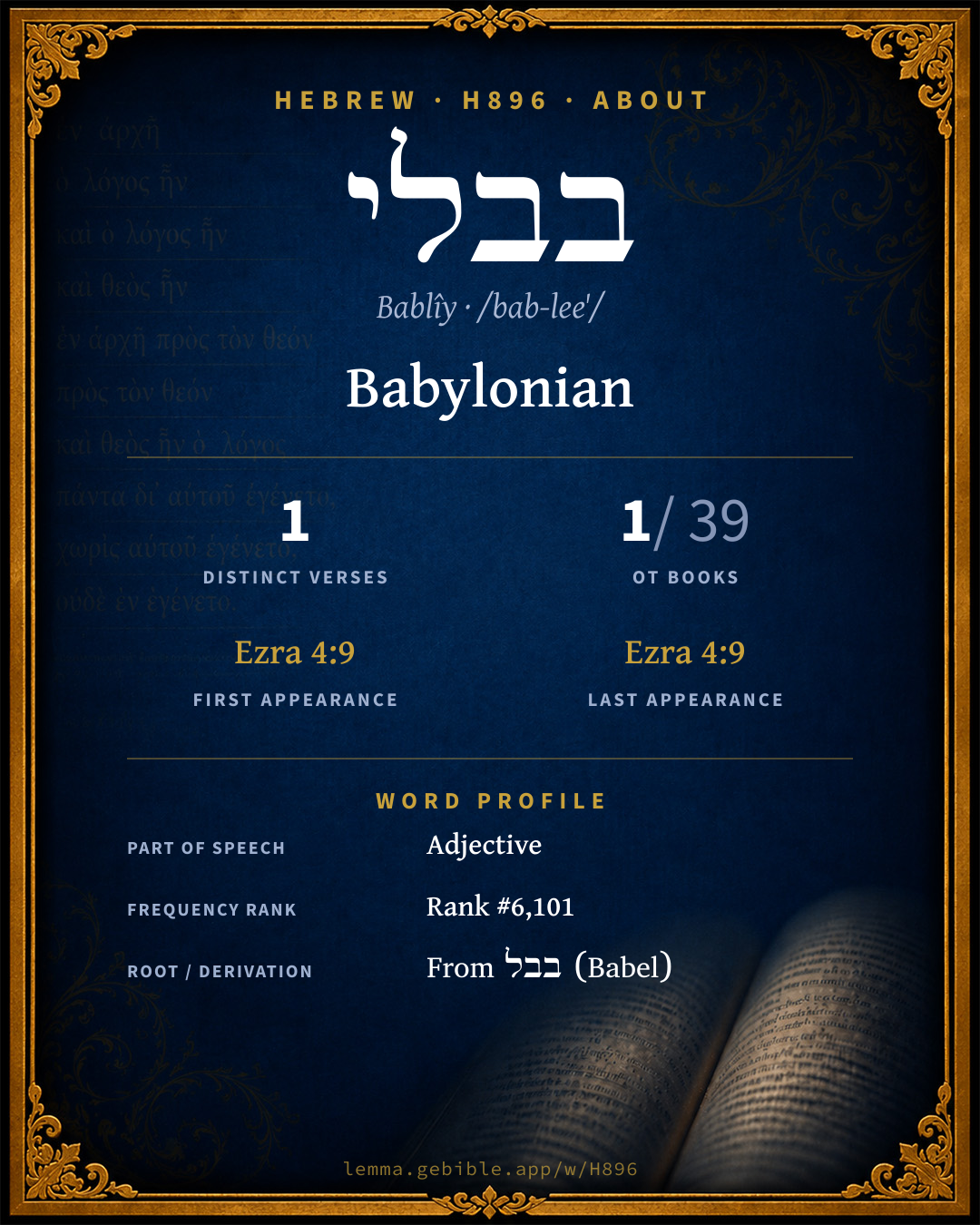
בָּֽבְלַי
Babylonian
BDB lists 2 entries for ‘Babylonian’ fuller range ↓
Full lexicon entry — Brown-Driver-Briggs (BDB)
From Brown-Driver-Briggs (BDB)
Where this word appears
Every verse where H896 appears — 1 distinct verse across 1 book. Click any verse to open its interlinear word-by-word view. Verse text shown in the World English Bible for context — . Each verse’s Hebrew form is shown with its reference; the English is not keyword-highlighted, since the data carries no word-level English alignment. Use “Compare translations” on any verse to read it across multiple English versions. This concordance covers the Hebrew Bible; Septuagint (Greek Old Testament) occurrences are not indexed here.
Ezra 1 verse
About this entry
At a glance — auto-summarized from this page’s data, not written by a person. Every figure links to its source below. This summary describes the numbers; it doesn’t interpret them.
“Babylonian” is the headline sense of the Hebrew name בבלי (Bablîy). A scarce word — 1 verse in all of the Hebrew Bible. It clusters heavily in Ezra, which alone accounts for 100% of its uses. A true hapax — its single appearance is Ezra 4:9. The sections below give every occurrence and version rendering.
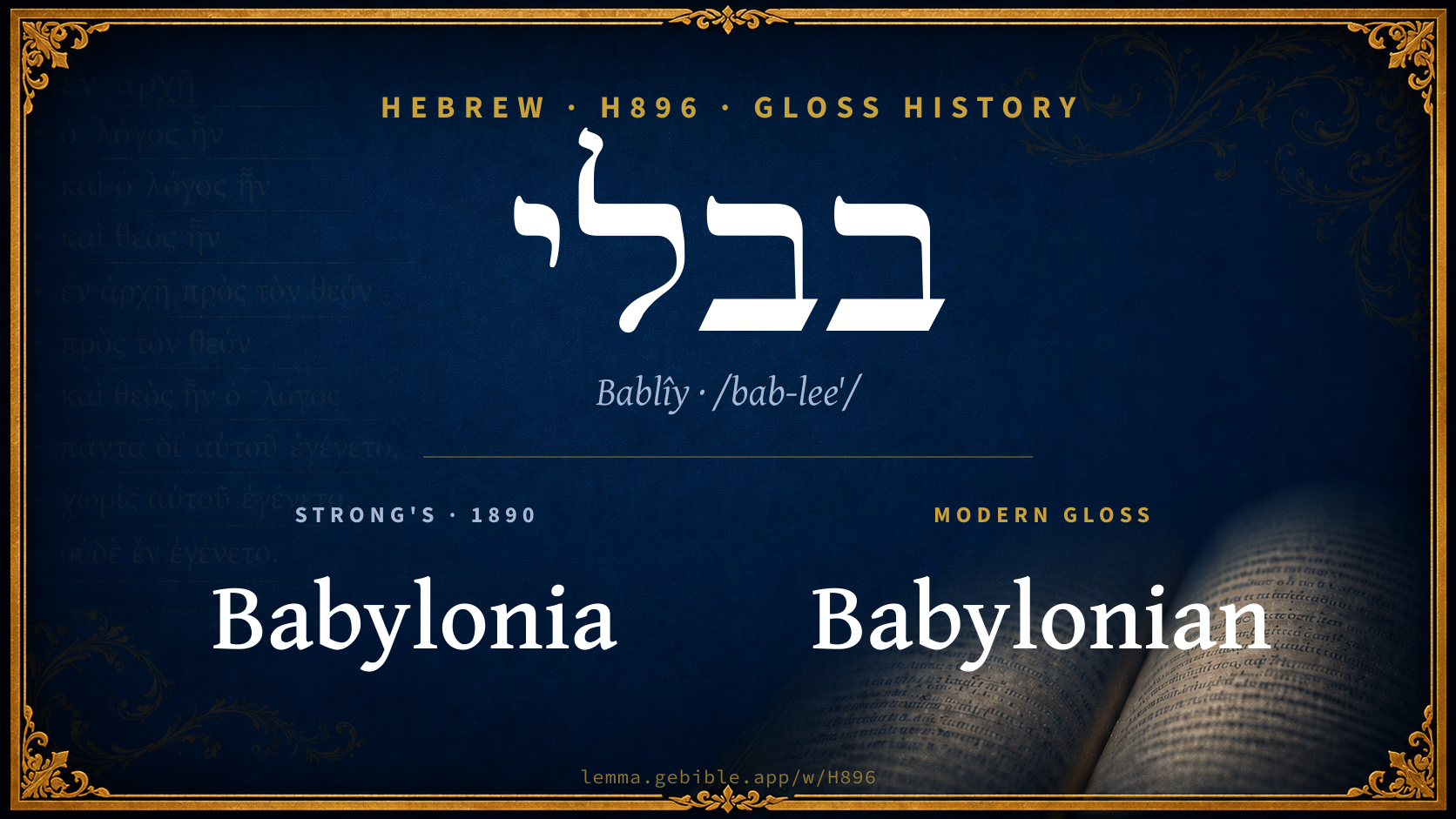
Gloss history
Strong's 1890 vs modern scholarship
About this word
Strong's H896 catalogs a Hebrew word from the Hebrew Old Testament.
These counts are not copied from any lexicon or concordance. They are computed here, from the morphology-tagged Hebrew Old Testament. What Lemma adds →
- 1
- distinct verses
- The word appears in 1 distinct verse.
- 1 / 39
- OT books
- The word appears in 1 of 39 Old Testament books.
- #6,101
- by frequency
- Rank #6,101 (rank 6,101 of 8,640 Hebrew words by occurrence).
View all 1 occurrence in the concordance →
Most concentrated in
- Ezra 1 verse 100%
By section of the Old Testament
By traditional corpus
Conventional, traditional groupings — biblical authorship is debated, so this is a traditional corpus grouping, not an authorship claim. Each share is this word’s portion of its verses in that division of the Hebrew canon. Each figure is a share of the word’s 1 distinct verse.
- Writings (Ketuvim) 1 verse · 100%
How translations render this word
Counts come from each version’s own published word-to-Strong’s tagging or interlinear alignment — an approximate guide to how each version renders this word, not a word-level alignment the data otherwise carries. Because each total is that version’s own tagged count, the per-version totals vary from one another and need not match the appearance or distinct-verse counts above. These counts may also differ from a printed concordance because Lemma counts each distinctly tagged rendering and does not collapse phrase taggings into a single head-word total. This is a fixed set of word-tagged versions (KJV, ASV, BSB, ULT) and does not change with the reading translation you choose elsewhere. Each version’s license is shown beside its name below (and on Sources).
- King James Version: Babylonians 1×
- American Standard Version: Babylonians 1×
- Berean Standard Bible: Babylon 1×
- unfoldingWord Literal Text: Babylonians 1×
King James Version Public Domain
Renders H896 across 1 tagged occurrence — most commonly:
American Standard Version Public Domain
Renders H896 across 1 tagged occurrence — most commonly:
Berean Standard Bible Public Domain
Renders H896 across 1 tagged occurrence — most commonly:
unfoldingWord Literal Text CC BY-SA 4.0
Renders H896 across 1 tagged occurrence — most commonly:
Senses in BDB
The 2 senses BDB distinguishes for this word, in lexicon order (not ranked by frequency or importance). The full entry — with sub-senses — is in the Lexicon Entry tab.
- Babylonian = "confusion (by mixing)"
- Babylonian
Word origin
[ בָּֽבְלַי ] adj.gent. pl. emph. as subst. Ezr 4:9 the Babylonians.
— Brown-Driver-Briggs (Oxford 1906, public domain), digitized via Sefaria, supplemented by the OpenScriptures HebrewLexicon (CC BY 4.0). See Sources.
Derived from בבל (Babel) (H895) — Babylon.
Jastrow Dictionary
A second Hebrew/Aramaic lexicon for comparison, covering Aramaic and post-biblical (Talmudic, Targumic, Midrashic) usage that the biblical-Hebrew BDB does not. Matched by lemma rather than by Strong’s number, so a lemma may carry more than one Jastrow headword (shown separately below), and the entries cover usage well beyond the Bible.
בַּבְלִי
- (preced. ws.) Babylonian. Pes. 66ᵃ הילל הב׳ Hillel the Babylonian; a. fr.—Pl. בַּבְלִיִּים, בַּבְלִיִּין. Yoma 66ᵇ; Men. 100ᵃ. Cant. R. to VIII, 9; Lam. R. to I, 13 ספסלין מלאין ב׳ וכ׳ students’ seats in Palestine occupied by Babylonians; [for מונחי Lam. R. l. c. prob. to be read מומחין].
בלי
- , Y. Ned. III, 38ᵃ top, v. בריכסון.—Pesik. Baḥod. p. 107ᵇ, v. כִּילִי.
בלי ²
- , v. בלל; cmp. נבל) to be crumbled; to be worn out, to fail, decay, perish. Koh. R. to I, 4 הוא בוֹלֶה it (the generation of man) decays (dies out), אינה בוֹלָה it (the earth) does not grow old. Taan. 9ᵃ (play on עד בלי די Mal. III, 10) עד שיִבְלוּ שפתותיכם מלומר די until your lips grow tired from saying, It is enough; (Y. ib. III, 66ᵈ bot. שיבללו, v. בָּלַל); a. fr.—Part. pass. בָּלוּי outworn. Pl. בְּלוּיִים. Midr. Till. to Ps. XXV, 1. e.g. Malachi 3:10
- to wear out, outlive, survive. Lev. R. s. 4 הנפש מְבַלָּה וכ׳ the soul survives the body. Lev. R. s. 19 (play on אין בלתך, I Sam. II, 2) אין לְבַלֹּותֶךָ there is none to outlive thee. Koh. R. l. c.; Cant. R. to V, 15 one erects a building ואחר מְבַלֶּה אותו (not מכלה) and another man ruins it. Snh. 105ᵃ, v. בִּלְעָם. e.g. 1 Samuel 2:2
- , Nithpa. נִתְבַּלָּה to become outworn, fade away. Esth. R. introd. עתידין לְהִבָּלוֹת (Gen. R. s. 42 לִבְלוֹת) are destined to decay. Deut. R. s. 7, end נִתְבַּלּוּ (the garments) were worn out. B. Mets. 87ᵃ נ׳ הבשר her body was withered. B. Bath. 146ᵃ עשויין לִיבָּלוֹת made to be used up.
בְּלֵי I
- Targ. Deut. VIII, 4; Targ. Y. Deut. XXIX, 4 בלמו, Var. כלמו, read בלת; a. fr.—Lev. R. s. 19 כולו בלה all goes to ruin. Ber. 5ᵇ, v. בְּכָא. Ib. 6ᵃ. Bekh. 9ᵃ ובלו להו ואזול they failed and went to destruction. Ab. V, 22 סיב ובְלֵה בה grow old and frail in it (the study of the Law).—[Targ. Ps. LXII, 11; XCI, 2 Ms., v. כְּלִי I.]
- as preced. Pi.—Targ. Is. III, 15; a. e.—Ab. Zar. 20ᵃ that this beauty ב׳ עפרא dust will destroy.—Part. pass. f. מְבַלְּיָא. Lev. R. s. 33 (interpret. בלה נאפים Ezek. XXIII, 43) Aquila translates παλαιὰ πόρνη (old harlot), דהוא מבליא גייארא ed. (Ar. דהיא מב׳ גיירייא, Yalk. Dan. 1061 only דהיא מבליא) which means, a wasted harlot (wasted through fornication). e.g. Ezekiel 23:43
*בְּלֵי II
- constr. (preced., cmp. בְּלָאוֹת, בְּלוֹיִים) rotten pieces of (wood). Targ. Is. XLIV, 19 (h. text בּוּל, v. Rashi a. l.; Var. יִבְלֵי).
בְּלִי
- v. preced. ws.) prop. destruction, naught; not; v. בְּלִימָה. Ber. 44ᵇ מב׳ בשר if without meat.
A Dictionary of the Targumim, the Talmud Babli and Yerushalmi, and the Midrashic Literature (Marcus Jastrow; London, Luzac, 1903) — Public Domain. Digitized via Sefaria. Digitized via Sefaria. Full attribution on Sources.
Septuagint verse parallels
This word appears in 1 verse that also exists in the Greek Old Testament (Septuagint), out of the 1 Hebrew verse it occurs in. You can read those verses in Greek by switching the Old Testament edition to the Septuagint.
Read these verses in the Septuagint
This is a verse-level parallel only — the same verses exist in both the Hebrew and Greek Old Testaments. No word-level Hebrew↔Greek correspondence is claimed: the data carries no such alignment, so no Greek word is shown as this Hebrew word’s translation. Coverage is not total — the Septuagint omits the deuterocanon and renumbers the Psalms, so some Hebrew verses have no direct Greek parallel.