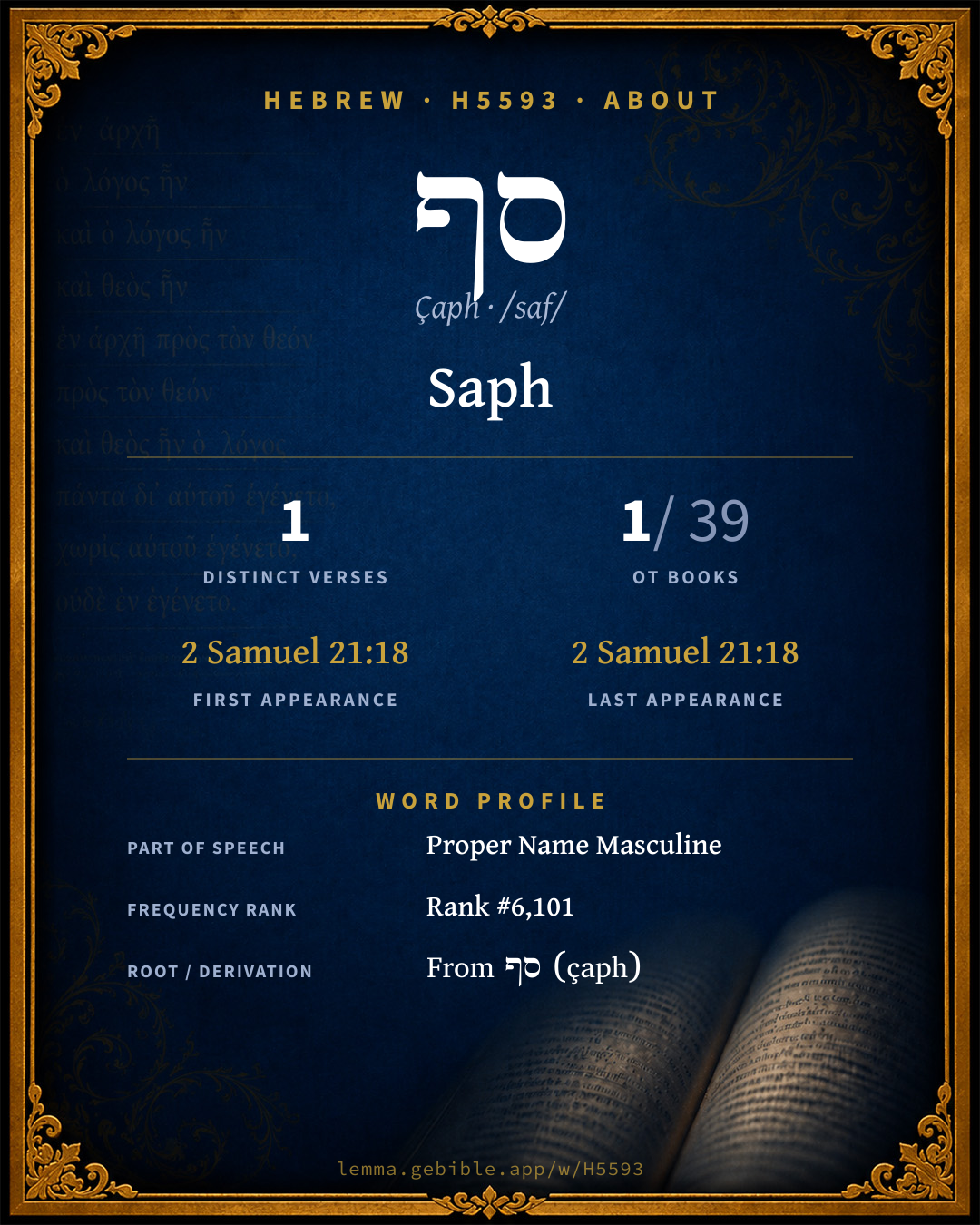
סַף
Saph
BDB lists 2 entries for ‘Saph’ fuller range ↓
Full lexicon entry — Brown-Driver-Briggs (BDB)
From Brown-Driver-Briggs (BDB)
Where this word appears
Grammar key — what these labels mean
Part of speech
- Noun
- A naming word — a person, place, thing, or idea.
Noun type
- Proper
- A name of a specific person, place, or people (e.g. Abraham, Zion, Israel).
Every verse where H5593 appears — 1 distinct verse across 1 book. Click any verse to open its interlinear word-by-word view. Verse text shown in the World English Bible for context — . Each verse’s Hebrew form is shown with its reference; the English is not keyword-highlighted, since the data carries no word-level English alignment. Use “Compare translations” on any verse to read it across multiple English versions. This concordance covers the Hebrew Bible; Septuagint (Greek Old Testament) occurrences are not indexed here.
2 Samuel 1 verse
About this entry
At a glance — auto-summarized from this page’s data, not written by a person. Every figure links to its source below. This summary describes the numbers; it doesn’t interpret them.
“Saph” is the headline sense of the Hebrew name סף (Çaph). It occurs a mere 1 verse across Scripture. It clusters heavily in 2 Samuel, which alone accounts for 100% of its uses. A true hapax — its single appearance is 2 Samuel 21:18. The sections below give every occurrence and version rendering.
Gloss history
Strong's 1890 vs modern scholarship
About this word
Strong's H5593 catalogs a Hebrew word from the Hebrew Old Testament.
These counts are not copied from any lexicon or concordance. They are computed here, from the morphology-tagged Hebrew Old Testament. What Lemma adds →
- 1
- distinct verses
- The word appears in 1 distinct verse.
- 1 / 39
- OT books
- The word appears in 1 of 39 Old Testament books.
- #6,101
- by frequency
- Rank #6,101 (rank 6,101 of 8,640 Hebrew words by occurrence).
View all 1 occurrence in the concordance →
Most concentrated in
- 2 Samuel 1 verse 100%
By section of the Old Testament
By traditional corpus
Conventional, traditional groupings — biblical authorship is debated, so this is a traditional corpus grouping, not an authorship claim. Each share is this word’s portion of its verses in that division of the Hebrew canon. Each figure is a share of the word’s 1 distinct verse.
- Prophets (Nevi'im) 1 verse · 100%
How translations render this word
Counts come from each version’s own published word-to-Strong’s tagging or interlinear alignment — an approximate guide to how each version renders this word, not a word-level alignment the data otherwise carries. Because each total is that version’s own tagged count, the per-version totals vary from one another and need not match the appearance or distinct-verse counts above. These counts may also differ from a printed concordance because Lemma counts each distinctly tagged rendering and does not collapse phrase taggings into a single head-word total. This is a fixed set of word-tagged versions (KJV, ASV, BSB, ULT) and does not change with the reading translation you choose elsewhere. Each version’s license is shown beside its name below (and on Sources).
BDB lists this Strong’s number as 3 distinct words (homographs). Each count above pools all of them and is not split by sense — see the Senses section below. A low-frequency rendering may belong to a different one of those words, not the primary meaning.
- King James Version†: Saph 1×
- American Standard Version†: Saph 1×
- Berean Standard Bible†: Saph 1×
- unfoldingWord Literal Text†: Saph 1×
King James Version Public Domain
Renders H5593 across 1† tagged occurrence — most commonly:
American Standard Version Public Domain
Renders H5593 across 1† tagged occurrence — most commonly:
Berean Standard Bible Public Domain
Renders H5593 across 1† tagged occurrence — most commonly:
unfoldingWord Literal Text CC BY-SA 4.0
Renders H5593 across 1† tagged occurrence — most commonly:
Senses in the full BDB
What do BDB’s symbols mean?
BDB uses these scholarly abbreviations:
| Symbol | Meaning |
|---|---|
| 𝔊 | the Septuagint (the ancient Greek translation, LXX) |
| 𝔙 | the Vulgate (the Latin translation) |
| 𝔖 | the Syriac version (the Peshitta) |
| 𝔗 | the Targum (the Aramaic translation) |
| ψ | the Psalms |
| √ | root (the underlying root or stem) |
| ‖ | parallel passage (a synonymous or contrasted parallel) |
| † | the dagger: every passage where the word occurs is cited |
The 0 senses and sub-senses the full Brown-Driver-Briggs lexicon distinguishes for this word, in lexicon order (not ranked by frequency), with BDB’s own verbatim wording and sub-sense lettering. Shown in Hebrew script with BDB’s own scholarly abbreviations. The condensed entry is in the Lexicon Entry tab.
סף I basin, goblet (NH סַף
סף II m. a Philistine, 2 S 21
Senses from the full Brown-Driver-Briggs lexicon (Brown, Driver, Briggs; Oxford 1906 — public domain), digitized via Sefaria, supplemented by the OpenScriptures HebrewLexicon (CC BY 4.0). Full attribution on Sources.
Word origin
II. n.m. basin, goblet (NH סַף; Ph. סף (Inscr. of Tyre(1), 5, 6) SchrödZMG xxxix (1885), 917 f. Cl-Gann Annales du Musée Guimet x. 511 = Recueil d’arch. orient. (1886), 89 HalRÉJ xii. 107 Bloch; but Lzb330 door-sill);—ס׳ abs. basin Ex 12:22(×2) (J; containing blood of passover lamb); cstr. סַף־רַעַל Zc 12:2 goblet of reeling (intoxicating, fig.), prob. also Hb 2:15, where read מִסַּף תֲמָֽתְךָ from the goblet of thy fury (for MT מְסַפֵּחַ ח׳, v. I. ספח); pl. abs. סַפּוֹת 2 S 17:28 basins for ordinary use; הַסִּפִּים Je 52:19, הַסִּפּוֹת 1 K 7:50 and cstr. סִפּוֹת כֶּסֶף 2 K 12:14, of temple utensils.
III. n.m. Am 9:1 threshold, sill (NH id.; Ph. v. Lzb i. סַף; Aramaic סִפָּא, ܣܶܦܳܐ, (sepo,) Arabic sippu Dl 509, all id.);—abs. ס׳ 2 K 12:10 +, also הַסָּ֑ף Ju 19:27 + 3 times (Baer Ginsb), הַסָּ֑ף 2 K 25:8; sf. סִפִּי Ez 43:8, סִפָּם v 8; pl. סִפִּים Am 9:1; Is 6:4 + 6 times Ez Ch;—threshold, sill Ju 19:27; Am 9:1; Is 6:4 Ez 41:16(×2); 43:8(×2); 2 Ch 3:7, ס׳הַבַּיִת 1 K 14:17, ס׳ הַשַּׁעַר Ez 40:6, 7, cf. v 6 b; שֹׁמֵר הַסַּף = door-keeper, an important temple official, Je 35:4, so שֹׁמְרֵי הַסּ׳ 2 K 12:10 (priests), 22:4 = 2 Ch 34:9 (Levites!), 2 K 23:4; 25:18 = Je 52:24; in Persia, of palace Est 2:21; 6:2; of tabern. שׁ׳ הַסִּפִּים 1 Ch 9:19; שֹׁעֲרֵי הַסּ׳ 2 Ch 23:4 (Levites), שֹׁעֲרִים בַּסּ׳ 1 Ch 9:22; coll. חֹרֶב בַּסָּ֑ף Zp 2:14 desolation in the thresholds.
IV. n.pr.m. a Philistine, 2 S 21:18 (𝔊 τὸν Σεφ(ε); 𝔊L τοὺς ἐπισυνηγμένους), = סִפַּי 1 Ch 20:4 (𝔊 τὸν Σαφουτ, A Σαφφι, 𝔊L Σαπφι).
— Brown-Driver-Briggs (Oxford 1906, public domain), digitized via Sefaria, supplemented by the OpenScriptures HebrewLexicon (CC BY 4.0). See Sources.
Derived from סף (çaph) (H5592) — basin.
Jastrow Dictionary
A second Hebrew/Aramaic lexicon for comparison, covering Aramaic and post-biblical (Talmudic, Targumic, Midrashic) usage that the biblical-Hebrew BDB does not. Matched by lemma rather than by Strong’s number, so a lemma may carry more than one Jastrow headword (shown separately below), and the entries cover usage well beyond the Bible.
סַף
- part. a. perf. of סוּף.
סַף ²
- , v. סוּף, to cut, hollow out; also to put ends together, join)
- 1. door-sill;
- 2. bowl. Mekh. Bo, s. 6 (ref. to Ex. XII, 22) מניד הכתוב … ואין סף אלא אסקופה the text intimates that he loosens and digs a hole on the side of the threshold and slaughters over it, for saf means (a cavity made in) the threshold. Ib. אין סף אלא כלי saf means a vessel; Y. Pes. IX, 36ᵈ bot., sq. e.g. Exodus 12:22
- 3. pl. סִפִּים, סִפִּין, סִי׳ [cut stones, cmp. גָּזִית,] paving-blocks, stone-pavement. Midr. Till. to Ps. LXXVIII, 45 והס׳ נבקעין וכ׳ and the blocks burst before them (the frogs). Midr. Till. to Ps. CV, 30 בתי הס׳ houses which had stone pavements; (Yalk. ib. 820 פספסין; Ex. R. s. 10 פסיפס).
A Dictionary of the Targumim, the Talmud Babli and Yerushalmi, and the Midrashic Literature (Marcus Jastrow; London, Luzac, 1903) — Public Domain. Digitized via Sefaria. Digitized via Sefaria. Full attribution on Sources.
Same root — word family
Other BDB entries built from the same root as H5593, grouped by Strong’s listed origin. These share a root / origin per the lexicon — not necessarily a shared meaning. Each links to that word’s own entry.
Derives from
Proper names from this root
People and places named from this root — a name, not an additional meaning of the word.
Compare all same-root words → 1 of the same-root words is a proper name (a person or place). They share a root, not necessarily a meaning.
Bible dictionary
Public-domain dictionary articles matched to this entry by name (Saph). A biblical name can be shared by more than one person or place, so an article may treat several.
Easton's Bible Dictionary · M. G. Easton, 1897
Extension, the son of the giant whom Sibbechai slew (2 Sam. 21:18); called also Sippai (1 Chr. 20:4).
Smith's Bible Dictionary · William Smith, 1863
(tall), one of the sons of the giant slain by Sibbechai the Hushathite. (2 Samuel 21:18) In (1 Chronicles 20:4) he is called Sippai. (B.C. about 1050.)
Hitchcock's Bible Names Dictionary · Roswell D. Hitchcock, 1869
rushes; sea-moss
Classic public-domain reference works; full attribution on Sources.
Septuagint verse parallels
This word appears in 1 verse that also exists in the Greek Old Testament (Septuagint), out of the 1 Hebrew verse it occurs in. You can read those verses in Greek by switching the Old Testament edition to the Septuagint.
Read these verses in the Septuagint
This is a verse-level parallel only — the same verses exist in both the Hebrew and Greek Old Testaments. No word-level Hebrew↔Greek correspondence is claimed: the data carries no such alignment, so no Greek word is shown as this Hebrew word’s translation. Coverage is not total — the Septuagint omits the deuterocanon and renumbers the Psalms, so some Hebrew verses have no direct Greek parallel.