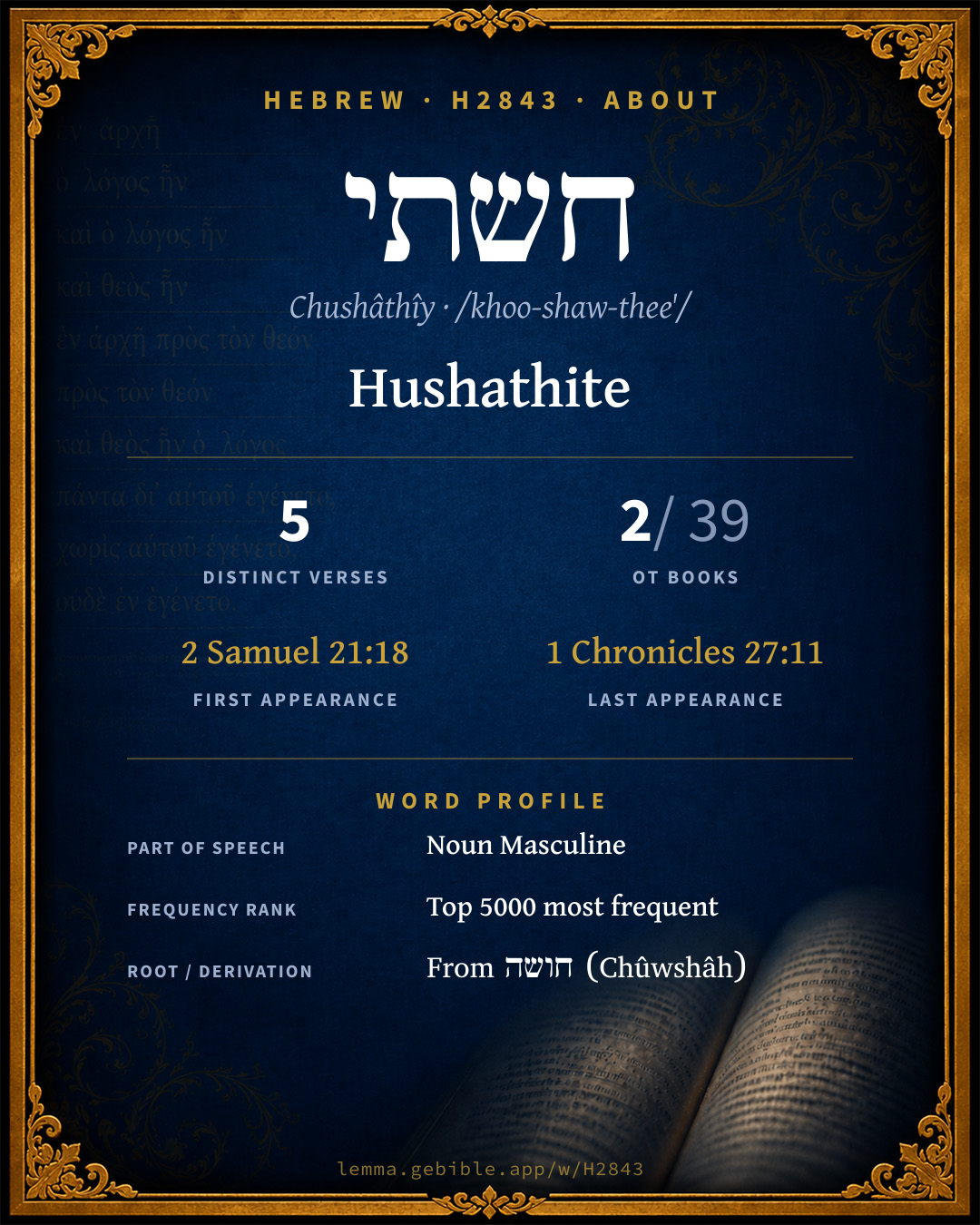
חֻשָׁתִי
Hushathite
BDB lists 2 entries for ‘Hushathite’ fuller range ↓
Full lexicon entry — Brown-Driver-Briggs (BDB)
From Brown-Driver-Briggs (BDB)
Where this word appears
Grammar key — what these labels mean
Noun type
- Gentilic
- A noun naming a member of a people, tribe, or region of origin (e.g. an Israelite, a Moabite).
State
- Absolute
- The independent form of a noun, not bound to a following word.
Gender
- Masculine
- Grammatically masculine.
Number
- Singular
- One.
Every verse where H2843 appears — 5 distinct verses across 2 books. Click any verse to open its interlinear word-by-word view. Verse text shown in the World English Bible for context — . Each verse’s Hebrew form is shown with its reference; the English is not keyword-highlighted, since the data carries no word-level English alignment. Use “Compare translations” on any verse to read it across multiple English versions. This concordance covers the Hebrew Bible; Septuagint (Greek Old Testament) occurrences are not indexed here.
2 Samuel 2 verses
- 2 Samuel 21:18 הַ/חֻ֣שָׁתִ֔י ptcl def.art + n Gentilic ms It came to pass after this, that there was again war with the Philistines at Gob: then Sibbecai the Hushathite killed Saph, who was of the sons of the giant.
- 2 Samuel 23:27 הַ/חֻשָׁתִֽי ptcl def.art + n Gentilic ms Abiezer the Anathothite, Mebunnai the Hushathite,
1 Chronicles 3 verses
- 1 Chronicles 11:29 הַ/חֻ֣שָׁתִ֔י ptcl def.art + n Gentilic ms Sibbecai the Hushathite, Ilai the Ahohite,
- 1 Chronicles 20:4 הַ/חֻֽשָׁתִ֗י ptcl def.art + n Gentilic ms It happened after this, that there arose war at Gezer with the Philistines: then Sibbecai the Hushathite killed Sippai, of the sons of the giant; and they were subdued.
- 1 Chronicles 27:11 הַ/חֻשָׁתִ֖י ptcl def.art + n Gentilic ms The eighth [captain] for the eighth month was Sibbecai the Hushathite, of the Zerahites: and in his division were twenty-four thousand.
About this entry
At a glance — auto-summarized from this page’s data, not written by a person. Every figure links to its source below. This summary describes the numbers; it doesn’t interpret them.
The Hebrew name חשתי centers on the idea of “Hushathite.” It is rare — just 5 verses in the entire Hebrew Bible. 1 Chronicles dominates its distribution — 3 of 5 verses. Its earliest occurrence is 2 Samuel 21:18. Dig into 5-verse concordance and the renderings breakdown below.
Gloss history
Strong's 1890 vs modern scholarship
About this word
Strong's H2843 catalogs a Hebrew word from the Hebrew Old Testament.
These counts are not copied from any lexicon or concordance. They are computed here, from the morphology-tagged Hebrew Old Testament. What Lemma adds →
- 5
- distinct verses
- The word appears in 5 distinct verses.
- 2 / 39
- OT books
- The word appears in 2 of 39 Old Testament books.
- #3,337
- by frequency
- Top 5000 most frequent Hebrew words (rank 3,337 of 8,640 Hebrew words by occurrence).
View all 5 occurrences in the concordance →
Most concentrated in
- 1 Chronicles 3 verses 60%
- 2 Samuel 2 verses 40%
By section of the Old Testament
By traditional corpus
Conventional, traditional groupings — biblical authorship is debated, so this is a traditional corpus grouping, not an authorship claim. Each share is this word’s portion of its verses in that division of the Hebrew canon. Each figure is a share of the word’s 5 distinct verses.
- Writings (Ketuvim) 3 verses · 60%
- Prophets (Nevi'im) 2 verses · 40%
How translations render this word
Counts come from each version’s own published word-to-Strong’s tagging or interlinear alignment — an approximate guide to how each version renders this word, not a word-level alignment the data otherwise carries. Because each total is that version’s own tagged count, the per-version totals vary from one another and need not match the appearance or distinct-verse counts above. These counts may also differ from a printed concordance because Lemma counts each distinctly tagged rendering and does not collapse phrase taggings into a single head-word total. This is a fixed set of word-tagged versions (KJV, ASV, BSB, ULT) and does not change with the reading translation you choose elsewhere. Each version’s license is shown beside its name below (and on Sources).
- King James Version: Hushathite 5×
- American Standard Version: Hushathite 5×
- Berean Standard Bible: Hushathite 5×
- unfoldingWord Literal Text: Hushathite 5×
King James Version Public Domain
Renders H2843 across 5 tagged occurrences — most commonly:
American Standard Version Public Domain
Renders H2843 across 5 tagged occurrences — most commonly:
Berean Standard Bible Public Domain
Renders H2843 across 5 tagged occurrences — most commonly:
unfoldingWord Literal Text CC BY-SA 4.0
Renders H2843 across 5 tagged occurrences — most commonly:
Senses in BDB
The 2 senses BDB distinguishes for this word, in lexicon order (not ranked by frequency or importance). The full entry — with sub-senses — is in the Lexicon Entry tab.
- Hushathite = "inhabitant of Hushah"
- an inhabitant of Hushah or a descendant of Hushah; the designation given to two of David's mighty warriors
Word origin
חֻשָׁתִי adj.gent. of foregoing [ h.bo.ab ]:—1. of individ.
— Brown-Driver-Briggs (Oxford 1906, public domain), digitized via Sefaria, supplemented by the OpenScriptures HebrewLexicon (CC BY 4.0). See Sources.
Derived from חושה (Chûwshâh) (H2364) — Hushah.
Forms in the corpus
The 4 distinct written forms H2843 takes in the Hebrew Bible, most frequent first — each parse links to that state’s occurrences in the concordance. Hebrew forms include their vowel points and cantillation, so a single lemma takes many written forms.
| Form | Parsing | Example | Uses |
|---|---|---|---|
| הַ/חֻ֣שָׁתִ֔י | Noun, Gentilic, Masculine, Singular, Absolute | 1 Chronicles 11:29 | 2 |
| הַ/חֻֽשָׁתִ֗י | Noun, Gentilic, Masculine, Singular, Absolute | 1 Chronicles 20:4 | 1 |
| הַ/חֻשָׁתִ֖י | Noun, Gentilic, Masculine, Singular, Absolute | 1 Chronicles 27:11 | 1 |
| הַ/חֻשָׁתִֽי | Noun, Gentilic, Masculine, Singular, Absolute | 2 Samuel 23:27 | 1 |
Bible dictionary
Public-domain dictionary articles matched to this entry by name (Hushathite). A biblical name can be shared by more than one person or place, so an article may treat several.
Smith's Bible Dictionary · William Smith, 1863
(inhabitant of Hushah), The, the designation of two of the heroes of David's guard.
+ Sibbechai. (2 Samuel 21:18; 1 Chronicles 11:29; 20:4; 27:11) Josephus, however, called him a Hittite. + Mebunnai, (2 Samuel 23:27) a mere corruption of Sibbechai.
Hitchcock's Bible Names Dictionary · Roswell D. Hitchcock, 1869
Hushim, man of haste, or of silence
Classic public-domain reference works; full attribution on Sources.
Septuagint verse parallels
This word appears in 5 verses that also exist in the Greek Old Testament (Septuagint), out of the 5 Hebrew verses it occurs in. You can read those verses in Greek by switching the Old Testament edition to the Septuagint.
Read these verses in the Septuagint
This is a verse-level parallel only — the same verses exist in both the Hebrew and Greek Old Testaments. No word-level Hebrew↔Greek correspondence is claimed: the data carries no such alignment, so no Greek word is shown as this Hebrew word’s translation. Coverage is not total — the Septuagint omits the deuterocanon and renumbers the Psalms, so some Hebrew verses have no direct Greek parallel.