
2 Kings 23:37

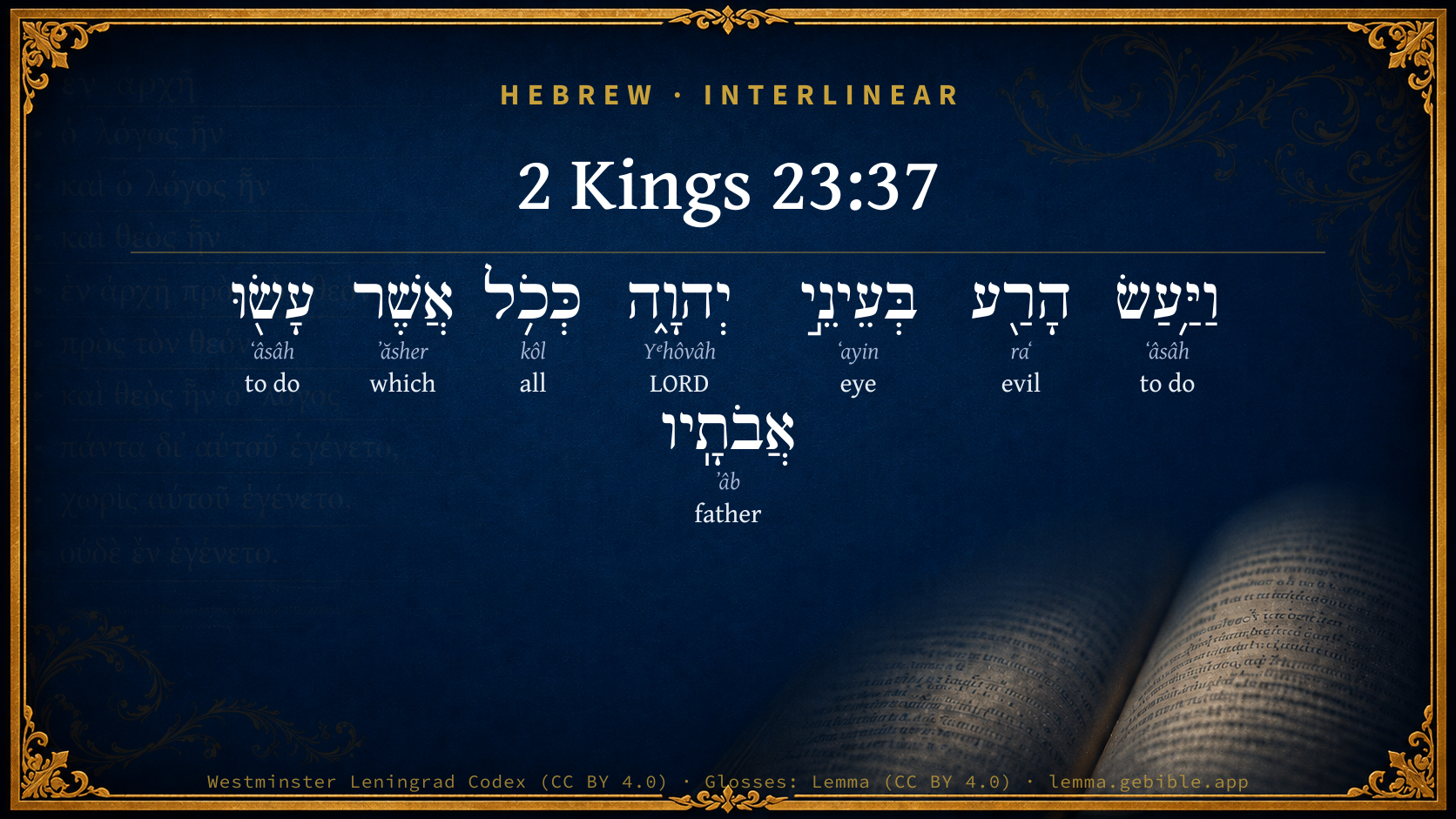
Hebrew (Westminster Leningrad Codex) 2 Kings 23:37 appears in the Hebrew Old Testament. The text above is from the Westminster Leningrad Codex. Each word links to its Strong’s number, a concise gloss, and parsing drawn from the Open Scriptures Hebrew Bible morphology. Click any word for its full Brown-Driver-Briggs (BDB) entry.
Download image
Cite this verse

2 Kings 23:37 (World English Bible). Public Domain. Lemma interlinear Bible study tool, https://lemma.gebible.app/v/2-kings/23/37.

Show BibTeX & RIS
BibTeX
RIS
English Translation
He did that which was evil in the sight of Yahweh, according to all that his fathers had done.
World English Bible · Public Domain
Download a study sheet

One document with this verse’s original text, its word-by-word gloss line, the meaning frame, cross-references with their text, attributed commentary, and full source and license credits — printable, and it pastes into notes with its structure intact.

This verse Autodidact and up

Study sheet (.html) Plain text (.txt)

A passage Seminary Student

Up to 50 verses in one chapter. A passage sheet keeps up to 6 commentary sources and 12 cross-references per verse, in the order this page ranks them, and says so on the sheet whenever that leaves anything out. Ask for a single verse and you get the Autodidact verse sheet above.

Everything on this page stays free to read, with no account — the sheet is a download of what is already on screen, not access to it.

Want to remove ads? Support Godless Engineer
Compare translations 3

The same verse in 3 English versions, stacked beneath the original-language interlinear above. Click any original word for its lexicon entry.

Each is an independent rendering of the whole verse — the interlinear is not word-aligned to these translations.

Highlighted words mark where these versions differ — a whole-verse word diff, not a word-by-word alignment.

  • World English Bible Public Domain
    He did that which was evil in the sight of Yahweh, according to all that his fathers had done.
  • King James Version Public Domain
    And he did that which was evil in the sight of the LORD, according to all that his fathers had done.
  • unfoldingWord Literal Text CC BY-SA 4.0
    And he did evil in the eyes of Yahweh, like all that his fathers had done.

unfoldingWord Literal Text — © unfoldingWord, licensed CC BY-SA 4.0. Word-aligned USFM3 via Door43 (git.door43.org/unfoldingWord/en_ult).

Versions to compare (up to 4)

3 of 4 selected

Show all 18 translations

Every available English version of this verse, each an independent rendering of the whole verse.

  • World English Bible Public Domain
    He did that which was evil in the sight of Yahweh, according to all that his fathers had done.
  • Berean Standard Bible Public Domain
    And he did evil in the sight of the LORD, just as his fathers had done.
  • Majority Standard Bible Public Domain
    And he did evil in the sight of the LORD, just as his fathers had done.
  • King James Version Public Domain
    And he did that which was evil in the sight of the LORD, according to all that his fathers had done.
  • American Standard Version (1901) Public Domain
    And he did that which was evil in the sight of Jehovah, according to all that his fathers had done.
  • Revised Version (1885) Public Domain
    And he did that which was evil in the sight of the LORD, according to all that his fathers had done.
  • Geneva Bible (1599) Public Domain
    And he did euill in the sight of the Lord, according to all that his fathers had done.
  • Douay-Rheims (1899) Public Domain
    And he did evil before the Lord according to all that his fathers had done.
  • Young's Literal Translation Public Domain
    and he doth the evil thing in the eyes of Jehovah, according to all that his fathers did.
  • Literal Standard Version CC BY-SA 4.0
    and he does evil in the eyes of YHWH, according to all that his fathers did.
  • Unlocked Literal Bible CC BY-SA 4.0
    Jehoiakim did what was evil in the sight of Yahweh, just as his ancestors had done.
  • unfoldingWord Literal Text CC BY-SA 4.0
    And he did evil in the eyes of Yahweh, like all that his fathers had done.
  • Darby Bible Public Domain
    And he did evil in the sight of Jehovah, according to all that his fathers had done.
  • World Messianic Bible Public Domain
    He did that which was evil in the LORD’s sight, according to all that his fathers had done.
  • Webster's Bible Public Domain
    And he did that which was evil in the sight of the LORD, according to all that his fathers had done.
  • Free Bible Version CC BY-SA 4.0
    He did evil in the Lord's sight, just as his forefathers had done.
  • Bible in Basic English Public Domain
    He did evil in the eyes of the Lord as his fathers had done.
  • JPS Tanakh (1917) Public Domain
    And he did that which was evil in the sight of the LORD, according to all that his fathers had done.

Literal Standard Version (2020), Covenant Press — licensed CC BY-SA 4.0. Text via the HelloAO Bible API (eBible.org). Unlocked Literal Bible (unfoldingWord) — licensed CC BY-SA 4.0. Text via the HelloAO Bible API (eBible.org). unfoldingWord Literal Text — © unfoldingWord, licensed CC BY-SA 4.0. Word-aligned USFM3 via Door43 (git.door43.org/unfoldingWord/en_ult). Free Bible Version, Dr. Jonathan Gallagher — licensed CC BY-SA 4.0. Text via the HelloAO Bible API (eBible.org).

Word by word

More ways to search: Search by grammar → Find every occurrence → Compare this word →

Practice this passage: Drill this verse → Learn its vocabulary →

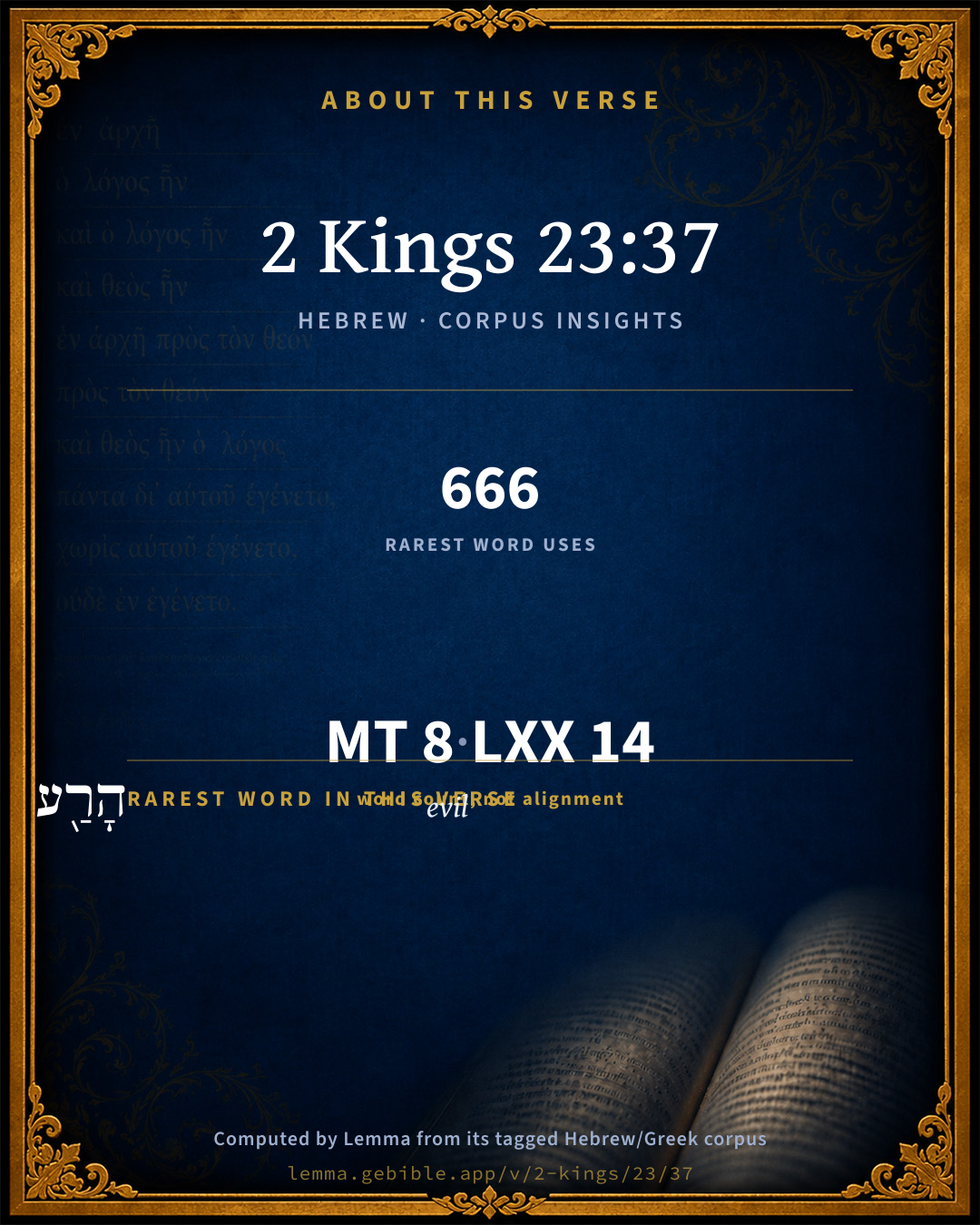
הָרַ֖ע
raʻ
H7451
“the · evil”
Particle, Definite Article + Adjective, Adjective, Masculine, Singular, Absolute
Part of Speech
Particle + Adjective
Type
Adjective
Gender
Masculine
Number
Singular
State
Absolute
Full BDB Definition

Origin: from H7489

TWOT: 2191a , 2191c

bad, evil (adjective) - bad, disagreeable, malignant - bad, unpleasant, evil (giving pain, unhappiness, misery) - evil, displeasing - bad (of its kind - land, water, etc) - bad (of value) - worse than, worst (comparison) - sad, unhappy - evil (hurtful) - bad, unkind (vicious in disposition) - bad, evil, wicked (ethically) - in general, of persons, of thoughts - deeds, actions - evil, distress, misery, injury, calamity (noun masculine) - evil, distress, adversity - evil, injury, wrong - evil (ethical) - evil, misery, distress, injury (noun feminine) - evil, misery, distress - evil, injury, wrong - evil (ethical)
  1. וַיַּ֥עַשׂ ʻâsâh H6213 “and · to do” Conjunction + Verb, Qal, Sequential Imperfect, 3rd Person, Masculine, Singular
  2. בְּעֵינֵ֣י ʻayin H5869 “in/at · eyes of” Preposition + Noun, Common, Both, Dual, Construct
  3. יְהוָ֑ה Yᵉhôvâh H3068 “LORD” Noun, Proper
  4. כְּכֹ֥ל kôl H3605 “like/as · all” Preposition + Noun, Common, Masculine, Singular, Absolute
  5. אֲשֶׁר ʼăsher H834 “which” Particle, Relative
  6. עָשׂ֖וּ ʻâsâh H6213 “to do” Verb, Qal, Perfect, 3rd Person, Common, Plural
  7. אֲבֹתָֽיו ʼâb H1 “fathers · his” Noun, Common, Masculine, Plural, Construct + Suffix, Personal, 3rd Person, Masculine, Singular

About this verse

These counts appear in no published source. They are computed here, from the morphology-tagged text and Lemma’s own curated glosses. What Lemma adds →

8
words
7
distinct lemmas
Historical
section

Grammatical profile

  • 2 verbs
  • 4 nouns
  • 1 adjective
  • 1 particle

Verb forms

  • וַיַּ֥עַשׂ Qal · Sequential Imperfect
  • עָשׂ֖וּ Qal · Perfect

Repetition

A word recurs within this verse — often emphatic in Hebrew:

  • וַיַּ֥עַשׂ to do H6213 ×2

Hebrew & Septuagint length

In English translation the verse runs 19 words from the Hebrew and 21 from the Septuagint (LXX English) — closely comparable.

A rough comparison of the two English renderings, which tokenize alike — not a word-level alignment.

Word counts can differ between the Hebrew and the Greek without any difference in meaning — e.g. the Hebrew direct-object marker אֵת has no separate Greek word, and Greek often adds the article ὁ.

In the original languages it is 8 Hebrew tokens and 14 Greek tokens — but the two are counted differently (Hebrew bundles its prefixes and suffixes into one token; the Greek is in lemma form), so that isn’t a like-for-like length.

Cross-references

9

Topical passages linked to 2 Kings 23:37 in the Treasury of Scripture Knowledge — connected by theme and wording, ordered by reader-vote popularity; previews shown in the World English Bible.

  • 2 Kings 23:32 He did that which was evil in the sight of Yahweh, according to all that his fathers had done.
  • 2 Chronicles 28:22–25 In the time of his distress did he trespass yet more against Yahweh, this same king Ahaz.
  • 2 Chronicles 33:4–10 He built altars in the house of Yahweh, of which Yahweh said, In Jerusalem shall my name be forever.
  • 2 Chronicles 33:22–23 He did that which was evil in the sight of Yahweh, as did Manasseh his father; and Amon sacrificed to all the engraved images which Manasseh his father had made, and served them.
  • Jeremiah 22:13–17 Woe to him who builds his house by unrighteousness, and his chambers by injustice; who uses his neighbor's service without wages, and doesn't give him his hire;
  • Jeremiah 26:20–23 There was also a man who prophesied in the name of Yahweh, Uriah the son of Shemaiah of Kiriath Jearim; and he prophesied against this city and against this land according to all the words of Jeremiah:
  • Jeremiah 36:23–26 It happened, when Jehudi had read three or four leaves, that [the king] cut it with the penknife, and cast it into the fire that was in the brazier, until all the scroll was consumed in the fire that was in the brazier.
  • Jeremiah 36:31 I will punish him and his seed and his servants for their iniquity; and I will bring on them, and on the inhabitants of Jerusalem, and on the men of Judah, all the evil that I have pronounced against them, but they didn't listen.
  • Ezekiel 19:5–9 Now when she saw that she had waited, and her hope was lost, then she took another of her cubs, and made him a young lion.

Cross-references courtesy of OpenBible.info (CC BY 4.0).

Hebrew and Greek witnesses Masoretic Hebrew ↔ Greek Septuagint

The same verse in the two great witnesses to the Old Testament, shown verse-for-verse.

These are two independent witnesses, not word-aligned to each other, and the Septuagint is shown in lemma (dictionary) form.

Hebrew 2 Kings 23:37 Masoretic · Westminster Leningrad Codex

וַיַּ֥עַשׂ הָרַ֖ע בְּעֵינֵ֣י יְהוָ֑ה כְּכֹ֥ל אֲשֶׁר עָשׂ֖וּ אֲבֹתָֽיו

He did that which was evil in the sight of Yahweh, according to all that his fathers had done.

World English Bible · Public Domain

Greek LXX 2 Kings 23:37 Septuagint · lemma form

καί ποιέω ὁ πονηρός ἐν ὀφθαλμός κύριος κατά πᾶς ὅσος ποιέω ὁ πατήρ αὐτός

And he did that which was evil in the eyes of the lord, according to all that his fathers had done.

LXX2012 (modern English Septuagint) · Public Domain

Hebrew: Westminster Leningrad Codex (CC BY 4.0). Greek: Septuagint (public domain); English from LXX2012 (modern English Septuagint) (Public Domain). How the Septuagint differs from the Hebrew →

Targum (Aramaic paraphrase)

1

The Targum is the ancient Jewish Aramaic paraphrase of the Hebrew Scriptures — an interpretive translation, not the Hebrew text itself. Onkelos (literal) and Pseudo-Jonathan (expansive) render the Torah, and Jonathan the Prophets. Coverage is partial: where no permissively-licensed English translation exists for a verse, only the Aramaic is shown. This is verse-level text, not a word-by-word alignment to the Hebrew.

  1. Targum Jonathan Prophets (Joshua–Malachi)
    וַעֲבַד דְבִישׁ קֳדָם יְיָ כְּכֹל דַעֲבָדוּ אֲבָהָתוֹהִי:

    (no public-domain English translation for this verse)

    Targum Jonathan — Aramaic: “Mikraot Gedolot” (public domain). English: “Sefaria Community Translation” (CC0 1.0 (public-domain dedication)); “London "Chaldee Paraphrase," 1871” (public domain). Text via Sefaria.

Commentary

Notes on 2 Kings 23:37 from classic Christian and Jewish commentators (each source and its license shown beneath its notes). The classic Christian expositions comment on the surrounding passage and are grouped to its opening verse, so a note may address several verses; the Jewish commentaries on the Tanakh (Rashi and others) are per-verse, so they appear only where the commentator wrote on this verse.

Lemma curates 59 commentaries, every one of them public domain or Creative Commons licensed, each selected and text-cleaned for this edition rather than reprinted as found. About our sources →

Trapp's Complete Commentary

John Trapp

2Ki 23:37 And he did [that which was] evil in the sight of the LORD, according to all that his fathers had done.

Ver. 37. And he did that which was evil.] To all his former evils he added this, that he slew Urijah the prophet. {Jer 26:20; Jer 26:23}

John Trapp, A Commentary or Exposition upon All the Books of the Old and New Testament (1647–1656) — public domain. Text from a community e-Sword module.

Joseph Benson's Commentary

2Ki 23:37. He did that which was evil, &c. — By idolatry, the oppression of his people, and the persecution of the prophets and other good men. For he killed the Prophet Urijah, and was at the charge to fetch him out of Egypt, whither he fled to save his life, Jer 26:20-21, &c. And if it had not been for Ahikam, the son of Shaphan, who had been a great man in his father Josiah’s courts, he would have served Jeremiah in the same manner, 2Ki 23:24. And from hence it is evident, that the reformation of the people, in general, was not sincere in the time of Josiah, but that they dissembled in obedience to the king’s command; otherwise it cannot be supposed that this young king would have immediately set at naught, and gone directly contrary to, all his father had done: but, Josiah being dead, it is likely the people threw off their mask, and showed how vehemently they were inclined to idolatry, and this young king was thereby soon induced to join with them in it.

Joseph Benson's Commentary on the Old and New Testaments (1811–1818) — public domain. Text from a community e-Sword module.

Tyndale Open Study Notes

Tyndale Open Resources

23:37 did what was evil: The record in the book of Jeremiah characterizes Jehoiakim as a total apostate (see Jer 22:13-23; 25:1-14; 26:20-23; 36:1-32).

Tyndale Open Study Notes — © Tyndale Open Resources, licensed CC BY-SA 4.0. Text via the HelloAO Bible API.

Adam Clarke's Commentary

Verse 37. He did that which was evil in the sight of the Lord] He was a most unprincipled and oppressive tyrant. Jeremiah gives us his character at large, Jer 22:13-19, to which the reader will do well to refer. Jeremiah was at that time in the land, and was an eyewitness of the abominations of this cruel king.

Adam Clarke's Commentary on the Bible (1810–1826) — public domain. Text from a community e-Sword/MySword module.

Haydock's Catholic Bible Commentary

Fathers, or ancestors, not his immediate father Josias, ver. 32. (Haydock) --- Joakim chose to imitate the wicked, and was not deterred by the chastisement of his brother. (Calmet) --- His character was marked with avarice and cruelty. He slew the prophet Urias, Jeremias xxii. 13., and xxvi 23. (Haydock) --- St. Matthew (i. 11.) calls him Jechonias, (Menochius) 1 Paralipomenon iii. 15.

George Leo Haydock (1774–1849), Haydock's Catholic Family Bible and Commentary, 1859 edition — public domain. Excludes Psalms (Douay-Rheims chapter numbering differs from Protestant) and Deuterocanonical books (Catholic canon only).

Matthew Poole's English Annotations

By idolatry, the oppression of his people, and the persecution of the prophets, and other good men, Jer 26:21; Eze 19:5-7.

Matthew Poole's English Annotations on the Holy Bible (1683–1685) — public domain. Text from a community e-Sword/MySword module.

The Pulpit Commentary

And he did that which was evil in the sight of the Lord, according to all that his fathers had done. Jeremiah says of Jehoiakim,

unto him that buildeth his house by unrighteousness, and his chambers by wrong; that useth his neighbor"s service without wages, and giveth him not for his work; that saith, I will build me a large house and wide chambers, and cutteth him out windows; and it is coiled with cedar, and painted with vermilion. Shalt thou reign, because thou closest thyself in cedar? did not thy father eat and drink, and do judgment and justice, and then it was well with him? He judged the cause of the poor and needy; then it was well with him: was not this to know me? saith the Lord. But thine eyes and thine heart are not but for thy covetousness, and for to shed innocent blood, and for oppression, and for violence, to do it". (Jer_22:13-17) Josephus calls him "an unjust man and an evildoer, neither pious in his relations towards God nor equitable in his dealings with his fellow men" ("Ant. Jud:," 10:5. His execution of Urijah, the son of Shemalah, for prophesying the destruction of Jerusalem, (Jer_26:20-23) was an act at once of cruelty and impiety. It is suspected (Ewald, "History of Israel," vol. 4. p. 252) that, besides reintroducing into Judah all the foreign rites extirpated by his father, he added Egyptian rites to their number. The tyranny which he practiced was likewise of an Egyptian cast, including, as it did, the exaction of forced labor from his subjects, (Jer_22:13) an old custom of thePharaohs, and it is quite possible that his "passion for building splendid and costly houses" (Ewald) was awakened by his knowledge of the magnificence which characterized the monarchs of the Saitic dynasty, who revived in Egypt the architectural glories of the Ramessides (see Herod., 2:153, 175, 176).

The Pulpit Commentary (1880–1919), ed. H.D.M. Spence-Jones & Joseph S. Exell — public domain. Text from a community e-Sword module.

Lesson kit

Teaching starters — assembled from the data on this page, not authored interpretation. Every prompt links to the verse data it draws on. Edit before teaching.

2 Kings, in the Historical, opens this verse with 8 words (7 distinct Hebrew lemmas). Its most distinctive word is raʻ (“evil”). A historical commentator’s framing appears above. Read the whole chapter for the surrounding context.

Discussion questions

  1. How does “evil” (raʻ) shape what this verse is saying?
  2. How does 2 Kings 23:32, which shares this passage’s theme, read alongside this verse?
  3. What does the repetition of “to do” (2× in this one verse) do in this verse?
  4. The translations on this page render this verse differently — a whole-verse word diff, not a word-by-word alignment. What might account for the different wordings?
  5. «וַיַּ֥עַשׂ» is a Qal Sequential Imperfect verb. How does that grammatical form shape the action described?
  6. Compare how Trapp's Complete Commentary and Joseph Benson's Commentary read this verse. Where do they agree or differ?

Things to notice

Reading settings

Reading text

Shown beneath each verse's original-language words.

Old Testament
Old Testament edition

Read the OT as the Masoretic Hebrew (MT) or the Greek Septuagint (LXX).

English shown for the Greek Septuagint (in the Hebrew ↔ Greek comparison).

Comparing translations? Open the Compare panel on any verse page to stack up to four side by side.