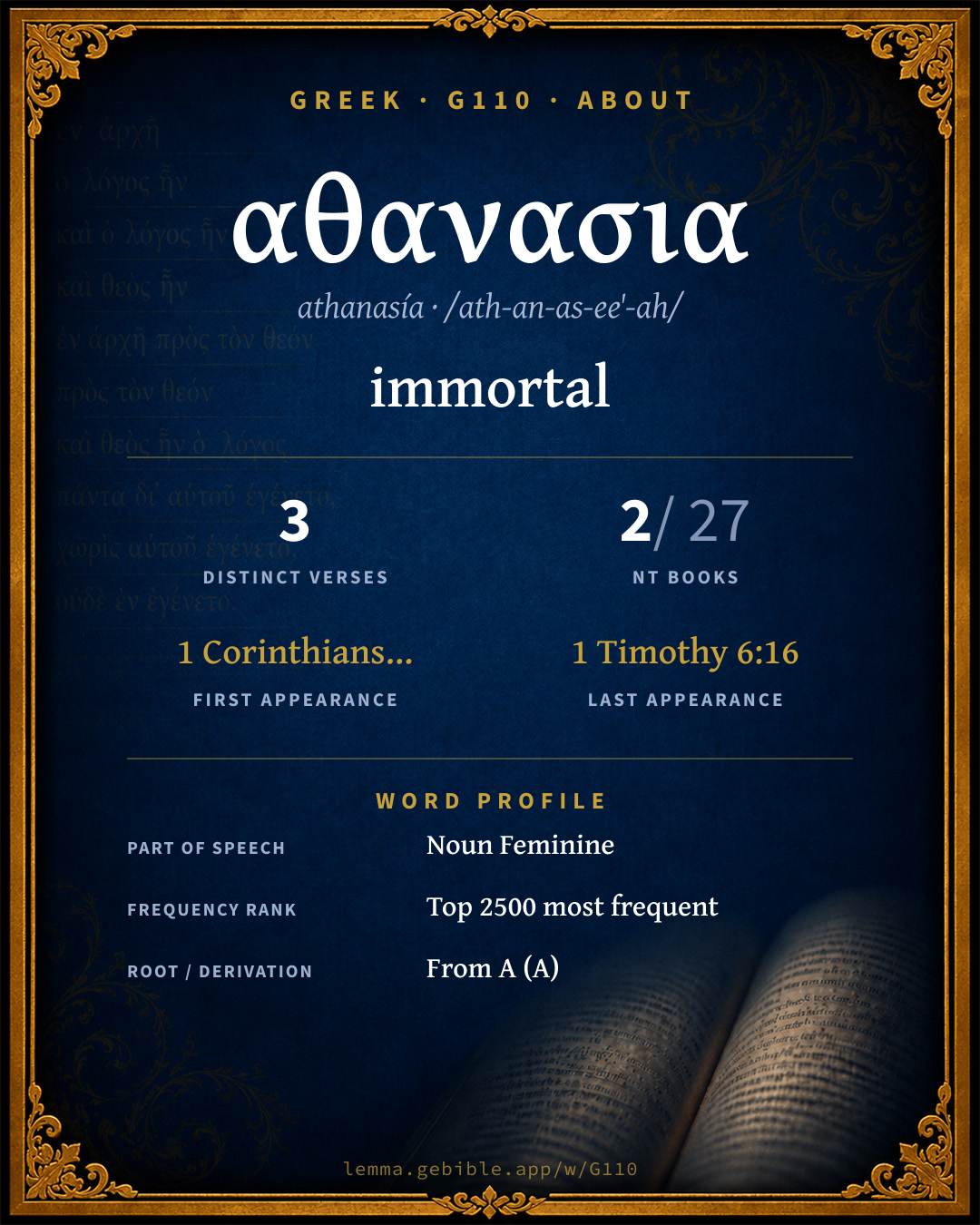
ἀθανασία
immortal
Full lexicon entry — Thayer's Greek Lexicon
From Thayer's Greek Lexicon
Where this word appears
Grammar key — what these labels mean
Part of speech
- Noun
- A naming word — a person, place, thing, or idea.
Case
- Accusative
- The case of the direct object and of extent.
Gender
- Feminine
- Grammatically feminine.
Number
- Singular
- One.
Every verse where G110 appears — 3 distinct verses across 2 books. Click any verse to open its interlinear word-by-word view. Verse text shown in the World English Bible for context — . Each verse’s Greek form is shown with its reference; the English is not keyword-highlighted, since the data carries no word-level English alignment. Use “Compare translations” on any verse to read it across multiple English versions. This concordance covers the Greek New Testament; Septuagint (Greek Old Testament) occurrences of this word are not indexed here.
1 Corinthians 2 verses
- 1 Corinthians 15:53 ἀθανασίαν n acc sg fem For this corruptible must put on incorruption, and this mortal must put on immortality.
- 1 Corinthians 15:54 ἀθανασίαν n acc sg fem But when this corruptible will have put on incorruption, and this mortal will have put on immortality, then what is written will happen: "Death is swallowed up in victory."
1 Timothy 1 verse
About this entry
At a glance — auto-summarized from this page’s data, not written by a person. Every figure links to its source below. This summary describes the numbers; it doesn’t interpret them.
At its core, αθανασια (athanasía) means “immortal.” The Greek New Testament uses it only 3 verses. The word gravitates to 1 Corinthians (67%), then 1 Timothy. First canonically at 1 Corinthians 15:53, it enters the text early. It shares a root with Α, αβαρης and αβυσσος. Each statement above links to its evidence; the full detail follows below.
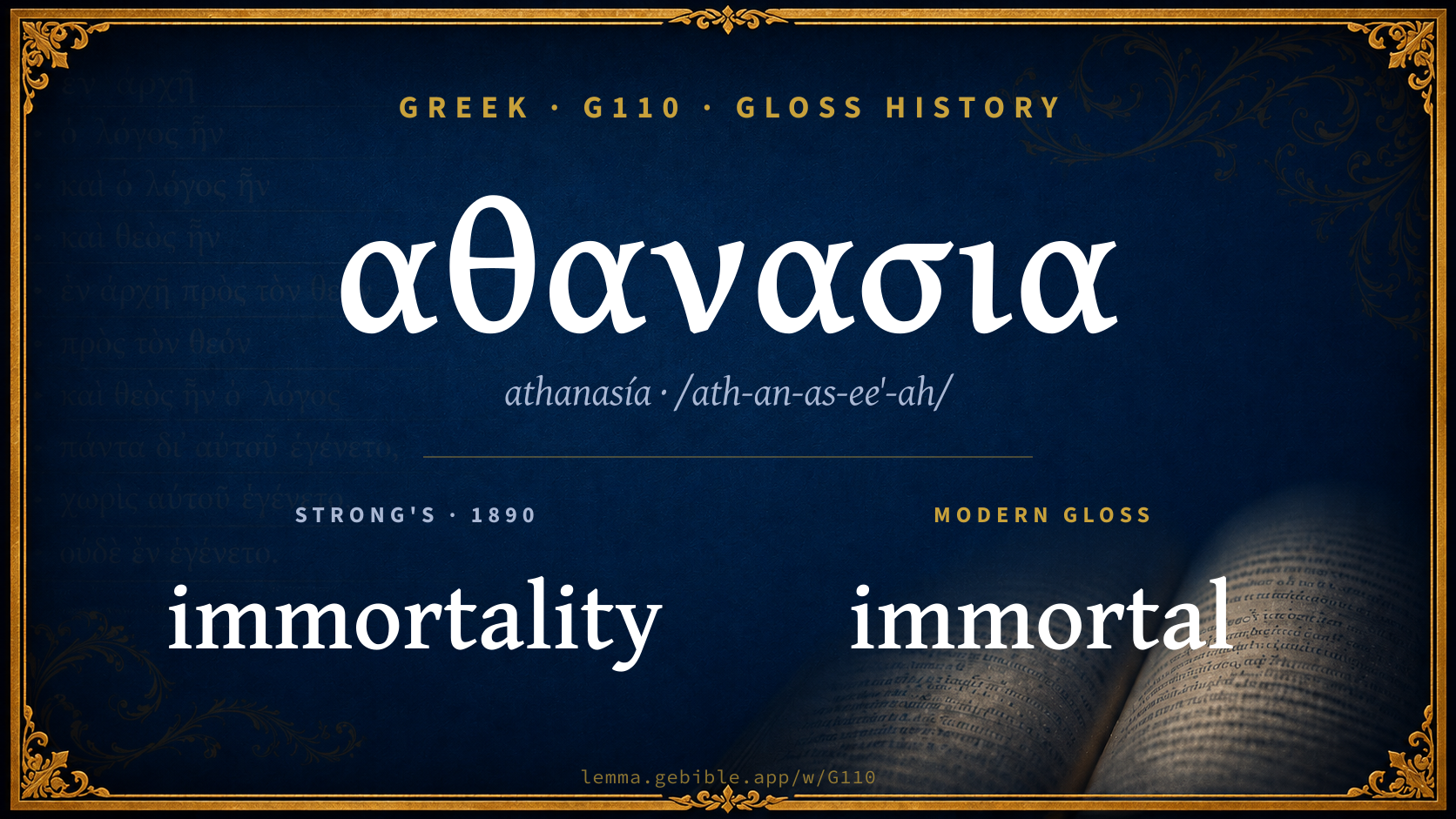
Gloss history
Strong's 1890 vs modern scholarship
About this word
Strong's G110 catalogs a Greek word from the Greek New Testament.
These counts are not copied from any lexicon or concordance. They are computed here, from the morphology-tagged Greek New Testament. What Lemma adds →
- 3
- distinct verses
- The word appears in 3 distinct verses.
- 2 / 27
- NT books
- The word appears in 2 of 27 New Testament books.
- #2,203
- by frequency
- Top 2500 most frequent Greek words (rank 2,203 of 5,347 Greek words by occurrence).
View all 3 occurrences in the concordance →
Most concentrated in
- 1 Corinthians 2 verses 67%
- 1 Timothy 1 verse 33%
By section of the New Testament
By traditional corpus
Conventional, traditional groupings — biblical authorship is debated, so this is a traditional corpus grouping, not an authorship claim. Some books belong to more than one corpus (Luke is in both the Gospels and the Lukan corpus, and so on), so these shares overlap and need not total 100%. Each figure is a share of the word’s 3 distinct verses.
- Pauline corpus 3 verses · 100%
How translations render this word
Counts come from each version’s own published word-to-Strong’s tagging or interlinear alignment — an approximate guide to how each version renders this word, not a word-level alignment the data otherwise carries. Because each total is that version’s own tagged count, the per-version totals vary from one another and need not match the appearance or distinct-verse counts above. These counts may also differ from a printed concordance because Lemma counts each distinctly tagged rendering and does not collapse phrase taggings into a single head-word total. This is a fixed set of word-tagged versions (KJV, ASV, BSB, ULT) and does not change with the reading translation you choose elsewhere. Each version’s license is shown beside its name below (and on Sources).
- King James Version: Immortality 3×
- American Standard Version: Immortality 3×
- Berean Standard Bible: Immortality 2×
- unfoldingWord Literal Text: Immortality 3×
King James Version Public Domain
Renders G110 across 3 tagged occurrences — most commonly:
American Standard Version Public Domain
Renders G110 across 3 tagged occurrences — most commonly:
Berean Standard Bible Public Domain
Renders G110 across 3 tagged occurrences — most commonly:
Plus 1 rendering that appears only once — usually multi-word phrases or single function words the recovered tagging swept in, not distinct renderings.
unfoldingWord Literal Text CC BY-SA 4.0
Renders G110 across 3 tagged occurrences — most commonly:
Senses in Thayer's
The 1 sense Thayer's distinguishes for this word, in lexicon order (not ranked by frequency or importance). The full entry — with sub-senses — is in the Lexicon Entry tab.
- undying, immortality, everlasting
Word origin
Derived from Α (A) (G1) — alpha.
Same root — word family
Other Thayer's entries built from the same root as G110, grouped by Strong’s listed origin. These share a root / origin per the lexicon — not necessarily a shared meaning. Each links to that word’s own entry.
Derives from
Shares the same root
- αβαρης abarḗs G4 light
- αβυσσος ábyssos G12 abyss
- αγαμος ágamos G22 unmarried
- αγενεαλογητος agenealógētos G35 without genealogy
- αγενης agenḗs G36 ignoble
- αγναφος ágnaphos G46 unprocessed
- αγνοεω agnoéō G50 to be ignorant
- αγνωσια agnōsía G56 ignorance
- αγνωστος ágnōstos G57 unknown
- αγραμματος agrámmatos G62 unlearned
- αγρυπνεω agrypnéō G69 to watch
- αδαπανος adápanos G77 free
- αδελφος adelphós G80 brother
- αδηλος ádēlos G82 obscure
- αδης háidēs G86 hell
- αδιακριτος adiákritos G87 clear
- αδιαλειπτος adiáleiptos G88 continual
- αδικος ádikos G94 unjust
- αδοκιμος adókimos G96 unapproved
- αδολος ádolos G97 guileless
- αδυνατος adýnatos G102 weak
- αζυμος ázymos G106 unleavened
- αθεμιτος athémitos G111 unlawful
- αθεος átheos G112 godless
+149 more words share this root (not shown).
Proper names from this root
People and places named from this root — a name, not an additional meaning of the word.
Compare all same-root words → Showing 4 of 176 — not the complete family. 1 of the same-root words is a proper name (a person or place). They share a root, not necessarily a meaning.