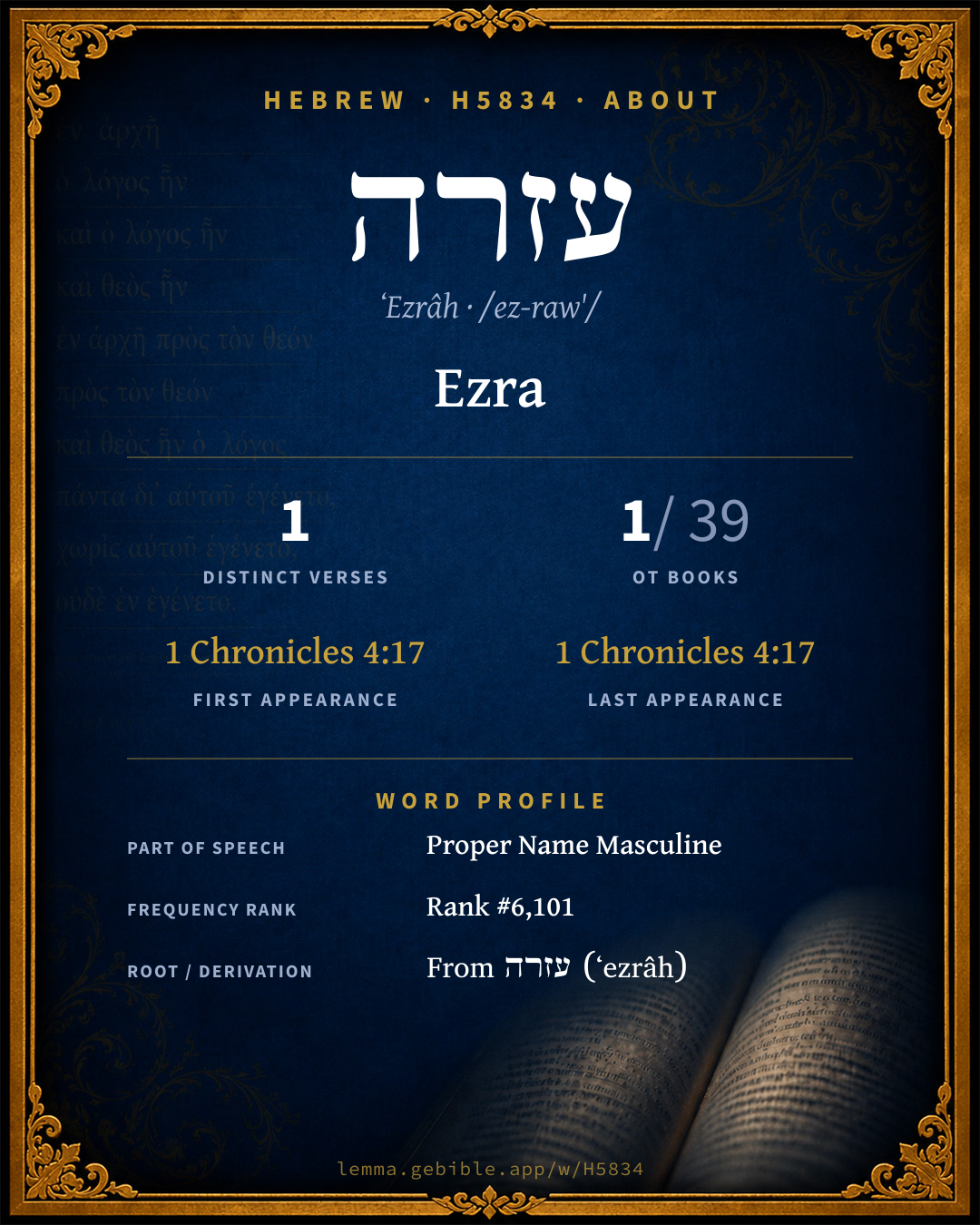
עֶזְרָה
Ezra
BDB lists 2 entries for ‘Ezra’ fuller range ↓
Full lexicon entry — Brown-Driver-Briggs (BDB)
From Brown-Driver-Briggs (BDB)
Where this word appears
Grammar key — what these labels mean
Part of speech
- Noun
- A naming word — a person, place, thing, or idea.
Noun type
- Proper
- A name of a specific person, place, or people (e.g. Abraham, Zion, Israel).
Every verse where H5834 appears — 1 distinct verse across 1 book. Click any verse to open its interlinear word-by-word view. Verse text shown in the World English Bible for context — . Each verse’s Hebrew form is shown with its reference; the English is not keyword-highlighted, since the data carries no word-level English alignment. Use “Compare translations” on any verse to read it across multiple English versions. This concordance covers the Hebrew Bible; Septuagint (Greek Old Testament) occurrences are not indexed here.
1 Chronicles 1 verse
About this entry
At a glance — auto-summarized from this page’s data, not written by a person. Every figure links to its source below. This summary describes the numbers; it doesn’t interpret them.
עזרה — transliterated ʻEzrâh — is a Hebrew name carrying the sense “Ezra.” A scarce word — 1 verse in all of the Hebrew Bible. More than three-quarters of its appearances fall in 1 Chronicles. Scripture uses it exactly once, at 1 Chronicles 4:17. Each statement above links to its evidence; the full detail follows below.
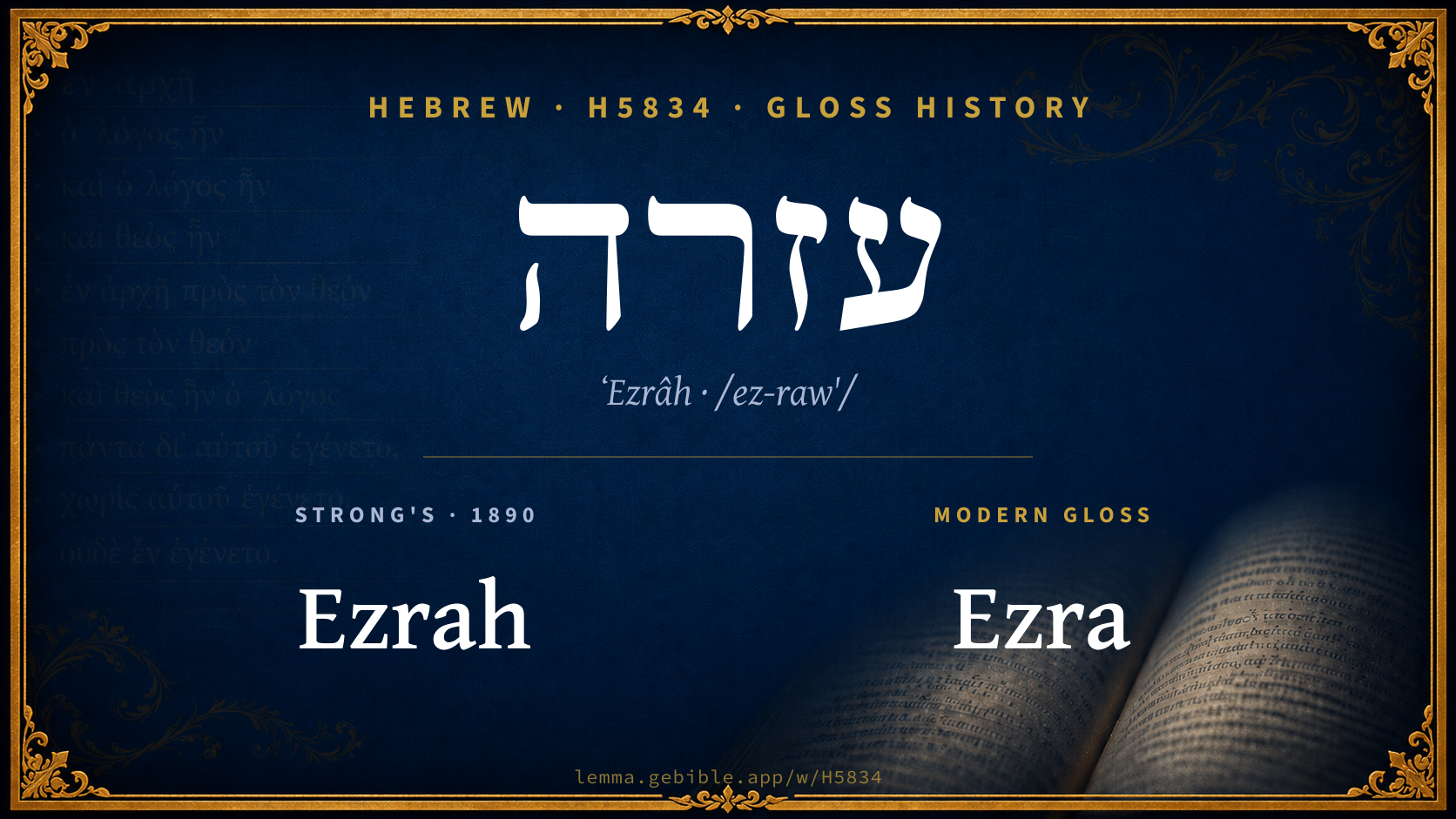
Gloss history
Strong's 1890 vs modern scholarship
About this word
Strong's H5834 catalogs a Hebrew word from the Hebrew Old Testament.
These counts are not copied from any lexicon or concordance. They are computed here, from the morphology-tagged Hebrew Old Testament. What Lemma adds →
- 1
- distinct verses
- The word appears in 1 distinct verse.
- 1 / 39
- OT books
- The word appears in 1 of 39 Old Testament books.
- #6,101
- by frequency
- Rank #6,101 (rank 6,101 of 8,640 Hebrew words by occurrence).
View all 1 occurrence in the concordance →
Most concentrated in
- 1 Chronicles 1 verse 100%
By section of the Old Testament
By traditional corpus
Conventional, traditional groupings — biblical authorship is debated, so this is a traditional corpus grouping, not an authorship claim. Each share is this word’s portion of its verses in that division of the Hebrew canon. Each figure is a share of the word’s 1 distinct verse.
- Writings (Ketuvim) 1 verse · 100%
How translations render this word
Counts come from each version’s own published word-to-Strong’s tagging or interlinear alignment — an approximate guide to how each version renders this word, not a word-level alignment the data otherwise carries. Because each total is that version’s own tagged count, the per-version totals vary from one another and need not match the appearance or distinct-verse counts above. These counts may also differ from a printed concordance because Lemma counts each distinctly tagged rendering and does not collapse phrase taggings into a single head-word total. This is a fixed set of word-tagged versions (KJV, ASV, BSB, ULT) and does not change with the reading translation you choose elsewhere. Each version’s license is shown beside its name below (and on Sources).
BDB lists this Strong’s number as 2 distinct words (homographs). Each count above pools all of them and is not split by sense — see the Senses section below. A low-frequency rendering may belong to a different one of those words, not the primary meaning.
- King James Version†: Ezra 1×
- American Standard Version†: Ezrah 1×
- Berean Standard Bible†: Ezrah 1×
- unfoldingWord Literal Text†: Ezrah 1×
King James Version Public Domain
Renders H5834 across 1† tagged occurrence — most commonly:
American Standard Version Public Domain
Renders H5834 across 1† tagged occurrence — most commonly:
Berean Standard Bible Public Domain
Renders H5834 across 1† tagged occurrence — most commonly:
unfoldingWord Literal Text CC BY-SA 4.0
Renders H5834 across 1† tagged occurrence — most commonly:
Senses in the full BDB
What do BDB’s symbols mean?
BDB uses these scholarly abbreviations:
| Symbol | Meaning |
|---|---|
| 𝔊 | the Septuagint (the ancient Greek translation, LXX) |
| 𝔙 | the Vulgate (the Latin translation) |
| 𝔖 | the Syriac version (the Peshitta) |
| 𝔗 | the Targum (the Aramaic translation) |
| ψ | the Psalms |
| √ | root (the underlying root or stem) |
| ‖ | parallel passage (a synonymous or contrasted parallel) |
| † | the dagger: every passage where the word occurs is cited |
The 4 senses and sub-senses the full Brown-Driver-Briggs lexicon distinguishes for this word, in lexicon order (not ranked by frequency), with BDB’s own verbatim wording and sub-sense lettering. Shown in Hebrew script with BDB’s own scholarly abbreviations. The condensed entry is in the Lexicon Entry tab.
עזרה I help, succour, assistance
- 1. help, succour Is 10:3; 20:6 (+ לְהִנָּצֵל), 31:1; Je 37:7;La 4:17; Jb 6:13; 2 Ch 28:21; ע׳ פֹּעֲלֵי אָ֑וֶן Is 31:2 help from, etc.; ע׳ י׳ Ju 5:23(×2) help of (for) י׳; from י׳ ψ 22:20, 38:23; 40:14 (‖ לְהַצִּילֵנִי), 70:2 (‖ id.), 71:12, + מִצָּ֑ר 60:13 (‖ תְּשׁוּעָה) = 108:13. e.g. Isaiah 10:3
- 2. concr., embodied help, one who helps (cf. i. עֵזֶר 2):
- a. coll. Jb 31:21 when I saw my help (assistance, support) in the gate; בְּע׳ (v. i. עֵזֶר 2) Na 3:9. e.g. Job 31:21
- b. of י׳ ψ 27:9; 40:18 (+ מְפַלֵּט), 46:2 (‖ מַחֲסֶה, עֹז), 44:27; 63:8; 94:17; בְּע׳ 35:2. e.g. Psalms 27:9
עזרה II m. Εσρει, Ιεζραα, in Judah 1 Ch 4
Senses from the full Brown-Driver-Briggs lexicon (Brown, Driver, Briggs; Oxford 1906 — public domain), digitized via Sefaria, supplemented by the OpenScriptures HebrewLexicon (CC BY 4.0). Full attribution on Sources.
Word origin
I. n.f. help, succour, assistance;—abs. ע׳ Is 10:3 +, עֶזְרָת ψ 60:13; 108:13 (Ges§ 80 g), עֶזְרָ֫תָה ψ 63:8 + 2 times; cstr. עֶזְרַת Is 31:2 +; sf. עֶזְרָתִי ψ 22:20 +, etc.;—
II. n.pr.m. Εσρει, Ιεζραα, in Judah 1 Ch 4:17.
— Brown-Driver-Briggs (Oxford 1906, public domain), digitized via Sefaria, supplemented by the OpenScriptures HebrewLexicon (CC BY 4.0). See Sources.
Derived from עזרה (ʻezrâh) (H5833) — help.
Jastrow Dictionary
A second Hebrew/Aramaic lexicon for comparison, covering Aramaic and post-biblical (Talmudic, Targumic, Midrashic) usage that the biblical-Hebrew BDB does not. Matched by lemma rather than by Strong’s number, so a lemma may carry more than one Jastrow headword (shown separately below), and the entries cover usage well beyond the Bible.
עֶזְרָה I
- pr. n. m., v. עֶזְרָא
עֶזְרָה II
- help. Taan. III, 7 (19ᵃ) לע׳ ולא לצעקה (you may blow the alarm on the Sabbath to summon people) for help, but not for prayer. Kidd. 6ᵃ עֶזְרָתִי מהו (if one says to a woman) ‘be my help’, how is it (is she betrothed)?, v. עֵזֶר.
עֲזָרָה
- enclosure, esp. Temple court. Midd. I, 4 שבעה שערים היו בע׳ the Temple court had seven gates. Ib. II, 5 עֶזְרַת הנשים the women’s compartment in the Temple court; עזרת ישראל the men’s compartment (for non-priests). Ib. 6 כל הע׳ וכ׳ the whole ʿĂzarah was one hundred and seventy five cubits long &c.; a. v. fr.—ספר הע׳ the copy of the Torah used in the Temple court. M. Kat. III, 4 (18ᵇ) ספר הע׳ (Var. עזרא the copy deposited by Ezra). B. Bath. 14ᵇ top. Kel. XV, 6; a. fr.
A Dictionary of the Targumim, the Talmud Babli and Yerushalmi, and the Midrashic Literature (Marcus Jastrow; London, Luzac, 1903) — Public Domain. Digitized via Sefaria. Digitized via Sefaria. Full attribution on Sources.
Same root — word family
Other BDB entries built from the same root as H5834, grouped by Strong’s listed origin. These share a root / origin per the lexicon — not necessarily a shared meaning. Each links to that word’s own entry.
Derives from
Proper names from this root
People and places named from this root — a name, not an additional meaning of the word.
Compare all same-root words → 1 of the same-root words is a proper name (a person or place). They share a root, not necessarily a meaning.
Bible dictionary
Public-domain dictionary articles matched to this entry by name (Ezra). A biblical name can be shared by more than one person or place, so an article may treat several.
Easton's Bible Dictionary · M. G. Easton, 1897
Help. (1.) A priest among those that returned to Jerusalem under Zerubabel (Neh. 12:1).
(2.) The "scribe" who led the second body of exiles that returned from Babylon to Jerusalem B.C. 459, and author of the book of Scripture which bears his name. He was the son, or perhaps grandson, of Seraiah (2 Kings 25:18-21), and a lineal descendant of Phinehas, the son of Aaron (Ezra 7:1-5). All we know of his personal history is contained in the last four chapters of his book, and in Neh. 8 and 12:26.
In the seventh year of the reign of Artaxerxes Longimanus (see DARIUS), he obtained leave to go up to Jerusalem and to take with him a company of Israelites (Ezra 8). Artaxerxes manifested great interest in Ezra's undertaking, granting him "all his request," and loading him with gifts for the house of God. Ezra assembled the band of exiles, probably about 5,000 in all, who were prepared to go up with him to Jerusalem, on the banks of the Ahava, where they rested for three days, and were put into order for their march across the desert, which was completed in four months. His proceedings at Jerusalem on his arrival there are recorded in his book.
He was "a ready scribe in the law of Moses," who "had prepared his heart to seek the law of the Lord and to do it, and to teach in Israel statutes and judgments." "He is," says Professor Binnie, "the first well-defined example of an order of men who have never since ceased in the church; men of sacred erudition, who devote their lives to the study of the Holy Scriptures, in order that they may be in a condition to interpret them for the instruction and edification of the church. It is significant that the earliest mention of the pulpit occurs in the history of Ezra's ministry (Neh. 8:4). He was much more of a teacher than a priest. We learn from the account of his labours in the book of Nehemiah that he was careful to have the whole people instructed in the law of Moses; and there is no reason to reject the constant tradition of the Jews which connects his name with the collecting and editing of the Old Testament canon. The final completion of the canon may have been, and probably was, the work of a later generation; but Ezra seems to have put it much into the shape in which it is still found in the Hebrew Bible. When it is added that the complete organization of the synagogue dates from this period, it will be seen that the age was emphatically one of Biblical study" (The Psalms: their History, etc.).
For about fourteen years, i.e., till B.C. 445, we have no record of what went on in Jerusalem after Ezra had set in order the ecclesiastical and civil affairs of the nation. In that year another distinguished personage, Nehemiah, appears on the scene. After the ruined wall of the city had been built by Nehemiah, there was a great gathering of the people at Jerusalem preparatory to the dedication of the wall. On the appointed day the whole population assembled, and the law was read aloud to them by Ezra and his assistants (Neh. 8:3). The remarkable scene is described in detail. There was a great religious awakening. For successive days they held solemn assemblies, confessing their sins and offering up solemn sacrifices. They kept also the feast of Tabernacles with great solemnity and joyous enthusiasm, and then renewed their national covenant to be the Lord's. Abuses were rectified, and arrangements for the temple service completed, and now nothing remained but the dedication of the walls of the city (Neh. 12).
Smith's Bible Dictionary · William Smith, 1863
(help), called Esdras in the Apocrypha, the famous scribe and priest. He was a learned and pious priest residing at Babylon in the time of Artaxerxes Longimanus. The origin of his influence with the king does not appear, but in the seventh year of his reign he obtained leave to go to Jerusalem, and to take with him a company of Israelites. (B.C. 457.) The journey from Babylon to Jerusalem took just four months; and the company brought with them a large freewill offering of gold and silver, and silver vessels. It appears that Ezra's great design was to effect a religious reformation among the Palestine Jews. His first step was to enforce separation upon all who had married foreign wives. (Ezra 10:1) ... This was effected in little more than six months after his arrival at Jerusalem. With the detailed account of this important transaction Ezra's autobiography ends abruptly, and we hear nothing more of him till, thirteen years afterwards, in the twentieth of Artaxerxes, we find him again at Jerusalem with Nehemiah. It seems probable that after effecting the above reformations he returned to the king of Persia. The functions he executed under Nehemiah's government were purely of a priestly and ecclesiastical character. The date of his death is uncertain. There was a Jewish tradition that he was buried in Persia. The principal works ascribed to him by the Jews are--
+ The instruction of the great synagogue; + The settling the canon of Scripture, and restoring, correcting and editing the whole sacred volume; + The introduction of the Chaldee character instead of the old Hebrew or Samaritan; + The authorship of the books of Chronicles, Ezra, Nehemiah, and, some add, Esther; and, many of the Jews say, also of the books of Ezekiel, Daniel, and the twelve prophets; + The establishment of synagogues.
Hitchcock's Bible Names Dictionary · Roswell D. Hitchcock, 1869
help; court
Classic public-domain reference works; full attribution on Sources.
Septuagint verse parallels
This word appears in 1 verse that also exists in the Greek Old Testament (Septuagint), out of the 1 Hebrew verse it occurs in. You can read those verses in Greek by switching the Old Testament edition to the Septuagint.
Read these verses in the Septuagint
This is a verse-level parallel only — the same verses exist in both the Hebrew and Greek Old Testaments. No word-level Hebrew↔Greek correspondence is claimed: the data carries no such alignment, so no Greek word is shown as this Hebrew word’s translation. Coverage is not total — the Septuagint omits the deuterocanon and renumbers the Psalms, so some Hebrew verses have no direct Greek parallel.