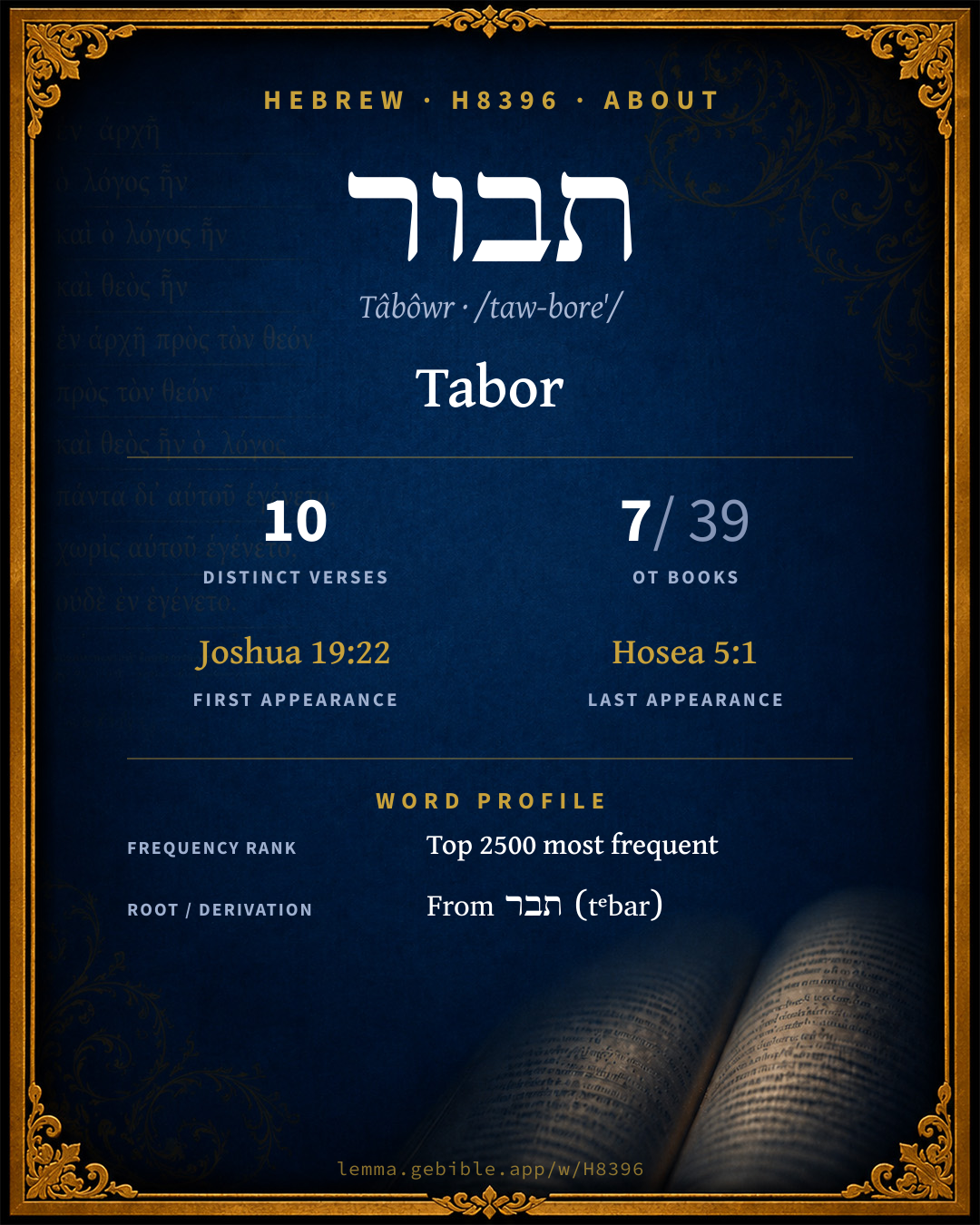
תָּבוֹר
Tabor
BDB lists 5 entries for ‘Tabor’ fuller range ↓
Full lexicon entry — Brown-Driver-Briggs (BDB)
From Brown-Driver-Briggs (BDB)
Where this word appears
Grammar key — what these labels mean
Part of speech
- Noun
- A naming word — a person, place, thing, or idea.
Noun type
- Proper
- A name of a specific person, place, or people (e.g. Abraham, Zion, Israel).
Every verse where H8396 appears in the Book of Judges — 4 distinct verses. Click any verse to open its interlinear word-by-word view. Verse text shown in the World English Bible for context — . Each verse’s Hebrew form is shown with its reference; the English is not keyword-highlighted, since the data carries no word-level English alignment. Use “Compare translations” on any verse to read it across multiple English versions. This concordance covers the Hebrew Bible; Septuagint (Greek Old Testament) occurrences are not indexed here.
Judges
- Judges 4:6 תָּב֔וֹר n Proper She sent and called Barak the son of Abinoam out of Kedesh-naphtali, and said to him, Hasn't Yahweh, the God of Israel, commanded, [saying], Go and draw to Mount Tabor, and take with you ten thousand men of the children of Naphtali and of the children of Zebulun?
- Judges 4:12 תָּבֽוֹר n Proper They told Sisera that Barak the son of Abinoam was gone up to Mount Tabor.
- Judges 4:14 תָּב֔וֹר n Proper Deborah said to Barak, Up; for this is the day in which Yahweh has delivered Sisera into your hand; hasn't Yahweh gone out before you? So Barak went down from Mount Tabor, and ten thousand men after him.
- Judges 8:18 בְּ/תָב֑וֹר prep + n Proper Then said he to Zebah and Zalmunna, What manner of men were they whom you killed at Tabor? They answered, As you are, so were they; each one resembled the children of a king.
About this entry
At a glance — auto-summarized from this page’s data, not written by a person. Every figure links to its source below. This summary describes the numbers; it doesn’t interpret them.
תבור (Tâbôwr) is a Hebrew name most often rendered “Tabor.” Debuting at Joshua 19:22, it then recurs through the corpus. The Hebrew Bible uses it across 10 verses — uncommon. Judges dominates its distribution — 4 of 10 verses. The sections below give every occurrence and version rendering.
Gloss history
Strong's 1890 vs modern scholarship
About this word
Strong's H8396 catalogs a Hebrew word from the Hebrew Old Testament.
These counts are not copied from any lexicon or concordance. They are computed here, from the morphology-tagged Hebrew Old Testament. What Lemma adds →
- 10
- distinct verses
- The word appears in 10 distinct verses.
- 7 / 39
- OT books
- The word appears in 7 of 39 Old Testament books.
- #2,342
- by frequency
- Top 2500 most frequent Hebrew words (rank 2,342 of 8,640 Hebrew words by occurrence).
View all 10 occurrences in the concordance →
By section of the Old Testament
By traditional corpus
Conventional, traditional groupings — biblical authorship is debated, so this is a traditional corpus grouping, not an authorship claim. Each share is this word’s portion of its verses in that division of the Hebrew canon. Each figure is a share of the word’s 10 distinct verses.
- Prophets (Nevi'im) 8 verses · 80%
- Writings (Ketuvim) 2 verses · 20%
How translations render this word
Counts come from each version’s own published word-to-Strong’s tagging or interlinear alignment — an approximate guide to how each version renders this word, not a word-level alignment the data otherwise carries. Because each total is that version’s own tagged count, the per-version totals vary from one another and need not match the appearance or distinct-verse counts above. These counts may also differ from a printed concordance because Lemma counts each distinctly tagged rendering and does not collapse phrase taggings into a single head-word total. This is a fixed set of word-tagged versions (KJV, ASV, BSB, ULT) and does not change with the reading translation you choose elsewhere. Each version’s license is shown beside its name below (and on Sources).
- King James Version: Tabor 9×
- American Standard Version: Tabor 8×
- Berean Standard Bible: Tabor 9×
- unfoldingWord Literal Text: Tabor 9×
King James Version Public Domain
Renders H8396 across 10 tagged occurrences — most commonly:
Plus 1 rendering that appears only once — usually multi-word phrases or single function words the recovered tagging swept in, not distinct renderings.
American Standard Version Public Domain
Renders H8396 across 10 tagged occurrences — most commonly:
Plus 2 renderings that appear only once — usually multi-word phrases or single function words the recovered tagging swept in, not distinct renderings.
Berean Standard Bible Public Domain
Renders H8396 across 10 tagged occurrences — most commonly:
Plus 1 rendering that appears only once — usually multi-word phrases or single function words the recovered tagging swept in, not distinct renderings.
unfoldingWord Literal Text CC BY-SA 4.0
Renders H8396 across 9 tagged occurrences — most commonly:
Senses in the full BDB
What do BDB’s symbols mean?
BDB uses these scholarly abbreviations:
| Symbol | Meaning |
|---|---|
| 𝔊 | the Septuagint (the ancient Greek translation, LXX) |
| 𝔙 | the Vulgate (the Latin translation) |
| 𝔖 | the Syriac version (the Peshitta) |
| 𝔗 | the Targum (the Aramaic translation) |
| ψ | the Psalms |
| √ | root (the underlying root or stem) |
| ‖ | parallel passage (a synonymous or contrasted parallel) |
| † | the dagger: every passage where the word occurs is cited |
The 4 senses and sub-senses the full Brown-Driver-Briggs lexicon distinguishes for this word, in lexicon order (not ranked by frequency), with BDB’s own verbatim wording and sub-sense lettering. Shown in Hebrew script with BDB’s own scholarly abbreviations. The condensed entry is in the Lexicon Entry tab. See also the Forms in the corpus table below.
- 1. mont. NE. edge of Great Plain, SW. of Sea of Galilee, on border of Issachar, Zeb. and Napht., mod. Jebel eṭ-Ṭûr; cf. Rel.Pal. 331ff. BurckhardtTravels, 332ff. RobBR iii. 340f. BädPal. Index, s.v. BuhlGeogr. 108 GACookeEncy. Bib., s.v.;—הַר(־)ת׳ Ju 4:6, 12, 14; ת׳ alone Ho 5:1; Je 46:18; Jos 19:22, 34 (P), ψ 89:13 (+ חֶרְמוֹן); 𝔊 Θαβωρ (so Euseb Onom.), but Ho Je Ιταβυριον, and so JosAnt. v, 1, 22 [84], BJ iv. 1, 8 [54], etc. (other Gk. forms v. Cookel.c.). e.g. Judges 4:6
- 2. loc. Ju 8:18 (too far away to be = 1 Be al.), GFM conj. טַבּוּר (9:37), Bu תֵּבֵץ (9:50); 𝔊 Θαβωρ. e.g. Judges 8:18
- 3. loc. Levit. city in Zebulun 1 Ch 6:62; appar. = כְּסֻלֹּת ת׳ Jos 19:12, and perhaps ת׳ v 22 (in Issachar), 𝔊 Θαχχεια, A 𝔊L Θαβωρ. e.g. 1 Chronicles 6:62
- 4. arbor. in אֵלוֹן ת׳ 1 S 10:3, near Bethel; 𝔊 Θαβωρ. e.g. 1 Samuel 10:3
Senses from the full Brown-Driver-Briggs lexicon (Brown, Driver, Briggs; Oxford 1906 — public domain), digitized via Sefaria, supplemented by the OpenScriptures HebrewLexicon (CC BY 4.0). Full attribution on Sources.
Word origin
Derived from תבר (tᵉbar) (H8406) — to break.
Forms in the corpus
The 7 distinct written forms H8396 takes in the Hebrew Bible, most frequent first — each parse links to that state’s occurrences in the concordance. Hebrew forms include their vowel points and cantillation, so a single lemma takes many written forms.
| Form | Parsing | Example | Uses |
|---|---|---|---|
| תָּב֔וֹר | Noun, Proper | 1 Samuel 10:3 | 3 |
| תָּבֽוֹר | Noun, Proper | Hosea 5:1 | 2 |
| בְּ/תָב֑וֹר | Noun, Proper | Judges 8:18 | 1 |
| בְּ/תָב֤וֹר | Noun, Proper | Joshua 19:22 | 1 |
| כְּ/תָב֣וֹר | Noun, Proper | Jeremiah 46:18 | 1 |
| תָּב֖וֹר | Noun, Proper | 1 Chronicles 6:77 | 1 |
| תָּב֥וֹר | Noun, Proper | Psalms 89:12 | 1 |
Bible dictionary
Public-domain dictionary articles matched to this entry by name (Tabor). A biblical name can be shared by more than one person or place, so an article may treat several.
Easton's Bible Dictionary · M. G. Easton, 1897
A height. (1.) Now Jebel et-Tur, a cone-like prominent mountain, 11 miles west of the Sea of Galilee. It is about 1,843 feet high. The view from the summit of it is said to be singularly extensive and grand. This is alluded to in Ps. 89:12; Jer. 46:18. It was here that Barak encamped before the battle with Sisera (q.v.) Judg. 4:6-14. There is an old tradition, which, however, is unfounded, that it was the scene of the transfiguration of our Lord. (See HERMON.) "The prominence and isolation of Tabor, standing, as it does, on the border-land between the northern and southern tribes, between the mountains and the central plain, made it a place of note in all ages, and evidently led the psalmist to associate it with Hermon, the one emblematic of the south, the other of the north." There are some who still hold that this was the scene of the transfiguration (q.v.).
(2.) A town of Zebulum (1 Chr. 6:77).
(3.) The "plain of Tabor" (1 Sam. 10:3) should be, as in the Revised Version, "the oak of Tabor." This was probably the Allon-bachuth of Gen. 35:8.
Smith's Bible Dictionary · William Smith, 1863
is mentioned in the lists of 1Chr 6 as a city of the Merarite Levites, in the tribe of Zebulun. ver. (1 Chronicles 6:77) The list of the towns of Zebulun. Josh 19 contains the name of Chisloth-tabor. ver. (Joshua 19:12) It is, therefore, possible, either that Chisloth-tabor is abbreviated into Tabor by the chronicler, or that by the time these later lists were compiled the Merarites had established themselves on the sacred mountain, and that Tabor is Mount Tabor.
(a mound), or Mount Tabor, one of the most interesting and remarkable of the single mountains in Palestine. It rises abruptly from the northeastern arm of the plain of Esdraelon, and stands entirely insulated, except on the west where a narrow ridge connects it with the hills of Nazareth. It presents to the eye, as seen from a distance, a beautiful appearance, being symmetrical in its proportions and rounded off like a hemisphere or the segment of a circle, yet varying somewhat as viewed from different directions. The body of the mountain consists of the peculiar limestone of the country. It is now called Jebel-et-Tur . It lies about six or eight miles almost due east from Nazareth. The ascent is usually made on the west side, near the little village of Deburieh--probably the ancient Daberath, (Joshua 19:12)--though it can be made with entire ease in other places. It requires three quarters of an hour or an hour to reach the to the top. The top of Tabor consists of an irregular platform, embracing a circuit of half an hour's walk, and commanding wide views of the subjacent plain from end to end. Tabor does not occur in the New Testament, but makes a prominent figure in the Old. The book of Joshua (Joshua 19:22) mentions it as the boundary between Issachar and Zebulun, See ver. 12. Barak, at the command of Deborah, assembled his forces on Tabor, and descended thence, with "ten thousand men after him," into the plain, and conquered Sisera on the banks of the Kishon. (Judges 4:6-15) The brothers of Gideon each of whom "resembled the children of a king," were murdered here by Zebah and Zalmunna. (Judges 8:18,19) There are at present the ruins of a fortress round all the summit of Tabor. The Latin Christians have now an altar here at which their priests from Nazareth perform an annual mass. The Greeks also have a chapel, where, on certain festivals they assemble for the celebration of religious rites. The idea that our Saviour was transfigured on Tabor prevailed extensively among the early Christians, and still reappears often in popular religious works. It is impossible, however, to acquiesce in the correctness of this opinion. It can be proved from the Old Testament and from later history that a fortress or town existed on Tabor from very early times down to B.C. 53 or 50; and as Josephus says that he strengthened the fortifications there about A.D. 60, it is morally certain that Tabor must have been inhabited during the intervening Period that is in the days of Christ. Tabor, therefore, could not have been the Mount of Transfiguration [see Hermon]; for when it is said that Jesus took his disciples "up into a high mountain apart, and was transfigured before them (Matthew 17:1,2) we must understand that he brought them to the summit of the mountain, where they were alone by themselves.
Hitchcock's Bible Names Dictionary · Roswell D. Hitchcock, 1869
choice; purity; bruising
Classic public-domain reference works; full attribution on Sources.
Septuagint verse parallels
This word appears in 8 verses that also exist in the Greek Old Testament (Septuagint), out of the 10 Hebrew verses it occurs in. You can read those verses in Greek by switching the Old Testament edition to the Septuagint.
Read these verses in the Septuagint
This is a verse-level parallel only — the same verses exist in both the Hebrew and Greek Old Testaments. No word-level Hebrew↔Greek correspondence is claimed: the data carries no such alignment, so no Greek word is shown as this Hebrew word’s translation. Coverage is not total — the Septuagint omits the deuterocanon and renumbers the Psalms, so some Hebrew verses have no direct Greek parallel.