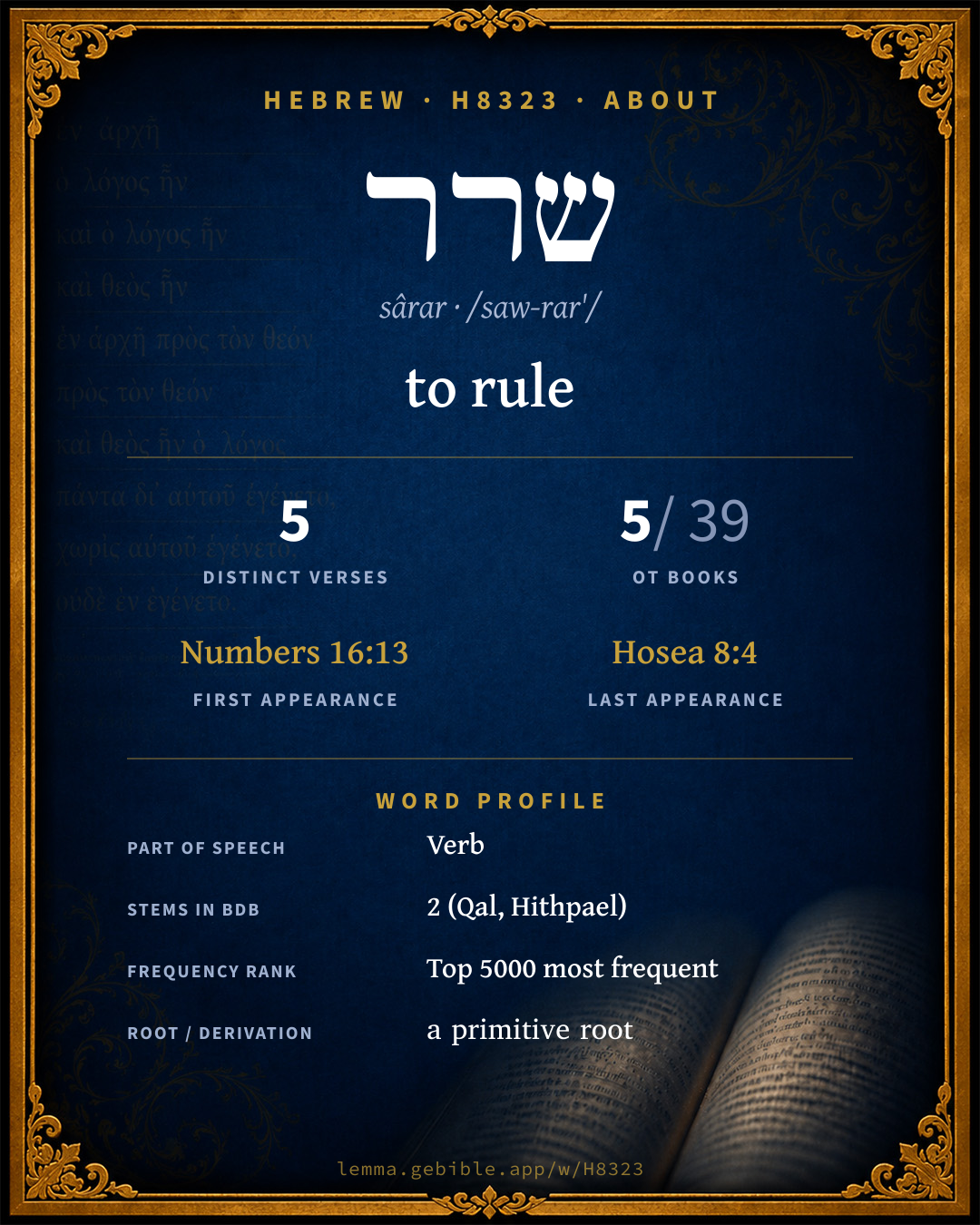
שָׂרַר
to rule
‘to rule’ is one of 3 main senses fuller range ↓
Full lexicon entry — Brown-Driver-Briggs (BDB)
From Brown-Driver-Briggs (BDB)
Where this word appears
Grammar key — what these labels mean
Part of speech
- Verb
- An action or state-of-being word.
Stem
- Qal
- The basic, simple active stem — the plain form of the verb (“he wrote”).
- Hiphil
- The causative active stem (“he caused / brought about”).
- Hithpael
- The reflexive or reciprocal stem (the subject acts on itself).
Form
- Imperfect
- An incomplete, ongoing, or future action (“he will / would write”).
- Perfect
- A completed action or state — Hebrew marks aspect (completeness) more than strict tense (“he wrote”).
- Participle Active
- A verbal adjective expressing ongoing or characteristic action (“writing / one who writes”).
- Infinitive Absolute
- An unbound verbal noun, often intensifying or standing in for a finite verb.
State
- Absolute
- The independent form of a noun, not bound to a following word.
Person
- 3rd Person
- The one spoken about (“he / she / it / they”).
- 2nd Person
- The one addressed (“you”).
Gender
- Masculine
- Grammatically masculine.
- Common
- Either gender — not distinguished for this form.
Number
- Plural
- More than one (in Hebrew, generally three or more).
- Singular
- One.
Every verse where H8323 appears in the Book of Isaiah — 1 distinct verse. Click any verse to open its interlinear word-by-word view. Verse text shown in the World English Bible for context — . Each verse’s Hebrew form is shown with its reference; the English is not keyword-highlighted, since the data carries no word-level English alignment. Use “Compare translations” on any verse to read it across multiple English versions. This concordance covers the Hebrew Bible; Septuagint (Greek Old Testament) occurrences are not indexed here.
Isaiah
About this entry
At a glance — auto-summarized from this page’s data, not written by a person. Every figure links to its source below. This summary describes the numbers; it doesn’t interpret them.
שרר (sârar) is a Hebrew verb most often rendered “to rule.” With only 5 verses it sits in the long tail of Hebrew Bible vocabulary. It first appears in Numbers 16:13. Read the stem: it spans 2 stems, including Qal and Hithpael. Sharing its root, it stands alongside שר. The sections below give every sense, occurrence, and version rendering.
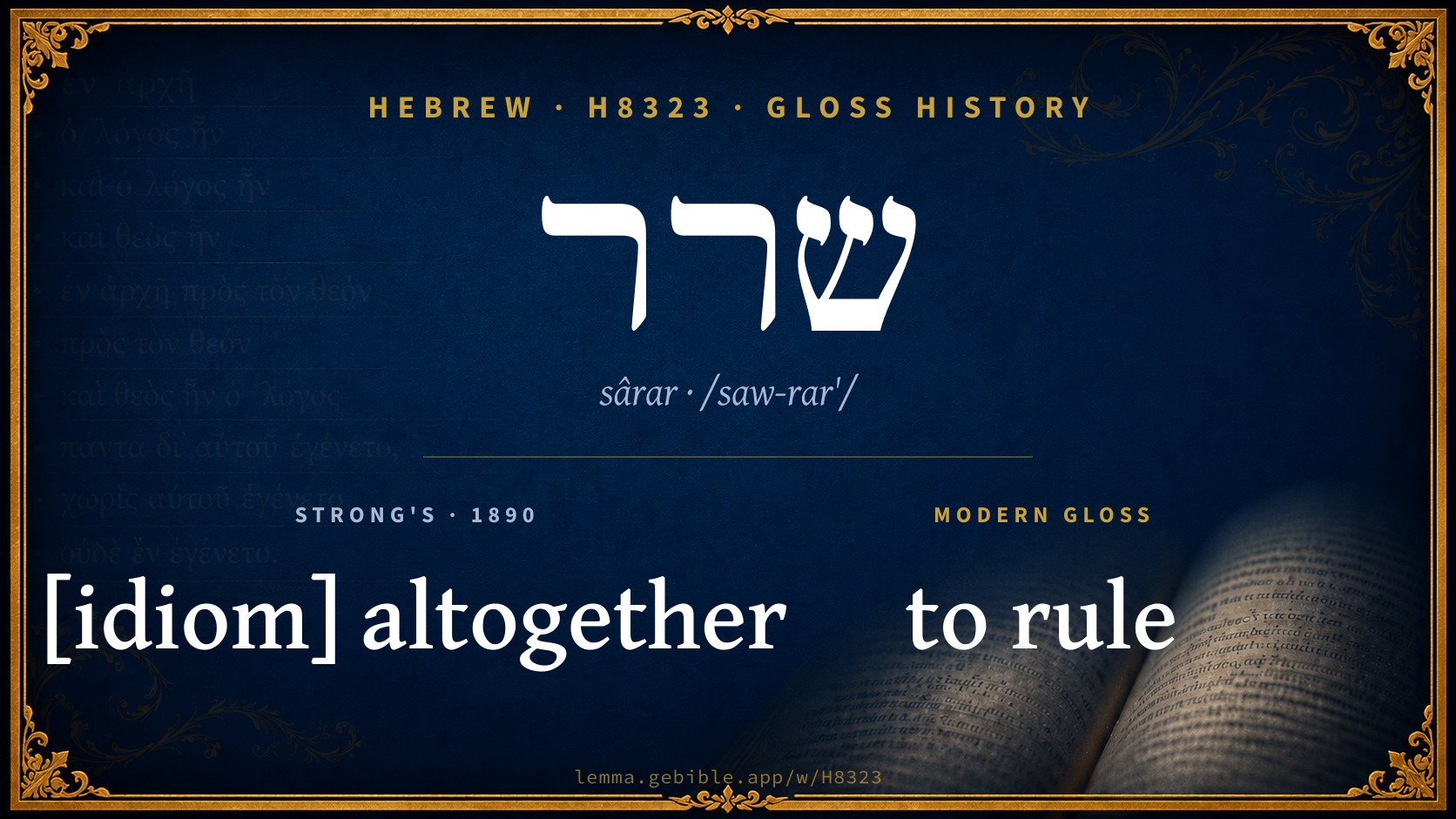
Gloss history
Strong's 1890 vs modern scholarship
About this word
Strong's H8323 catalogs a Hebrew word from the Hebrew Old Testament.
These counts are not copied from any lexicon or concordance. They are computed here, from the morphology-tagged Hebrew Old Testament. What Lemma adds →
- 5
- distinct verses
- The word appears in 5 distinct verses.
- 5 / 39
- OT books
- The word appears in 5 of 39 Old Testament books.
- #3,040
- by frequency
- Top 5000 most frequent Hebrew words (rank 3,040 of 8,640 Hebrew words by occurrence).
View all 5 occurrences in the concordance →
By section of the Old Testament
By traditional corpus
Conventional, traditional groupings — biblical authorship is debated, so this is a traditional corpus grouping, not an authorship claim. Each share is this word’s portion of its verses in that division of the Hebrew canon. Each figure is a share of the word’s 5 distinct verses.
- Prophets (Nevi'im) 2 verses · 40%
- Writings (Ketuvim) 2 verses · 40%
- Torah (Pentateuch) 1 verse · 20%
How translations render this word
Counts come from each version’s own published word-to-Strong’s tagging or interlinear alignment — an approximate guide to how each version renders this word, not a word-level alignment the data otherwise carries. Because each total is that version’s own tagged count, the per-version totals vary from one another and need not match the appearance or distinct-verse counts above. These counts may also differ from a printed concordance because Lemma counts each distinctly tagged rendering and does not collapse phrase taggings into a single head-word total. This is a fixed set of word-tagged versions (KJV, ASV, BSB, ULT) and does not change with the reading translation you choose elsewhere. Each version’s license is shown beside its name below (and on Sources).
- King James Version: Except thou make 1×, Prince 1×, Rule 1×
- American Standard Version: Prince over us 1×, Rule 1×, Shall rule 1×
- Berean Standard Bible: Appoint yourself as ruler 1×, I will deliver you 1×, Master 1×
- unfoldingWord Literal Text: Making yourself rule 1×, Rule 1×, Ruling 1×
King James Version Public Domain
Renders H8323 across 6 tagged occurrences — most commonly:
American Standard Version Public Domain
Renders H8323 across 6 tagged occurrences — most commonly:
Berean Standard Bible Public Domain
Renders H8323 across 5 tagged occurrences — most commonly:
Not rendered by a distinct English word in 1 further occurrence.
unfoldingWord Literal Text CC BY-SA 4.0
Renders H8323 across 6 tagged occurrences — most commonly:
Senses in the full BDB
Hebrew verbs can shift meaning by stem (binyan): Qal is the basic action, Niphal is often passive or reflexive, Piel often intensifies or makes it factitive, and Hiphil is typically causative. The senses below are grouped under the stem BDB assigns to each. This entry also uses Hithpael (reflexive or reciprocal).
What do BDB’s symbols mean?
BDB uses these scholarly abbreviations:
| Symbol | Meaning |
|---|---|
| 𝔊 | the Septuagint (the ancient Greek translation, LXX) |
| 𝔙 | the Vulgate (the Latin translation) |
| 𝔖 | the Syriac version (the Peshitta) |
| 𝔗 | the Targum (the Aramaic translation) |
| ψ | the Psalms |
| √ | root (the underlying root or stem) |
| ‖ | parallel passage (a synonymous or contrasted parallel) |
| † | the dagger: every passage where the word occurs is cited |
The 2 senses and sub-senses the full Brown-Driver-Briggs lexicon distinguishes for this word, in lexicon order (not ranked by frequency), with BDB’s own verbatim wording and sub-sense lettering. Shown in Hebrew script with BDB’s own scholarly abbreviations. The condensed entry is in the Lexicon Entry tab. See also the Forms in the corpus table below.
Qal
- Impf. 3 ms. וַיָּ֫שַׂר עַל־יִשְׂרָאֵל Ju 9:22 Abim. ruled over Isr. three years; 3 mpl. שָׂרִים … יָשׂ֑רוּ Is 32:1 princes shall govern (prince it) justly (‖ יִמְלָךְ־מֶלֶךְ), cf. Pr 8:16; Pt. לִהְיוֹת … שֹׂרֵר Est 1:22 that every man should bear rule בְּבֵיתוֹ. e.g. Judges 9:22
Hithpael
- Impf., 2 ms. + Inf. abs. כִּי־תִשְׂתָּרֵר עָלֵינוּ גַּס־הִשְׂתָּרֵר Nu 16:13 that thou shouldst also keep playing the prince over us.—יָסֹר 1 Ch 15:22 v. יָסַר Qal and שַׂר 4 b. Hiph. Pf. 3 pl. metapl. הֵשִׂירוּ (Ges§ 67 v) Ho 8:4 they made princes (abs.; ‖ הִמְלִיכוּ). e.g. Numbers 16:13
Senses from the full Brown-Driver-Briggs lexicon (Brown, Driver, Briggs; Oxford 1906 — public domain), digitized via Sefaria, supplemented by the OpenScriptures HebrewLexicon (CC BY 4.0). Full attribution on Sources.
Word origin
vb. denom. (Gerber20) be, or act as, prince, rule;—
— Brown-Driver-Briggs (Oxford 1906, public domain), digitized via Sefaria, supplemented by the OpenScriptures HebrewLexicon (CC BY 4.0). See Sources.
Origin: a primitive root
Jastrow Dictionary
A second Hebrew/Aramaic lexicon for comparison, covering Aramaic and post-biblical (Talmudic, Targumic, Midrashic) usage that the biblical-Hebrew BDB does not. Matched by lemma rather than by Strong’s number, so a lemma may carry more than one Jastrow headword (shown separately below), and the entries cover usage well beyond the Bible.
שָֹרַר
- (b. h.) to be great, to rule.
- to make one’s self lord; (homilet.; cmp. שִׁרְבֵּב) to stretch one’s self. Yoma 9ᵇ (play on מהשֹתֹרֹעֹ, Is. XXVIII, 20) קצר מצע זה מֵהִשְׂ֗תָּ֗רֵר עליו שני ר̇ע̇ים כאחד this couch is too narrow for two lovers to stretch themselves on it (Ms. O. a. Yalk. Is. 302 מהשתרע, v. שָׂרַע); Snh. 103ᵇ מִלְּהִשְׂתָּרֵר. e.g. Isaiah 28:20
שָׁרָר
- , with suffix שָׁרְר׳; שרר to knot, chain) navel, umbilical cord. Num. R. s. 14 (ref. to Cant. VII, 3) והיא משולה בש׳ and it (the Sanhedrin) is compared to the navel; מה הש׳ הזה וכ׳ as the navel is placed in the centre of the body, so are the Sanhedrin &c.; Tanḥ. Ki Thissa 2 (in parallels טיבור). Ib. מה הש׳ הזה … ומן הש׳ הוא אוכל וכ׳ as with regard to the umbilical cord, so long as the child is in its mother’s womb, its mouth is closed, and it is fed from the umbilical cord, so &c. Tanḥ. Thazr. 5 שׁוֹרְרוֹ יוצא עמו וכ׳ its navel comes out with it (the infant) …, and the mother has to cut it off. e.g. Song of Solomon 7:3
שְׁרַר
- (preced.) to chain, knot.—Part. pass. שָׁרִיר, q. v.
- to make strong, hard. Sabb. 74ᵇ מהו דתימא לשָׁרוּרֵי מנא וכ׳ you may have thought that (by putting a green plug into a stove) he intends to make of it a hard coulter (v. מָאנָא); Ab. Zar. 38ᵃ
- to become hard. Nidd. 48ᵇ top אִשְׁתָּרוּר דדיך Var. Ar. ed. Koh. s. v. כרף thy breasts have become hard, v. שְׁדַר II, a. כְּרף.
A Dictionary of the Targumim, the Talmud Babli and Yerushalmi, and the Midrashic Literature (Marcus Jastrow; London, Luzac, 1903) — Public Domain. Digitized via Sefaria. Digitized via Sefaria. Full attribution on Sources.
Forms in the corpus
The 6 distinct written forms H8323 takes in the Hebrew Bible, most frequent first — each parse links to that stem’s occurrences in the concordance. Hebrew forms include their vowel points and cantillation, so a single lemma takes many written forms.
| Form | Parsing | Example | Uses |
|---|---|---|---|
| הִשְׂתָּרֵֽר | Verb, Hithpael, Infinitive Absolute | Numbers 16:13 | 1 |
| הֵשִׂ֖ירוּ | Verb, Hiphil, Perfect, 3rd Person, Common, Plural | Hosea 8:4 | 1 |
| יָשֹׂ֑רוּ | Verb, Qal, Imperfect, 3rd Person, Masculine, Plural | Proverbs 8:16 | 1 |
| יָשֹֽׂרוּ | Verb, Qal, Imperfect, 3rd Person, Masculine, Plural | Isaiah 32:1 | 1 |
| שֹׂרֵ֣ר | Verb, Qal, Participle Active, Masculine, Singular, Absolute | Esther 1:22 | 1 |
| תִשְׂתָּרֵ֥ר | Verb, Hithpael, Imperfect, 2nd Person, Masculine, Singular | Numbers 16:13 | 1 |
Same root — word family
Other BDB entries built from the same root as H8323, grouped by Strong’s listed origin. These share a root / origin per the lexicon — not necessarily a shared meaning. Each links to that word’s own entry.
Derived from this word
Compare all same-root words → They share a root, not necessarily a meaning.
Septuagint verse parallels
This word appears in 5 verses that also exist in the Greek Old Testament (Septuagint), out of the 5 Hebrew verses it occurs in. You can read those verses in Greek by switching the Old Testament edition to the Septuagint.
Read these verses in the Septuagint
This is a verse-level parallel only — the same verses exist in both the Hebrew and Greek Old Testaments. No word-level Hebrew↔Greek correspondence is claimed: the data carries no such alignment, so no Greek word is shown as this Hebrew word’s translation. Coverage is not total — the Septuagint omits the deuterocanon and renumbers the Psalms, so some Hebrew verses have no direct Greek parallel.