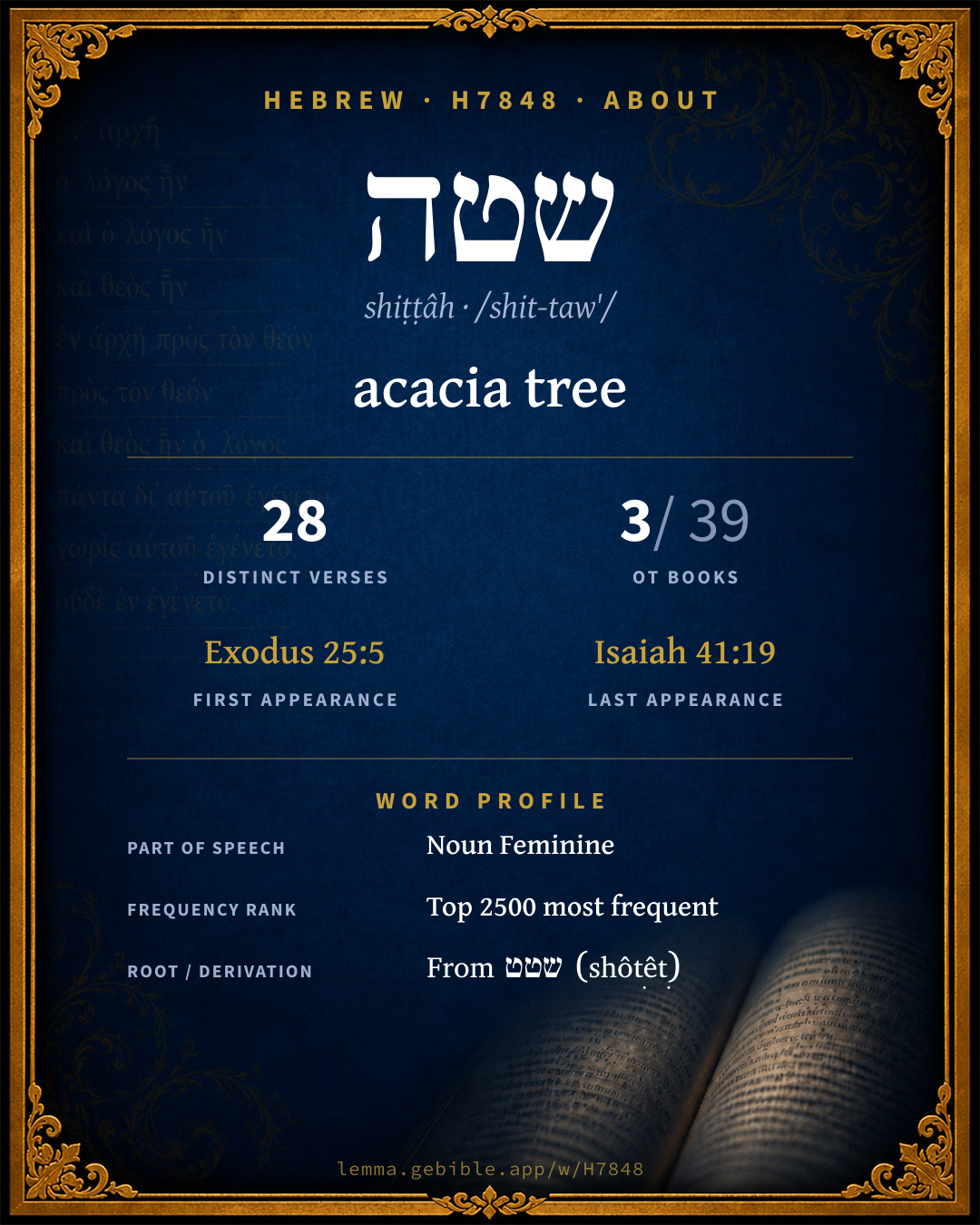
שִׁטָּה
acacia tree
Full lexicon entry — Brown-Driver-Briggs (BDB)
From Brown-Driver-Briggs (BDB)
Where this word appears
Grammar key — what these labels mean
Part of speech
- Noun
- A naming word — a person, place, thing, or idea.
Noun type
- Common
- A common noun — a general class of person, place, or thing (“king,” “city,” “water”), not a specific name.
State
- Absolute
- The independent form of a noun, not bound to a following word.
Gender
- Feminine
- Grammatically feminine.
Number
- Plural
- More than one (in Hebrew, generally three or more).
- Singular
- One.
Every verse where H7848 appears in the Book of Isaiah — 1 distinct verse. Click any verse to open its interlinear word-by-word view. Verse text shown in the World English Bible for context — . Each verse’s Hebrew form is shown with its reference; the English is not keyword-highlighted, since the data carries no word-level English alignment. Use “Compare translations” on any verse to read it across multiple English versions. This concordance covers the Hebrew Bible; Septuagint (Greek Old Testament) occurrences are not indexed here.
Isaiah
About this entry
At a glance — auto-summarized from this page’s data, not written by a person. Every figure links to its source below. This summary describes the numbers; it doesn’t interpret them.
“acacia tree” is the headline sense of the Hebrew noun שטה (shiṭṭâh). More than three-quarters of its appearances fall in Exodus. The Hebrew Bible uses it across 28 verses — moderately common. Its earliest occurrence is Exodus 25:5. Its English rendering has broadened — “shittim” classically, “acacia” (Berean Standard Bible) and “acacias” (unfoldingWord Literal Text) in modern versions; see the renderings breakdown. The sections below give every sense, occurrence, and version rendering.
Gloss history
Strong's 1890 vs modern scholarship
About this word
Strong's H7848 catalogs a Hebrew word from the Hebrew Old Testament.
These counts are not copied from any lexicon or concordance. They are computed here, from the morphology-tagged Hebrew Old Testament. What Lemma adds →
- 28
- distinct verses
- The word appears in 28 distinct verses.
- 3 / 39
- OT books
- The word appears in 3 of 39 Old Testament books.
- #1,190
- by frequency
- Top 2500 most frequent Hebrew words (rank 1,190 of 8,640 Hebrew words by occurrence).
View all 28 occurrences in the concordance →
Most concentrated in
- Exodus 26 verses 93%
- Deuteronomy 1 verse 4%
- Isaiah 1 verse 4%
By section of the Old Testament
By traditional corpus
Conventional, traditional groupings — biblical authorship is debated, so this is a traditional corpus grouping, not an authorship claim. Each share is this word’s portion of its verses in that division of the Hebrew canon. Each figure is a share of the word’s 28 distinct verses.
- Torah (Pentateuch) 27 verses · 96%
- Prophets (Nevi'im) 1 verse · 4%
How translations render this word
Counts come from each version’s own published word-to-Strong’s tagging or interlinear alignment — an approximate guide to how each version renders this word, not a word-level alignment the data otherwise carries. Because each total is that version’s own tagged count, the per-version totals vary from one another and need not match the appearance or distinct-verse counts above. These counts may also differ from a printed concordance because Lemma counts each distinctly tagged rendering and does not collapse phrase taggings into a single head-word total. This is a fixed set of word-tagged versions (KJV, ASV, BSB, ULT) and does not change with the reading translation you choose elsewhere. Each version’s license is shown beside its name below (and on Sources).
- King James Version: Shittim 27×
- American Standard Version: Acacia 26×
- Berean Standard Bible: Acacia 24×, Acacia wood 3×
- unfoldingWord Literal Text: Acacias 23×, Acacia wood 3×, Acacia 2×
King James Version Public Domain
Renders H7848 across 28 tagged occurrences — most commonly:
Plus 1 rendering that appears only once — usually multi-word phrases or single function words the recovered tagging swept in, not distinct renderings.
American Standard Version Public Domain
Renders H7848 across 28 tagged occurrences — most commonly:
Plus 2 renderings that appear only once — usually multi-word phrases or single function words the recovered tagging swept in, not distinct renderings.
Berean Standard Bible Public Domain
Renders H7848 across 28 tagged occurrences — most commonly:
Plus 1 rendering that appears only once — usually multi-word phrases or single function words the recovered tagging swept in, not distinct renderings.
unfoldingWord Literal Text CC BY-SA 4.0
Renders H7848 across 28 tagged occurrences — most commonly:
Senses in BDB
The 1 sense BDB distinguishes for this word, in lexicon order (not ranked by frequency or importance). The full entry — with sub-senses — is in the Lexicon Entry tab.
- acacia tree, acacia wood
Word origin
n.f. acacia, tree and wood (= שִׁנְטָה*, Arabic سَنْطٌ, prob. loan-word from Egyptian šndt, šondet, Thes1452 ErmanZMG xivi (1892), 120);—growing in dry places; especially acacia (mimosa) Nilotica; cf. RobBR ii. 20, or a. seyyâl PostFlora 298 f. Hast. DB Shittah-tree TristrNHB 390 ff.;—שׁ׳ sg. Is 41:19 (to grow in desert); usually pl., עֲצֵי שִׁטִּים shiṭṭîm wood, material of ark, altars, staves, etc., in tabern., Dt 10:3; Ex 25:5, 10, 13 + 19 times Ex 25–38 (P); עֲצֵי om., עַמּוּדֵי שׁ׳ pillars of shiṭṭîm (wood), Ex 26:32, 37; 36:36 (P).
— Brown-Driver-Briggs (Oxford 1906, public domain), digitized via Sefaria, supplemented by the OpenScriptures HebrewLexicon (CC BY 4.0). See Sources.
Derived from שטט (shôṭêṭ) (H7850) — scourge.
Jastrow Dictionary
A second Hebrew/Aramaic lexicon for comparison, covering Aramaic and post-biblical (Talmudic, Targumic, Midrashic) usage that the biblical-Hebrew BDB does not. Matched by lemma rather than by Strong’s number, so a lemma may carry more than one Jastrow headword (shown separately below), and the entries cover usage well beyond the Bible.
שִׁטָּא
- , v. sub שִׁיטּ׳.
שָׂטָה
- , v. שׂטי
שָׁטָה
- , v. שׁטי
שׂטי
- , v. סָטָה
שטי
- (cmp. סָטָה) [to go astray,] to be demented, foolish. V. שׁוֹטֶה.
- , Nithpa. נִשְׁתַּטֶּה
- 1. to become demented. Tosef. B. Kam. IV, 4 שנִישְׁטוּ בעלין ed. Zuck. (Var. שנִשְׁתַּטּוּ) whose owner became insane; B. Kam. 39ᵇ. Yeb. XIV, 1 נִשְׁתַּטֵּית וכ׳ if the wife becomes insane, he cannot divorce her; נ׳ וכ׳ if he becomes insane, he can never divorce her; a. fr.
- 2. to be mad; to rage, be impassioned. Num. R. s. 2023 היה נִשְׁטֶה אחריה וכ׳ he was mad with passion for her, as we read (Hos. IV, 11) &c.; Tanḥ. Balak 18 היו משטתה וכ׳ (read: היה מִשְׁתַּטֶּה; ed. Bub. 25 נשטה). Ib. והוא נ׳ וכ׳ and he in his rage for her slaughtered it to Baal Peor; Num. R. l. c. Tosef. Nidd. V, 17 עד מתי אתם נִשְׁטִין וכ׳ how long will you rage? cry to him that created the sea. Tanḥ. Vayera 22 והזקן הוא ה׳ וכ׳ and that old man (Abraham) has run mad, and he is going to slay thee. Yalk. Sam. 131 והיתה צועקת ומִשְׁתַּטָּה … ומִשְׁתַּטֶּה מבחוץ and she screamed and raged within, and David screamed and raged without; Midr. Till. to Ps. XXXIV והיו צועקות שתיהן ומַשְׁטוֹת … ומַשְׁטֶה בחוץ and both of them (mother and daughter) screamed and raged &c. Yalk. Ps. 846 [read:] מכאן שמשאדם רואה בנים כאילו הוא משתטה from this we learn that, when a man lives to have children, he acts like a fool (in playing with them). e.g. Hosea 4:11
- 1. same, v. supra.
- 2. (with ב) to fool, jest. Yeb. 106ᵃ; B. Kam. 116ᵃ אמר ליה משטה אני בך he may say, I was only jesting with thee. B. Bath. 175ᵃ אין אדם משטה בשעת מיתה nobody jests in his dying hour (therefore a dying man’s admission of indebtedness does not require the usual formalities to be binding).
שִׁטִּים
- v. שִׁיטָּה.
A Dictionary of the Targumim, the Talmud Babli and Yerushalmi, and the Midrashic Literature (Marcus Jastrow; London, Luzac, 1903) — Public Domain. Digitized via Sefaria. Digitized via Sefaria. Full attribution on Sources.
Forms in the corpus
The 7 distinct written forms H7848 takes in the Hebrew Bible, most frequent first — each parse links to that state’s occurrences in the concordance. Hebrew forms include their vowel points and cantillation, so a single lemma takes many written forms.
| Form | Parsing | Example | Uses |
|---|---|---|---|
| שִׁטִּ֑ים | Noun, Common, Feminine, Plural, Absolute | Exodus 25:10 | 15 |
| שִׁטִּ֔ים | Noun, Common, Feminine, Plural, Absolute | Deuteronomy 10:3 | 6 |
| שִׁטִּ֖ים | Noun, Common, Feminine, Plural, Absolute | Exodus 26:15 | 3 |
| שִׁטִּ֛ים | Noun, Common, Feminine, Plural, Absolute | Exodus 35:24 | 1 |
| שִׁטִּֽים | Noun, Common, Feminine, Plural, Absolute | Exodus 25:5 | 1 |
| שִׁטָּ֔ה | Noun, Common, Feminine, Singular, Absolute | Isaiah 41:19 | 1 |
| שִׂטִּֽים | Noun, Common, Feminine, Plural, Absolute | Exodus 35:7 | 1 |
Same root — word family
Other BDB entries built from the same root as H7848, grouped by Strong’s listed origin. These share a root / origin per the lexicon — not necessarily a shared meaning. Each links to that word’s own entry.
Derives from
Shares the same root
Proper names from this root
People and places named from this root — a name, not an additional meaning of the word.
Compare all same-root words → 1 of the same-root words is a proper name (a person or place). They share a root, not necessarily a meaning.
Septuagint verse parallels
This word appears in 26 verses that also exist in the Greek Old Testament (Septuagint), out of the 28 Hebrew verses it occurs in. You can read those verses in Greek by switching the Old Testament edition to the Septuagint.
Read these verses in the Septuagint
This is a verse-level parallel only — the same verses exist in both the Hebrew and Greek Old Testaments. No word-level Hebrew↔Greek correspondence is claimed: the data carries no such alignment, so no Greek word is shown as this Hebrew word’s translation. Coverage is not total — the Septuagint omits the deuterocanon and renumbers the Psalms, so some Hebrew verses have no direct Greek parallel.