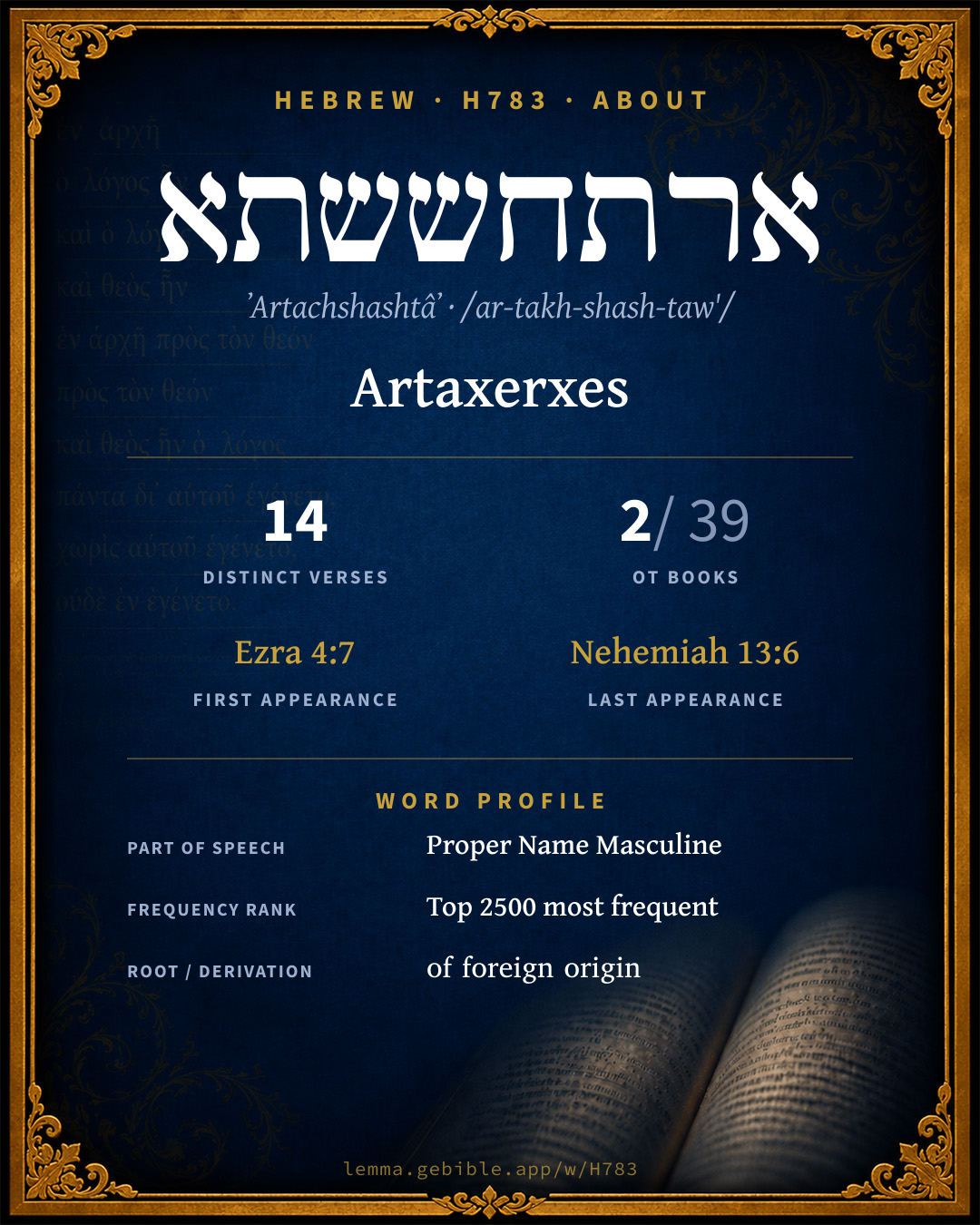
ארתחששתא
Artaxerxes
BDB lists 2 entries for ‘Artaxerxes’ fuller range ↓
Full lexicon entry — Brown-Driver-Briggs (BDB)
From Brown-Driver-Briggs (BDB)
Where this word appears
Grammar key — what these labels mean
Part of speech
- Noun
- A naming word — a person, place, thing, or idea.
Noun type
- Proper
- A name of a specific person, place, or people (e.g. Abraham, Zion, Israel).
Every verse where H783 appears in the Book of Ezra — 11 distinct verses. Click any verse to open its interlinear word-by-word view. Verse text shown in the World English Bible for context — . Each verse’s Hebrew form is shown with its reference; the English is not keyword-highlighted, since the data carries no word-level English alignment. Use “Compare translations” on any verse to read it across multiple English versions. This concordance covers the Hebrew Bible; Septuagint (Greek Old Testament) occurrences are not indexed here.
Ezra
- Ezra 4:7 אַרְתַּחְשַׁ֗שְׂתָּא ארתחששתא אַרְתַּחְשַׁ֖שְׂתְּ n Proper n Proper n Proper In the days of Artaxerxes wrote Bishlam, Mithredath, Tabeel, and the rest of his companions, to Artaxerxes king of Persia; and the writing of the letter was written in the Syrian [character], and set forth in the Syrian [language].
- Ezra 4:8 לְ/אַרְתַּחְשַׁ֥שְׂתְּא prep + n Proper Rehum the chancellor and Shimshai the scribe wrote a letter against Jerusalem to Artaxerxes the king in this sort:
- Ezra 4:11 אַרְתַּחְשַׁ֖שְׂתְּא n Proper This is the copy of the letter that they sent to Artaxerxes the king: Your servants the men beyond the River, and so forth.
- Ezra 4:23 ארתחששתא אַרְתַּחְשַׁ֣שְׂתְּ n Proper n Proper Then when the copy of king Artaxerxes' letter was read before Rehum, and Shimshai the scribe, and their companions, they went in haste to Jerusalem to the Jews, and made them to cease by force and power.
- Ezra 6:14 וְ/אַרְתַּחְשַׁ֖שְׂתְּא conj + n Proper The elders of the Jews built and prospered, through the prophesying of Haggai the prophet and Zechariah the son of Iddo. They built and finished it, according to the commandment of the God of Israel, and according to the decree of Cyrus, and Darius, and Artaxerxes king of Persia.
- Ezra 7:1 אַרְתַּחְשַׁ֣סְתְּא n Proper Now after these things, in the reign of Artaxerxes king of Persia, Ezra the son of Seraiah, the son of Azariah, the son of Hilkiah,
- Ezra 7:7 לְ/אַרְתַּחְשַׁ֥סְתְּא prep + n Proper There went up some of the children of Israel, and of the priests, and the Levites, and the singers, and the porters, and the Nethinim, to Jerusalem, in the seventh year of Artaxerxes the king.
- Ezra 7:11 אַרְתַּחְשַׁ֔סְתְּא n Proper Now this is the copy of the letter that the king Artaxerxes gave to Ezra the priest, the scribe, even the scribe of the words of the commandments of Yahweh, and of his statutes to Israel:
- Ezra 7:12 אַ֨רְתַּחְשַׁ֔סְתְּא n Proper Artaxerxes, king of kings, to Ezra the priest, the scribe of the law of the God of heaven, perfect and so forth.
- Ezra 7:21 אַרְתַּחְשַׁ֤סְתְּא n Proper I, even I Artaxerxes the king, do make a decree to all the treasurers who are beyond the River, that whatever Ezra the priest, the scribe of the law of the God of heaven, shall require of you, it be done with all diligence,
- Ezra 8:1 אַרְתַּחְשַׁ֥סְתְּא n Proper Now these are the heads of their fathers' [houses], and this is the genealogy of those who went up with me from Babylon, in the reign of Artaxerxes the king:
About this entry
At a glance — auto-summarized from this page’s data, not written by a person. Every figure links to its source below. This summary describes the numbers; it doesn’t interpret them.
The Hebrew name ארתחששתא centers on the idea of “Artaxerxes.” The word gravitates to Ezra (79%), then Nehemiah. It turns up in 14 verses across 2 books, an uncommon footprint. Its earliest occurrence is Ezra 4:7. For the data behind this summary, explore 14-verse concordance and the renderings breakdown below.
Gloss history
Strong's 1890 vs modern scholarship
About this word
Strong's H783 catalogs a Hebrew word from the Hebrew Old Testament.
These counts are not copied from any lexicon or concordance. They are computed here, from the morphology-tagged Hebrew Old Testament. What Lemma adds →
- 14
- distinct verses
- The word appears in 14 distinct verses.
- 2 / 39
- OT books
- The word appears in 2 of 39 Old Testament books.
- #1,671
- by frequency
- Top 2500 most frequent Hebrew words (rank 1,671 of 8,640 Hebrew words by occurrence).
View all 14 occurrences in the concordance →
By traditional corpus
Conventional, traditional groupings — biblical authorship is debated, so this is a traditional corpus grouping, not an authorship claim. Each share is this word’s portion of its verses in that division of the Hebrew canon. Each figure is a share of the word’s 14 distinct verses.
- Writings (Ketuvim) 14 verses · 100%
How translations render this word
Counts come from each version’s own published word-to-Strong’s tagging or interlinear alignment — an approximate guide to how each version renders this word, not a word-level alignment the data otherwise carries. Because each total is that version’s own tagged count, the per-version totals vary from one another and need not match the appearance or distinct-verse counts above. These counts may also differ from a printed concordance because Lemma counts each distinctly tagged rendering and does not collapse phrase taggings into a single head-word total. This is a fixed set of word-tagged versions (KJV, ASV, BSB, ULT) and does not change with the reading translation you choose elsewhere. Each version’s license is shown beside its name below (and on Sources).
- King James Version: Artaxerxes 14×
- American Standard Version: Artaxerxes 15×
- Berean Standard Bible: Artaxerxes 15×
- unfoldingWord Literal Text: Artaxerxes 15×
King James Version Public Domain
Renders H783 across 15 tagged occurrences — most commonly:
Plus 1 rendering that appears only once — usually multi-word phrases or single function words the recovered tagging swept in, not distinct renderings.
American Standard Version Public Domain
Renders H783 across 15 tagged occurrences — most commonly:
Berean Standard Bible Public Domain
Renders H783 across 15 tagged occurrences — most commonly:
unfoldingWord Literal Text CC BY-SA 4.0
Renders H783 across 15 tagged occurrences — most commonly:
Senses in BDB
The 2 senses BDB distinguishes for this word, in lexicon order (not ranked by frequency or importance). The full entry — with sub-senses — is in the Lexicon Entry tab.
- Artaxerxes = "I will make the spoiled to boil: I will stir myself (in) winter"
- son and successor of Xerxes as emperor of Persia, 465-424 BC
Word origin
n.pr.m. Artaxerxes (Pers. Artakhshatrâ, SpiegAPK 68, 207 𝔊 Ἀρταξερξης, cf. BeRy on Ezr 4:23; 7:1 f. Ne 1:1) א׳ Ezr 4:7 v. BD 102; אַרְתַּחְשַׁשְׂתְּא Ezr 4:7, 23, אַרְתַּחְשַׁסְתְּא Ezr 7:1, 11; 8:1 Ne 2:1; 5:14; 13:6; Artaxerxes I, or Longimanus, son & successor of Xerxes, regined b.c. 465–424.
— Brown-Driver-Briggs (Oxford 1906, public domain), digitized via Sefaria, supplemented by the OpenScriptures HebrewLexicon (CC BY 4.0). See Sources.
Origin: of foreign origin
Forms in the corpus
The 15 distinct written forms H783 takes in the Hebrew Bible, most frequent first — each parse links to that state’s occurrences in the concordance. Hebrew forms include their vowel points and cantillation, so a single lemma takes many written forms.
| Form | Parsing | Example | Uses |
|---|---|---|---|
| ארתחששתא | Noun, Proper | Ezra 4:23 | 2 |
| לְ/אַרְתַּחְשַׁ֥סְתְּא | Noun, Proper | Ezra 7:7 | 2 |
| אַ֨רְתַּחְשַׁ֔סְתְּא | Noun, Proper | Ezra 7:12 | 1 |
| אַרְתַּחְשַׁ֔סְתְּא | Noun, Proper | Ezra 7:11 | 1 |
| אַרְתַּחְשַׁ֖שְׂתְּ | Noun, Proper | Ezra 4:7 | 1 |
| אַרְתַּחְשַׁ֖שְׂתְּא | Noun, Proper | Ezra 4:11 | 1 |
| אַרְתַּחְשַׁ֗שְׂתָּא | Noun, Proper | Ezra 4:7 | 1 |
| אַרְתַּחְשַׁ֣סְתְּא | Noun, Proper | Ezra 7:1 | 1 |
| אַרְתַּחְשַׁ֣שְׂתְּ | Noun, Proper | Ezra 4:23 | 1 |
| אַרְתַּחְשַׁ֤סְתְּא | Noun, Proper | Ezra 7:21 | 1 |
| אַרְתַּחְשַׁ֥סְתְּא | Noun, Proper | Ezra 8:1 | 1 |
| וְ/אַרְתַּחְשַׁ֖שְׂתְּא | Noun, Proper | Ezra 6:14 | 1 |
| לְ/אַרְתַּחְשַׁ֣סְתְּא | Noun, Proper | Nehemiah 5:14 | 1 |
| לְ/אַרְתַּחְשַׁ֤סְתְּא | Noun, Proper | Nehemiah 13:6 | 1 |
| לְ/אַרְתַּחְשַׁ֥שְׂתְּא | Noun, Proper | Ezra 4:8 | 1 |
Bible dictionary
Public-domain dictionary articles matched to this entry by name (Artaxerxes). A biblical name can be shared by more than one person or place, so an article may treat several.
Easton's Bible Dictionary · M. G. Easton, 1897
The Greek form of the name of several Persian kings. (1.) The king who obstructed the rebuilding of the temple (Ezra 4:7). He was probably the Smerdis of profane history.
(2.) The king mentioned in Ezra 7:1, in the seventh year (B.C. 458) of whose reign Ezra led a second colony of Jews back to Jerusalem, was probably Longimanus, who reigned for forty years (B.C. 464-425); the grandson of Darius, who, fourteen years later, permitted Nehemiah to return and rebuild Jerusalem.
Smith's Bible Dictionary · William Smith, 1863
(the great warrior).
+ The first Artaxerxes is mentioned in (Ezra 4:7) and appears identical with Smerdis, the Magian impostor and pretended brother of Cambyses, who usurped the throne B.C. 522, and reigned eight months. + In (Nehemiah 2:1) we have another Artaxerxes. We may safely identify him with Artaxerxes Macrocheir or Longimanus, the son of Xerxces, who reigned B.C. 464-425.
Hitchcock's Bible Names Dictionary · Roswell D. Hitchcock, 1869
the silence of light; fervent to spoil
Classic public-domain reference works; full attribution on Sources.
Septuagint verse parallels
This word appears in 11 verses that also exist in the Greek Old Testament (Septuagint), out of the 14 Hebrew verses it occurs in. You can read those verses in Greek by switching the Old Testament edition to the Septuagint.
Read these verses in the Septuagint
This is a verse-level parallel only — the same verses exist in both the Hebrew and Greek Old Testaments. No word-level Hebrew↔Greek correspondence is claimed: the data carries no such alignment, so no Greek word is shown as this Hebrew word’s translation. Coverage is not total — the Septuagint omits the deuterocanon and renumbers the Psalms, so some Hebrew verses have no direct Greek parallel.