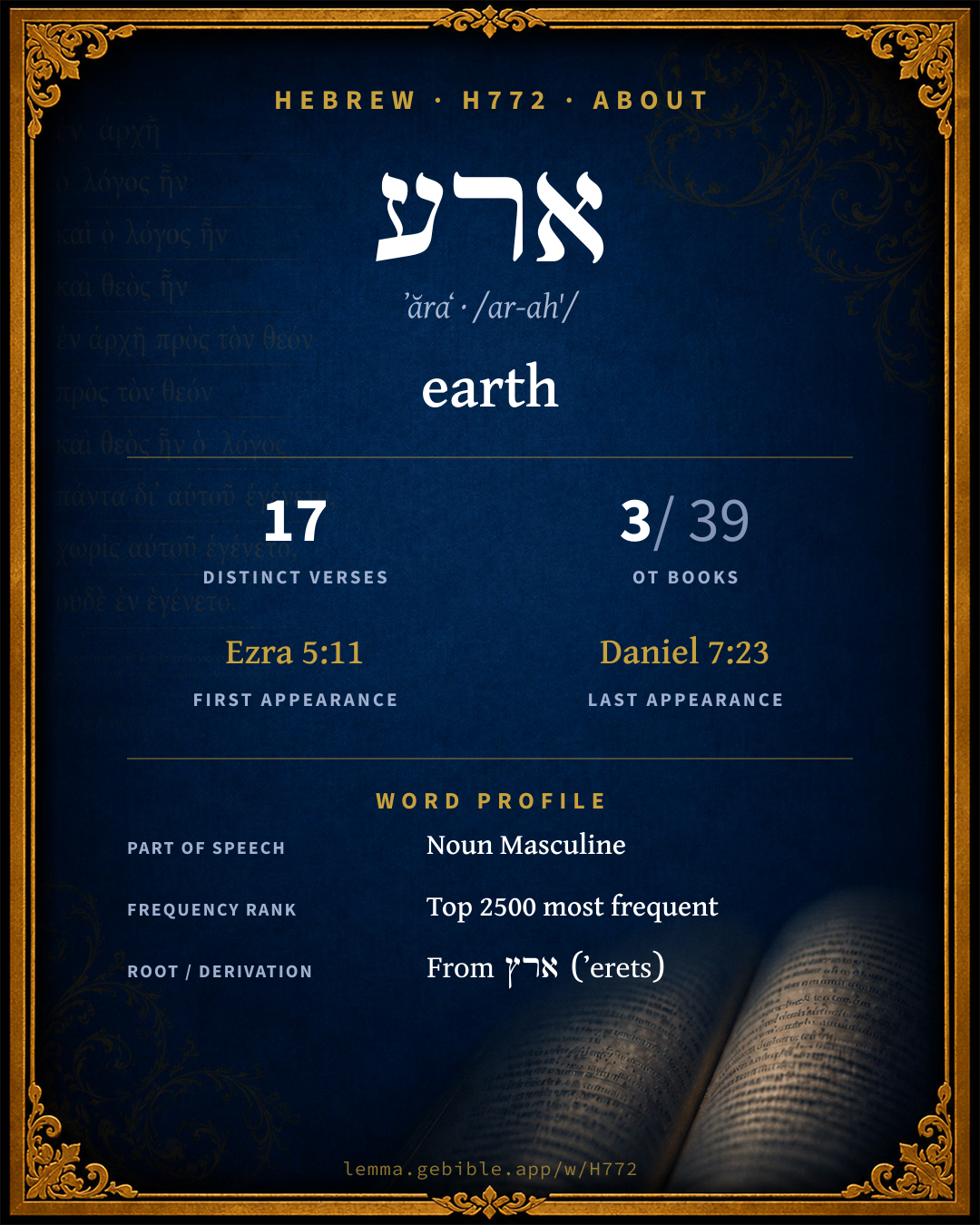
אֲרַע
earth
Full lexicon entry — Brown-Driver-Briggs (BDB)
From Brown-Driver-Briggs (BDB)
Where this word appears
See every Construct-state word in the Hebrew Bible →
Grammar key — what these labels mean
Part of speech
- Noun
- A naming word — a person, place, thing, or idea.
Noun type
- Common
- A common noun — a general class of person, place, or thing (“king,” “city,” “water”), not a specific name.
State
- Construct
- A noun bound to a following noun in a possessive / “of” relationship (the construct chain).
- Determined
- A noun marked definite — in Aramaic, the emphatic state.
Gender
- Feminine
- Grammatically feminine.
Number
- Singular
- One.
1 distinct verse where H772 appears in the Construct state, across 1 book. Filtered view — show all forms. Click any verse to open its interlinear word-by-word view. Verse text shown in the World English Bible for context — . Each verse’s Hebrew form is shown with its reference; the English is not keyword-highlighted, since the data carries no word-level English alignment. Use “Compare translations” on any verse to read it across multiple English versions. This concordance covers the Hebrew Bible; Septuagint (Greek Old Testament) occurrences are not indexed here.
Daniel 1 verse
About this entry
At a glance — auto-summarized from this page’s data, not written by a person. Every figure links to its source below. This summary describes the numbers; it doesn’t interpret them.
The Hebrew noun ארע centers on the idea of “earth.” The word gravitates to Daniel (88%), then Ezra and Jeremiah. It turns up in 17 verses across 3 books, an uncommon footprint. First canonically at Ezra 5:11, it enters the text early. It clusters with ארץ, ארעית and ארק under a shared root. Dig into 17-verse concordance and the renderings breakdown below.
Gloss history
Strong's 1890 vs modern scholarship
About this word
Strong's H772 catalogs a Hebrew word from the Hebrew Old Testament.
These counts are not copied from any lexicon or concordance. They are computed here, from the morphology-tagged Hebrew Old Testament. What Lemma adds →
- 17
- distinct verses
- The word appears in 17 distinct verses.
- 3 / 39
- OT books
- The word appears in 3 of 39 Old Testament books.
- #1,412
- by frequency
- Top 2500 most frequent Hebrew words (rank 1,412 of 8,640 Hebrew words by occurrence).
View all 17 occurrences in the concordance →
By section of the Old Testament
By traditional corpus
Conventional, traditional groupings — biblical authorship is debated, so this is a traditional corpus grouping, not an authorship claim. Each share is this word’s portion of its verses in that division of the Hebrew canon. Each figure is a share of the word’s 17 distinct verses.
- Writings (Ketuvim) 16 verses · 94%
- Prophets (Nevi'im) 1 verse · 6%
How translations render this word
Counts come from each version’s own published word-to-Strong’s tagging or interlinear alignment — an approximate guide to how each version renders this word, not a word-level alignment the data otherwise carries. Because each total is that version’s own tagged count, the per-version totals vary from one another and need not match the appearance or distinct-verse counts above. These counts may also differ from a printed concordance because Lemma counts each distinctly tagged rendering and does not collapse phrase taggings into a single head-word total. This is a fixed set of word-tagged versions (KJV, ASV, BSB, ULT) and does not change with the reading translation you choose elsewhere. Each version’s license is shown beside its name below (and on Sources).
- King James Version: Earth 19×
- American Standard Version: Earth 19×
- Berean Standard Bible: Earth 15×, Ground 3×, Land 2×
- unfoldingWord Literal Text: Earth 19×, The 3×
King James Version Public Domain
Renders H772 across 21 tagged occurrences — most commonly:
Plus 2 renderings that appear only once — usually multi-word phrases or single function words the recovered tagging swept in, not distinct renderings.
American Standard Version Public Domain
Renders H772 across 21 tagged occurrences — most commonly:
Plus 2 renderings that appear only once — usually multi-word phrases or single function words the recovered tagging swept in, not distinct renderings.
Berean Standard Bible Public Domain
Renders H772 across 21 tagged occurrences — most commonly:
Plus 1 rendering that appears only once — usually multi-word phrases or single function words the recovered tagging swept in, not distinct renderings.
unfoldingWord Literal Text CC BY-SA 4.0
Renders H772 across 24 tagged occurrences — most commonly:
Plus 2 renderings that appear only once — usually multi-word phrases or single function words the recovered tagging swept in, not distinct renderings.
Senses in BDB
The 1 sense BDB distinguishes for this word, in lexicon order (not ranked by frequency or importance). The full entry — with sub-senses — is in the Lexicon Entry tab.
- earth, world, ground
Word origin
Derived from ארץ (ʼerets) (H776) — land.
Jastrow Dictionary
A second Hebrew/Aramaic lexicon for comparison, covering Aramaic and post-biblical (Talmudic, Targumic, Midrashic) usage that the biblical-Hebrew BDB does not. Matched by lemma rather than by Strong’s number, so a lemma may carry more than one Jastrow headword (shown separately below), and the entries cover usage well beyond the Bible.
אָרַע
- (√רע, v. רעע) to strike against. Nif. נֶאֱרַע to come in contact with (cmp. זווג), to happen, befall (gen. of evil occurrences). Ber. IV, 2 שלא תֵּאָרַע וכ׳ (Bab. ed. 28ᵇ שלא יֵאָרַע דבר וכ׳) that no (religious) offence may happen through me (by an erroneous decision &c.). Yoma I, 1 שׁמא יארע בו פסול lest something may occur to him to unfit him for services. Esth. R. to II, 7 שיארע על ישראל (read שיארע לישר׳) will happen to Israel; a. fr.
- to strike, befall; (neut. v.) to occur. Y. Kidd. I, 58ᵈ top ולא א׳ מעשה no accident (illegal act) occurred. Gen. R. s. 84 כל מה שאירע לזה וכ׳ whatever befell the one, befell also the other; a. fr.—M. Kat. II, 1 אֵירְעוֹ אבל (Ms. M. אירע בו) mourning in the family befell him; a. e.—Y. Shek. V, 48ᵈ bot. כך וכך אירע; Y. Dem. I, 22ᵃ אירעון … (read אירעוֹ) so and so it happened to him. Part. Pu. מְאוֹרָע q. v.
- to be added to, to join. Y. Sot. I, 17ᵃ אחת מִתְאַרְעָה לאחת וכ׳ one (sin) is added to the other, until the account is full; Num. R. s. 9.
אֲרַע I
- (in Targ. Y.; in O. usu. עֲרַע q. v.) same; to join, meet, find; to attack, visit. Targ. Y. Gen. XIX, 19 תִירְעִינַנִי may befall me Targ. Y. Deut. XXXII, 10 (h. text מצא). Targ. Y. Ex. V, 3 (h. פגע). Ib. IV, 2 (h. פגש; ed. Vien. ועַרַע read וַאֲרַע). Targ. Y. Lev. V, 7 לא תֶאֱרַע ידיה he will not be able, cannot afford (h. text תגיע וכ׳, cmp. תמצא ידו); a. fr. [Targ. Y. II, Ex. XV, 9 ואַרְעֵי יתהון (I ונָרַע, וגדע) read ואֶירַע and I shall meet them.]
- or Pa. אַרַע to be met; to meet. Targ. Y. I Num. XXIII, 15 אֶתְעָרַע (h. text אֶקָּרֶה). M. Kat. 18ᵃ, a. e. איתרע ביה מילתא an accident befell him (death in the family).—Lev. R. s. 37 אַרְעַת שעתא it so happened. Koh. R. to XI, 1 ארעת ענת׳ וכ׳ it happened to be the season when the Israelites travelled to Jerusalem. Y. Dem. I, 22ᵃ אירעון, v. preced. Targ. Esth. VIII, 8 תִתְּרַן = תתארען; Targ. Y. Gen. XLIV, 34 תברז (corr. acc.). [אתרע to be shaken, weakened, v. רעע.]
- = Pe. Targ. Ruth II, 3; a. e.—Targ. Ps. LXXXV, 11 אוֹרְעוּן (some ed. אָרְעִין Pe.) meet each other.
*אָרַע II
- (√רע, cmp. רוּעַ, Hif. הֵרִיעַ, cmp. קָרָא a. קָרָה) to proclaim a festival. Sifré Num. 147 אֵירְעוֹ במאכל וכ׳ proclaim it (as מקרא קדש) with special meal and dress; v. Mekh. Bo 9, beg.
- to be proclaimed. B. Bath. 113ᵇ with והיתה … משפט (Num. XXVII, 11) אוֹרְעָה כל וכ׳ the whole section has been proclaimed as of a judicial nature; (Ms. M. הודעה, v. יָדַע). e.g. Numbers 27:11
אֲרַע II
- (Targ. Y., O. usu. עֲרַע q. v.), Pa. אָרַע, אַרַע same. Targ. Y. Lev. XXIII, 2; a. fr. Targ. O. Num. X, 2 לעָרָעָה ed. Berl. (oth. ed. לאַרְעָא); (Targ. Y. לעָרָעָא, לעַרְעָא!). [Targ. Y. Lev. XXIII, 4 דִּי יִתְרְעוּן, corr. די תְאַרְעוּן. Ib. 21, a gloss חיין וקיימין הי בזמן ref. to the festive benediction שהחייני וקימנו וכ׳.]—Denom. מְאַרְעָא, מְעַרְעָא.
אַרַע
- land, v. אַרְעָא.—אַרַע nether-, beneath, v. אַרְעָאָה.
רְעַע
- , to shatter, break. Targ. Jud. IX, 53 ורָעַת (Levita ורְעִיעַת; some ed. ורעתת, corr. acc.). Targ. Y. II, Ex. XV, 6 רָעָא (some ed. רעע, corr. acc.). Targ. Job XX, 19 (ed. Wil. רָעַע Pa.); a. e.—Part. pass. רְעִיעַ, רְעִיעָא; f. רְעִיעָא, רְעִיעֲתָא. Targ. Is. XLII, 3. Targ. Koh. XII, 6; a. e.—Taan. 20ᵇ אשיתא ר׳ Ms. M. (ed. רעועה h.) a threatening wall. Ib. ביתא ר׳ a ruinous-looking house; a. fr.
- same. Targ. Job XX, 10. Ib. 19, v. supra; a. e.
- to do harm. Ib. XXIV, 21 מֵרַע (Ms. מְיָירַע; h. text רֹעֶה).
- 1. to be shaken, broken; be afraid. Targ. Y. Deut. XX, 3 (Var. תִּתְיָרְע׳).
- 2. to be shaken, impaired. Hor. 12ᵃ ומִיתְרַע מזליה and his luck may be shaken, v. רִיעַ II. B. Bath. 59ᵃ דתִיתְרַע וכ׳, v. אֲשִׁיתָא. Ḥull. 10ᵃ סכין אִיתְרְעָאִי וכ׳ the status of the knife has been impaired (the knife having been found notched after slaughtering), but the status of the slaughtered animal (the presumption of its ritual fitness) has not been shaken, v. רֵיעוּתָא.
A Dictionary of the Targumim, the Talmud Babli and Yerushalmi, and the Midrashic Literature (Marcus Jastrow; London, Luzac, 1903) — Public Domain. Digitized via Sefaria. Digitized via Sefaria. Full attribution on Sources.
Forms in the corpus
The 13 distinct written forms H772 takes in the Hebrew Bible, most frequent first — each parse links to that state’s occurrences in the concordance. Hebrew forms include their vowel points and cantillation, so a single lemma takes many written forms.
| Form | Parsing | Example | Uses |
|---|---|---|---|
| אַרְעָֽ/א | Particle, Definite Article | Daniel 2:35 | 7 |
| אַרְעָ֖/א | Particle, Definite Article | Daniel 4:1 | 3 |
| בְּ/אַרְעָ֣/א | Particle, Definite Article | Daniel 4:15 | 2 |
| אֲרַע | Noun, Common, Feminine, Singular, Determined | Daniel 2:39 | 1 |
| אַרְעָ/א֙ | Particle, Definite Article | Daniel 4:35 | 1 |
| אַרְעָ֑/א | Particle, Definite Article | Daniel 4:35 | 1 |
| אַרְעָ֔/א | Particle, Definite Article | Daniel 7:23 | 1 |
| אַרְעָ֗/א | Particle, Definite Article | Daniel 7:4 | 1 |
| ארע/א | Noun, Common, Feminine, Singular, Construct | Daniel 2:39 | 1 |
| בְ/אַרְעָ֔/א | Particle, Definite Article | Daniel 7:23 | 1 |
| וְ/אַרְעָ֗/א | Particle, Definite Article | Ezra 5:11 | 1 |
| וּ/בְ/אַרְעָ֑/א | Particle, Definite Article | Daniel 6:27 | 1 |
| מֵֽ/אַרְעָ֛/א | Particle, Definite Article | Jeremiah 10:11 | 1 |
Same root — word family
Other BDB entries built from the same root as H772, grouped by Strong’s listed origin. These share a root / origin per the lexicon — not necessarily a shared meaning. Each links to that word’s own entry.
Derives from
Derived from this word
Proper names from this root
People and places named from this root — a name, not an additional meaning of the word.
Compare all same-root words → Showing 4 of 6 — not the complete family. 2 of the same-root words are proper names (people or places). They share a root, not necessarily a meaning.
Septuagint verse parallels
This word appears in 16 verses that also exist in the Greek Old Testament (Septuagint), out of the 17 Hebrew verses it occurs in. You can read those verses in Greek by switching the Old Testament edition to the Septuagint.
Read these verses in the Septuagint
This is a verse-level parallel only — the same verses exist in both the Hebrew and Greek Old Testaments. No word-level Hebrew↔Greek correspondence is claimed: the data carries no such alignment, so no Greek word is shown as this Hebrew word’s translation. Coverage is not total — the Septuagint omits the deuterocanon and renumbers the Psalms, so some Hebrew verses have no direct Greek parallel.