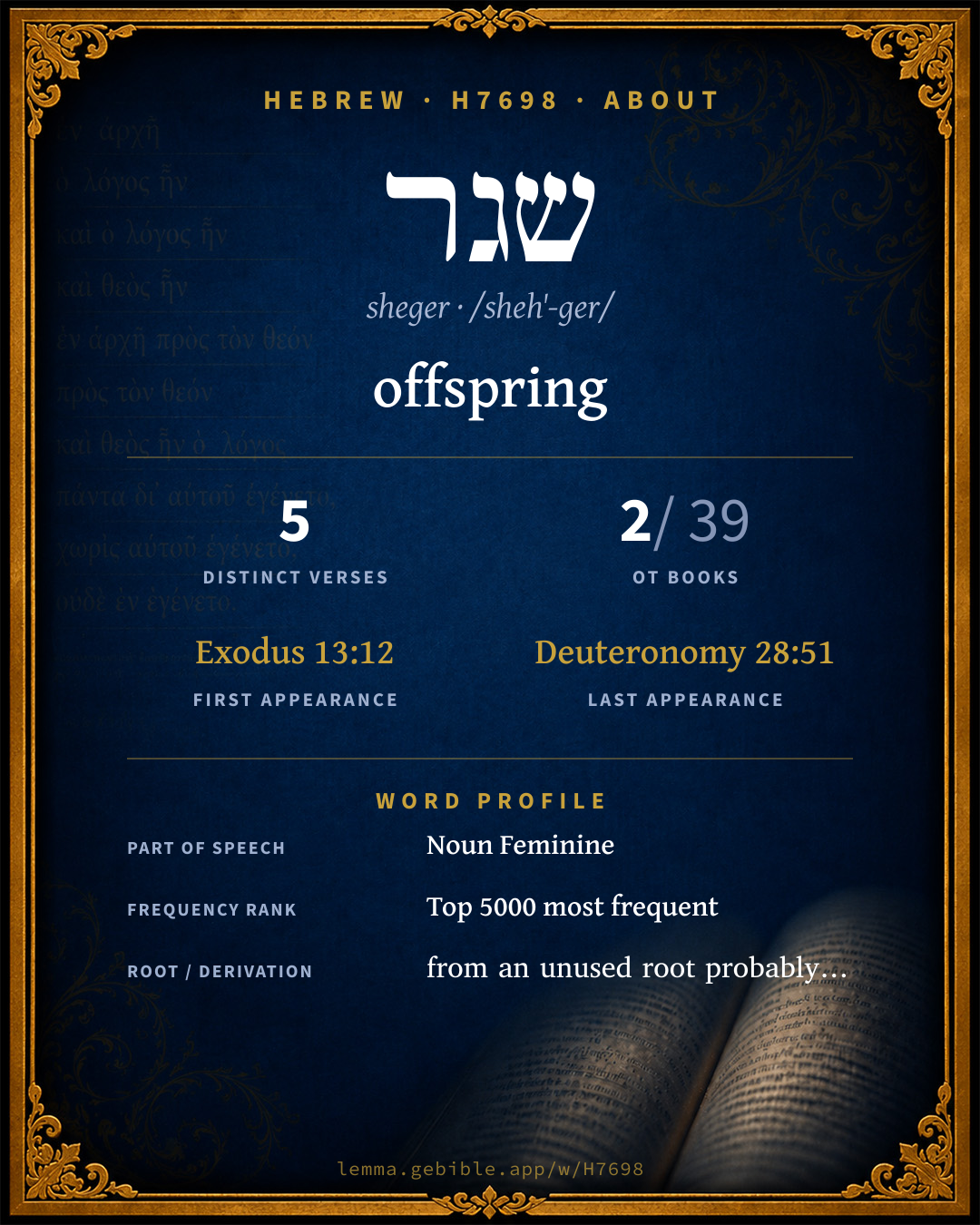
שֶׁ֫גֶר
offspring
Full lexicon entry — Brown-Driver-Briggs (BDB)
From Brown-Driver-Briggs (BDB)
Where this word appears
Grammar key — what these labels mean
Part of speech
- Noun
- A naming word — a person, place, thing, or idea.
Noun type
- Common
- A common noun — a general class of person, place, or thing (“king,” “city,” “water”), not a specific name.
State
- Construct
- A noun bound to a following noun in a possessive / “of” relationship (the construct chain).
Gender
- Masculine
- Grammatically masculine.
Number
- Singular
- One.
Every verse where H7698 appears in the Book of Deuteronomy — 4 distinct verses. Click any verse to open its interlinear word-by-word view. Verse text shown in the World English Bible for context — . Each verse’s Hebrew form is shown with its reference; the English is not keyword-highlighted, since the data carries no word-level English alignment. Use “Compare translations” on any verse to read it across multiple English versions. This concordance covers the Hebrew Bible; Septuagint (Greek Old Testament) occurrences are not indexed here.
Deuteronomy
- Deuteronomy 7:13 שְׁגַר n c ms cs and he will love you, and bless you, and multiply you; he will also bless the fruit of your body and the fruit of your ground, your grain and your new wine and your oil, the increase of your cattle and the young of your flock, in the land which he swore to your fathers to give you.
- Deuteronomy 28:4 שְׁגַ֥ר n c ms cs Blessed shall be the fruit of your body, and the fruit of your ground, and the fruit of your animals, the increase of your cattle, and the young of your flock.
- Deuteronomy 28:18 שְׁגַ֥ר n c ms cs Cursed shall be the fruit of your body, and the fruit of your ground, the increase of your cattle, and the young of your flock.
- Deuteronomy 28:51 שְׁגַ֥ר n c ms cs and shall eat the fruit of your cattle, and the fruit of your ground, until you are destroyed; that also shall not leave you grain, new wine, or oil, the increase of your cattle, or the young of your flock, until they have caused you to perish.
About this entry
At a glance — auto-summarized from this page’s data, not written by a person. Every figure links to its source below. This summary describes the numbers; it doesn’t interpret them.
שגר (sheger) is a Hebrew noun most often rendered “offspring.” The Hebrew Bible uses it only 5 verses. It clusters heavily in Deuteronomy, which alone accounts for 80% of its uses. It first appears in Exodus 13:12. The sections below give every sense, occurrence, and version rendering.
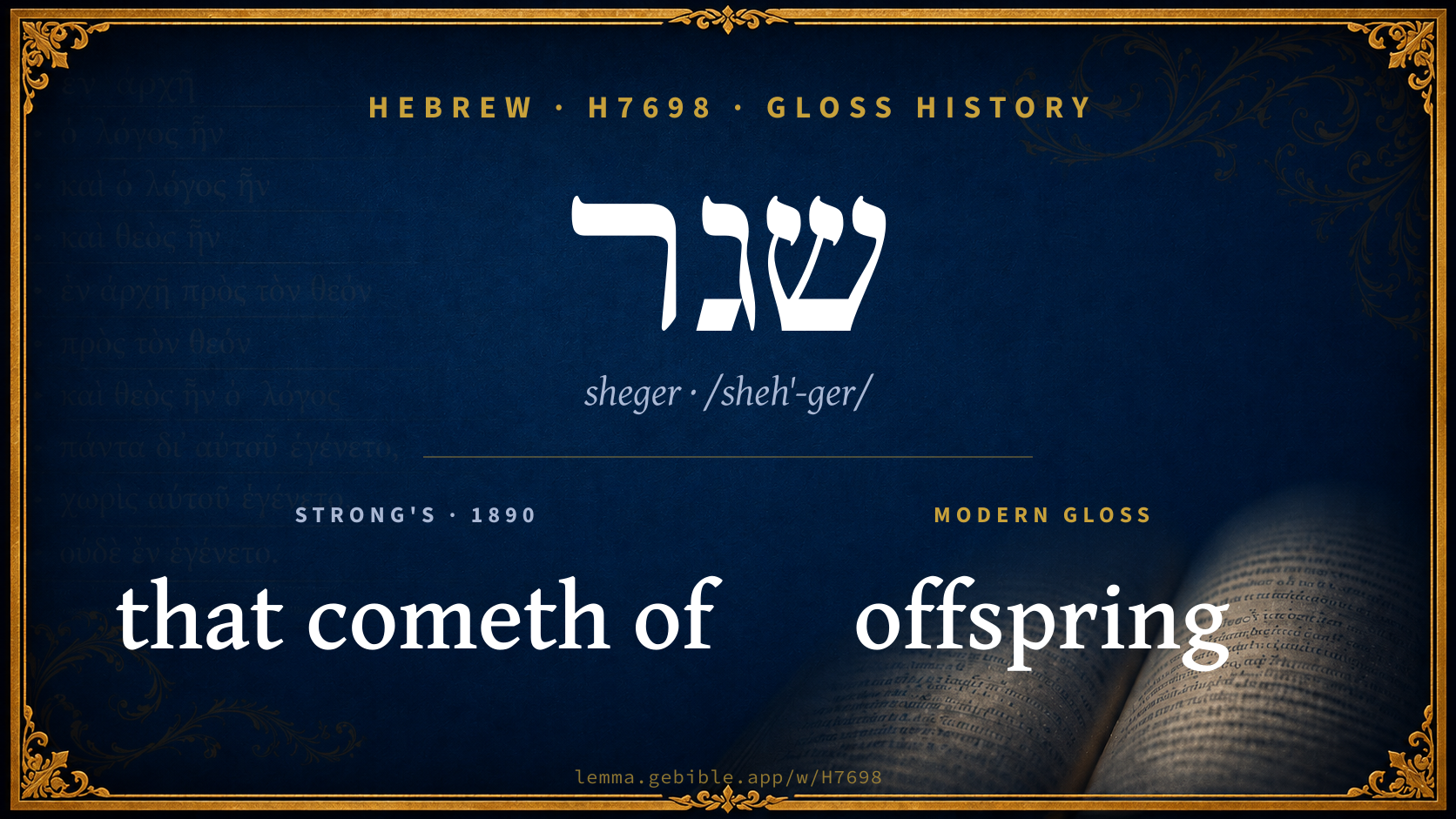
Gloss history
Strong's 1890 vs modern scholarship
About this word
Strong's H7698 catalogs a Hebrew word from the Hebrew Old Testament.
These counts are not copied from any lexicon or concordance. They are computed here, from the morphology-tagged Hebrew Old Testament. What Lemma adds →
- 5
- distinct verses
- The word appears in 5 distinct verses.
- 2 / 39
- OT books
- The word appears in 2 of 39 Old Testament books.
- #3,337
- by frequency
- Top 5000 most frequent Hebrew words (rank 3,337 of 8,640 Hebrew words by occurrence).
View all 5 occurrences in the concordance →
Most concentrated in
- Deuteronomy 4 verses 80%
- Exodus 1 verse 20%
By section of the Old Testament
By traditional corpus
Conventional, traditional groupings — biblical authorship is debated, so this is a traditional corpus grouping, not an authorship claim. Each share is this word’s portion of its verses in that division of the Hebrew canon. Each figure is a share of the word’s 5 distinct verses.
- Torah (Pentateuch) 5 verses · 100%
How translations render this word
Counts come from each version’s own published word-to-Strong’s tagging or interlinear alignment — an approximate guide to how each version renders this word, not a word-level alignment the data otherwise carries. Because each total is that version’s own tagged count, the per-version totals vary from one another and need not match the appearance or distinct-verse counts above. These counts may also differ from a printed concordance because Lemma counts each distinctly tagged rendering and does not collapse phrase taggings into a single head-word total. This is a fixed set of word-tagged versions (KJV, ASV, BSB, ULT) and does not change with the reading translation you choose elsewhere. Each version’s license is shown beside its name below (and on Sources).
- King James Version: Increase 3×
- American Standard Version: Increase 4×
- Berean Standard Bible: Calves 3×
- unfoldingWord Literal Text: Increase of 3×
King James Version Public Domain
Renders H7698 across 5 tagged occurrences — most commonly:
Plus 2 renderings that appear only once — usually multi-word phrases or single function words the recovered tagging swept in, not distinct renderings.
American Standard Version Public Domain
Renders H7698 across 5 tagged occurrences — most commonly:
Plus 1 rendering that appears only once — usually multi-word phrases or single function words the recovered tagging swept in, not distinct renderings.
Berean Standard Bible Public Domain
Renders H7698 across 4 tagged occurrences — most commonly:
Plus 1 rendering that appears only once — usually multi-word phrases or single function words the recovered tagging swept in, not distinct renderings. Not rendered by a distinct English word in 1 further occurrence.
unfoldingWord Literal Text CC BY-SA 4.0
Renders H7698 across 5 tagged occurrences — most commonly:
Plus 2 renderings that appear only once — usually multi-word phrases or single function words the recovered tagging swept in, not distinct renderings.
Senses in BDB
The 1 sense BDB distinguishes for this word, in lexicon order (not ranked by frequency or importance). The full entry — with sub-senses — is in the Lexicon Entry tab.
- offspring, young or offspring of beasts
Word origin
n.[f. AlbrZAW xvi (1896), 70] offspring, young of beasts (שגר id. Ecclus 40:19; cf. WeSkizzen iii. 170);—cstr. שׁ׳;—כָּל־פֶּטֶר שׁ׳ בְּהֵמָה Ex 13:12 (J; כָּל־פ׳ רֶחֶם precedes); also שְׁגַר אֲלָפֶיךָ Dt 7:13; 28:4, 18, 51 (all ‖ עַשְׁתְּרֹת צֹאנֶ֑ךָ).
— Brown-Driver-Briggs (Oxford 1906, public domain), digitized via Sefaria, supplemented by the OpenScriptures HebrewLexicon (CC BY 4.0). See Sources.
Origin: from an unused root probably meaning to eject
Jastrow Dictionary
A second Hebrew/Aramaic lexicon for comparison, covering Aramaic and post-biblical (Talmudic, Targumic, Midrashic) usage that the biblical-Hebrew BDB does not. Matched by lemma rather than by Strong’s number, so a lemma may carry more than one Jastrow headword (shown separately below), and the entries cover usage well beyond the Bible.
גֵּר
- 1. a dweller. Sabb. 104ᵃ, v. preced.
- 2. a stranger. Tanḥ. Vayigg. 4 גרא שנעשה ג׳ he is named Gera, because he (Joseph) became a stranger, v. גּוּר.—Esp. a proselyte, convert to Judaism. Yeb. 46ᵇ; Ber. 47ᵇ לעולם אינו ג׳ וכ׳ one is not a proselyte until he has been &c. Yeb. l. c.; Kidd. 62ᵇ ג׳ צריך שלשה a proselyte requires a court of three for making declaration and immersion. Kerith. II, 1 ג׳ מחוסר כפרה a proselyte who has not yet offered a sacrifice in the Temple; a. v. fr.—ג׳ צֶדֶק a full, true proselyte, ג׳ תֹּושָׁב one who, for the sake of acquiring limited citizenship in Palestine, renounces idolatry. Snh. 96ᵇ; Gitt. 57ᵇ; a. fr.—ג׳ שקר an insincere proselyte (from impure motives). Y. B. Mets. V, 10ᶜ.—Pl. גֵּרִים, constr. גֵּרֵי, גֵּירֵי.—ג׳ גרורים self-made converts, not formally admitted. Ab. Zar. 3ᵇ; 24ᵃ; a. e.—גרי אריות lion-proselytes, i.e. proselytes from mere fear (with ref. to II Kings XVII, 25 sq.). Ḥull. 3ᵇ, opp. גרי אמת. Kidd. 75ᵇ; Snh. 85ᵇ; a. fr.—גרי חלומות proselytes converted by the advice of a dreamer or an interpreter of dreams; גרי מרדכי ואסתר such as joined the Jewish ranks from motives like those prevalent in the days of Mordecai and Esther (Esth. VIII, 17). Yeb. 24ᵇ.—Nidd. VII, 3 (56ᵇ) גרים טועין Ar. (ed. וטועין) proselytes not living in accordance with the Jewish usages.—בן גרים a descendant of proselytes. B. Mets. IV, 10 (58ᵇ).—Sabb. 33ᵇ יהודה בן ג׳. [Mode of admission, v. Yeb. 47ᵃ.—Views about converts, v. Num. R. s. 8; Nidd. 13ᵇ; Pes. 87ᵇ; a. fr.]. Fem. גֵּרָה. Gen. R. s. 88, end.—Usu. גִּיֹּורֶת. Keth. IV, 3; a. fr. e.g. 2 Kings 17:25
שָׁגַר
- (Shaf. of גרר; cmp. נגר) to run, flow.—Part. pass. שָׁגוּר; f. שְׁגוּרָה fluent, spoken without hesitation. Ber. V, 5 אם ש׳ תפלתי וכ׳ if my prayer is fluent in my mouth, I know &c., v. טָרַף; Tosef. ib. III, 3 שָׁגְרָה ed. Zuck. (Var. שגורה).—[Cant. R. to I, 15 שוגרת, v. infra.]
- 1. to speak with fluency. Ex. R. s. 9 כיון ששִׁיגְּרוּ … בפיהם וכ׳ when they recited (these verses) the whole night with fluency, they considered it a good sign &c.
- 2. to make run, to send. Tanḥ. Mick. 8 תפוש … ושַׁגֵּר אותם לפני arrest them and send them up before me; Gen. R. s. 91. Ib. וש׳ בשבילם וכ׳ and sent (messengers) out for them to hunt them up &c. Tosef. Sabb. XIII (XIV), 9 ולהיפרכוס שלהן ש׳ לו וכ׳ and to their commander he sent a present of fifty denars. Ber. 51ᵃ, sq. מְשַׁגְּרוֹ לאנשי וכ׳ he sends it as a gift to his household. Snh. 59ᵇ אחד משגרו וכ׳ he sent out one (serpent) to the south &c. B. Bath. 146ᵃ. Sot. 35ᵇ שִׁגְּרוּ וכ׳, v. נוֹטָרִין a. fr.—Part. pass. מְשׁוּגָּר; f. מְשׁוּגֶּרֶת. Cant. R. to IV, 1, v. רוֹגְלִית; ib. to I, 15 שוגרת corr. acc.).
- [to speak fluently,] to improvise a prayer, change the established form. Y. Ber. V, 9ᶜ שליח צבור שה׳ שתים וכ׳ if a reader improvises two or three sections (of the Prayer of Benedictions), we do not make him go back and recite the established form.
שְׁגַר I
- 1. to run, flow. Targ. Jer. XIII, 17 (ed. Wil. ותְשַׁגֵּד Pa., shed). Ib. IX, 17 (ed. Wil. Pa.).
- 2. to drag. Ḥull. 51ᵃ דהוו שָׁגְרָן וכ׳ Tosaf. (ed. שדרן) they dragged their hind legs.
- 1. to cause to run, shed tears. tears. Targ. Jer. l. c., v. supra.
- 2. to send. Targ. Y. Ex. XXIII, 20.
- 3. to cast; (of beasts) to give birth. Ib. XIII, 12 דמְשַׁגְּרָא (not דמִשַּׁ׳). Targ. Jer. XXII, 19.—Part. pass. מְשַׁגַּד; f. מְשַׁגְּרָא; pl. מְשַׁגְּרָן. Ib. VII, 33; XXXVI, 30. Targ. Deut. XXVIII, 26. Targ. Is. V, 25, a. e.
- 1. (neut. verb.) (neut. verb.) to run over. Y. Sabb. VIII, 9ᵇ bot. אַשְׁגְּרַת עיינה דר׳ וכ׳ R. Aḥa’s eye ran over the whole Torah, and he did not find (that the word מלאכה appeared 39 times).
- 2. to cast an eye. Y. Kil. IX, 32ᵇ bot.; Y. Keth. XII, 35ᵃ bot. בהיא שעתא אַשְׁגְרִית עיניי וכ׳ (not עינוי) at that moment I let my eyes run (reviewed in my mind) the whole &c., v. תְּהִלָּה.
- 3. to improvise, change the established form of a prayer. Y. Ber. V, 9ᶜ א׳ חד ברכה (read חדא) he changed one section of the Benedictions. Ib. א׳ מכניע זדים בסופה he changed the benediction which closes with makhniʿa zedim (the twelfth section) at the end of it.
שְׁגַר II
- (preced.; cmp. גָּרָה) to heat. Targ. Ez. XXXIX, 9.—Sabb. 109ᵇ שָׁגְרָא תנורא וכ׳ she heated the oven and swept it &c.—Part. pass. שְׁגִיר; f. שְׁגִירָא. Yoma 29ᵃ תנורא ש׳ a hot oven (in which it is easy to kindle a fresh fire), opp. קְרִירָא.
שְׁגַר III
- Sh’gar, one of Haman’s ancestors. Targ. Esth. V, 1; Targ. II Esth. III, 1.
שֶׁגֶר
- 1. [that which is cast,] birth, foetus, premature birth. Bekh. 3ᵃ (ref. to Ex. XIII, 12) פטר שגר בהמה ש׳ בהמה Rashi Var. ‘the first cast of an animal’, even the premature first birth of an animal is sacred; (ed. שֶׁגָּר בבהמה that which dwells in an animal).—2) run, flight (of a dove). B. Bath. II, 5 מלא ש׳ היונה a far as the dove flies (for food). e.g. Exodus 13:12
A Dictionary of the Targumim, the Talmud Babli and Yerushalmi, and the Midrashic Literature (Marcus Jastrow; London, Luzac, 1903) — Public Domain. Digitized via Sefaria. Digitized via Sefaria. Full attribution on Sources.
Forms in the corpus
The 3 distinct written forms H7698 takes in the Hebrew Bible, most frequent first — each parse links to that state’s occurrences in the concordance. Hebrew forms include their vowel points and cantillation, so a single lemma takes many written forms.
| Form | Parsing | Example | Uses |
|---|---|---|---|
| שְׁגַ֥ר | Noun, Common, Masculine, Singular, Construct | Deuteronomy 28:4 | 3 |
| שְׁגַר | Noun, Common, Masculine, Singular, Construct | Deuteronomy 7:13 | 1 |
| שֶׁ֣גֶר | Noun, Common, Masculine, Singular, Construct | Exodus 13:12 | 1 |
Septuagint verse parallels
This word appears in 5 verses that also exist in the Greek Old Testament (Septuagint), out of the 5 Hebrew verses it occurs in. You can read those verses in Greek by switching the Old Testament edition to the Septuagint.
Read these verses in the Septuagint
This is a verse-level parallel only — the same verses exist in both the Hebrew and Greek Old Testaments. No word-level Hebrew↔Greek correspondence is claimed: the data carries no such alignment, so no Greek word is shown as this Hebrew word’s translation. Coverage is not total — the Septuagint omits the deuterocanon and renumbers the Psalms, so some Hebrew verses have no direct Greek parallel.