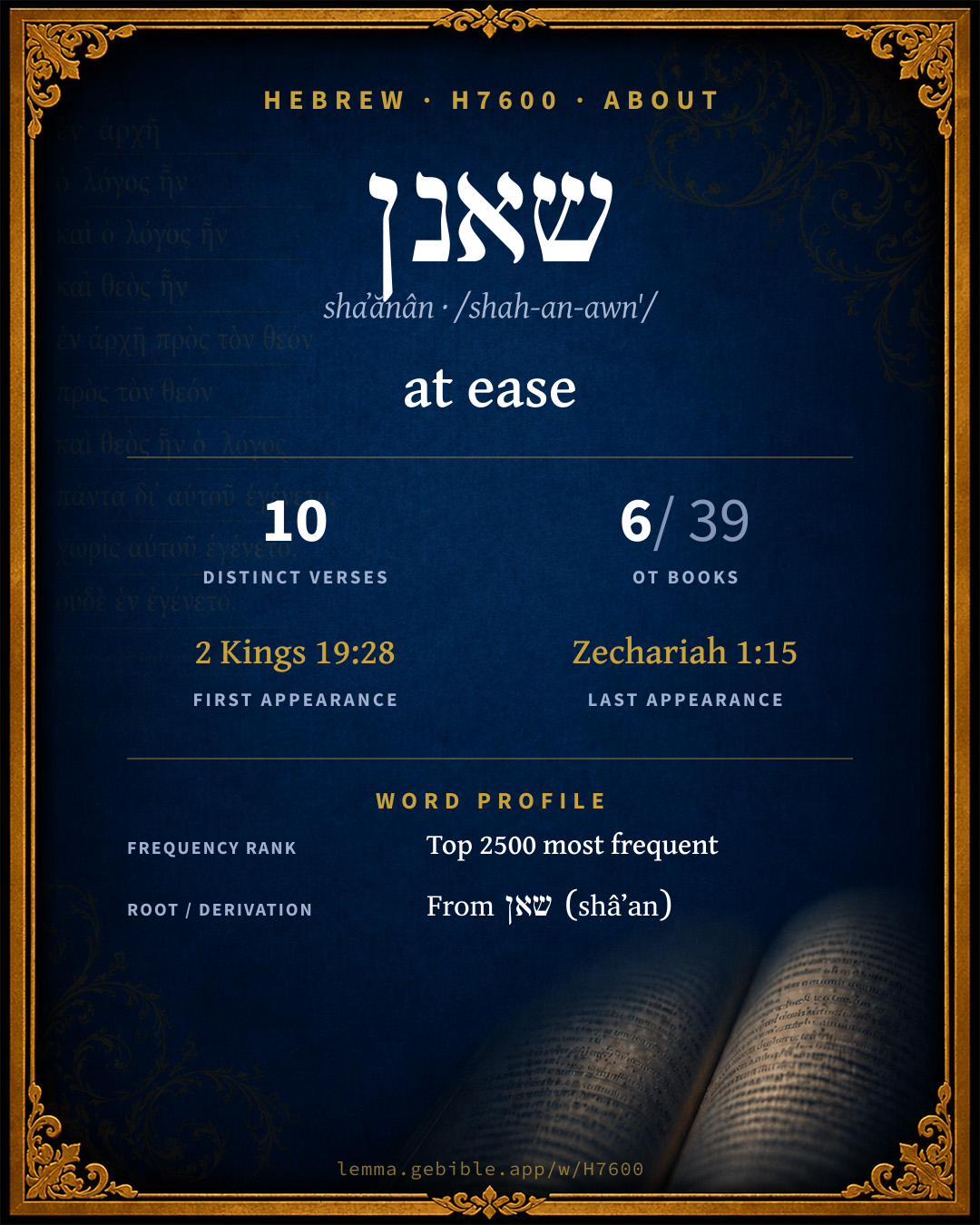
שַׁאֲנָן
at ease
also: quiet, secure fuller range ↓
Full lexicon entry — Brown-Driver-Briggs (BDB)
From Brown-Driver-Briggs (BDB)
Where this word appears
See every Absolute-state word in the Hebrew Bible →
Grammar key — what these labels mean
Part of speech
- Adjective
- A word that describes or qualifies a noun.
State
- Absolute
- The independent form of a noun, not bound to a following word.
- Construct
- A noun bound to a following noun in a possessive / “of” relationship (the construct chain).
Gender
- Feminine
- Grammatically feminine.
- Masculine
- Grammatically masculine.
Number
- Plural
- More than one (in Hebrew, generally three or more).
- Singular
- One.
Every verse where H7600 appears in the Book of Isaiah — 5 distinct verses. Click any verse to open its interlinear word-by-word view. Verse text shown in the World English Bible for context — . Each verse’s Hebrew form is shown with its reference; the English is not keyword-highlighted, since the data carries no word-level English alignment. Use “Compare translations” on any verse to read it across multiple English versions. This concordance covers the Hebrew Bible; Septuagint (Greek Old Testament) occurrences are not indexed here.
Isaiah
- Isaiah 32:9 שַֽׁאֲנַנּ֔וֹת adj Adjective fp Rise up, you women who are at ease, [and] hear my voice; you careless daughters, give ear to my speech.
- Isaiah 32:11 שַֽׁאֲנַנּ֔וֹת adj Adjective fp Tremble, you women who are at ease; be troubled, you careless ones; strip yourselves, and make yourselves naked, and gird [sackcloth] on your loins.
- Isaiah 32:18 שַׁאֲנַנּֽוֹת adj Adjective fp My people shall abide in a peaceable habitation, and in safe dwellings, and in quiet resting-places.
- Isaiah 33:20 שַׁאֲנָ֗ן adj Adjective ms Look on Zion, the city of our solemnities: your eyes shall see Jerusalem a quiet habitation, a tent that shall not be removed, the stakes of it shall never be plucked up, neither shall any of the cords of it be broken.
- Isaiah 37:29 וְ/שַׁאֲנַנְ/ךָ֖ conj + Adjective Adjective ms cs + sfx pers 2ms Because of your raging against me, and because your arrogance is come up into my ears, therefore will I put my hook in your nose, and my bridle in your lips, and I will turn you back by the way by which you came.
About this entry
At a glance — auto-summarized from this page’s data, not written by a person. Every figure links to its source below. This summary describes the numbers; it doesn’t interpret them.
The Hebrew word שאנן centers on the idea of “at ease.” The word gravitates to Isaiah (50%), then 2 Kings and Job. It appears 10 verses across 6 books of the Hebrew Bible, among its uncommon vocabulary. Debuting at 2 Kings 19:28, it then recurs through the corpus. Alongside “at ease” the lexicon also lists “quiet” and “secure” — part of its full sense range. Dig into 10-verse concordance and the renderings breakdown below.
Gloss history
Strong's 1890 vs modern scholarship
About this word
Strong's H7600 catalogs a Hebrew word from the Hebrew Old Testament.
These counts are not copied from any lexicon or concordance. They are computed here, from the morphology-tagged Hebrew Old Testament. What Lemma adds →
- 10
- distinct verses
- The word appears in 10 distinct verses.
- 6 / 39
- OT books
- The word appears in 6 of 39 Old Testament books.
- #2,342
- by frequency
- Top 2500 most frequent Hebrew words (rank 2,342 of 8,640 Hebrew words by occurrence).
View all 10 occurrences in the concordance →
By section of the Old Testament
By traditional corpus
Conventional, traditional groupings — biblical authorship is debated, so this is a traditional corpus grouping, not an authorship claim. Each share is this word’s portion of its verses in that division of the Hebrew canon. Each figure is a share of the word’s 10 distinct verses.
- Prophets (Nevi'im) 8 verses · 80%
- Writings (Ketuvim) 2 verses · 20%
How translations render this word
Counts come from each version’s own published word-to-Strong’s tagging or interlinear alignment — an approximate guide to how each version renders this word, not a word-level alignment the data otherwise carries. Because each total is that version’s own tagged count, the per-version totals vary from one another and need not match the appearance or distinct-verse counts above. These counts may also differ from a printed concordance because Lemma counts each distinctly tagged rendering and does not collapse phrase taggings into a single head-word total. This is a fixed set of word-tagged versions (KJV, ASV, BSB, ULT) and does not change with the reading translation you choose elsewhere. Each version’s license is shown beside its name below (and on Sources).
- King James Version: Are at ease 4×, Against me and thy tumult 2×, Quiet 2×
- American Standard Version: Are at ease 4×, Against me 2×, Quiet 2×
- Berean Standard Bible: Arrogance 2×
- unfoldingWord Literal Text: Are at ease 2×, Arrogance 2×, Haughty 2×
King James Version Public Domain
Renders H7600 across 10 tagged occurrences — most commonly:
Plus 2 renderings that appear only once — usually multi-word phrases or single function words the recovered tagging swept in, not distinct renderings.
American Standard Version Public Domain
Renders H7600 across 10 tagged occurrences — most commonly:
Plus 2 renderings that appear only once — usually multi-word phrases or single function words the recovered tagging swept in, not distinct renderings.
Berean Standard Bible Public Domain
Renders H7600 across 10 tagged occurrences — most commonly:
Plus 8 renderings that appear only once — usually multi-word phrases or single function words the recovered tagging swept in, not distinct renderings.
unfoldingWord Literal Text CC BY-SA 4.0
Renders H7600 across 12 tagged occurrences — most commonly:
Plus 4 renderings that appear only once — usually multi-word phrases or single function words the recovered tagging swept in, not distinct renderings.
Senses in the full BDB
What do BDB’s symbols mean?
BDB uses these scholarly abbreviations:
| Symbol | Meaning |
|---|---|
| 𝔊 | the Septuagint (the ancient Greek translation, LXX) |
| 𝔙 | the Vulgate (the Latin translation) |
| 𝔖 | the Syriac version (the Peshitta) |
| 𝔗 | the Targum (the Aramaic translation) |
| ψ | the Psalms |
| √ | root (the underlying root or stem) |
| ‖ | parallel passage (a synonymous or contrasted parallel) |
| † | the dagger: every passage where the word occurs is cited |
The 4 senses and sub-senses the full Brown-Driver-Briggs lexicon distinguishes for this word, in lexicon order (not ranked by frequency), with BDB’s own verbatim wording and sub-sense lettering. Shown in Hebrew script with BDB’s own scholarly abbreviations. The condensed entry is in the Lexicon Entry tab. See also the Forms in the corpus table below.
- 1. at ease, secure: נָוֶה שׁ׳ Is 33:20 secure habitation (of Jerus.), cf. מְנוּחוֹת שׁ׳ 32:18 (‖ מִבְטַחִים). e.g. Isaiah 33:20
- 2. as subst., one at ease, free from misfortune, Jb 12:5. e.g. Job 12:5
- 3. at ease, with collat. idea of careless, wanton, arrogant, Am 6:1; Is 32:9, 11; Zc 1:15 ψ 123:4. e.g. Amos 6:1
- 4. as subst. abstr. = arrogance: sf. שַׁאֲנַנְךָ 2 K 19:28 (‖ הִתְרַגֶּזְךָ) = Is 37:29, but שְׁאוֹנְךָ thine uproar, BuZAW xii (1892), 36 Gr Che Marti Kit (perhaps), Bur. cf. שׁלאנן. e.g. 2 Kings 19:28
Senses from the full Brown-Driver-Briggs lexicon (Brown, Driver, Briggs; Oxford 1906 — public domain), digitized via Sefaria, supplemented by the OpenScriptures HebrewLexicon (CC BY 4.0). Full attribution on Sources.
Word origin
adj. at ease, secure (BaNB § 143 a Ges§ 84 b k);—abs. שׁ׳ Is 33:20; pl. שַׁאֲנַנִּים Am 6:1 +, שַׁאֲנַנּוֹת Is 32:9, 11, 18;—
— Brown-Driver-Briggs (Oxford 1906, public domain), digitized via Sefaria, supplemented by the OpenScriptures HebrewLexicon (CC BY 4.0). See Sources.
Derived from שאן (shâʼan) (H7599) — to rest.
Jastrow Dictionary
A second Hebrew/Aramaic lexicon for comparison, covering Aramaic and post-biblical (Talmudic, Targumic, Midrashic) usage that the biblical-Hebrew BDB does not. Matched by lemma rather than by Strong’s number, so a lemma may carry more than one Jastrow headword (shown separately below), and the entries cover usage well beyond the Bible.
אֲנָא
- , emph. אֲנָנָא ch. = h. אֲנִי, I. הא אנא contr. הָאנָא. Targ. O. Gen. XXII, 7; a. fr.—Ḥull. 2ᵇ א׳ וכ׳ as to myself &c. Y. Taan. IV, 68ᵈ bot. דאננא משלים וכ׳ that I myself should surrender the country.—Pl. אֲנַן we. Targ. Y. Gen. XLIII, 8; a. e.—Ber. 49ᵇ נחזי א׳ let us see; a. fr.—אֲנַחְנָא, נַחְנָא. Targ. O. Gen. l. c.; a. fr.—
אָנַן
- , v. אָוֶן) to press, oppress, wrong, v. אָנָה.—אוֹנָן one who feels grieved, mourner, esp. Onan, mourner before the burial of a kinsman, contrad. to אָבֵל; v. אֲנִינָה. M. Kat. 14ᵇ מקדיב א׳ may officiate at sacrifices though being an Onan.—Pl. אוֹנָנִין. Snh. 47ᵇ לא היו מתאבלין אלא א׳ they observed no mourning ceremonies but lived in silent and retired mourning.—Fem. אוֹנֶנֶת. Keth. 53ᵃ.—Denom. אָנִין complaining, fastidious, feeble. Pl. אֲנִינֵי הדעת fastidious of taste, easily taking an aversion, delicate. Pes. 113ᵇ. Cmp. אִיסְתְּנִיס.
- to feel wronged, complain of being overreached, v. אָנָה.
אֲנַן
- to be grieved, to mourn. Targ. Koh. VII, 4.—Denom. אָנִין; f. אֲנִינָא, with דעתא = h. אָנִין, v. preced. Ḥull. 112ᵃ א׳ דעתיה he was fastidious, delicate. Ber. 24ᵇ; B. Bath. 23ᵃ א׳ דעתאי I am &c.
אֲנַן ²
- pl. of אֲנָא.
שַׁאֲנָן
- שאן to rest)
- 1. at ease, undisturbed. Pirké d’R. El. ch. XXXVIII אז … בטח וש׳ וכ׳ then Jacob dwelt in Canaan safe and undisturbed; Yalk. Gen. 138 בטח ש׳ ושליו.
- 2. rest, ease. Gen. R. s. 10 end ומה … ש׳ ונחת שלוה והשקט and what was created therein after he rested? Ease, rest, peace, and repose. Lam. R. introd. (R. Joḥ. 1) זכורה אני בטחון וש׳ ושלוה שהייתי וכ׳ I remember the confidence and ease and contentment in which I used to dwell; a. e.
A Dictionary of the Targumim, the Talmud Babli and Yerushalmi, and the Midrashic Literature (Marcus Jastrow; London, Luzac, 1903) — Public Domain. Digitized via Sefaria. Digitized via Sefaria. Full attribution on Sources.
Forms in the corpus
The 8 distinct written forms H7600 takes in the Hebrew Bible, most frequent first — each parse links to that state’s occurrences in the concordance. Hebrew forms include their vowel points and cantillation, so a single lemma takes many written forms.
| Form | Parsing | Example | Uses |
|---|---|---|---|
| וְ/שַׁאֲנַנְ/ךָ֖ | Adjective, Adjective, Masculine, Singular, Construct | 2 Kings 19:28 | 2 |
| שַֽׁאֲנַנּ֔וֹת | Adjective, Adjective, Feminine, Plural, Absolute | Isaiah 32:9 | 2 |
| הַ/שַּֽׁאֲנַנִּ֑ים | Adjective, Adjective, Masculine, Plural, Absolute | Zechariah 1:15 | 1 |
| הַ/שַּׁאֲנַנִּ֑ים | Adjective, Adjective, Masculine, Plural, Absolute | Psalms 123:4 | 1 |
| הַ/שַּׁאֲנַנִּ֣ים | Adjective, Adjective, Masculine, Plural, Absolute | Amos 6:1 | 1 |
| שַׁאֲנַנּֽוֹת | Adjective, Adjective, Feminine, Plural, Absolute | Isaiah 32:18 | 1 |
| שַׁאֲנָ֑ן | Adjective, Adjective, Masculine, Singular, Absolute | Job 12:5 | 1 |
| שַׁאֲנָ֗ן | Adjective, Adjective, Masculine, Singular, Absolute | Isaiah 33:20 | 1 |
Same root — word family
Other BDB entries built from the same root as H7600, grouped by Strong’s listed origin. These share a root / origin per the lexicon — not necessarily a shared meaning. Each links to that word’s own entry.
Derives from
Derived from this word
Compare all same-root words → They share a root, not necessarily a meaning.
Septuagint verse parallels
This word appears in 10 verses that also exist in the Greek Old Testament (Septuagint), out of the 10 Hebrew verses it occurs in. You can read those verses in Greek by switching the Old Testament edition to the Septuagint.
Read these verses in the Septuagint
This is a verse-level parallel only — the same verses exist in both the Hebrew and Greek Old Testaments. No word-level Hebrew↔Greek correspondence is claimed: the data carries no such alignment, so no Greek word is shown as this Hebrew word’s translation. Coverage is not total — the Septuagint omits the deuterocanon and renumbers the Psalms, so some Hebrew verses have no direct Greek parallel.