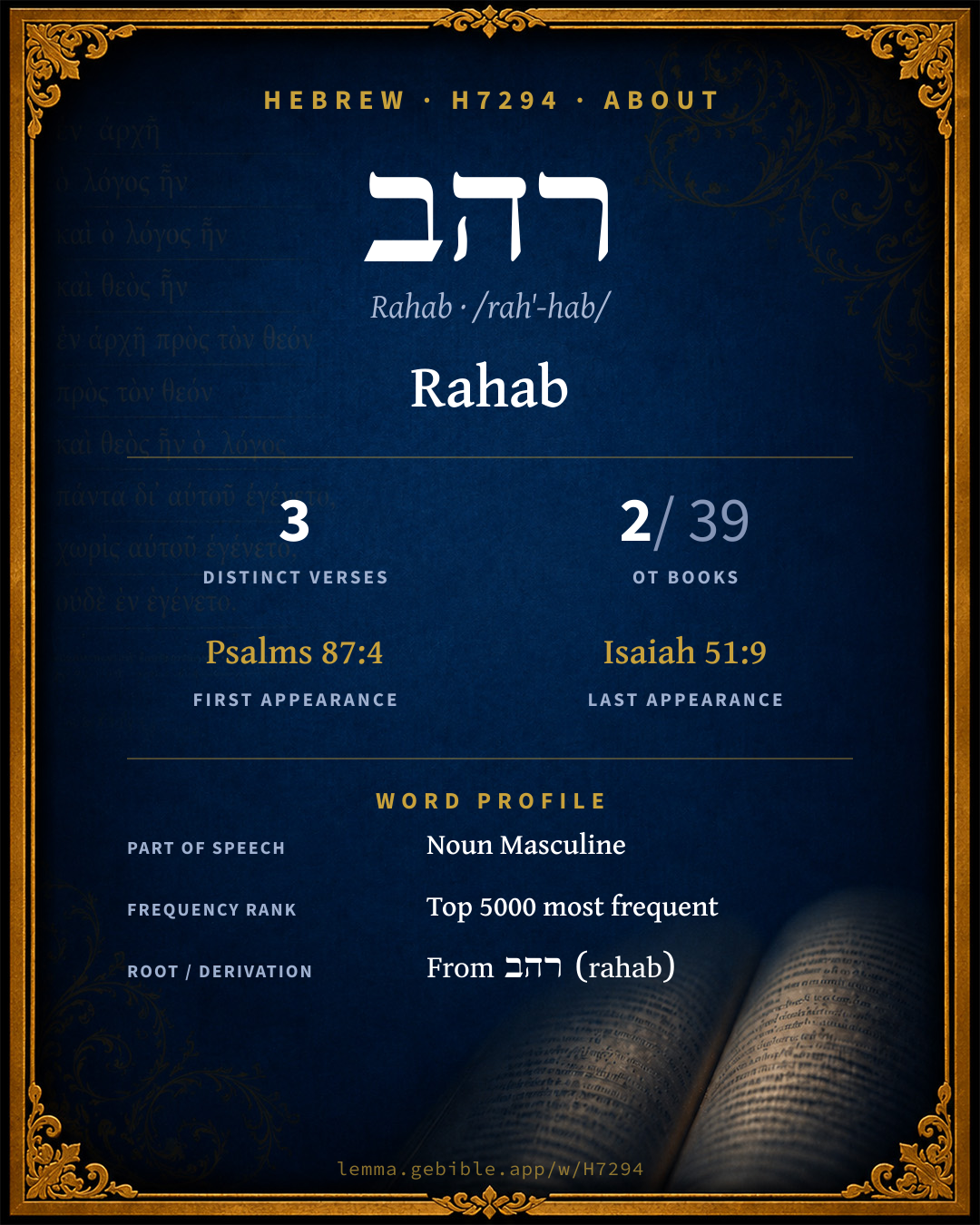
רַ֫הַב
Rahab
BDB lists 2 entries for ‘Rahab’ fuller range ↓
Full lexicon entry — Brown-Driver-Briggs (BDB)
From Brown-Driver-Briggs (BDB)
Where this word appears
Grammar key — what these labels mean
Part of speech
- Noun
- A naming word — a person, place, thing, or idea.
Noun type
- Proper
- A name of a specific person, place, or people (e.g. Abraham, Zion, Israel).
Every verse where H7294 appears in the Book of Psalms — 2 distinct verses. Click any verse to open its interlinear word-by-word view. Verse text shown in the World English Bible for context — . Each verse’s Hebrew form is shown with its reference; the English is not keyword-highlighted, since the data carries no word-level English alignment. Use “Compare translations” on any verse to read it across multiple English versions. This concordance covers the Hebrew Bible; Septuagint (Greek Old Testament) occurrences are not indexed here.
Psalms
- Psalms 87:4 רַ֥הַב n Proper I will record Rahab and Babylon among those who acknowledge me. Behold, Philistia, Tyre, and also Ethiopia: "This one was born there."
- Psalms 89:10 רָ֑הַב n Proper You have broken Rahab in pieces, like one of the slain. You have scattered your enemies with your mighty arm.
About this entry
At a glance — auto-summarized from this page’s data, not written by a person. Every figure links to its source below. This summary describes the numbers; it doesn’t interpret them.
רהב — transliterated Rahab — is a Hebrew name carrying the sense “Rahab.” It occurs a mere 3 verses across Scripture. Its uses cluster heavily in Psalms (67% of all occurrences). Debuting at Psalms 87:4, it then recurs through the corpus. Each statement above links to its evidence; the full detail follows below.
Gloss history
Strong's 1890 vs modern scholarship
About this word
Strong's H7294 catalogs a Hebrew word from the Hebrew Old Testament.
These counts are not copied from any lexicon or concordance. They are computed here, from the morphology-tagged Hebrew Old Testament. What Lemma adds →
- 3
- distinct verses
- The word appears in 3 distinct verses.
- 2 / 39
- OT books
- The word appears in 2 of 39 Old Testament books.
- #4,179
- by frequency
- Top 5000 most frequent Hebrew words (rank 4,179 of 8,640 Hebrew words by occurrence).
View all 3 occurrences in the concordance →
By traditional corpus
Conventional, traditional groupings — biblical authorship is debated, so this is a traditional corpus grouping, not an authorship claim. Each share is this word’s portion of its verses in that division of the Hebrew canon. Each figure is a share of the word’s 3 distinct verses.
- Writings (Ketuvim) 2 verses · 67%
- Prophets (Nevi'im) 1 verse · 33%
How translations render this word
Counts come from each version’s own published word-to-Strong’s tagging or interlinear alignment — an approximate guide to how each version renders this word, not a word-level alignment the data otherwise carries. Because each total is that version’s own tagged count, the per-version totals vary from one another and need not match the appearance or distinct-verse counts above. These counts may also differ from a printed concordance because Lemma counts each distinctly tagged rendering and does not collapse phrase taggings into a single head-word total. This is a fixed set of word-tagged versions (KJV, ASV, BSB, ULT) and does not change with the reading translation you choose elsewhere. Each version’s license is shown beside its name below (and on Sources).
- King James Version: Rahab 3×
- American Standard Version: Rahab 2×
- Berean Standard Bible: Rahab 3×
- unfoldingWord Literal Text: Rahab 3×
King James Version Public Domain
Renders H7294 across 3 tagged occurrences — most commonly:
American Standard Version Public Domain
Renders H7294 across 3 tagged occurrences — most commonly:
Plus 1 rendering that appears only once — usually multi-word phrases or single function words the recovered tagging swept in, not distinct renderings.
Berean Standard Bible Public Domain
Renders H7294 across 4 tagged occurrences — most commonly:
Plus 1 rendering that appears only once — usually multi-word phrases or single function words the recovered tagging swept in, not distinct renderings.
unfoldingWord Literal Text CC BY-SA 4.0
Renders H7294 across 3 tagged occurrences — most commonly:
Senses in the full BDB
What do BDB’s symbols mean?
BDB uses these scholarly abbreviations:
| Symbol | Meaning |
|---|---|
| 𝔊 | the Septuagint (the ancient Greek translation, LXX) |
| 𝔙 | the Vulgate (the Latin translation) |
| 𝔖 | the Syriac version (the Peshitta) |
| 𝔗 | the Targum (the Aramaic translation) |
| ψ | the Psalms |
| √ | root (the underlying root or stem) |
| ‖ | parallel passage (a synonymous or contrasted parallel) |
| † | the dagger: every passage where the word occurs is cited |
The 2 senses and sub-senses the full Brown-Driver-Briggs lexicon distinguishes for this word, in lexicon order (not ranked by frequency), with BDB’s own verbatim wording and sub-sense lettering. Shown in Hebrew script with BDB’s own scholarly abbreviations. The condensed entry is in the Lexicon Entry tab. See also the Forms in the corpus table below.
- 1. mythical sea monster (cf. Barton JAOS xv. 1 (1891), 22 f.): עֹזְרֵי ר׳ Jb 9:13; ‖ יָם 26:12; ‖ תַּנִּין Is 51:9; ψ 89:11 e.g. Job 9:13
- 2. emblemat. name of Egypt, רַהַב וּבָבֶל ψ 87:4; ‖ מצרים Is 30:7. e.g. Psalms 87:4
Senses from the full Brown-Driver-Briggs lexicon (Brown, Driver, Briggs; Oxford 1906 — public domain), digitized via Sefaria, supplemented by the OpenScriptures HebrewLexicon (CC BY 4.0). Full attribution on Sources.
Word origin
n.[m.] lit. storm, arrogance, but only as names, v. infr.;—abs. ר׳ Is 30:7, רָ֑הַב Jb 9:13 +;—
— Brown-Driver-Briggs (Oxford 1906, public domain), digitized via Sefaria, supplemented by the OpenScriptures HebrewLexicon (CC BY 4.0). See Sources.
Derived from רהב (rahab) (H7293) — pride.
Jastrow Dictionary
A second Hebrew/Aramaic lexicon for comparison, covering Aramaic and post-biblical (Talmudic, Targumic, Midrashic) usage that the biblical-Hebrew BDB does not. Matched by lemma rather than by Strong’s number, so a lemma may carry more than one Jastrow headword (shown separately below), and the entries cover usage well beyond the Bible.
רָהַב
- (b. h.) [to be great; to boast,] to acknowledge the authority of, submit to. Ex. R. s. 27 (ref. to התרפס ורהב, Prov. VI, 3) התרפס … והמליכם עליך be trodden in the dust of the feet of those greater than thyself and make them kings over thee; v. רַהַב. e.g. Proverbs 6:3
- to declare great, do homage to. Cant. R. to VI, 5 (expl. הרהיבני ib.) שהם הִרְהִיבוּנִי הם המליכו וכ׳ for they (the children at the Red Sea) did me homage, made me king over them, saying (Ex. XV, 18), ‘the Lord shall reign &c.; ib. שהם הרהיבוני הם קבלו וכ׳ for they (the elders) did me homage, they accepted my rulership over them at Sinai (Ex. XXIV, 7). e.g. Exodus 15:18
*רְהַב
- , to be proud, arrogant. Targ. Ps. XXII, 8 ירהבון ed. Lag. (oth. ed. ידחכין; h. text לעג). Targ. Job XI, 3 ed. Vien. (oth. ed. דחכ׳; ed. Lag. דהיכ׳; corr. acc.).
רַהַב
- preced.)
- 1. pride, greatness, royalty. Ex. R. s. 27 (v. רָהַב) אין ר׳ אלא מלכות rahab means rulership (ref. to Ps. LXXXVII, 4); a. e. e.g. Psalms 87:4
- 2. Rahab, name of the genius of the sea. Tanḥ. Ḥuck. 1 את מוצא … ר׳ שמו you will find that the chief of the sea is named Rahab (ref. to Job XXVI, 12); Num. R. s. 18; B. Bath. 74ᵇ; a. e. e.g. Job 26:12
A Dictionary of the Targumim, the Talmud Babli and Yerushalmi, and the Midrashic Literature (Marcus Jastrow; London, Luzac, 1903) — Public Domain. Digitized via Sefaria. Digitized via Sefaria. Full attribution on Sources.
Forms in the corpus
The 3 distinct written forms H7294 takes in the Hebrew Bible, most frequent first — each parse links to that state’s occurrences in the concordance. Hebrew forms include their vowel points and cantillation, so a single lemma takes many written forms.
| Form | Parsing | Example | Uses |
|---|---|---|---|
| רַ֖הַב | Noun, Proper | Isaiah 51:9 | 1 |
| רַ֥הַב | Noun, Proper | Psalms 87:4 | 1 |
| רָ֑הַב | Noun, Proper | Psalms 89:10 | 1 |
Bible dictionary
Public-domain dictionary articles matched to this entry by name (Rahab). A biblical name can be shared by more than one person or place, so an article may treat several.
Easton's Bible Dictionary · M. G. Easton, 1897
Insolence; pride, a poetical name applied to Egypt in Ps. 87:4; 89:10; Isa. 51:9, as "the proud one."
Rahab, (Heb. Rahab; i.e., "broad," "large"). When the Hebrews were encamped at Shittim, in the "Arabah" or Jordan valley opposite Jericho, ready to cross the river, Joshua, as a final preparation, sent out two spies to "spy the land." After five days they returned, having swum across the river, which at this season, the month Abib, overflowed its banks from the melting of the snow on Lebanon. The spies reported how it had fared with them (Josh. 2:1-7). They had been exposed to danger in Jericho, and had been saved by the fidelity of Rahab the harlot, to whose house they had gone for protection. When the city of Jericho fell (6:17-25), Rahab and her whole family were preserved according to the promise of the spies, and were incorporated among the Jewish people. She afterwards became the wife of Salmon, a prince of the tribe of Judah (Ruth 4:21; 1 Chr. 2:11; Matt. 1:5). "Rahab's being asked to bring out the spies to the soldiers (Josh. 2:3) sent for them, is in strict keeping with Eastern manners, which would not permit any man to enter a woman's house without her permission. The fact of her covering the spies with bundles of flax which lay on her house-roof (2:6) is an undesigned coincidence' which strictly corroborates the narrative. It was the time of the barley harvest, and flax and barley are ripe at the same time in the Jordan valley, so that the bundles of flax stalks might have been expected to be drying just then" (Geikie's Hours, etc., ii., 390).
Smith's Bible Dictionary · William Smith, 1863
a poetical name of Egypt, (Psalms 89:10; Isaiah 51:9) signifying "fierceness, insolence, pride." Rahab, as a name of Egypt, occurs once only without reference to the exodus: this is in (Psalms 87:4) In (Isaiah 30:7) the name is alluded to.
Hitchcock's Bible Names Dictionary · Roswell D. Hitchcock, 1869
proud; quarrelsome (applied to Egypt)
Classic public-domain reference works; full attribution on Sources.
Septuagint verse parallels
This word appears in 3 verses that also exist in the Greek Old Testament (Septuagint), out of the 3 Hebrew verses it occurs in. You can read those verses in Greek by switching the Old Testament edition to the Septuagint.
Read these verses in the Septuagint
This is a verse-level parallel only — the same verses exist in both the Hebrew and Greek Old Testaments. No word-level Hebrew↔Greek correspondence is claimed: the data carries no such alignment, so no Greek word is shown as this Hebrew word’s translation. Coverage is not total — the Septuagint omits the deuterocanon and renumbers the Psalms, so some Hebrew verses have no direct Greek parallel.